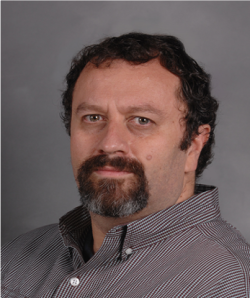
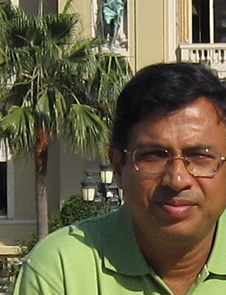
Lindsay McHenry is Professor and Department Chair of Geosciences at the University of Wisconsin-Milwaukee. She holds a Ph.D. from Rutgers University, an M.S. from Dartmouth College, and a B.S. from Dartmouth College. Her research focuses on using volcanic ash composition to correlate archaeological sites in East Africa and identifying terrestrial analogues for Martian surface minerals. Her research interests include tephrostratigraphy for human evolution studies, Mars geology analogs, sulfate mineral formation processes, and paleolimnology of saline-alkaline systems. Recent publications demonstrate strong focus on Martian analog studies using terrestrial environments (Iceland, East African lakes), mineral mapping with remote sensing/ML techniques, and paleolake reconstruction. Work increasingly incorporates drone technology and machine learning for planetary exploration applications.
Reza Curtmola is a Professor in the Department of Computer Science at NJIT. His research focuses on cybersecurity, distributed systems, and network security with an emphasis on secure routing, cloud computing, and privacy-preserving technologies. He holds a Ph.D. in Computer Science from Johns Hopkins University (2007), an M.S. from the same institution (2003), and a B.S. from the Politehnica University of Bucharest (2001). Dr. Curtmola’s work addresses challenges in wireless mesh networks, vehicular communication systems, and mobile-cloud integration. His contributions include innovative solutions for secure network coding, distributed resource management (e.g., parking assignment systems), and auditable data storage mechanisms. He has developed middleware frameworks like Moitree for mobile-cloud applications and has explored defenses against side-channel attacks, cache leaks, and entropy-based network vulnerabilities. His research also extends to privacy in vehicular DSRC protocols, dynamic traffic optimization, and verifiable code review systems. He has published extensively on topics ranging from cryptographic defenses in distributed systems to practical implementations of remote data checking in untrusted clouds. Current research activities include advancing secure cloud infrastructure, improving mobile crowdsensing reliability, and mitigating threats in IoT-enabled urban environments. His work often bridges theoretical foundations with practical system implementations, emphasizing real-world applicability in smart cities and critical infrastructure systems.
Cynthia Cruickshank is a Full Professor in Mechanical and Aerospace Engineering at Carleton University and currently serves as Associate Dean for Equity, Diversity, and Inclusion within the Faculty of Engineering and Design. She holds degrees including a B.Sc. and Ph.D. from Queen's University. Her research focuses on advanced building energy systems, high-performance buildings, and sustainable construction materials. Key areas include solar-assisted heat pumps, thermal energy storage (both sensible and latent), and solar absorption cooling. She leads the Centre for Advanced Building Envelope Research (CABER), dedicated to innovative building envelope technologies. Her recent work examines telework impacts on home energy use, smart thermostat data analysis, and the integration of bio-based phase change materials in construction. Over 150 peer-reviewed articles highlight her contributions to energy efficiency, renewable energy systems, and building retrofit strategies. Prof. Cruickshank's research teams collaborate on projects such as solar-driven adsorption systems, vacuum insulation panel retrofits, and policy implications of remote work. Her labs emphasize experimental validation of novel materials and systems through guarded hot box testing, hygrothermal modeling, and in-situ evaluations.
Mohammad Samie Tootooni is an Assistant Professor in the Department of Health Informatics and Data Science at Loyola University Chicago, with a secondary appointment in the Center for Health Outcomes and Informatics Research. He holds a PhD in Industrial and Systems Engineering from Binghamton University (2016) and completed a postdoctoral fellowship at Mayo Clinic's Department of Health Sciences Research (2016-2018). His research focuses on applying artificial intelligence, machine learning, and systems engineering principles to improve healthcare outcomes. Core areas include clinical decision support systems, predictive analytics for complex healthcare systems, and natural language processing (NLP). He also explores quality assurance, optimization, and systems thinking to address challenges in healthcare delivery and patient care. Recent work emphasizes AI-driven solutions for medication management in ICUs, ECG-based disease prediction (e.g., coronary heart disease, preeclampsia), and addressing therapeutic inertia in hypertension treatment. His methodologies combine machine learning with clinical data analysis to bridge gaps between engineering and medical practice. Teaching responsibilities include courses on health informatics ontologies and NLP applications in healthcare. His interdisciplinary collaborations span clinicians, data scientists, and engineers to tackle real-world healthcare problems.
Marina Freire-Gormaly is an Assistant Professor in the Mechanical Engineering Department at York University's Lassonde School of Engineering. Her research focuses on renewable energy-powered water treatment systems, machine learning for smart design, advanced manufacturing, and sustainable engineering solutions for remote communities. She holds a PhD and M.A.Sc. from the University of Toronto, specializing in carbon capture and storage technologies. She has worked on nuclear energy projects at Ontario Power Generation and contributed to World Bank sustainability assessments. She currently chairs the Canadian Society of Mechanical Engineers' Student and Young Professional Affairs committee. Education: PhD in Mechanical Engineering, University of Toronto M.A.Sc. in Mechanical Engineering, University of Toronto Research Interests: She pioneers solar-powered reverse osmosis systems, energy recovery mechanisms, and IoT-driven smart systems. Her lab explores nanotechnology applications in environmental sustainability, including carbon capture and aquatic remediation. She integrates machine learning for optimizing energy-water nexus challenges in off-grid regions. Key Contributions: Developed models for membrane fouling in desalination systems, advanced pore network characterization for geologic CO2 storage, and designed automated renewable energy systems. Her work bridges engineering innovation with global sustainability goals. Grants & Collaborations: Engages with industries like Honda Canada and Trane Canada on sustainability initiatives. Supervises graduate students in emerging areas like nanobubble technology and direct air capture systems. Lab Activities: The Freire-Gormaly Lab focuses on clean energy-water systems, with current projects involving nano-technology for space applications (Canadian Space Agency collaboration) and life cycle assessments of carbon storage technologies.
Steven Livingston is the Founding Director of the Institute for Data, Democracy, and Politics (IDDP) and a Professor of Media and Public Affairs at George Washington University (GW). He has held leadership roles including Director of the Political Communication Program (1996–2002, 2004–2006) and Acting Director of the School of Media and Public Affairs (2004–2006). He founded the Public Diplomacy Institute (now the Institute for Public Diplomacy and Global Communication) in 2000. His research focuses on media/information technology’s role in governance, human rights, and global security, with notable work on the 'CNN Effect' and disinformation’s impact on democracy. Education: Ph.D. (Political Science, University of Washington, 1990), M.A., and B.A. from the University of South Florida (1984 and 1981). Professional milestones include a 2019 $5M grant for IDDP, a Goldsmith Award (Harvard), and Fulbright Scholarship (declined). Research interests span media-tech governance, political disinformation, international development, and security implications of technological advancement. His work examines how information systems shape policy in Africa, the Middle East, and post-conflict regions. Recent publications address disinformation’s erosion of democratic institutions and ICT’s role in African governance. Key grants and fellowships: $5M IDDP grant (2019), Ford Foundation-funded research (1992–1993), McCormick Tribune Foundation funding (1995), and multiple visiting roles at Harvard, Cambridge, and the Brookings Institution. Labs/teams: IDDP (founded 2019), Public Diplomacy Institute, and collaborative projects with NDU Press and the Carr Center for Human Rights Policy. His consulting spans UN agencies, governments, and NGOs on media strategies and public opinion dynamics.
Angela Kelly is a Professor of Physics and Science Education at Stony Brook University and serves as Associate Director of the Institute for STEM Education. She leads the MAT Physics Program, which ranks among the top U.S. producers of physics teachers. Dr. Kelly holds a Ph.D. in Science Education from Teachers College, Columbia University (2006), and has received awards including the SUNY Chancellor’s Excellence in Teaching Award (2015-2016). Her research focuses on equity in STEM education, quantum information science (QIST) outreach, and reformed teaching practices. Current NSF-funded projects include QuEST (Quantum Education for Students and Teachers) and the International Year of Quantum (IYQ) Conferences, advancing QIST education for underserved populations. She also investigates online laboratory learning efficacy, particularly following the pandemic's shift to remote instruction. Dr. Kelly’s work bridges university and K-12 education, collaborating with institutions like Brookhaven National Laboratory. Her initiatives, such as the MAT Physics Program’s PhysTEC 5+ Award (2023), highlight her commitment to teacher preparation. Research outcomes include over 200 high school students and 70 teachers engaged in QIST outreach programs. Grants total $2M, emphasizing equity in STEM access and diversifying the QIST workforce. Education : Ph.D. in Science Education, Teachers College, Columbia University (2006) Grants : NSF DRL 2148467 (QuEST), NSF DRL-2414742 (IYQ Conferences), NSF DUE-2142587 (Online Labs) Awards : SUNY Chancellor’s Award (2015-16), Provost’s Faculty Recognition Award (2010) Her research explores sociocognitive influences on STEM participation and addresses systemic barriers through innovative programs. The IYQ Conferences (2025) aim to replicate QIST education models nationwide.
Justin Leidwanger is an Associate Professor of Classics at Stanford University with a courtesy appointment in Oceans at the Doerr School of Sustainability, specializing in Mediterranean maritime archaeology through fieldwork in southeast Sicily and southwest Turkey. His educational background includes: Ph.D. in Art and Archaeology of the Mediterranean World from the University of Pennsylvania (2011) M.A. in Nautical Archaeology and Anthropology from Texas A&M University B.A. in History & Classical Studies from Loyola University Chicago Leidwanger's research centers on Mediterranean mobilities, maritime communities, and exchange systems from the Roman period through late antiquity, using shipwrecks and port sites to analyze socioeconomic dynamics. His work integrates ceramic analysis, port network studies, and digital heritage methods to explore ancient technologies of distribution and long-term maritime interactions. Recent publications reveal consistent focus on Roman/late antique maritime economies with growing emphasis on digital documentation (3D modeling, GIS) and contemporary relevance through migration studies. Key trends include transport amphorae standardization, underwater survey methodologies, and the intersection of ancient maritime heritage with modern migration patterns in the central Mediterranean. Leidwanger actively advises students in classical archaeology while leading major field projects including the Marzamemi 'church wreck' investigation (2013-2019) and ongoing 'U Mari research in Sicily. His work combines underwater survey, community-based archaeology, and heritage activism addressing both ancient tuna fishing traditions (mattanza) and contemporary migration routes. He directs the Maritime Archaeology and Digital Heritage Lab (MEDLab) at Stanford's Archaeology Center, which supports advanced digital modeling (photogrammetry, laser scanning, network analysis) and ceramic analysis (petrography, pXRF, computational morphometrics) for field research and museum collaborations.
Thomas S. Dee is the Barnett Family Professor at Stanford University's Graduate School of Education (GSE), a Research Associate at the National Bureau of Economic Research (NBER), a Senior Fellow at the Stanford Institute for Economic Policy Research (SIEPR), and a Senior Fellow (Joint) at the Hoover Institution. He serves as the Faculty Director of the John W. Gardner Center for Youth and Their Communities and holds multiple administrative appointments including Member of the Executive Committee of Stanford's Public Policy Program. Professor Dee's research focuses on the use of quantitative methods to inform contemporary issues of public policy and practice, with particular emphasis on education policy, economics of education, and program evaluation. His work spans critical areas including pandemic education effects, chronic absenteeism, school choice, educational equity, STEM education, and research methodology. He has made significant contributions to understanding how quantitative analysis can shape effective educational policy and practice. Dee's recent publications reveal a strong focus on pandemic-related educational disruptions, examining issues like chronic absenteeism, enrollment declines, and school reopening preferences. His research demonstrates expertise in quasi-experimental methods and has increasingly addressed questions of educational equity, particularly regarding underrepresented students in STEM fields. His 2025 work on Advanced Placement computer science shows how course design can broaden participation among female and minority students. Outstanding Public Communication of Education Research Award, American Educational Research Association (2024) Peter H. Rossi Award for Contributions to the Theory or Practice of Program Evaluation, Association for Public Policy Analysis and Management (2024) Research-Practice Partnership Award (co-recipient), California Educational Research Association (2023) Community Outcomes and Impact Award, International Association for Research on Service Learning and Community Engagement (2020) Raymond Vernon Memorial Award, Association for Public Policy Analysis and Management (2019) Raymond Vernon Memorial Award, Association for Public Policy Analysis and Management (2015) Professor Dee actively contributes to academic discourse through editorial roles on journals including the American Educational Research Journal and Education Finance and Policy. His teaching portfolio includes advanced courses in quantitative policy analysis and quasi-experimental research design, reflecting his methodological expertise. While specific grant information isn't detailed in the provided text, his extensive publication record and leadership roles suggest significant research funding support. As Faculty Director of the John W. Gardner Center for Youth and Their Communities, Dee leads initiatives connecting Stanford with community organizations to address youth development challenges. His work bridges academic research with practical community applications, emphasizing the importance of research-practice partnerships in creating meaningful educational change.
Robert Thorne is a Professor in the Department of Physics at Cornell University's College of Arts and Sciences. His research spans biological physics, experimental condensed matter physics, and physics education innovations. He holds a B.Sc. from the University of Manitoba (1981) and a Ph.D. from the University of Illinois at Urbana (1987). Stephen H. Weiss Presidential Fellow (2011-present) Founder and CTO of MiTeGen LLC (2004-present) Research Interests: Thorne's work focuses on: Single-particle cryo-EM and time-resolved molecular movies Advanced X-ray crystallography and SAXS techniques Water/ice physics in biological and materials contexts X-ray fluorescence imaging for archaeology Physics education curriculum reform and outreach programs Publication Trends: His 15 most recent articles (2004-2021) demonstrate expertise in: Structural biology methodology Radiation damage mitigation Nanoconfined material behavior Cultural heritage imaging Physics education innovation Crystallography instrumentation Awards: Presidential Young Investigator (1988-1993) Alfred P. Sloan Fellow (1988-1990) Stephen H. Weiss Presidential Fellow (2011-present) Advising & Grants: Active mentor of M.S. student Myeonghak Lee and undergraduate Andrew DiFabbio . His research has received grants supporting student engagement and CHESS synchrotron upgrades.
Robert Xiao is an Assistant Professor in the Department of Computer Science at the University of British Columbia (UBC), affiliated with the Designing for People research cluster. He holds a Ph.D. from Carnegie Mellon University and a BMath from the University of Waterloo. His research focuses on interactive technologies, including VR/AR interfaces, sensing systems, and cybersecurity. Notable contributions include Lumitrack (tracking system), TouchTools (touch interaction), and CVE-2023-37271 (Python sandbox exploit). Education: Ph.D., Human-Computer Interaction Institute, Carnegie Mellon University; BMath, Computer Science & Combinatorics, University of Waterloo Affiliations: Core member of UBC's Designing for People cluster Research interests span novel input modalities, mixed-reality systems, and security challenges. He actively competes in DEF CON CTF (multiple 1st places) and publishes in top venues like CHI, UIST, and ISMAR. Recent work explores VR decision-making, low-latency tracking, and collaborative AR/VR environments. Awards: SIGCHI Outstanding Dissertation Award, CHI Honorable Mention, DIS Honourable Mention Teaching includes courses on computer systems (CPSC 213), human-computer interaction (CPSC 554X), and cybersecurity (CPSC 436S). His lab develops tools like SurfShare (surface sharing) and VirtualNexus (collaborative AR).
Professor Damien Field is a leading academic in global soil security and soil education at the University of Sydney, serving as Director of the Sydney Institute of Agriculture and Chair of Division 4 in the International Union of Soil Science. He holds roles in the School of Life and Environmental Sciences and chairs the Sydney Southeast Asia Centre's Executive Research Training committee. His career includes research fellowships, academic leadership roles, and a Master of Education (Higher Education). Education: Bachelor of Science in Soil Science PhD in Soil Structure (Cotton Production) Master of Education (Higher Education) Research Interests: Integrating soil security with global sustainability, soil modeling, and education. His work spans soil functionality, agroecosystems, and community-driven research in Laos and Papua New Guinea. He advocates linking research with teaching, emphasizing real-world problem-solving through innovative curricula and field schools. Publications & Grants: Over 100 peer-reviewed articles, including books on global soil security and chapters on soil sensing. Key projects include soil mapping in Laos and cocoa sustainability in PNG, funded by ACIAR and GRDC. Collaborates with universities in Cambodia, Laos, Vietnam, and the USA. Awards: Vice Chancellor’s Award for Outstanding Mentorship (2016) Fellow of Soil Science Australia (2020) Principal Fellow Higher Education Academy (2020) Roles & Lab: Leads the Sydney Institute of Agriculture and coordinates international field schools with the National University of Laos. Advises postgraduate training and chairs soil education committees internationally.
Dr. Andrew Curtis is a Professor in the Department of Population and Quantitative Health Sciences at Case Western Reserve University's School of Medicine. He also holds a joint appointment in the Department of Anthropology, College of Arts and Sciences. His research focuses on spatial epidemiology, context-driven spatial data collection, and spatial confidentiality, with methodological expertise in geospatial data collection and analysis. He previously directed the WHO Collaborating Center for Remote Sensing and Public Health and has advised numerous public health agencies internationally. His work addresses health disparities at neighborhood scales, disaster response, and spatial syndromic surveillance. Dr. Curtis has mentored 10 PhD graduates now working in academia and public health sectors globally. Education includes a PhD in Geography from SUNY Buffalo (1995), MA in Geography from SUNY Buffalo (1991), and a BA from Portsmouth Polytechnic (1987). He has taught courses in GIS for health, medical geography, and global health. His advisory roles include collaborations with the CDC, Red Cross, and public health departments in Ohio and internationally. His research has been applied to cholera outbreaks, opioid overdose patterns, and pandemic response strategies. He co-edited a special issue on health geography and serves on the editorial board of the Annals of the Association of American Geographers. Dr. Curtis' spatial video methodologies have enabled fine-scale mapping in informal settlements, disaster zones, and conflict-affected areas. His recent work includes geospatial support for Ohio hospitals during the pandemic and energy vulnerability analysis. He emphasizes participatory research and context-enriched data collection to bridge gaps between health research and actionable policy.
Amiya Nayak is a Professor at the School of Electrical Engineering and Computer Science of the University of Ottawa. His research focuses on Fault-Tolerant Computing , Distributed Systems , and Ad hoc and Sensor Networks . He specializes in cybersecurity, IoT security, blockchain integration, and machine learning applications in healthcare and vehicular networks. His work addresses challenges in secure communication protocols, distributed learning frameworks, and energy-efficient network designs. Notable research areas include: IoT Security : Developing frameworks for threat detection, privacy-preserving systems, and blockchain-empowered IoT defenses. Federated Learning : Enhancing healthcare predictions and IoT management through decentralized, privacy-aware machine learning. Vehicular Networks : Securing Vehicle-to-Everything (V2X) communication and optimizing QoS in cooperative internet of vehicles (IoV). Network Optimization : Leveraging deep reinforcement learning and graph neural networks for WDM network restoration and edge computing. His publications (2020–2025) highlight contributions to: Secure authentication protocols in medical sensor networks. AI-driven metaverse security solutions. Decentralized energy trading using NFTs. Energy-efficient sleep scheduling in wireless body area networks (WBANs). Nayak holds a Ph.D. and is a P.Eng. (Professional Engineer). His work bridges theoretical computer science with practical applications in telecommunications and healthcare systems.

Alexandr Lucas is a Teaching Professor in Robotics at the University of Sheffield's School of Computer Science. He joined in September 2019 and holds roles including Deputy Admissions Tutor (General Engineering) and IPE Tutor. His research focuses on developmental neuro-robotics, cognitive assessment via human-robot interaction, and educational robotics applications. He contributes to courses like COM1005 (Machines and Intelligence) and COM3528 (Cognitive and Biomimetic Robotics), developing teaching materials for MiRo robots and simulators. Publications include work on cognitive skill assessment using cloud computing and robotic systems, visual finger-counting for neuro-robotics learning, and public perception analysis of robots in urban environments. He co-founded the SERAI Network CIC and maintains active roles in robotics education and outreach. Lucas has created extensive teaching resources, including guides for MiRoCloud simulation platforms and visual coding tools (MiRoCODE). His work emphasizes practical robotics education and bridging theory with hands-on experiments in undergraduate and postgraduate programs.