
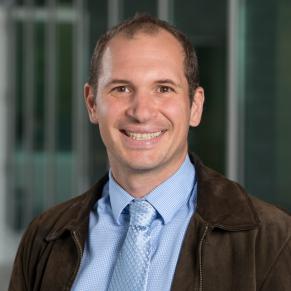
Matthew Scherer is an Associate Professor of Government and Politics in the Schar School of Policy and Government at George Mason University. He directs the undergraduate program in Philosophy, Politics, and Economics (PPE) and teaches courses in ancient, modern, and contemporary political theory, as well as constitutional law. His academic background includes a PhD in Political Science from Johns Hopkins University and a BA in Physics and Political Science from Williams College. He has held prestigious postdoctoral appointments at Georgetown University’s Berkley Center, Johns Hopkins University, and the University of California, Berkeley. Scherer's research centers on the intersection of religion and politics, with a focus on modern secularism and political theologies. He challenges conventional views of secularism as mere separation of church and state, instead conceptualizing it as a dynamic process of transformation akin to religious conversion. His work spans critical theory, rhetorical theory, constitutionalism, and the political thought of early America and modernity. The 15 most recent scholarly works reflect a consistent engagement with political theory, secularism, sovereignty, democracy, and the global construction of religion and politics. His publications reveal a deep interdisciplinary approach, drawing from philosophy, history, literature, and political science, with recurring themes of power, legitimacy, and the evolving relationship between religion and governance in modern and postmodern contexts. Andrew W. Mellon Postdoctoral Fellow in the Humanities Patrick Henry Postdoctoral Fellow for the Study of Early American Politics Scherer has advised various academic programs and seminars, particularly in the PPE concentration. He has led capstone courses on political economy, examining thinkers from Smith and Marx to Brown and Foucault, and has developed graduate seminars on sovereignty and biopolitics. While specific grant funding is not detailed, his research fellowships indicate significant external support. He is actively engaged in shaping curriculum and mentoring students in political theory and interdisciplinary studies. He is affiliated with research initiatives related to political theory and secularism, and his teaching includes seminars on democracy, ancient political thought, and contemporary political economy. His work bridges historical analysis and normative theory, contributing to ongoing debates about democracy, religion, and governance in the modern world.


