James Kreines is the Edward S. Gould Professor of Philosophy at Claremont McKenna College, specializing in the History of European Philosophy, particularly Classical German Philosophy. He teaches courses on philosophy that is historically or culturally distant. Research Interests: Kreines' work focuses on post-Kantian German Idealism, Hegel’s metaphysics, and the interplay between systematic philosophy and historical critique. His research explores the philosophical systems of Hegel, Schelling, and Jacobi, emphasizing their relevance to contemporary debates about metaphysics and reason. Publications: Kreines' recent work includes studies on Hegel’s dialectics, Schelling’s critique of Hegel, and Kant’s philosophy of nature. His monograph Reason in the World (2015) examines Hegel’s metaphysical contributions, while his forthcoming Hegel and Spinoza extends this analysis. His articles span Kant’s laws of nature, teleology, and the philosophical legacy of German Idealism. Contact: For inquiries, reach him at jkreines@cmc.edu .
Warrick Van Zyl serves as Associate Professor of Accounting at The University of Western Australia Business School, where he also holds the position of Director of External Engagement leading the School's interactions with business communities. A qualified Chartered Accountant with over 25 years of professional experience spanning Big 4 accounting firms, investment banking, and academia, he holds a PhD in Accounting from the University of Cape Town. His research specializes in accounting standards implementation across multiple domains including financial instruments, executive remuneration, share-based payments, and extractive industries. Current projects examine non-GAAP reporting interactions with executive compensation, accounting standard effectiveness across industries, harmonization of extractive industry accounting, and professional skepticism development in accounting education. His research demonstrates strong industry relevance through presentations at International Accounting Standards Board forums and contributions to Australian Accounting Standards Board initiatives. Van Zyl's publication portfolio reveals consistent focus on practical accounting challenges, with recent work emphasizing professional skepticism development in accounting education, diluted earnings per share calculations, and executive remuneration disclosure practices. His research bridges theoretical accounting frameworks with real-world applications across mining, financial services, and government sectors. Best Emerging Scholar Presentation - UWA UQ Accounting and Finance Forum 2016 He has secured research funding including a CAANZ Research Grant ($20,000) in 2016 and led the Professional Skepticism Toolkit project (2021-2022). His teaching responsibilities include the MBA Core Accounting unit and third-year Financial Accounting Theory and Practice. Van Zyl maintains active industry engagement through media contributions on accounting standards impacts and serves on external committees including Trinity Residential College Council (2017-2022).
Debbie Roberts is a Senior Lecturer and Head of Philosophy in the School of Philosophy, Psychology and Language Sciences at the University of Edinburgh, where she has been a faculty member since 2014. She previously served as a lecturer at the University of York (2011-2014) and as a teaching fellow at the University of Sussex. Roberts earned her PhD from the University of Reading in 2011 under the supervision of Jonathan Dancy and Philip Stratton-Lake, following earlier teaching experience at the University of KwaZulu-Natal in South Africa. Roberts specializes in metaethics, with particular focus on thick evaluative concepts, the metaphysics of the normative, naturalism and non-naturalism, supervenience, and grounding. Her research explores connections between metaethics and philosophy of mathematics, as well as the role of thick concepts in scientific contexts. She has developed significant contributions to understanding how thick concepts function in evaluative discourse and their implications for moral ontology and semantics. Her publication record demonstrates a consistent trajectory of influential work in metaethics, with recent articles examining normative indispensability arguments, the relevance of supervenience, and the epistemic dimensions of thick concepts. Roberts' research shows increasing engagement with interdisciplinary connections, particularly between metaethics and philosophy of mathematics, while maintaining a strong focus on the foundational questions of moral philosophy. As an academic leader, Roberts serves as Deputy Head of Subject Area and Phil Skills Co-ordinator. She has held significant editorial positions including Associate Editor of Analysis (2016-2021) and member of the Mind Executive Committee (2015-2020). Roberts is actively involved in PhD supervision, currently working with Declan O'Gara and Ethan Moore, and has previously supervised Brian Ness. She welcomes PhD supervision inquiries from students working in metaethics and normative ethics, particularly on issues related to realism, naturalism and non-naturalism, the metaphysics of the normative, and thick concepts. Her teaching includes the first-year course on Morality and Value.
Dr. Maha N. Mian serves as an Assistant Professor in the Psychology department at Suffolk University, where she directs the Safety and Harm Reduction (SAHAR) Lab. Her research program develops accessible protective strategies for cannabis, alcohol, and psychedelic use through community-engaged quantitative and qualitative studies, while investigating drug policy impacts including decriminalization effects on substance use behaviors. Dr. Mian's educational background includes: PhD from University at Albany, SUNY MA from University at Albany, SUNY BS from Tufts University She completed a Clinical Internship at VA Palo Alto and a Postdoctoral Fellowship at the University of California, San Francisco & Kaiser Permanente, supported by a NIDA T32 Substance Use Disorders Treatment and Services Research Fellowship. Her research spans harm reduction, psychometric development for protective strategies, and policy analysis. She emphasizes community-based practices and the humanity of substance users, developing tools like the Protective Strategies for Psychedelics Scale (PSPS) to promote equitable, accessible interventions that reduce risks without judgment. Dr. Mian's publication record (2019-2025) demonstrates consistent innovation in substance use harm reduction, particularly through psychometric scale validation, qualitative user preference studies, and policy framework analysis. A defining trend is her examination of how decriminalization influences perceived risks and behaviors, alongside novel approaches like savoring interventions for cannabis use. No specific scientific awards beyond her NIDA T32 postdoctoral fellowship were documented, though her methodological contributions to protective strategy measurement represent significant scholarly impact. Dr. Mian actively mentors through the SAHAR Lab and is recruiting graduate students for Fall 2026. While current grant details beyond her fellowship aren't specified, her community-collaborative research model suggests ongoing external funding for harm reduction science. She emphasizes participatory approaches in all advising and research activities. The SAHAR Lab functions as Suffolk University's dedicated hub for advancing harm reduction science, conducting studies on policy impacts, protective strategy efficacy, and community-engaged intervention development. The lab collaborates directly with substance user communities to ensure research relevance and accessibility, with current focus on psychedelic and cannabis safety frameworks.
Christian Fermüller is an Associate Professor in the Department of Theory and Logic at the Faculty of Informatics, Technische Universität Wien (TU Wien). His research focuses on theoretical computer science, artificial intelligence, automated deduction, and formal logic systems. He specializes in fuzzy logic, proof theory, and non-classical logics, with contributions to semantic games, dialogue systems, and computational models of reasoning under vagueness. **Research Interests:** Foundations of fuzzy logic and many-valued logics Proof theory and analytic calculi Game-based semantics for non-classical logics Formal models of judgment aggregation and argumentation theory Applications in automated reasoning and computational intelligence **Grants & Projects:** Austrian Science Fund (FWF) projects on graded deontic reasoning (2025–2027), semantic games and analytic calculi (2019–2023), and fuzzy logic foundations (2008–2013) Co-PI of the LogICCC initiative exploring contextualism and fuzzy logic **Teaching:** Courses include logical methods in computer science, quantum computing, and theoretical computer science. Supervised over 15 PhD and master’s theses on topics ranging from semantic games to argumentation frameworks. **Affiliations:** Active in the LogiCS research group and regularly organizes seminars on logic and computation.
Rainer K. Silbereisen is a Research Professor of Developmental Psychology at Friedrich Schiller University Jena , Director of the Center for Applied Developmental Science , and Adjunct Professor of Human Development at Pennsylvania State University . He has held faculty positions at Technical University Berlin, Justus Liebig University Giessen, and Penn State, alongside leadership roles at the Gesis social science infrastructure company and the University of Haifa Board of Governors. Research Focus: Human development across lifespan, dynamic interactionism, social change impacts, acculturation of immigrants, entrepreneurship, and biobehavioral aspects of adolescence. Applications: Prevention of maladjustment, promotion of positive development, and social policy relevance. International Collaborations: Comparative studies in Germany, Poland, Israel, and post-Soviet states. Funding Sources: German National Science Foundation, W.T. Grant Foundation, Jacobs Foundation, and the German Federal Ministry of Education and Research. Scientific Recognition: Member of Academia Europaea and Erfurt Academy of Sciences Fellow of American Psychological Association and Association for Psychological Science 2012 ISSBD Distinguished Scientific Award 2014 EARA Lifetime Award Academic Leadership: Past-President of ISSBD, German Psychological Society, and IUPsyS. Editor of European Psychologist and American Psychologist Associate Editor. Directed large-scale networks on immigration and social change.
Martin Hilbert is a Professor at the University of California, Davis, jointly affiliated with the Department of Communication and Computer Science. He is a leading scholar in digital technology, algorithmic systems, and computational social science, and chairs the campus’s designated emphasis in Computational Social Science. His work bridges theory and practice, integrating information theory with social science to understand the digital age. Education: Ph.D., Communication, Annenberg School of Communication, University of Southern California, 2012 Ph.D., Economics and Social Sciences, Friedrich-Alexander University Erlangen-Nuremberg, Germany, 2006 Dipl.-Kfm. (Master of Business Administration), Friedrich-Alexander University Erlangen-Nuremberg, Germany, 2003 Professor Hilbert's research focuses on the digital transformation of society, using formal tools from information theory to analyze AI and algorithmic systems. His work spans digital ethics, cognitive biases, and the evolution of communication in networked environments. He is particularly known for his pioneering study on global information capacity and early warnings about algorithmic manipulation in politics. His recent publications reveal a consistent trend of applying information-theoretic frameworks to social and digital phenomena, with a strong emphasis on measuring algorithmic impact, digital inequality, and the interplay between human cognition and automated systems. His work frequently appears in high-impact journals across disciplines, reflecting its interdisciplinary nature. Professor Hilbert has made significant contributions to public policy, having designed the first digital action plan for Latin America and the Caribbean at the United Nations and served as an Economic Affairs Officer for 15 years. His technical assistance has reached over 20 countries and major corporations. He is also an innovator in digital education, with online courses taken by over 100,000 students worldwide. Advising and Grants: Chairs the Designated Emphasis in Computational Social Science at UC Davis Teaches graduate and undergraduate courses in information theory, digital technology, and computational social science Has received research support through academic and policy-oriented grants (specifics not listed) Labs and Teams: He is associated with the Center for Computational Science (C2) and the Center for Science and Society (CSS) at UC Davis, which support interdisciplinary research on digital systems and their societal implications. These centers foster collaboration between computer scientists, social scientists, and policymakers.
Prof. Maria Alessandra Umiltà is an Associate Professor of General Physiology at the University of Parma’s Department of Food and Drug Sciences. She holds adjunct positions at Columbia University’s Department of Art History and Archaeology (since 2010) and has held visiting roles at University College London. Her research focuses on the cortical motor system’s role in cognitive functions, social cognition, and embodied perception. She has contributed to projects like NeuroProbes and NEUROBOTICS, advancing technology for neural recording. Education: BSc in Biological Sciences (University of Bologna, 1996) PhD in Neuroscience (University of Parma, 2000) Research Interests: Prof. Umiltà investigates how motor systems underlie higher cognitive functions, including action understanding, emotional perception, and aesthetic evaluation. Her work bridges neuroscience with art, film, and social interaction, employing EEG, fMRI, and behavioral studies. Recent studies explore trauma’s impact on social cognition and embodiment in cinematic experiences. Articles Trends: Recent publications emphasize embodied cognition’s role in aesthetic judgment, emotional processing, and motor inhibition in language. Key themes include cross-modal correspondences, trauma’s neurobiological effects, and sensorimotor mechanisms in film perception. Grants & Projects: EU-funded NeuroProbes and NEUROBOTICS projects (neural interface tech) PRIN projects on motor cognition and mirror systems Labs/Teams: Collaborates with interdisciplinary groups studying art neuroscience, trauma effects, and embodied interaction. Leads studies on sensorimotor foundations of perception at the University of Parma.
Craig Long serves as Visiting Assistant Professor of Biblical Studies in the Biblical Studies, Christian Ministries, Intercultural Studies & Philosophy Department at Taylor University. His academic work bridges biblical scholarship with practical ministry applications, particularly in correctional settings. Education PhD in Theological and Historical Studies (New Testament) from Trinity Evangelical Divinity School MDiv from Southwestern Baptist Theological Seminary BA in Bible from Oklahoma Baptist University Research Interests Dr. Long specializes in New Testament Greek exegesis , apocalyptic literature (particularly Revelation), and Old Testament history , with groundbreaking work applying restorative justice frameworks to biblical interpretation. His research uniquely connects historic Christian belief with contemporary criminal justice reform, informed by extensive prison ministry experience. He emphasizes linguistic precision in biblical texts while exploring practical applications for modern faith communities. Publication Trends His scholarly trajectory reveals deepening engagement with justice themes, evolving from technical New Testament linguistics (2010-2012 book reviews) toward integrative theological-justice scholarship, culminating in his 2023 restorative justice analysis of Revelation. Throughout his career, he maintains consistent focus on biblical hermeneutics and theological implications for social contexts, with increasing emphasis on practical ministry applications. Awards and Honors Eisenberg Award from Wisconsin Public Defenders' Office for prison ministry work Mheit Scholar in New Testament at Trinity Evangelical Divinity School (2008-2010) Advising and Professional Engagement Dr. Long has mentored students through formal academic programs and prison ministry initiatives, notably leading a Biblical Studies BA program for incarcerated men. His professional service includes editorial work for the Trinity Journal (2009-2014) and panel participation at the Prison Seminaries Foundation Conference, demonstrating commitment to accessible theological education. His teaching philosophy centers on fostering transformative dialogue about Scripture's relevance to contemporary life. Professional Context Combining 15 years of pastoral experience with academic rigor, Dr. Long integrates prison ministry insights into university teaching. His current work strengthens partnerships between Taylor University and correctional education initiatives, advancing biblical literacy within criminal justice settings through the Prison Seminaries Foundation network.
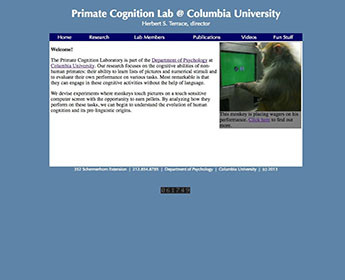
Herbert Terrace is a Professor of Psychology at Columbia University, where he directs the Primate Cognition Lab within the Department of Psychology in the Faculty of Arts and Sciences. His research focuses on animal cognition, particularly primate cognition and the evolution of language. Dr. Terrace received his Ph.D. from Harvard University in 1961. His academic journey has been dedicated to understanding cognitive processes that do not require language, with a particular focus on rhesus monkeys' ability to learn serial tasks, numerical sequences, and social learning paradigms. His research interests span across animal cognition, cognitive psychology, primate cognition, and the evolution of language. Dr. Terrace has made significant contributions to understanding how non-human primates process numerical information, learn through observation, and develop cognitive skills that may represent precursors to human language. His work on the evolution of intelligence examines cognitive processes that can be performed without language, providing insights into what language adds to those fundamental cognitive abilities. Notably, he has written extensively on the evolution of language, particularly in his 2019 book "Why Chimpanzees Can't Learn Language and Only Humans Can," where he argues that separating the evolution of language into the origin of words and the origins of grammar makes an intractable problem more manageable. Dr. Terrace has taught courses including Evolution of Intelligence and Consciousness, Evolution of Cognition, and Evolution of Language at Columbia University. His laboratory, the Primate Cognition Lab, devises experiments where monkeys interact with touch-sensitive computer screens to earn food rewards, allowing researchers to analyze their cognitive performance and understand the pre-linguistic origins of human cognition. Among his notable scientific contributions are the development of the simultaneous chaining methodology for studying serial learning in animals, groundbreaking work on numerical cognition in non-human primates, and research on cognitive imitation that has implications for understanding autism spectrum disorders. His research has been published in top journals including Science, Nature, and Psychological Science. Dr. Terrace has mentored numerous researchers in the field of comparative cognition and has directed the Primate Cognition Lab at Columbia University for many years. His work continues to influence our understanding of the cognitive capabilities of non-human primates and their relevance to human cognitive evolution.
Jason Gaiger is Professor of Aesthetics and Art Theory at the University of Oxford and a Fellow of St Edmund Hall. He serves as Head of Art History and Theory at the Ruskin School of Art and acts as the Undergraduate Admissions Co-Ordinator. Previously, from 2010 to 2014, he was Head of the Ruskin School of Art and currently serves as Director of Graduate Studies. Professor Gaiger received his education in art history and philosophy at the universities of St Andrews, Essex and Heidelberg. Before joining Oxford in 2010, he was Senior Lecturer and Director of Research in the Art History Department at the Open University. Jason Gaiger's research spans aesthetics and art theory from the seventeenth century through to the present day, with additional focus on theories of depiction and visual meaning, and contemporary art practice and theory. His scholarly work is informed by both the historical resources of the German aesthetic tradition and debates in contemporary analytic philosophy. He has published extensively on topics including painting theory, sculpture, rhythm in visual art, visual perception, and the historical development of art theory. His most significant contribution is Philosophy of Painting: Ancient, Modern, Contemporary (2022), which provides a historically informed analysis of painting's contemporary relevance. Professor Gaiger's publication record demonstrates a consistent focus on the philosophical dimensions of visual art, particularly examining the temporal aspects of viewing, the relationship between materiality and meaning, and the historical continuity of aesthetic concepts. His work bridges historical analysis with contemporary philosophical inquiry, often drawing connections between eighteenth and nineteenth-century aesthetic theories and current debates in visual culture. The recurring themes across his publications include the nature of pictorial representation, the cognitive processes involved in art viewing, and the philosophical foundations of art historical interpretation. Professor Gaiger has supervised numerous graduate students, with recent theses under his direction exploring topics such as The Epistemic Value of Contemporary Art , Modes of Presence in the Contemporary Sculptural Encounter , and Affective Vision: Urban Landscape Photographs and their Paratexts . His mentorship reflects his broad expertise across historical and contemporary art theory.
Jacek Gwizdka is an Associate Professor and Director of the Information eXperience Lab at the University of Texas at Austin's School of Information (iSchool). His research focuses on human-computer interaction, cognitive psychology applied to information retrieval, and neuro-physiological methods to assess cognitive processes during information search. He holds a PhD in Industrial Engineering from the University of Toronto and has held academic roles since 2005, including visiting appointments at Rutgers University and the University of Toronto. Affiliations: ACM Senior Member, ASIS&T Distinguished Member Key Projects: NeuroIS initiatives, health misinformation research, eye-tracking and EEG studies Research Interests: Cognitive load measurement, implicit assessment of information relevance, and neuro-physiological tools for studying human-information interaction. Active in conference organization (CHIIR, SIGIR) and editorial roles (Interacting with Computers). Recent Awards: Distinguished Fellow of the Kosciuszko Foundation, 2025 h-index=42 (Google Scholar). Grants: Google Faculty Award (2020), UT VPR grant on health search behavior & cognitive impairment. Supervises research in areas like generative AI, EEG-text bridging, and health misinformation correction. Labs/Teams: Information eXperience Lab, collaborations with UT’s Communication Sciences & Nursing departments on health search studies.
Arthur M. Nezu is a Distinguished University Professor in the Department of Psychological and Brain Sciences at Drexel University, holding concurrent roles as Professor of Medicine and Professor of Public Health. He is Editor-in-Chief of Clinical Psychology: Science and Practice and former Editor of Journal of Consulting and Clinical Psychology and Behavior Therapist . Dr. Nezu co-developed Problem-Solving Therapy (PST), now Emotion-Centered PST (EC-PST), which has been applied globally across psychological disorders and age groups. His work includes designing programs for the U.S. Department of Veterans Affairs and Defense, focusing on suicide prevention and resilience. Education: PhD (1979), MA (1976), and BA (1974) in Clinical Psychology from the State University of New York at Stony Brook. Research interests center on EC-PST, stress management, ethics in psychotherapy, and reducing health disparities through culturally relevant interventions. He has pioneered EC-PST for suicide risk mitigation, veterans’ resilience, and medical comorbidities. His work emphasizes evidence-based practice and adapting therapies for diverse populations. Publications span over 225 journal articles, 26 books, and chapters on PST frameworks, including Emotion-Centered Problem-Solving Therapy: Treatment Guidelines (2019). Notable grants include funding from the National Cancer Institute, National Institute of Mental Health, and Pew Charities Trust. Awards include ABCT’s Career/Lifetime Achievement Award (2024), honorary doctoral degrees, and the ABPP diversity research award named in his honor. He has mentored numerous students across doctoral, master’s, and undergraduate levels in research methods and clinical ethics. Led the development of Full of Possibilities , a nonprofit providing education and skills training to girls in Kenya. Active in professional organizations, he has served as past president of the Association of Behavioral and Cognitive Therapies (ABCT) and American Board of Behavioral and Cognitive Therapies.
Dr. Gary Marchionini is the Cary C. Boshamer Distinguished Professor and Dean of the School of Information and Library Science (SILS) at the University of North Carolina at Chapel Hill. He previously served as a professor at the University of Maryland's College of Library and Information Services and as a member of the Human-Computer Interaction Laboratory. His expertise spans information interaction, human-computer interaction, digital libraries, and information policy. Marchionini holds a PhD in mathematics education from Wayne State University, emphasizing educational computing. His research focuses on interfaces for information seeking, digital video retrieval, and the impact of data science. Notable projects include the Information in Life Video Series (2007), one of the first academic YouTube channels, and leadership in the Open Video Project . He has secured grants from NSF, NASA, Microsoft, and Google, among others. Marchionini's awards include the ASIS&T Award of Merit (2011) and the LITA Kilgour Award (2000). He has served as editor-in-chief of ACM Transactions on Information Systems (2002–2008) and as president of ASIS&T (2010). Current interests include the societal impact of information, personal health records usability, and digital curation strategies. His leadership roles include serving on the iSchools Board of Directors and directing the Center for Information Impact. He has advised numerous grants, including Mellon Foundation-funded initiatives and EPA research library operations. Marchionini's work bridges academic research with real-world applications, emphasizing human-centered design and interdisciplinary collaboration.
Dr. Tom Overmans is Associate Professor and Director of Undergraduate Programs at Utrecht University School of Governance. His research in public administration focuses on behavioral budgeting, cognitive biases in public decision-making, and innovative responses to fiscal stress. Current projects examine how cognitive biases affect politicians' budget preferences and public procurement practices. His publications consistently explore behavioral dimensions of public finance, including micro-level budget behavior, consultant selection biases, and austerity implementation challenges. Methodologically, he employs experimental approaches and case studies to investigate public sector decision-making under constraints. Awards include the Veni Talent Grant for research on politicians' spending behavior and multiple teaching recognitions. As education director, he oversees curriculum development and pedagogical innovation in public administration programs. Engagement includes keynote presentations on austerity governance and membership in international research societies (IRSPM, EGPA, PMRA).