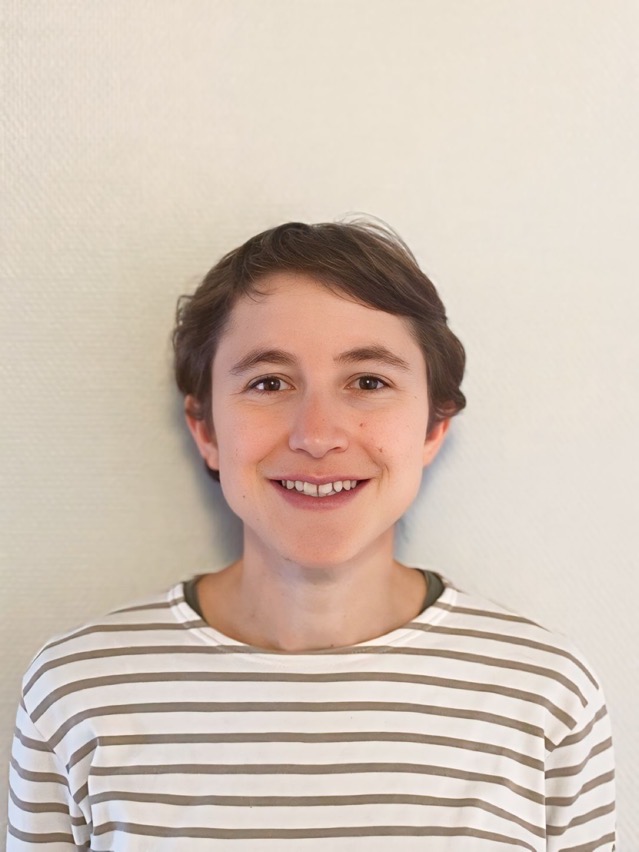
Catherine Wolfram is a Gibbs Assistant Professor at Yale University and a National Science Foundation (NSF) postdoctoral fellow. She holds a PhD in Mathematics from MIT (2024), advised by Scott Sheffield, and an undergraduate degree from the University of Chicago. Her research focuses on complex analysis, probability, and geometry, with applications to statistical mechanics and random surfaces. She has presented her work at institutions including the University of Michigan, Columbia University, and international conferences such as the World Congress on Probability and Statistics. Her recent activities include talks on dimer models, holography in mathematical physics, and Teichmüller theory. Catherine has also engaged in teaching roles at MIT, leading recitations in probability and multivariable calculus. Her research has been supported by NSF postdoctoral funding, and her work has been published in journals like International Mathematics Research Notices (IMRN). She actively collaborates with researchers in probability, geometry, and mathematical physics, evidenced by her co-authored papers and participation in workshops at IHES, CIRM, and the Fields Institute.
Irène Marcovici is a Professor in the Department of Mathematics at the University of Rouen Normandy, affiliated with the Raphaël Salem Mathematics Laboratory (LMRS). She leads the Probability and Dynamical Systems team within LMRS and participates in the ALEA and SDA2 working groups of the GDR Informatique Fondamentale et ses Mathématiques. PhD in Mathematics (2013, University of Paris Diderot) Habilitation à Diriger des Recherches (2021, University of Lorraine) Her research focuses on probability theory , dynamical systems , and cellular automata , with significant contributions to percolation theory, self-organization phenomena, and combinatorics on words. She investigates how randomness influences complex systems, particularly through probabilistic cellular automata and their ergodic properties. Analysis of her recent publications (2021-2025) reveals a strong emphasis on percolation dynamics (e.g., corner percolation with directional bias), self-stabilization mechanisms in cellular systems, and combinatorial structures like Kolakoski sequences. Her work bridges theoretical computer science and pure mathematics, often employing stochastic methods to solve problems in symbolic dynamics and discrete geometry. Supervision & Collaborations: Currently supervising Maxence Poutrel (with Jérôme Casse) Previously supervised Pierrick Siest (2021-2024), Jocelyn Begeot (now Associate Professor), and Pierre-Adrien Tahay (now PRAG at Telecom Nancy) Regular collaborations with Régine Marchand, Nazim Fatès, and Pascal Moyal Laboratory Context: As leader of the Probability and Dynamical Systems team at LMRS, she contributes to France's national research infrastructure in fundamental mathematics, with connections to CNRS and international working groups focused on automata theory and discrete probability.
Ronald Graham is a Professor in the Computer Science and Engineering Department at the University of California San Diego (UCSD), affiliated with the Jacobs School of Engineering. He also serves as Chief Scientist at the California Institute for Telecommunications and Information Technology (Calit2). Graham’s career spans academia and industry, including a 37-year tenure at Bell Labs and leadership roles at AT&T Labs. He is renowned for contributions to combinatorics, Ramsey theory, scheduling algorithms, and discrete mathematics. His Erdős number of 1 underscores his collaborative ties to Paul Erdős, a legendary mathematician. Education: Graham earned his PhD in Mathematics from UC Berkeley in 1962. Research Interests: Graham’s work focuses on combinatorics, graph theory, number theory, computational geometry, scheduling theory, and quasi-randomness. He has also explored recreational mathematics, notably through his book Magical Mathematics (2011), which intertwines card tricks with mathematical principles. His research has influenced internet infrastructure design, including foundational work on routing algorithms and the development of Akamai Technologies. Notable Achievements: Graham has received the Steele Prize for Lifetime Achievement (2003), Euler Medal (1994), and Polya Prize in Combinatorics (1972). His concept of “Erdős numbers” revolutionized academic collaboration tracking, later adapted into Hollywood’s “Six Degrees of Separation” game. Advising & Grants: Graham mentors students and faculty, inspiring future generations through teaching and mentorship. The UCSD CSE Department established the Ronald L. Graham Chair in Computer Science in 2015 to honor his legacy, funded by an $18.5M alumni donation. Labs & Collaborations: As Calit2’s Chief Scientist, Graham advises on strategic directions, emphasizing interdisciplinary research in information technology and communications. His work bridges theoretical mathematics and applied computing, shaping global technological advancements.
Michael Baake is a Professor of Mathematics at Bielefeld University, affiliated with the Faculty of Mathematics. His research focuses on Aperiodic Order, Dynamical Systems, Combinatorics, and Mathematical Physics. He leads multiple research projects, including the SFB/TR 358 'Integral Structures in Geometry and Representation Theory' and SFB 1283 'Taming Uncertainty'. His work bridges pure mathematics with applications in crystallography and stochastic systems. Affiliations: Representative for the Faculty Library, Co-Director of the Research Focus on Mathematical Modeling. Cooperations: Collaborates with international experts like Uwe Grimm, Daniel Lenz, and Nicolae Strungaru on topics such as aperiodic tilings and spectral theory. Research Groups: Leads a vibrant research group with members including Anna Klick, Daniel Luz, and Timo Spindeler, focusing on quasicrystals, combinatorial structures, and number theory applications. His contributions include co-editing the book 'Aperiodic Order: Crystallography and Almost Periodicity' and organizing workshops on spectral theory and dynamical systems. He actively engages in academic service, including editorial roles and conference organization.
Clinton Conley is an Associate Professor and Director of Graduate Studies in the Department of Mathematical Sciences at Carnegie Mellon University, part of the Mellon College of Science. He holds a Ph.D. in Mathematics from UCLA and has held postdoctoral appointments at the Kurt Gödel Research Center (Vienna, Austria) and Cornell University. His research focuses on descriptive set theory, measurable group actions, and Borel graphs, exploring intersections with ergodic theory, combinatorics, and set theory. Key research areas include measurable chromatic numbers, Borel combinatorics, and hyperfinite equivalence relations. His work often bridges abstract set-theoretic principles with concrete problems in dynamics and graph theory. Notable awards include the Julius Ashkin Award. Education: Ph.D. in Mathematics, University of California, Los Angeles Postdoctoral Appointments: KGRC (Vienna), Cornell University Recent publications span topics like measurable regular subgraphs, quasi-invariant measures, and hyperfiniteness in Borel combinatorics. Teaching includes advanced courses on descriptive set theory, set theory, and mathematical paradoxes. Advising and grants sections remain unspecified in available data. No lab or team affiliations are noted.
Ron Peled is a Full Professor in the School of Mathematical Sciences at Tel Aviv University. Starting in summer 2024, he will serve as a Brin Professor in the Department of Mathematics at the University of Maryland, on leave from Tel Aviv University. During the 2022-2024 academic years, he visited Princeton University and the Institute for Advanced Study. His research spans multiple areas of probability theory and statistical physics, with significant contributions to understanding random surfaces, first-passage percolation, spin systems, and disordered models. Peled's research interests primarily focus on Probability Theory and Statistical Physics. His work examines the behavior of random systems, particularly in the presence of disorder or constraints. He has made significant contributions to understanding minimal surfaces in random environments, the structure of geodesics in first-passage percolation, phase transitions in spin systems, and the properties of random surfaces. His research often combines deep probabilistic insights with connections to statistical mechanics and mathematical physics, revealing universal behaviors in complex random systems. Analysis of Peled's recent publications reveals a strong focus on understanding the effects of disorder in statistical physics models. His work spans multiple domains including first-passage percolation, random surfaces, spin systems, and random matrix theory. A recurring theme is the investigation of how microscopic randomness affects macroscopic properties, with particular attention to phase transitions, correlation decay, and geometric structures emerging in random environments. His research often employs sophisticated probabilistic techniques combined with insights from statistical mechanics. Peled has received significant recognition through prestigious grants including multiple Israel Science Foundation grants (1048/11, 861/15, 1971/19, 2340/23), a Marie Skłodowska-Curie Actions International Reintegration Grant (SPTRF), an ERC Starting Grant (LocalOrder), and an ERC Consolidator Grant (Transitions). These awards reflect the importance and impact of his research in the mathematical community. Peled has supervised numerous students and postdocs throughout his career. His Ph.D. students include Daniel Hadas (joint with Wojciech Samotij) and Yinon Spinka (graduated August 2018). His Master's students include Michal Bassan (joint with Shoni Gilboa), Daniel Hadas, Yoav Bar Nir, Dor Elboim (who went on to do a Ph.D. at Princeton), Vital Kharash, Omri Cohen-Alloro, Alexey Gladkich, and Yinon Spinka. He has also mentored postdoctoral fellows including Lakshmi Priya, Paul Dario, Matan Harel, Raimundo Briceño, Alexander Glazman, Alexander Magazinov, Xiaolin Zeng, Nishant Chandgotia, Jeremiah Buckley, Wojciech Samotij, and Tom Ellis. Peled is actively involved in the academic community, serving as one of the organizers of the online Joint Israeli Probability Seminar and previously organizing the Horowitz Seminar on Probability, Ergodic Theory and Dynamical Systems. He has also organized several workshops and conferences including "Challenges in probability and statistical mechanics" at the Technion in 2022, the "Workshop on Strongly Correlated Random Interacting Processes" at Oberwolfach in 2018, and "Elegance in probability: A conference honoring Russell Lyons' 60'th birthday" at Tel Aviv University in 2017.
Luca Crocetti is an Assistant Professor at the Department of Information Engineering (DII) of the University of Pisa. His research focuses on hardware security, embedded systems, and VLSI design for applications in Automotive, Space, IoT, and High-Performance Computing. He specializes in cybersecurity modules for automotive systems, space-grade FPGAs, and digital signal processing in satellite communications. His teaching includes electronics laboratory practices and cybersecurity principles, with a recent course on hardware's role in security for the Ph.D. program in Information Engineering. He has authored over 20 publications and holds 3 patents (1 national, 2 international), with notable work on cryptographic cores, secure boot mechanisms, and automotive cybersecurity. His contributions span efficient hardware implementations of AES, SHA-3, and other cryptographic algorithms, emphasizing compliance with standards like CCSDS for space applications. His research trends highlight a focus on hardware-efficient architectures, modular design for scalability, and robust security protocols for trusted environments. Notable publications address cryptographic co-processors for the European Processor Initiative, PUF-based security for RISC-V, and FPGA-based RNGs. While no formal awards are listed, his active role in cutting-edge cybersecurity projects underscores his contributions to embedded and space system security. His teaching and research emphasize hands-on lab experiences and real-world applications of hardware security principles.
Alice Niemeyer is a Professor at the Algebra Teaching and Research Area of RWTH Aachen University , specializing in computational algebra, finite group theory, and interdisciplinary applications in civil engineering. She has co-authored over 30 publications in journals like PNAS Nexus , Linear Algebra and Its Applications , and International Journal of Solids and Structures , with recent work bridging abstract algebra and topological interlocking concrete systems. Research Interests : Finite groups, matrix decomposition algorithms, combinatorial design, and applications to sustainable construction. Key Collaborators : Cheryl Praeger, Tomasz Popiel, Wilhelm Plesken, Daniel Robertz, Reymond Akpanya. Notable Grants : Funding from the Simons Foundation for computational algebra research. Awards : No explicit awards mentioned in the provided text.
Oleg Pikhurko is a Professor of Mathematics at the University of Warwick, affiliated with both the Mathematics Institute and DIMAP (the Centre for Discrete Mathematics and its Applications). His office is located in room B2.12 at the University of Warwick in Coventry, UK. Pikhurko has established himself as a prominent researcher in combinatorics with significant contributions to extremal combinatorics, graph theory, and related fields. His research interests span a wide range of topics in discrete mathematics including extremal combinatorics and graph theory, descriptive combinatorics, graph limits, random structures, and algebraic, analytic and probabilistic methods in discrete mathematics. Pikhurko's work bridges theoretical foundations with practical applications, often employing sophisticated mathematical techniques to solve challenging problems in combinatorial structures. The analysis of Pikhurko's recent publications reveals a consistent focus on extremal combinatorics, particularly Turan-type problems, hypergraph theory, and graph limits. His work demonstrates increasing sophistication in handling complex combinatorial structures, with recent papers exploring connections to measure theory, geometry, and coding theory. Notably, his research shows a progression from classical combinatorial problems toward more abstract and interdisciplinary approaches, including measurable versions of combinatorial theorems and applications to high-dimensional spaces. ERC Advanced Grant 'Finite and Descriptive Combinatorics' (2022-2026) Pikhurko has successfully supervised numerous PhD students including Teresa Sousa (2006), David Offner (2009), Zelealem Yilma (2011), Matthew Fitch (2019), and Matteo Mazzamurro (2023). He currently co-advises Irene Gil Fernández and Zhuo Wu, both expected to complete their PhDs in 2025. His research group focuses on 'Finite and Descriptive Combinatorics,' reflecting his dual interest in finite combinatorial structures and their descriptive (measurable) counterparts. The ERC Advanced Grant awarded in 2022 has provided significant funding to support this research program through 2026. Beyond traditional research, Pikhurko founded the Hedgehog Fund, which encourages innovative proofs of mathematical results presented in his lectures. He also maintains an Erdos Lap Number of 2, having sat on the lap of Barbie Freidin (Erdos Lap Number 1) who herself sat on Paul Erdos's lap.
Pierre Guillon is a Researcher at the GDAC Team within the Institut de Mathématiques de Marseille (I2M) at Aix-Marseille University. His work focuses on symbolic dynamics, cellular automata, and computational models, with a strong emphasis on topological dynamics, ergodic theory, and group geometry. He has held postdoctoral positions at the University of Turku (Finland) and the Centro de Modelamiento Matemático (Chile), and has taught at institutions such as Paris-Est Marne la Vallée University and the University of Bejaia. Research interests include the dynamics of cellular automata, tilings, Turing machines, and decidability questions. Notable contributions include studies on uncomputable word problems in subshift automorphism groups, generic limit sets of cellular automata, and sand automata as cellular automata models. He co-ordinates the M2 IMD tutorial seminars and has contributed to conferences such as Automata, CiE, and MFCS. His work bridges symbolic dynamics with computational complexity, emphasizing connections between topology, algebra, and algorithmic undecidability.
Pooran Memari is a CNRS Researcher at the Laboratoire d'Informatique de l'École Polytechnique (LIX), UMR CNRS 7161, Institut Polytechnique de Paris, and an Affiliate Professor (part-time) at École Polytechnique. She leads research in geometric modeling within the GeomeriX team at LIX-Inria, focusing on theoretical foundations and applications in accessibility and neurocognition. Her academic journey includes: HDR (Habilitation à diriger des recherches), Institut Polytechnique de Paris, 2024 Ph.D. in Geometric Modeling, INRIA Sophia-Antipolis, 2010 Master in Image and Geometry, University of Nice-Sophia Antipolis, 2006 Engineering Degree, École Polytechnique, 2005 Bachelor in Mathematics, Sharif University of Technology, 2002 Dr. Memari's research bridges geometric modeling, computational geometry, and computer graphics with real-world impact. She pioneers techniques in shape representation, point pattern synthesis, and surface reconstruction, advancing proximity encoding and clustering algorithms. Her work extends to accessibility applications—developing geometric models for visually impaired navigation through multisensory perception—and neurocognition validation via tactile interfaces. This interdisciplinary approach integrates theoretical rigor with practical tools like the CGAL library. Recent publications (2024-2019) reveal a cohesive trajectory in geometric processing: advancing point pattern synthesis through image-based editing (Patternshop), stability-incorporated neighborhood graphs (SING), and multi-class disk distributions; innovating surface reconstruction via Voronoi-based methods (BallMerge); and expanding applications to virtual worlds simulation and neurocognitive accessibility. Key themes include bridging discrete geometry operators with high-dimensional data analysis and translating theoretical insights into tools for visual computing. Dr. Memari actively mentors the next generation of researchers, advising eight PhD students on topics ranging from generalized Voronoi diagrams to neurocognition-driven tactile navigation. She coordinates Computer Science Projects for École Polytechnique's Bachelor program since 2019 and co-leads the Interaction, Graphics & Design master's program at IP-Paris. Her leadership extends to editorial roles at Computer Graphics Forum and Graphical Models Journal, alongside prominent conference positions including SGP Program Co-Chair (2023) and Eurographics STARs Co-Chair (2025). As a core GeomeriX team member, she drives collaborative projects in geometric modeling and virtual environments. She coordinates the LIX Seminar since May 2025 and serves on the French Eurographics Chapter board, fostering community engagement through initiatives like the IGD master's program and Eurographics symposia.
Cesar Cuenca is an Assistant Professor of Mathematics at The Ohio State University, within the Department of Mathematics, part of the College of Arts and Sciences. Previously, he was a Benjamin Peirce Fellow at Harvard University (2020–2023) and an Olga Taussky & John Todd Instructor at Caltech (2019–2020). He earned his PhD in Mathematics from MIT in 2019 under the supervision of Alexei Borodin. His research focuses on Probability Theory and Algebraic Combinatorics, with particular emphasis on random matrices, random partitions, symmetric functions, and asymptotic representation theory. His work bridges probability, combinatorics, and mathematical physics, exploring topics like Jack polynomials, integrable systems, and asymptotic analysis of random structures. His research is supported by an NSF grant (DMS-2348139, 2024–2027) and a Simons Foundation Travel Grant (MP-TSM-00006777, 2024–2029). His publications span theoretical developments in random matrix asymptotics, determinantal processes, and applications of symmetric function theory. Recent work includes studies on high-temperature particle systems, elliptic kernels, and deformation theories in representation spaces. Cuenca’s academic journey reflects a deep engagement with algebraic structures and probabilistic methods, with contributions to both foundational theory and interdisciplinary applications in mathematical physics.
Azita Mayeli is a Professor of Mathematics and Faculty Deputy Executive Officer at the City University of New York's Graduate Center. Her academic leadership and research contributions position her at the forefront of mathematical analysis within the CUNY system, with a focus on theoretical and applied harmonic analysis. Her research spans abstract and classical harmonic analysis, Fourier analysis, representation theory, functional analysis, approximation theory, sampling theory, interpolation theory, and signal processing. She investigates fundamental connections between uncertainty principles, eigenvalue distributions, and signal recovery mechanisms across diverse mathematical structures including finite abelian groups, Riemannian manifolds, and fractal geometries. Her work bridges pure mathematics with practical applications in data science and signal processing. Analysis of her 15 most recent publications (2022-2025) reveals a dominant focus on eigenvalue distributions of spatio-spectral operators, uncertainty principles in novel settings, and sparse signal recovery techniques. Her research demonstrates increasing interdisciplinary reach, connecting harmonic analysis with machine learning, geometric measure theory, and time-series analysis while maintaining deep theoretical foundations. Scientific Awards: Feliks Gross Endowment Award (2015) - CUNY's highest honor for assistant professors, recognizing exceptional early-career contributions While specific advising records and grant details are not documented in available sources, her extensive publication record and leadership position suggest active mentorship of graduate students and involvement in significant research funding. Her work on signal recovery mechanisms and mathematical foundations has clear implications for data science applications and computational mathematics. Dr. Mayeli maintains active research laboratories focused on harmonic analysis applications, with particular emphasis on developing mathematical frameworks for signal processing in constrained environments. Her team explores connections between abstract function spaces and practical data recovery problems, contributing to both theoretical advances and algorithmic innovations.
Gunar Schirner is an Associate Professor of Electrical and Computer Engineering at Northeastern University's College of Engineering . He holds a Ph.D. and M.S. from the University of California, Irvine, and a B.Sc. from Berufsakademie Berlin. His research focuses on embedded systems, cyber-physical systems, and hardware/software co-design, with emphasis on embedded vision and system-level methodologies. Education: Ph.D. & M.S. in Electrical and Computer Engineering, University of California, Irvine (2008, 2005) Bachelor's in Computer Engineering, Berufsakademie Berlin, Germany (1998) Research Interests: Embedded system modeling, real-time AI on edge devices, accelerator-rich computing architectures, and assistive robotics. His work bridges algorithm design with system-level implementation, including projects on neural-controlled prosthetics and marine mammal monitoring via passive acoustic sensing. Grants & Collaborations: Schirner leads/navigate grants totaling over $2M from the National Science Foundation (NSF), U.S. Army, and Office of Naval Research, including a $13M Army contract for distributed sensing research. He co-directs the Embedded Systems Laboratory , advancing heterogeneous platform design and embedded vision systems. Students & Impact: His advisees, including Mo Han and Yagmur Gunay, have won best paper awards at PETRA 2019. He actively integrates industry experience (e.g., Alcatel-Lucent) into teaching, mentoring students in both academia and industry.
Siegfried Beckus is a Senior Lecturer and Researcher at the Institute of Mathematics , University of Potsdam, Germany, since 2020. His work focuses on spectral theory of Schrödinger operators on graphs with aperiodic ordered potentials, dynamical systems , and operator algebras . He has also contributed to the study of Delone sets , graph limits , and aperiodic tilings . Education : PhD in Mathematics (2016) and Diploma (2012) from Friedrich Schiller University Jena, Germany. Research Interests : Spectral theory of quantum systems, aperiodic order, groupoids, C*-algebras, and applications to quasicrystals. His recent publications address operator families defined by dynamical systems , Sturmian Hamiltonians , and symbolic substitution systems on non-abelian groups. These works establish spectral continuity , Lipschitz/Hölder estimates , and periodic approximation techniques . Scientific Awards include Postdoctoral Fellowships at Technion (Haifa) and Research in Pairs scholarships at Oberwolfach. He has supervised several theses on topics like non-Euclidean estimates , Delone dynamical systems , and primitive substitutions .