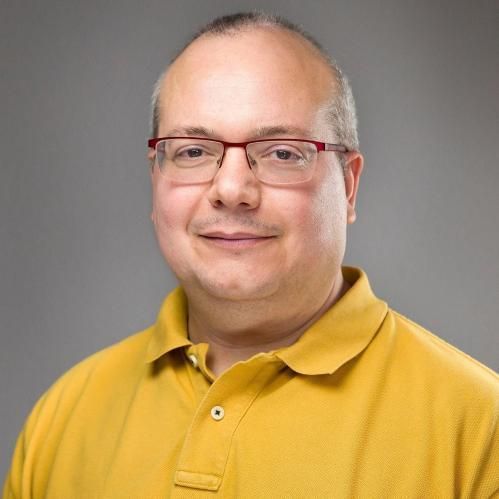
Leandro Tortosa Grau is a Professor in the Department of Computer Science and Artificial Intelligence at the University of Alicante's Higher Polytechnic School, where he has been teaching and conducting research since November 2007. He directs the Data Analysis and Visualization in Networks (ANVIDA) research group and is affiliated with the Institute of Computer Research at the University. His academic credentials include: Doctorate in Computer Engineering and Computing (2000) Computer Engineering degree (2000) Graduate in Mathematics from the University of Valencia (1988) Professor Tortosa Grau's research spans three distinct phases. Initially focused on parallel systems of linear equations during his doctoral studies (1995-2000), he then shifted to computer security and cryptography after joining the Security and Cryptology research group. Since late 2012, his research has centered on urban planning and urban networks from a computer science perspective, particularly using Self-Organizing Map (SOM) neural network models. In 2014, he founded the ANVIDA research group, which studies urban networks as complex networks and applies modern network theory to city modeling and visualization. His recent publications demonstrate a strong interdisciplinary approach, combining computer science with urban planning, traffic safety, and materials science. His work integrates deep learning, neural networks, and network analysis to address complex real-world problems in urban environments, transportation safety, and material science. Professor Tortosa Grau has supervised four doctoral theses to completion, all receiving the highest distinction of 'Sobresaliente Cum Laude.' He has coordinated multiple research projects including 'Analysis and visualization of the city as a multiple data network' (TIN2017-84821-P) and 'Analysis and visualization of data in complex networks' (TIN2014-53855-P), and contributed to the 'Data Analysis to Prevent the Spread of COVID-19' project (2020). He leads the ANVIDA research group which focuses on studying urban networks as complex networks, applying network theory to urban modeling and visualization. The group's work bridges computer science, urban planning, and data science to create innovative approaches for understanding and improving urban environments through computational methods.