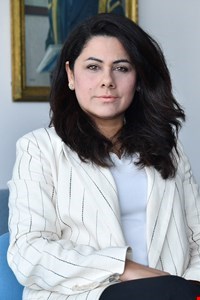
Crina Damsa is a Professor at the Department of Education, University of Oslo. Her research focuses on collaborative learning, interdisciplinary learning, and the role of digital technologies (including AI) in knowledge work and education. She leads projects like Unpacking collaboration: Multimodal analysis and combined method designs and Learning Ecologies in Higher Education , and is involved in research groups such as HEDWORK and LIDA. PhD in Educational Research, University of Oslo (2013) MSc in Learning Design and Technology, Utrecht University (Netherlands) BA in Language and Literature, Babes-Bolyai University (Romania) Her work examines sociocultural and sociomaterial aspects of learning, with a focus on student-centered environments, design-based research, and multimodal learning analysis. She supervises PhD students and contributes to methodological advancements in learning sciences. Editorial roles: Area Editor for Learning in Context , member of editorial boards for journals like Journal of the Learning Sciences and Frontline Learning Research Projects: Academic Hospitality in Interdisciplinary Education (AHIE) , Digital Integration of Video Assessment (DIVA) , Digital Tracing of Collaborative Learning (DigiT) , Global Teacher Education (GatherED)
Juliane Mora is an Associate Professor of Communication Studies at Gonzaga University, with 15 years of teaching experience across diverse disciplines including humanities, sciences, engineering, and business at four institutions from California to Florida. She holds a Ph.D. in Communication from the University of Utah and advanced degrees in Communication Studies from California State University-Sacramento. Ph.D., Communication, University of Utah M.A., Communication Studies, California State University-Sacramento B.A., Communication Studies, California State University-Sacramento Her research focuses on communication pedagogy for social justice, emphasizing innovative teaching practices that challenge power structures through classroom instruction. She also explores critical/cultural studies, rhetoric, and organizational communication frameworks in educational and business contexts. Her publications address topics spanning pedagogical praxis, social justice communication, correctional system evaluations, and interdisciplinary narratives. Notable themes include critical pedagogy, institutional training programs, and equity-focused communication strategies.
Dr. Kristian Gustafson is a Reader in Intelligence & War at Brunel University London's College of Business, Arts and Social Sciences , Department of Politics and History. He serves as Deputy Director of BCISS and leads the Distance Learning MA in Intelligence and Security Studies program. PhD in History from Cambridge University MA in History from University of Alberta BA (Hons) in History from Royal Military College of Canada His research focuses on practical intelligence analysis, structured analytical tools, and military doctrine. He has worked on improving counter-poaching outcomes in Africa and reducing gun crime through intelligence methods. Recent publications analyze intelligence failures in Kabul (2021), Ukraine war intelligence (2024), and structured analytic techniques across nations (2025). His work spans both academic journals and policy-oriented publications. Scientific recognition includes: CIA’s Walter L. Pforzheimer Award (2003) for outstanding contribution to intelligence history Co-editor of 'Intelligence Elsewhere' (2013), establishing comparative research agendas Teaching highlights: Convenor of MA Intelligence and Security Studies (Distance Learning) Module convenor for Contemporary Threats & Intelligence Analysis Director of Studies for MA Intelligence & Security Studies Professional experience includes senior lecturer at Royal Military Academy Sandhurst, military service in Canadian and British armies, and consultancy roles with UK MOD and Cabinet Office.
Dr. Asieh Hosseini Tabaghdehi is a Senior Lecturer in Strategy & Business Economy at Brunel Business School, Brunel University of London. She serves as Programme Lead for the BSc International Business Programme and Trade2Grow Executive Education Programme. Additionally, she is Impact Lead at the Brunel Centre for AI: Social and Digital Innovation, where she leads the capability area in the Future of Work. Dr. Tabaghdehi is also an economist and social impact advisor for the independent NGO, Social Innovation Movement. Dr. Tabaghdehi earned her PhD in Economics and Finance (2008) and MSc in International Money, Finance, and Investment (2015), both from Brunel University London. She also holds a BA in Theoretical Economics from University of Mazandaran. She completed the Postgraduate Certificate in Academic Practice and is a Fellow of the Higher Education Academy. Dr. Tabaghdehi is internationally recognized for her research on digital transformation, with particular expertise in the ethical integration of artificial intelligence and digital technologies. Her work focuses on how emerging technologies shape industries, labor markets, and society, with emphasis on enhancing SME growth through technological innovation. She explores applications across critical sectors including social care, supply chain management, and environmental sustainability. A central theme in her research is smart data governance, ensuring ethical, transparent, and responsible use of data in decision-making processes. Her research portfolio demonstrates a consistent focus on the intersection of technology, ethics, and business strategy. She has developed frameworks like the Digital Business Auditing Framework, which has been adopted internationally for smart city initiatives. Her work connects academic research with practical policy applications, as evidenced by her presentations as oral and written evidence to the House of Commons Select Committee. Her publications span AI ethics, digital footprint implications, fertility economics, and healthcare cost analysis, showing interdisciplinary breadth while maintaining thematic coherence around digital transformation's societal impact. Scientific Awards and Recognition Semi-finalist: Research Impact Award at Brunel University London, 2023 Staff Award: Exceptional in Collegiality and Supportive to Colleagues at Brunel University London, 2022 Exceptional Performance at Regents University London, 2018-19 Staff Award in Teaching, Learning and Assessment at Regents University London, 2016 Best Lecturer Award at London Brunel International College, 2014 Best Lecturer Award at London Brunel International College, 2013 Dr. Tabaghdehi actively supervises PhD students researching areas including Smart Data Governance, Ethical AI Governance, Digital Innovation Impact, Responsible AI Adoption Strategies, Sustainability, and Future of Labour Market. She has secured research funding from multiple sources including the Economic & Social Research Council (ESRC), Brunel University London, and Brunel Business School. Her current projects include research on AI Adoption and Governance, Youth digital addiction, Algorithm Reliability Framework, and SMEs digital footprints. She has also co-designed the "Digital Adoption" module for the UK Government's Help to Grow Management program, demonstrating the practical application of her research. As a member of multiple professional organizations, Dr. Tabaghdehi serves as an associate practitioner at Social Value International, associate member of the Big Innovation Centre, and member of the All-Party Parliamentary Group on AI. She is also a member of the ESRC Review College, British Academy of Management Review College, and Energy Institute UK, contributing to the broader academic and policy communities through these roles.
Assoc. Prof. Dr. Matilda Karamatić Brčić is a dedicated academic at the Department of Pedagogy, Faculty of Philosophy, University of Zadar, where she has been employed since 2004, progressing from junior researcher to her current position as Associate Professor. She teaches courses including Basic Knowledge of Education, Introduction to Pedagogy, Theory of Education, and Theory of Education in Practice across undergraduate, graduate, and teacher competency programs. Her research focuses on inclusive education , educational integration , and curriculum development , with particular emphasis on implementing inclusive practices in Croatian primary schools. Her doctoral dissertation examined the organization, content, and methodology of inclusive education implementation in primary schools. She has been actively involved in the scientific research project 'Education and Education for Entrepreneurship' since 2007. Dr. Karamatić Brčić has participated in numerous international conferences across Europe, with her most recent publications (2013-2015) analyzing sociodemographic factors in inclusive education, bilingual education implications, and models for quality inclusive practices. Her scholarly work demonstrates a consistent trajectory toward understanding and improving inclusive educational systems in Croatia. She maintains active professional engagement through memberships in: Croatian Pedagogical Society NGO 'Interkultura' in Zagreb European Association for International Education (EAIE) since 2005 Young SIETAR (Young society for International Education, Training and Research) since 2005 Dr. Karamatić Brčić has participated in extensive professional development, including working visits to Swiss teacher training universities focusing on inclusive education, and various international seminars on educational innovation and entrepreneurship.
Joan Ramon Resina is a Professor at Stanford University in both the Department of Iberian and Latin American Cultures and the Department of Comparative Literature. He serves as Director of the Iberian Studies Program under the Freeman Spogli Institute. Ph.D., University of Barcelona (1988) Ph.D., UC Berkeley (1986) Research interests include Catalan cultural studies, modernism, historical memory, philosophy of language, and urban modernity. His work interrogates the intersections of literature with political and cultural transformation. Recent publications focus on Iberian transnationalism, the Catalan independence movement, and Visconti’s cinematic philosophy. These works span interdisciplinary methodologies in cultural critique and historical analysis. Scientific awards include prestigious Alexander von Humboldt and Fulbright fellowships, reflecting his international scholarly recognition. Contact : jrresina@stanford.edu | Office: Pigott Hall, Bldg 260, Rm 224 | Office Hours: Tu/Th 12-1PM
Sylvain Kahn is a Tenured Lecturer at the Centre for History (CHSP) at Sciences Po , specializing in the history and geography of European integration. He holds a PhD in Geography, the agrégation (highest state teaching qualification) in History, and a degree in Geopolitics. Education : PhD in Geography, agrégation in History, Ecole Normale Supérieure (Fontenay-Saint-Cloud/Lyon), Geopolitics degree. Teaching : European integration and geopolitics at Sciences Po since 2001; leads 'History of European integration' class in the Master of European Affairs program. Research interests center on the role of nation-states in European integration, the territoriality of the European Union, and the Europeanization of higher education. His work bridges historical analysis with geopolitical frameworks, examining paradoxes in EU territorial governance. Recent publications include analyses of EU crises (e.g., Brexit, pandemic responses), geopolitical dynamics (e.g., Franco-German leadership), and cultural studies (e.g., 'La Reine Margot' as feminist critique). He has also explored the interplay between EU territorial policies and national sovereignty. Professional contributions extend to media production: he created the MOOC 'Geopolitics of Europe' (available in French and English) and hosted the radio program 'Planète Terre' on France Culture (2006-2016). He has served on examination juries (ENA) and as an expert for the European University Association.
Dr. Esther Prins is a Professor of Education in the Learning and Performance Systems department at Pennsylvania State University's College of Education. She serves as Co-Director of both the Goodling Institute for Research in Family Literacy and the Institute for the Study of Adult Literacy (ISAL). Her research employs critical and sociocultural theories to examine various forms of literacies (adult, family, digital, health), adult basic education, rural adult education, and participatory approaches to education, community development, and research. Her scholarship particularly explores the "wider benefits" of adult education and how it reproduces or mitigates inequities rooted in race/ethnicity, class, gender, and immigration status. Her primary focus is on community-based programs in adult and family literacy, including adult English as a Second Language (ESOL). Dr. Prins has recently expanded her research to explore the influence of White Christian nationalism in public education, school board elections, adult education, and literacy studies. Her work spans numerous disciplines with publications in journals such as Educational Researcher, American Educational Research Journal, Adult Education Quarterly, and Rural Sociology. Her research has been supported by major funding agencies including the National Science Foundation, Institute of Education Sciences, and Spencer Foundation. Selected awards: Exemplary Paper Award, Adult Literacy and Adult Education SIG, AERA (2025) Graduate Faculty Teaching Award, Penn State (2019) Mildred B. and Charles A. Wedemeyer Award for Outstanding Scholar in Distance Education (2013) Outstanding Researcher Award, College of Education, Penn State (2011) Imogene Okes Award for Outstanding Research, AAACE (2010) Outstanding Paper by an Early Career Scholar Award, AERA (2007) Dr. Prins has co-authored the book "Teaching and Learning about Family Literacy and Family Literacy Programs" (Routledge, 2022) and co-edited "Family and Intergenerational Literacy and Learning: International Perspectives" (UNESCO, 2025). She is actively engaged in community outreach, presenting her research on White Christian nationalism to churches and community groups.
Konstanze Schiemann is a Research Associate in the Department of Ancient History and Cultural History of Antiquity at Johannes Gutenberg University Mainz since April 2021. Her work integrates teaching and research, focusing on the cultural history of the Roman Empire, particularly games and popular culture, environmental history, human-animal relationships, and early Christianity's influence on societal norms. Doctorate : University of Amsterdam (2024), thesis on animal hunts in late antiquity. Master's : Binational History program (Paris/Heidelberg, 2014–2016). Bachelor's : History and Economics at University of Mannheim (2010–2014). Her research examines contested cultural practices like animal hunts, analyzing how late antique societies navigated Roman tradition and Christian ethics. Publications include peer-reviewed reviews, science communication articles, and conference contributions. Key Research Themes : Cultural conflict, human-animal dynamics, political symbolism in spectacles. Trends : Focus on late antiquity (4th–6th centuries), interdisciplinary analysis of environmental and religious shifts. She received a Heinrich Böll Foundation Doctoral Scholarship (2017–2020) and is active in academic networks including the Cultural and Literary Animal Studies (CLAS).
Suren Jayasuriya is an Associate Professor at Arizona State University's The GAME School, with joint appointments in the School of Electrical, Computer and Energy Engineering (ECEE) and the Department of Arts, Media and Engineering (AME). He is also an Affiliate Faculty Member at the Mary Lou Fulton College for Teaching and Learning Innovation. His lab, the Imaging Lyceum, focuses on transdisciplinary research bridging computational imaging, computer vision, sensors, and STEAM education. Education Ph.D. Electrical and Computer Engineering, Cornell University (2017) M.S. Electrical and Computer Engineering, Cornell University (2015) B.S. Mathematics, University of Pittsburgh (2012) B.A. Philosophy, University of Pittsburgh (2012) Research Focus Dr. Jayasuriya's work integrates optics, computational photography, and machine learning to develop novel imaging systems. His research spans: Computational cameras and light transport analysis Atmospheric turbulence modeling and video restoration Neural volumetric reconstruction for sonar/radar STEAM education frameworks for K-12 teachers Philosophical aspects of imaging and representation His lab emphasizes interdisciplinary collaboration across engineering, arts, and humanities. Publication Trends Recent publications demonstrate strong focus on computational imaging (45%), AI/ML applications (30%), and educational technology (25%). Dominant themes include turbulence mitigation in videos, neural rendering for sonar/radar, sensor fusion, and AI curriculum development for middle schools. Work frequently appears in top venues like CVPR, SIGGRAPH, and IEEE Transactions. Awards Image Electronics Technology Excellence Award (IIEEJ, 2021) Best Demo Awards: IEEE ICCP 2019, MIRU 2018 Best Paper Award: IEEE ICCP 2014 ASEE Diversity Paper Finalist (2020) Teaching Honors: Fulton Top 5% Award (2019, 2021), ASU Game Changing Faculty (2021) Teaching & Advising Teaches graduate/undergraduate courses including Machine Vision (EEE 515), Minds and Machines (AME 400), and thesis supervision. Leads NSF-funded projects on computational imaging education and AI teacher training. Mentors students through the Imaging Lyceum lab with projects spanning optics, philosophy, and educational technology. Lab & Collaborations Directs the Imaging Lyceum, emphasizing Aristotle-inspired collaborative research. The lab works on: computational cameras, STEAM education, sensor development, and philosophical inquiries into imaging. Collaborates with Carnegie Mellon Robotics Institute and international partners. Funded by NSF, NEH, and industrial partners for projects in sonar imaging, heat resiliency sensing, and educational AI.
Vincent Puech is a Senior Lecturer in Ancient History at the University of Versailles Saint-Quentin-en-Yvelines (UVSQ), where he serves as Director of the Institute of Cultural and International Studies (IECI) within the Department of History. With a career spanning over two decades at UVSQ, he has held various leadership positions including Director of the History Department (2016-2018), Director of the Cultural and Social History track (2017-2020), and Director of the History Master's program at Paris-Saclay University (2018-2020). Dr. Puech's academic journey began with his 1994 achievement of 9th place in the History Agrégation. He earned his doctorate in 2000 with a thesis on 'Aristocracy and Power in Byzantium during the 13th Century (1204-1310)' under Georges Tate's supervision. In 2020, he completed his Habilitation to Direct Research with a work titled 'Court Elites of Constantinople (450-610): A Prosopographical Approach to Power Relations.' His research focuses on Byzantine history, particularly court elites, power relations, and imperial ceremonial in Late Antiquity. Dr. Puech has made significant contributions to understanding the political structures of Constantinople between the 5th and 15th centuries, with special attention to prosopographical methods. His work bridges Roman and Byzantine studies, examining continuity and transformation in imperial administration and aristocratic networks. Dr. Puech's scholarly output reveals a consistent focus on Byzantine political structures, with particular attention to court ceremonial, elite networks, and the transition from Roman to Byzantine governance. His publications demonstrate expertise in prosopography as a method for understanding power dynamics in Late Antiquity, with increasing attention to spatial dimensions of power in Constantinople. Concours général d'Histoire (3rd prize, 1987) Dr. Puech has supervised numerous academic projects and directed research at UVSQ. His leadership roles in academic administration, including directing the Institute of Cultural and International Studies, reflect his standing within the university community. He has also contributed to significant collaborative research projects, particularly those examining court rituals and ceremonies from the Roman Empire through the Baroque period. As Director of the Institute of Cultural and International Studies, Dr. Puech oversees research initiatives that bridge historical studies with contemporary cultural analysis. His institute serves as a hub for interdisciplinary work connecting ancient history with modern international relations perspectives.
Susan Scott is an Associate Professor in the Information Systems and Innovation Group at the Department of Management of The London School of Economics and Political Science. Her research focuses on the intersection of digital innovation and organizational change, particularly examining how information systems reshape work practices and risk management in financial services, travel, and publishing sectors. Education : PhD in Management Studies (University of Cambridge, 1993-1998), MSc in Analysis, Design and Management of Information Systems (LSE, 1991-1992), BA in History and Politics (SOAS, 1987-1990) Research Interests Digital Innovation Work Practices and Organizational Structuring Organizational Technologies Strategy, Structures, and Information Infrastructures Managing Change Materiality and Practice Research Her recent publications analyze the materiality of digital systems through case studies in book publishing and travel , while historical studies trace the evolution of financial infrastructure like SWIFT . She explores how metadata, software standards, and social media reshape organizational accountability and risk practices. Scientific Awards ICIS Best Paper in Field Award (2007) Nordic Exchange Scholarship (2000-2001) ESRC PhD Scholarship (1993-1996) Best Paper Nominations (Academy of Management, ECIS, ICIS) Selected for European Research Paper of the Year (2014, 2015) Grants and Professional Roles Recipient of grants from SWIFT , British Academy , and HEFCE . She has served on editorial boards of Information and Organization and Organization Science , and co-chaired conferences like IFIP 8.2 and ICIS .
Dr. Anna Stevens is a Senior Lecturer in Archaeology and Ancient History at Monash University and an Honorary Research Associate at the McDonald Institute for Archaeological Research, University of Cambridge. She serves as Assistant Director of the Amarna Project, leading fieldwork at Akhetaten (modern Amarna), the Bronze Age city built by Pharaoh Akhenaten. Her work is conducted with permission from the Egyptian Ministry of Tourism and Antiquities. Stevens specializes in ancient Egyptian archaeology with a focus on urbanism, lived religion, and cultural interaction in the ancient world. Her research particularly examines how material culture and urban space illuminate the lives of non-elite populations in ancient Egypt. She has conducted fieldwork in Egypt, Sudan, the UK, and Australia, with Amarna serving as her primary research site. Her recent publications demonstrate a strong focus on cemetery studies at Amarna, examining burial practices, health patterns, and urban context. The research reveals significant insights about non-elite populations during Akhenaten's reign, including dietary deficiencies, heavy labor burdens, and pathogen loads that indicate challenging living conditions. Her work bridges Egyptology with broader social sciences through her editorial role for the book series 'Ancient Egypt in Context' published by Cambridge University Press. Stevens co-directs the Amarna Cemetery Project with Dr. Gretchen Dabbs, funded by the National Endowment for the Humanities, British Academy, and Egypt Exploration Society. She also leads 'Akhenaten's City: Protecting Amarna's Urban Heritage' (2023-2026), supported by the American Research Center in Egypt's Antiquities Endowment Fund. She serves on the editorial board of the Journal of Egyptian Archaeology and accepts PhD students at Monash University. Her fieldwork program at Amarna integrates archaeology and bioarchaeology to investigate health in ancient urban centers, non-elite funerary practices, and life under Akhenaten. This multidisciplinary approach has produced significant findings, including the discovery of a mature ovarian teratoma from New Kingdom Amarna, published in the International Journal of Paleopathology.
Abayomi Baiyere serves as an Associate Professor in the Department of Digitalization at Copenhagen Business School (CBS), where he conducts cutting-edge research at the intersection of digital technologies and organizational transformation. His work significantly contributes to UN Sustainable Development Goals through digitally-enabled societal impact initiatives and has yielded 69 research outputs including high-impact publications in premier journals like Information Systems Journal and Information Systems Research . His research program focuses on: Digital transformation frameworks (notably the MIND framework for capability assessment) Platform design and governance mechanisms Smart service systems development Workplace transformation through digital subtraction logic Digital strategy implementation challenges Analysis of his 15 most recent publications (2024-2025) reveals a strong theoretical grounding in institutional and practice-based perspectives, with increasing emphasis on ethical dimensions of digital transformation, AI implementation constraints, and methodological innovations in computational research. His work consistently bridges conceptual rigor with practical applicability for organizational leaders. Dr. Baiyere actively shapes academic discourse through editorial roles including co-editing The Routledge Companion to Management Information Systems (2025) and organizing key events like the African IS Paper Development Workshop (2020). His public engagement includes 6 media contributions discussing digital workplace transformation and strategic implementation challenges, demonstrating commitment to translating research into practical insights for broader audiences. Within CBS, he has supervised 8 academic works while contributing to the department's international recognition in digitalization research. His activities reflect deep engagement with both theoretical advancement in information systems and practical solutions for organizational digital maturity.
Prof. Dr. Rachid Ouaissa serves as University Professor and Head of the Department of Middle Eastern Politics at the Center for Near and Middle Eastern Studies (CNMS), Philipps University of Marburg since March 2009. He concurrently holds affiliations with the Center for Interdisciplinary Religious Studies and Center for Conflict Research at the same institution, and maintains active roles in Berlin-based research networks including EUME and the Wissenschaftskolleg zu Berlin. His academic formation includes a PhD from the University of Leipzig (2004) supervised by Prof. Hartmut Elsenhans, preceded by undergraduate studies at Martin-Luther-Universität Halle-Wittenberg (1994-1999) where he received the DAAD-Preis in 1997. His scholarly trajectory includes a Visiting Scholarship at Dalhousie University (2008) and prior research positions at the University of Leipzig. Ouaissa's research program centers on Middle Eastern and North African political dynamics with four interconnected pillars: cultural-identitarian political movements (comparing BJP in India and Algerian parties), moderate Islamist parties as potential EU partners, state-class behavior during resource scarcity (Iraq case study), and fundamentalist movement development (FIS in Algeria vs. Mahdia in Sudan). His conceptual innovation emphasizes blocked middle classes mobilizing religious identity to challenge state power, while his recent work develops 're-configuration' frameworks for understanding post-Arab Spring transformations. His publication trajectory from 1999-2021 reveals evolving scholarly priorities: early work focused on Algerian state formation and political Islam, shifting toward comparative cultural-identitarian movements (2007-2009), then moderate Islamist parties' foreign policy (2009-2012), with contemporary research addressing Hirak protests and theoretical re-configuration models. The corpus demonstrates consistent engagement with Algeria while expanding to regional comparative frameworks, particularly through co-edited volumes on Maghreb entanglements and MENA transformation processes. His scientific recognition includes: DAAD-Preis der Martin-Luther-Universität (1997) Friedrich-Ebert-Stiftung PhD Fellowship (2000-2002) Friedrich-Ebert-Stiftung Scholarship (1998-1999) Professor Ouaissa has secured major research funding including two German Research Foundation (DFG) projects: 'New Cultural-Identitarian Political Movements' (2007-2009) and 'Moderate Islamist Parties as EU Partners' (2009-2012). He actively mentors emerging scholars through the Friedrich-Ebert-Stiftung's doctoral programs and serves on its selection committees, while his policy engagement manifests through frequent media contributions analyzing Algerian protests and regional dynamics for outlets including Le Monde, El Watan, and Deutsche Welle. He leads the Department of Middle Eastern Politics at CNMS while contributing to the university's interdisciplinary research infrastructure through the Center for Interdisciplinary Religious Studies and Center for Conflict Research. His international scholarly integration is evidenced by co-editing the book series 'Politik und Gesellschaft des Nahen Ostens' and 'Studien zur Geschichte und Zeitgeschichte Westasiens und Nordafrikas', alongside editorial leadership of the journal META (Middle East Topics and Arguments).