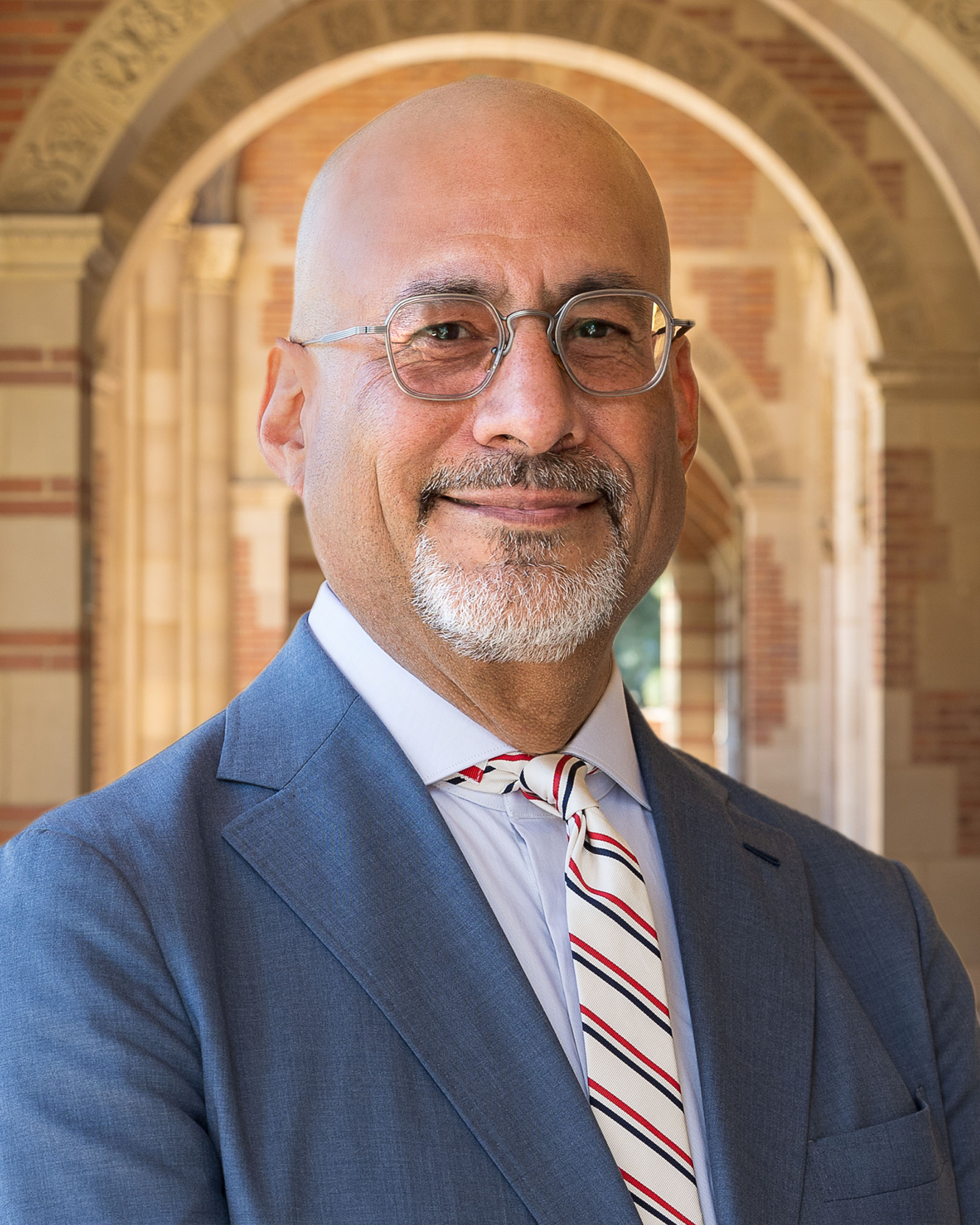
Abel Valenzuela Jr. is the Dean of Social Sciences and Professor of Labor Studies, Urban Planning, and Chicana/o and Central American Studies at the University of California, Los Angeles (UCLA). A faculty member since 1994, he has held leadership roles including chair of Chicana/o and Central American Studies, director of the Center for the Study of Urban Poverty, and special advisor to the chancellor on immigration policy. Currently, he leads UCLA’s Institute for Research on Labor and Employment (IRLE), overseeing units like the Labor Center, Labor Occupational Safety and Health Program (LOSH), and Human Resources Round Table (HARRT). Education PhD in Urban and Regional Studies, Massachusetts Institute of Technology (1993) MCP, Massachusetts Institute of Technology (1988) BA in Social Science, UC Berkeley (1986) His research focuses on precarious labor markets, immigrant workers, urban poverty, inequality, and the socio-economic implications of day labor. He has shaped national policy discussions on low-wage and immigrant labor through extensive publications. Valenzuela’s publications span topics like cosmopolitan politics, informal economy regulation, and comparative vulnerability studies. His work emphasizes intersections between migration, urban planning, and labor rights, with a geographic focus on Los Angeles and cross-national contexts. As director of IRLE, he has led initiatives integrating research, policy, and community engagement to address labor and employment challenges in Los Angeles and beyond.
Andrew Stewart is a Professor at the School of Law, Queensland University of Technology (QUT), specializing in Labour Law, Employment Relations, and regulatory frameworks for the Gig Economy. His research focuses on internships, platform work regulation, and workplace fairness. Key Collaborations: Penny Williams, Paula McDonald, Rosemary Owens, Jim Stanford Research Themes: Gig economy fairness, internship regulation, employment classification, workplace surveillance His recent work includes Creighton and Stewart's Labour Law (7th Edition) and submissions to parliamentary inquiries on digital platform work. He co-edited Internships, Employability and the Search for Decent Work Experience (2021). Publications span the Industrial Law Journal , American Journal of Comparative Law , and The Economic and Labour Relations Review . Research emphasizes regulatory innovation in employment law and the intersection of education/work.
Amanda Konkle serves as Associate Professor in the Department of English at Georgia Southern University and holds an affiliate appointment in the Women's, Gender & Sexuality Studies Program. Her academic profile spans film history, stardom studies, and gender/sexuality research with particular focus on Hollywood's Production Code era and contemporary media representations. Her educational credentials include: Ph.D. in English, University of Kentucky (2016) M.A. in English Literature, Miami University (2008) B.A. in English, Hanover College (2004) Graduate Certificate in Gender and Women's Studies, University of Kentucky (2010) Professor Konkle's research critically examines stardom construction (especially Marilyn Monroe's persona), gender performance in Westerns and comedies, censorship frameworks in Hollywood, and postfeminist television . Her work interrogates how domesticity narratives, racial dynamics, and method acting techniques shape cultural memory through film and media artifacts, with strong connections to UN Sustainable Development Goals regarding gender equality. Analysis of her 2021-2025 publications reveals concentrated exploration of Marilyn Monroe's cinematic legacy (including three Blonde adaptations), Production Code-era subversion strategies, and critical reevaluations of 1990s television reboots through intersectional feminist lenses. Recent scholarship increasingly addresses pedagogical innovation in composition instruction alongside media studies. As an active mentor, Professor Konkle currently accepts PhD students and maintains research collaborations examining precarious whiteness in television and adaptation theory across biographical media.
Aidan M Wong is a full-time Assistant Professor of Urban Studies (Education) at the College of Integrative Studies, Singapore Management University. He also serves as Programme Co-Director for the Master of Sustainability (MST) program and holds the Urban Fellow position at the SMU Urban Institute. His work bridges urban studies, economic geography, and sustainability education through interdisciplinary research and teaching. PhD : Queen Mary University of London (2014) MSc : National University of Singapore (2010) BSc : National University of Singapore (2008) Wong's research explores intersections of urban sustainability, active citizenship, and labor dynamics. His publications demonstrate expertise in: Broad Disciplines : Urban Studies, Environmental Science, Economic Geography Key Themes : E-waste regulation, informal labor networks, urban heritage preservation, and circular economy implementation He contributes to educational initiatives through courses like 'Big Questions', 'Urban Cultures', and 'Singapore: Imagining the Next 50 Years', while coordinating the 'Cultures of the Modern World' basket in the MST program.
Professor Damian Grimshaw is Professor of Employment Studies at King's College London's King's Business School, where he serves as Associate Dean for Research Impact. He is also London & South Forum Co-Lead for the Productivity Institute. Previously, he was Director of the Research Department at the International Labour Organisation (Geneva, 2018-19) and Professor at the University of Manchester, where he served as Head of the HR and Employment Relations and Law group and Director of the European Work and Employment Research Centre. Professor Grimshaw's research spans multiple disciplines including labour market analysis, comparative employment relations, feminist economics, sociology of work, and management. His work focuses on international comparisons of low-wage labour markets, outsourcing and HRM, technology and the future of work, precarious work, collective bargaining, and gender inequality. His research has strong policy impact across UK, European and international arenas. Recent publications reveal a clear trend toward examining the future of work through multiple lenses: collective bargaining structures, digital labor platforms, gendered impacts of pandemic policies, and regional approaches to decent work. His work consistently addresses how institutional frameworks shape employment outcomes across different national contexts and sectors. Professor Grimshaw has received significant research funding from major organizations including the British Academy, ESRC, European Commission, International Labour Organisation, Leverhulme Trust, Low Pay Commission, OECD, and Russell Sage Foundation. He coordinates a major UKRI research programme on human capital and productivity and leads the Regional Productivity Forum for London and the South alongside Marcela Miozzo and Mario Gruber. His ongoing research projects include precarious work in Europe and the gender inequalities of the Covid-19 pandemic and recession. During 2021-22, he taught 'Globalisation and Employment' on the MSc in HRM and Employment Relations and 'International HRM' to undergraduates. His research team is actively engaged in projects examining automation in knowledge-intensive business services and artificial intelligence's impact on occupations, with particular focus on the UK and US contexts.
Dr. Liang Ge is a Lecturer at King's College London teaching across the Digital Humanities Department and Culture, Media and Creative Industries Department. Holding a PhD from King's College London's Culture, Media and Creative Industries Department, they specialize in the intersection of digital media, gender/sexuality studies, and East/Southeast Asian popular cultures. BLit in Chinese Language and Literature, Peking University MSc in Sociology (with distinction), London School of Economics and Political Science PhD in Culture, Media and Creative Industries, King's College London Their research explores digital intimacy, queer fandoms, and cultural production in Chinese digital spaces, with particular focus on danmei (male-male romance) literature and its socio-political implications. They examine how state power, platform capitalism, and fan communities interact within China's digital landscape, analyzing affective labor, censorship mechanisms, and identity formation through frameworks of ambivalence and queer theory. Liang Ge's scholarly contributions appear in leading journals including Media, Culture & Society , European Journal of Cultural Studies , and Asian Studies Review , with research trends revealing sustained engagement with digital intimacy commodification, state-fandom power dynamics, and postcolonial queer methodologies across East Asian contexts. Great Britain-China Educational Trust Award (2023) Kelly Quinn Scholarship, Association for Internet Researchers (2024) MeCCSA Journal Article of the Year Award (Shortlisted, 2024) Sino-British Fellowship (2021) As an active scholar, they serve on the Society for Cinema and Media Studies committee (2023-2025) and contribute to UN Sustainable Development Goals through research on gender equality and inclusive cultural participation. Their work bridges academic analysis with contemporary digital culture debates, particularly regarding LGBTQ+ representation in Sinophone contexts.
Dr. Sara Ababneh is a Lecturer in International Relations at the University of Sheffield's School of Sociological Studies, Politics and International Relations. Previously an Associate Professor at the University of Jordan's Center for Strategic Studies, her research bridges political theory and gender studies with a regional focus on the Middle East. Her core research examines intersections of class, gender, resistance movements, liberation struggles, and economic sovereignty. She employs feminist and postcolonial frameworks to analyze Islamic political parties, labor movements, and women's rights advocacy across Jordan and Palestine. Current projects investigate decolonial pedagogies and geopolitical dimensions of feminist praxis. Her publications demonstrate strong thematic coherence, predominantly exploring: feminist critiques of Western epistemological hegemony; re-politicization of economic rights in Arab uprisings; and Islamic paradigms of gender justice. Methodologically, she combines discourse analysis with ethnographic approaches to capture lived experiences of resistance. Research grants include principal investigator roles for the Arab Barometer, Gender Barometer, and International Men and Gender Equality Survey (IMAGES Jordan). She coordinates international research networks addressing feminist ethics during geopolitical crises.
Dennis Nickson is Professor in Service Work and Employment at the Department of Work, Employment and Organisation, University of Strathclyde, where he has been a faculty member since 1996. He previously served as Head of Department (2008–2014) and co-directed the Scottish Centre for Employment Research (2004–2008). He is Editor-in-Chief of Employee Relations and a leading figure in research on service sector employment. PhD in Internationalization Strategies of Hotel Companies, University of Strathclyde (1999) BA in Humanities, University of Kent (1991) His research centers on aesthetic and emotional labour , skills, employability, and human resource management in interactive service work, particularly in retail and hospitality. He is a co-developer of the influential concept of aesthetic labour with Professors Chris Warhurst and the late Anne Witz. His work explores labour market dynamics, gender inequalities, fair work, and workplace harassment, especially in low-paid service roles. His recent publications focus on fair work frameworks, intersectional inequalities in global education sectors, and the impact of the pandemic on hospitality workers. These works reflect trends in critical HRM, service work ethics, and policy-oriented labour research. Scientific Awards: Academic Fellow, Chartered Institute of Personnel and Development (CIPD), 2013 He has supervised multiple research students and led externally funded projects on topics including equal pay, recruitment in the voluntary sector, and customer abuse in hospitality. His research has influenced employment relations policy and practice, particularly in Scotland’s public and third sectors. He has also contributed to major journal editorial work and professional conferences. He is actively involved in the Global Hospitality Research Alliance and collaborates internationally on fair work and hospitality employment issues. His work aligns with UN Sustainable Development Goals related to decent work and economic growth.
Prof. Dr. Heinz Stapf-Finé is a Professor of Social Policy at Alice Salomon University of Applied Sciences Berlin (ASH Berlin) . His work focuses on democracy development , social equality , and political participation through applied research projects. Current projects include Krise als Chance (2023-2025) analyzing pandemic impacts on volunteer engagement Gleiche politische Teilhabe (2021-2024) guiding outreach political education DEMOKRATIE (2015) examining democracy-distant attitudes His research spans social policy analysis , healthcare systems , and democratic resilience , with emphasis on qualitative methodologies and participatory research . Publications include: Handbuch aufsuchende politische Bildung (2025) on outreach political education The World We Want to Live In (2022) addressing digital transformation Scientific awards encompass roles as Vertrauensdozent (Hans-Böckler & Friedrich-Ebert Stiftungen) and editorial board membership of Sozialer Fortschritt journal. He supervises PhD students like Irene Köppe and Nele Rathke , and has received third-party funding from institutions like the Stiftung Deutsche Klassenlotterie Berlin .
Dr Kutoma Wakunuma is an Associate Professor in Information Systems at the School of Computer Science and Informatics, De Montfort University (DMU), UK. She is actively involved in research, teaching, and leadership, serving as Module Leader, Programme Leader for MSc Computing, and Deputy Subject Group Leader. She is affiliated with the Centre for Computing and Social Responsibility (CCSR) and holds a PhD in Information Communication Technologies for Development and Gender from Coventry University. PhD in Information Communication Technologies for Development and Gender, Coventry University, UK Post-Graduate Certificate in Higher Education (PGCert. Teaching), De Montfort University, UK MA in Women’s Studies (Challenges in Management and Decision-Making), Lancaster University, UK HND in Management Information Systems, Zambia Institute of Management Her research focuses on the societal impacts of technology, particularly in the Global South. Key areas include ICT for Development (ICT4D) , ethics in emerging technologies , gender and technology , Responsible Research and Innovation (RRI) , and AI governance in Africa . She explores how digitalisation affects development, equity, and sustainability, with a strong emphasis on the UN Sustainable Development Goals. Her recent publications reflect a growing focus on ethical AI, digital platforms, and the gig economy in Africa. Themes include gendered AI design , responsible innovation , digital governance , and stakeholder engagement . Her work often bridges technical systems with ethical and social justice concerns, particularly in underrepresented regions. Dr Wakunuma has received numerous awards and recognitions, including the Initiativkreis Ruhrgebiet Fellowship for outstanding research, UN World Summit Award, and DAAD Scholarships. She has also been a recipient of EU and UKRI/GCRF research funding. DMU award on Exploring Sustainable Development in Ahmedabad, India, 2019 Coventry University PhD full Studentship, 2007 Open Society Institute scholarship, Oxford Internet Institute, 2006 UN World Summit on the Information Society Award, 2005 DAAD Scholarships (2004, 2000) Initiativkreis Ruhrgebiet Fellowship (Honoured for outstanding research), 2002 International Federation for Information Processing (IFIP) Award, 2000 She is an active PhD supervisor and examiner, mentoring students on topics such as identity theft in Nigeria, e-voting, digital SMEs in South Africa, and feminist critiques of techno-capitalism. She has served as a Principal Investigator and Senior Researcher on major EU-funded projects including RRING, SATORI, CONSIDER, and ETICA. She is also a Visiting Lecturer and PhD Supervisor at Stockholm University, an Editorial Board Member for the Journal of Responsible Technology, and an ethics advisor for the European Commission. Dr Wakunuma is affiliated with the Centre for Computing and Social Responsibility (CCSR), where she contributes to interdisciplinary research on technology ethics and governance. She leads and participates in teams focused on responsible innovation, digital inclusion, and sustainable technology development, particularly in African contexts.
Marianne Pieper is a Professor of Sociology at the University of Hamburg's Faculty of Economics and Social Sciences since 1996. Her work focuses on migration, gender, neoliberalism, and biopolitical transformations. Leads the DFG-funded project on prenatal diagnostics and social change Coordinator for EU projects like MIG@NET and From Welfare to Work Founded the Center for Gender and Queer Studies (2000-2011) Research Interests span: Intersectional analysis of race, gender, and disability Neoliberal governance and precarity in labor markets Biopolitical shifts in migration and social policies Digital networks and transnational social movements Doctoral College supervises 25 projects funded by the Heinrich Böll Foundation, Hans Böckler Foundation, and others, covering topics from refugee integration to postnational subjectivity.
Patricia L. Maclachlan serves as Professor of Government and Asian Studies and the Mitsubishi Heavy Industries Professor of Japanese Studies at The University of Texas at Austin's College of Liberal Arts, where she has held faculty positions since 1997. Her scholarly profile centers on Japanese political economy within comparative frameworks, with extensive contributions to understanding institutional evolution in East Asia. Her academic credentials include: Ph.D. in Political Science and Japan Studies, Columbia University (1996) Research Associate, Program on U.S.-Japan Relations, Harvard University (1996-1997) Maclachlan's research investigates how Japanese institutions navigate globalization pressures, particularly in consumer protection, postal systems, and agricultural policy. Her seminal works include Consumer Politics in Postwar Japan (2002) analyzing citizen activism boundaries, The People's Post Office (2011) tracing postal system politics across 140 years, and Betting on the Farm (2022) co-authored with Kay Shimizu examining agricultural reforms. Current scholarship increasingly addresses digital economy impacts on labor and welfare systems. Recent publication trends reveal deepening analysis of institutional resistance to reform, especially regarding agricultural lobbies and postal privatization battles, while expanding into gender dimensions of Japan's digital transformation. Her work consistently bridges historical institutional analysis with contemporary policy challenges. Professional service highlights include membership on the U.S.-Japan Friendship Commission, U.S.-Japan Conference on Cultural and Educational Interchange (CULCON), and American Advisory Committee of the Japan Foundation. She previously served on the Journal of Japanese Studies board of trustees and editorial board. Maclachlan teaches core courses including Politics in Japan, Japanese Foreign Policy, and Political Economy of Asia, with recent offerings covering consumer politics and comparative institutions. Her academic leadership extends through committee service fostering U.S.-Japan scholarly exchange, though specific student mentorship details remain unpublicized.
Chris F Wright is a Professor of Work and Labour Market Policy at the University of Sydney Business School and serves as PRME Academic Director. He holds a BA (Hons) from the University of Sydney and a PhD from the University of Cambridge. His research focuses on institutional drivers of decent work, labour migration in low-wage sectors, and comparative employment relations methodologies. He has advised governments globally and contributed to over 100 scholarly works, including co-authoring Work and Industrial Relations Policy in Australia (2025) and editing volumes like Protecting the Future of Work (2023). Recent articles emphasize migrant worker rights, multi-employer collective bargaining, and pandemic-era labour dynamics. He has secured major grants such as an ARC DECRA and a UK ESRC Fellowship. His current students investigate modern slavery in healthcare, union power in fragmented workplaces, and migrant status impacts on delivery workers. Professor Wright chairs journal editorial boards and advises the Australian Government’s Skilled Migration Expert Subcommittee. His advocacy includes reforms to temporary migration systems and multi-level collective bargaining frameworks.
Professor Karin Sanders serves as Associate Dean (Research) at the UNSW Business School, where she is affiliated with the School of Management and Governance. With over two decades of academic experience, she has established herself as a leading scholar in Human Resource Management, particularly focusing on the HR process approach and employee perceptions of HR practices. Her research has been published in top-tier journals including HRM (Wiley), Academy of Management Learning & Education, Human Resource Management Journal, and International Journal of HRM. Professor Sanders' research primarily centers on the HR process approach, examining how employees' perceptions, understanding, and attributions of HR practices influence their attitudes and behaviors. Her work explores critical areas such as informal learning activities, cooperative behavior, commitment, knowledge sharing, team learning, and absenteeism. She has made significant contributions to understanding the effects of alignment between line managers and HR managers on organizational climate, defined as shared perceptions of the organization among employees within a team. Her methodological approach often employs multi-actor, multi-level, and multi-method research designs, reflecting the complexity of HR phenomena in organizational contexts. As an influential academic leader, Professor Sanders serves as Editor for Special Issues at the International Journal of HRM and Associate Editor for Human Resource Management and Frontiers of Business Research in China. She sits on the Editorial Boards of six HRM and management journals. Previously serving as Head of School for Management between 2015 and 2019, she was also a member of the Executive Committee of the HR Division Academy of Management from 2013 to 2018. Her recent work has increasingly focused on HRM during crises, including the development of HR analytics and responses to the pandemic. Professor Sanders has secured substantial research funding, including an Australian Research Council Linkage Project on capacity building in the Not-For-Profit sector and multiple industry collaborations. She has edited several books, including the "Handbook on HR Process Research" (2021) with Huadong Yang and Charmi Patel. Her scholarly contributions bridge theoretical rigor with practical relevance, influencing both academic discourse and HR practice worldwide.
Markus Jäntti serves as Professor at Stockholm University's Institute for Social Research (SOFI), where his research centers on income and wealth distribution, poverty dynamics, and socio-economic mobility through comparative international lenses. He specializes in quantifying family background's influence on economic outcomes and leads pivotal projects including MapIneq (life-course inequality trends), PrecaNord (Nordic precarious work analysis), and TITA (austerity-era inequality assessment). His research portfolio spans income distribution , wealth inequality , intergenerational mobility , and comparative social policy , employing advanced econometric techniques and cross-national datasets like the Luxembourg Income Study. Work within SOFI's Labor Market Economics (AME) group extends to education, health, taxation, and gender equality, reflecting labor economics' interdisciplinary nature. Analysis of his 2020-2025 publications reveals dual emphases: methodological innovation (e.g., grouped-data inequality measurement) and empirical exploration of family-background effects, labor policies, and social transfers. His influential 2020 framework synthesizing four mobility approaches underscores conceptual rigor, while recent Nordic-focused studies address contemporary challenges like migrant labor exploitation. Scientific awards: No awards were documented in source materials. Major grant-funded projects include: MapIneq : Tracking intergenerational, educational, labor market, and health inequality drivers across lifespans PrecaNord : Multi-level analysis of precarious/informal work in Finland, Norway, and Sweden TITA : Consortium study of austerity's impacts on financial, health, and opportunity inequalities As core faculty in SOFI's AME group, he contributes to research spanning labor market outcomes (wages, employment), social transfers, crime, and political economy—operating within Stockholm University's broader social policy ecosystem while maintaining independent research leadership.