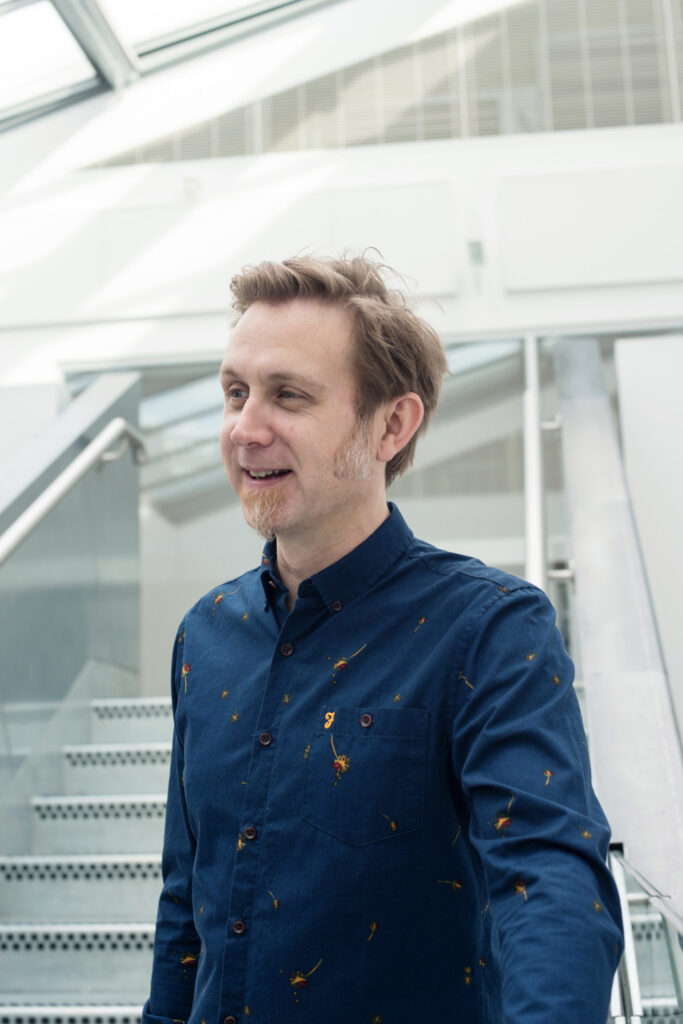
Geoff Cox is an Associate Professor at the School of Communication and Culture , Aarhus University , affiliated with the Centre for Advanced Visualisation and Interaction . His work explores coding as an aesthetic and political medium , blending technology, art, and critical theory. Fellow of the Higher Education Academy (FHEA) Research Interests: Cox investigates the intersection of digital media, political expression, and artistic practice. His project The Contemporary Condition (2015–2020) examined the sociopolitical implications of computational systems through interdisciplinary frameworks. Key Publication: His book Speaking Code: Coding as Aesthetic and Political Expression (MIT Press) critically analyzes how code functions as both a technical and cultural artifact.
Dr. Michael Wamposzyc is a Lecturer in Design at Edinburgh Napier University’s School of Arts and Creative Industries. He works as a Freelance Consultant, Designer, and Researcher in Data Visualisation, Information Design, and Graphic Design. Education : UdK Berlin, London College of Printing, School of Art Institute Chicago. His research explores intersections of Art and Design , Cultural Heritage , and Intercultural Communication through experimental design practices. Recent projects include Visual Literacy meets Academic Literacy , examining how graphic design integrates into academic ecosystems, and Photomediations: An Open Book , which advocates for open access and hybrid publishing models. His publications span data visualization , typographic systems , and digital humanities , often merging 3D modeling with cultural preservation . Collaborative efforts like Horti-BlueC highlight his focus on interactive design and environmental sustainability .
Dr. Amjad Fayoumi is a Senior Lecturer (Associate Professor) in Information Systems at the Department of Management Science, Lancaster University Management School, since 2017. He directs the MSc in Digital Business, Innovation and Management and previously led the MSc in E-business and Innovation Programme. He co-leads the Advanced Manufacturing Theme in LiRA (Lancaster Intelligent, Robotic and Autonomous Systems Centre) and participates in multiple research groups. PhD in Information Systems from Loughborough University Senior Fellow of Higher Education Academy (SFHEA) Professional memberships: BCS, MIEEE, IEEE Computer Society, Operational Research Society, AIS, and Association for Enterprise Architects His research focuses on two main themes: Advanced Manufacturing Systems and Digital Transformation of Healthcare . He applies enterprise modelling/simulation, design science, and socio-technical approaches to bridge strategy execution gaps in talent acquisition, healthcare IT, and manufacturing agility. Recent publications span digital business startups, healthcare apps, cyber-physical frameworks, and Industry 4.0 innovations. His work integrates enterprise architecture , digital twins , and privacy-preserving systems across industries. Advising expertise in enterprise information systems, knowledge engineering, and strategic IS Editorial roles in journals like Journal of Information Technology , IEEE Access , and Expert Systems with Applications Peer-review activities for multiple international conferences and journals Dr. Fayoumi leads projects such as IAA: Transforming Data into Decisions and Healthcare Systems Analysis, while participating in events like the International Conference on Information Systems 2024 and Cyber Leadership Symposium 2022.
Flora Mary Bartlett is an Assistant Professor at Linköping University's Department of Thematic Studies (TEMA), affiliated with the Technology and Social Change (TEMAT) research group. Her work bridges environmental anthropology, visual studies, and technology studies, focusing on landscape relations in rural Sweden, renewable infrastructures, and data center expansions. She collaborates with institutions like the Nordic Museum and leads projects such as 'Life with Forest Loss' and 'Megabytes vs Megawatts.' Research Interests: Bartlett explores human-environment interactions through visual ethnography, examining frictions around renewable energy, forest loss, and data center development. Her projects emphasize inclusive methodologies and interdisciplinary collaboration, such as curatorial interventions and participatory fieldwork. Publications: Her recent works analyze Arctic exhibitions, rural sustainability, and data center landscapes, reflecting her commitment to responsible research practices and environmental stewardship. Grants & Collaborations: Active in interdisciplinary initiatives like the 'Megabytes vs Megawatts' project and the Tema T Fellowship Programme, she engages with global issues of sustainability and digital infrastructure. Labs/Teams: Associated with Tema's DataLab, she co-creates visual and multimodal research on data center impacts, hosting events like the 'Visualising The Data Centre' crossover with Stripe.
Lowenna Jones is a Researcher at the University of Sheffield , affiliated with the School of Sociological Studies, Politics and International Relations. She is a NERC-funded PhD research student within the ECORISC Centre for Doctoral Training, focusing on post-Brexit chemical risk regulation and science-policy dynamics. BSc in Conservation Biology and Ecology (University of Exeter) Masters by Research in Biological Sciences (University of Exeter) Her research explores de-regulation, dis-engagement, and divergence from EU environmental policies, employing interdisciplinary methodologies from natural and social sciences. She is also a co-lead for the Sheffield Methods Institute’s Data Visualisation module and supported by the Grantham Centre for Sustainable Futures. Scientific Awards : Grantham Scholar
Dr. Marie Collier is a Lecturer in the Department of History of Art at the University of Cambridge, specializing in modernist Soviet and European architecture, with a focus on the visual representation of Soviet architecture and infrastructure in mass media during the Stalinist era. She holds a PhD from The Courtauld Institute of Art (2016) for her work on 'Visualising Socialist Construction: Soviet Architectural Photographs in Mass Printed Media c. 1928-1935.' Education: PhD in History of Art, The Courtauld Institute of Art, 2016 Research Interests: Her research explores the intersection of architecture, media, and politics in 20th-century Europe, including Soviet-European architectural connections, the role of mass media in disseminating architectural ideas, and the material culture of everyday life. She has organized conferences such as 'Fantasy In Reality: Architecture, Representation, Reproduction' and contributed to exhibitions like the V&A’s retrospective on Ove Arup. Awards & Affiliations: She held the Sackler Research Forum Postdoctoral Fellowship at The Courtauld and is affiliated with the Cambridge Courtauld Russian Art Centre (CCRAC). She teaches courses on modern/postmodern architecture, museum history, and critical theory. Labs/Teams: Collaborates with the CCRAC and has engaged with institutions like the Van Abbemuseum and the Victoria and Albert Museum.
Glen Robinson is a Teaching Professor and Course Leader for the BA (Hons) Design for Publishing and Graphic Design programmes at Norwich University of the Arts. His role involves curriculum coordination, teaching, and fostering interdisciplinary collaboration between art and design disciplines. He emphasizes typography, storytelling, and ethical communication in design education. Research interests include the anthropology of layered narratives, ethical challenges in mass communication, and the intersection of emerging technologies with spatial design. His practice merges photography, drawing, and writing to explore themes like labyrinths, folk stories, and societal symbolism. Glen’s work has been exhibited globally, including installations at Lincoln Cathedral (2014), Vienna’s SHOWROOM (2009), and Mexico City’s Universidad Autónoma Metropolitana (2008). Over 12 years of teaching, his students have earned prestigious awards such as D&AD Yellow Pencils and International Society of Typographic Designers membership. Glen’s publications and exhibitions focus on experimental typography, artists’ books, and parazines, reflecting his commitment to innovative visual storytelling.
Andrew Pepper is a Professor at Queen's University Belfast's School of Arts, English and Languages, and a member of the Senator George J Mitchell Institute for Global Peace, Security and Justice. His research focuses on transnational crime fiction, espionage narratives, and contemporary fiction addressing security and policing. He has authored monographs like Unwilling Executioner: Crime Fiction and the State (2016) and co-edited volumes such as Globalization and the State in Contemporary Crime Fiction (2016). He also writes historical crime novels set in 19th-century London. Education and Teaching: Pepper teaches modules on contemporary fiction and American writing, including a third-year course exploring themes like the 'war on drugs' and policing in U.S. literature. At the MA level, he examines violence and workplace dynamics in genre fiction. Research Projects: R6587AEL: Detecting Transcultural Identity in European Popular Crime Narratives (2018–2021) R1723AEL: Ian Rankin StoryTrek (2017–2019) R1368MLA: Visualising European Crime Fiction (2014–2015) Awards: Recipient of the International Crime Fiction Association Book Prize (2020). Active in academic activities, including PhD examinations and conference participation globally. Public Engagement: Featured in media such as BBC Radio 4's Open Book (2006). His work contributes to UN Sustainable Development Goals related to justice and global partnerships.
Amadea Kovič is a researcher at the Research Centre for Communication and Culture (CECC) at Universidade Católica Portuguesa, with a focus on visual storytelling and integral human development. She earned her PhD in Culture Studies at the Faculty of Human Sciences, Universidade Católica Portuguesa, and completed her Master’s and Bachelor’s degrees in History of Art and Slovene Studies at the University of Ljubljana, Faculty of Arts. Postdoctoral Fellow, DHI - Post-Doctoral Program in Integral Human Development PhD in Culture Studies (2021) MSc in History of Art and Slovene Studies (2019, University of Ljubljana) BSc in History of Art and Slovene Studies (2016, University of Ljubljana) Her research explores intersections of feminist visual art , digitalization’s impact on nostalgia , and gender visualization in Portugal and Slovenia. She analyzes climate change communication through speculative design and artistic interventions in public spaces. Her work contributes to the UN Sustainable Development Goals, particularly in education and art-science collaboration. Recent publications address topics like Sharks in Seine: excess, pollution, and climate change (2025), Embodied nostalgia in the age of digitalization (2024), and Visualising gender through contemporary art (2024), reflecting her engagement with environmental storytelling, affect theory, and gender representation. Activities include chairing Conjunctures of Hospitality (2024) and participating in Culture and Artificial Intelligence events. She is affiliated with CECC and contributes to academic supervision in integral human development projects.
Alison Alder is an Associate Professor at the School of Art & Design , Australian National University , with a focus on interdisciplinary research connecting art, politics, and social change. Research interests include visualizing social/political movements Explores intersections between art practices and activism Investigates feminist frameworks in contemporary art Works with community groups to develop collaborative visual projects Her work bridges critical theory with practice-based approaches to address systemic inequalities through artistic interventions.
Aritad (Alan) Choicharoon is a Senior Lecturer in Business Analytics at Leeds University Business School, University of Leeds, and a member of the Centre for Decision Research (CDR). He has been actively involved in teaching and research since 2020, focusing on quantitative modeling, analytics, and data visualization. Position: Senior Lecturer in Business Analytics Institution: University of Leeds School: Leeds University Business School Research Centre: Centre for Decision Research (CDR) Email: A.Choicharoon@leeds.ac.uk His research centers on the intersection of artificial intelligence and decision support systems, particularly the application of large language models in complex decision-making processes. He explores applied data science in business contexts, including marketing analytics, consultancy, and the integration of machine learning and decision science in the music industry. His work emphasizes interpretable and explainable AI, human interaction with decision support systems, and the role of such systems in managerial decision-making. Although no recent publications are listed in the provided text, his involvement in a UKRI-approved Knowledge Transfer Partnership (KTP) project with SR Mailing Ltd and colleagues from CDR indicates active research with real-world impact, particularly in applying AI and LLMs to improve sustainability in business operations. He has been recognized for his teaching contributions, having designed and led the fast-growing postgraduate module Creating Effective Data Visualisation (LUBS5991M) . He also leads Business Analytics and Decision Science (LUBS5308M) and has contributed to other modules such as Forecasting and Advanced Business Analytics and Machine Learning in Practice . Certified Analytics Professional (CAP) Fellow of the Higher Education Academy Certified Management & Business Educator Member of the Operational Research Society His educational background includes a BEng in Aerospace Engineering and an MSc in Business Analytics and Decision Science. Prior to academia, he worked as a data scientist in an international e-commerce platform and as a researcher at a top-3 music label, applying AI in talent scouting. He is actively engaged in the data science community and shares insights on data, technology, F1, and politics via social media. He is also a Professional Development Tutor for the MSc Business Analytics and Decision Science program and collaborates with interdisciplinary teams at the University of Leeds, including through the Leeds Institute for Data Analytics (LIDA) and the Centre for Decision Research.
Fiona Terry is an Honorary Professor at the School of Political Science and International Studies, University of Queensland. She serves as Head of the Centre for Operational Research at the International Committee of the Red Cross (ICRC) in Geneva, combining over three decades of field and management experience in humanitarian affairs across global conflict zones. Her work bridges academic scholarship and humanitarian practice. Research Interests: Terry specializes in humanitarian policies and politics, with a focus on conflict resolution, operational research, and the intersection of academic theory with real-world humanitarian challenges. Her scholarship contributes to understanding restraint in war and transforming aid policy through visual politics. Notable Work: Her book Condemned to Repeat: The Paradox of Humanitarian Action (2002) remains a seminal text in the field. She is a Partner Investigator in the Australian Research Council-funded project 'Visualising Humanitarian Crises: Transforming Images and Aid Policy' (2022–2025), collaborating with the ICRC and Prof. Roland Bleiker. Scientific Awards: Grawemeyer Award for Ideas Improving World Order (2002) for her book. Grants: Partner Investigator in the $1.2 million Australian Research Council Linkage Grant (2022–2025) for 'Visualising Humanitarian Crises.'
Eileen Alexander is a Research Fellow and CASE Associate at the London School of Economics and Political Science (LSE), affiliated with the Department of Methodology and Social Policy. Her work focuses on using creative and collaborative methods to explore lived experiences of inequality, insecurity, and informal welfare practices. Research interests: Qualitative methods, Creative/Visual methods, Research ethics, Informal welfare, Care ethics, Poverty studies Teaching: Convenes an MY580 short course on creative methods (to be offered in 2025); recipient of teaching accolades from LSE Student Union and LSE Class Teacher award Her research emphasizes engaging vulnerable populations in coproduction, with projects like Why are things this way? Visualising life in post-austerity Britain (2024) and her PhD thesis The Ultimate Safety Net? Informal financial support among low-income households (2022) . She has contributed to understanding multidimensional poverty, welfare policies, and the impacts of austerity measures in the UK.
Professor Simon Burnett is a Professor of Information Management in the School of Law and Social Sciences at Robert Gordon University (RGU). With a career spanning both academia and industry, he brings practical experience to his academic role. Prior to joining RGU, he worked in the private sector designing and implementing online information systems. He has held significant leadership positions including Director of the RGU Centre for Knowledge Management (2000-2008) and Associate Director (External) of the Scottish Graduate School of Social Science (2013-2016). Professor Burnett's educational background includes: PhD in "Knowing through Narratives" MSc in Information Analysis (1993-1994) Bachelor's Degree in Librarianship and Information Studies (1989-1993, Robert Gordon University) Professor Burnett's research focuses on Dark Knowledge , Knowledge Management, Information Management, Storytelling/Narrative, Knowledge-based Processes, Communities of Practice, Innovation Management, Social Media in Political and Policing Contexts, Information visualisation, and Digital Curation. His work explores forbidden and taboo aspects of knowledge, particularly how organizations handle information that is uncomfortable or politically sensitive. He has pioneered research on "desire lines" across information landscapes and examines how narratives function in knowledge sharing processes. His publication record shows a consistent output with 52 research outputs including 24 journal articles, 14 theses, and 9 conference presentations. Recent work (2023-2025) demonstrates growing interest in Dark Knowledge, with several publications exploring its theoretical foundations and practical implications. His research spans multiple disciplines including information science, knowledge management, social media studies, and organizational behavior, often with a focus on practical applications in industry contexts. Professor Burnett has received notable recognition including: A Knowledge Transfer Partnership (KTP) with Dean's of Huntly (2020) Funding from the Leverhulme Trust for a systematic literature review on Dark Knowledge (2024) Professor Burnett is an active supervisor with 16 doctoral students currently under his guidance across various programs. He has supervised over a dozen students to completion and serves as an external examiner for multiple universities. His research is well-funded with current projects including the Leverhulme Trust grant and an industry collaboration on digital strategy implementation. As former Director of the RGU Centre for Knowledge Management (2000-2008), Professor Burnett led a team providing knowledge management research and consultancy services to high-profile clients including the United Nations, BP, and the NHS. His current research group continues to explore cutting-edge topics in knowledge management, particularly focusing on Dark Knowledge and its implications for organizations. The group maintains strong industry connections and collaborates on practical applications of knowledge management theory.