Dr. Marcel Dettling is a Group Lead in Data Analysis and Statistics at the ZHAW School of Engineering , focusing on predictive analytics, applied statistics, and complex data analysis. He also serves as a Lecturer at ETH Zurich , teaching advanced statistical methods. Education : PhD in Mathematics (2000-2004), ETH Zurich Postdoc in Applied Statistics (2004-2006), Johns Hopkins University His research spans predictive analytics (regression, classification, time series), data mining, and applications in health economics, transportation safety, social sciences , and business analytics . Recent work includes pharmaceutical cost group analysis for Swiss healthcare and predictive maintenance for marine vessels. Selected publications highlight his expertise in flight trajectory modeling , deep learning error mitigation , and statistical frameworks for rehabilitation finance . His projects address diverse fields like crowdworking in nursing, energy optimization for shipping, and customer behavior prediction.
Professor Maia Angelova is a leading academic in data science and mathematical physics at Aston University's Aston Digital Futures Institute (ADFI) and College of Engineering and Physical Sciences. Her research focuses on interdisciplinary AI applications in healthcare, including precision medicine, chronic disease modeling, and athlete performance analytics. She previously held roles as Professor of Data Analytics at Deakin University (2017–2023) and Professor of Mathematical Physics at Northumbria University (1997–2016), with early experience as a College Lecturer at Oxford University (1991–1996). Education: PhD, MSc, and BSc in Physics from Sofia University 'St. Kliment Ohridski'. Research interests span AI-driven healthcare solutions, dynamical systems modeling, and sports performance analysis. Her work addresses sleep disorders, diabetes management, chronic pain, and athlete performance using advanced machine learning and data analytics. She has secured over £5M in research funding and supervised over 30 PhD students and postdoctoral researchers. Awards include Fellowship of The Institute of Physics. Professional memberships include The London Mathematical Society, Australian Mathematical Society, and Complex Systems Society. Key achievements include founding the Data to Intelligence research centre (2018–2020) and leading large-scale interdisciplinary projects. Current initiatives focus on precision healthcare through AI integration in clinical decision-making systems.
Simon Chadwick is a Professor of Sport and Geopolitical Economy at Skema Business School in France. He specializes in the intersection of sports, geopolitics, and economic transformation in the Middle East, particularly focusing on Gulf states' strategic investments in global sports ecosystems. His research examines how nations like Saudi Arabia and Qatar leverage sports to diversify economies, enhance soft power, and address unemployment. Key themes include the commercialization of football leagues, privatization of sports clubs, and the role of multinational corporations in shaping regional sports markets. Chadwick’s recent articles analyze the Gulf’s pursuit of the 2036 Olympics, the integration of esports into national strategies, and the challenges of building fan loyalty in the Saudi Pro League. His work also explores the economic implications of acquiring European football clubs and the long-term sustainability of Gulf-led sports initiatives. He has contributed to debates on 'sportswashing' and argues that Gulf investments extend beyond PR to systemic economic restructuring. His insights are frequently cited in analyses of Saudi Vision 2030 and its sports-related giga-projects like Neom and Diriyah.
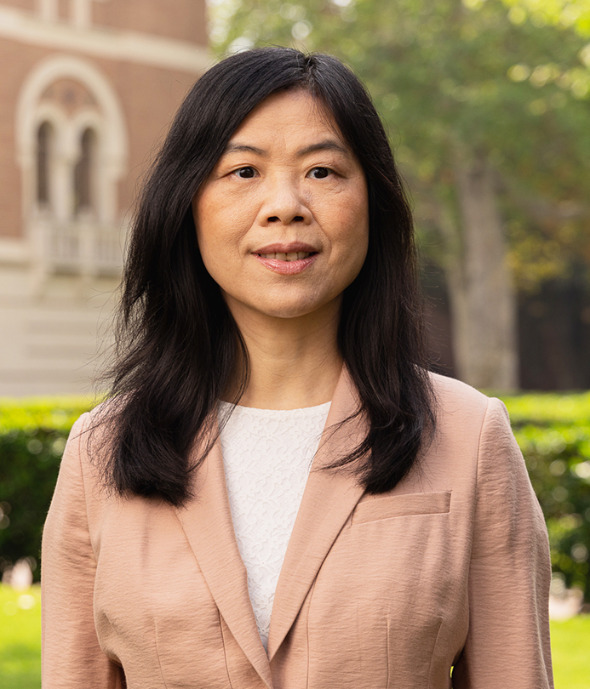
Sha Yang serves as the Ernest Hahn Professor of Marketing at the Marshall School of Business, University of Southern California, where she has held full-time faculty positions since 2017 after progressing from Assistant to Associate Professor roles at New York University and UC-Riverside. Her research examines interdependencies in consumer preferences, social influences on decision-making, and competitive dynamics in advertising, pricing, and platform growth. Her educational background includes a PhD in Marketing (2000) and MA in Statistics (1998) from Ohio State University, complemented by an MA in Economics (1995) and BA in International Economics (1994) from Renmin University of China. Her methodological expertise spans Bayesian methods, structural modeling, and data analytics applied to consumer behavior. Yang's research portfolio reveals consistent focus on digital marketing phenomena, with recent work analyzing cross-category spillovers in advertising, review impacts under negotiated pricing, and psychological pricing effects in luxury markets. Her publications in Journal of Marketing , Management Science , and Marketing Science demonstrate interdisciplinary approaches bridging econometrics and behavioral insights. Among her recognitions is the Marketing Science Institute Young Scholar award. She has served as Associate Editor for Journal of Marketing (2017-present) and Marketing Science (2017-2024), reflecting her scholarly impact. Marketing Science Institute Young Scholar Associate Editor, Journal of Marketing (2017-present) Associate Editor, Marketing Science (2017-2024) VP, INFORMS Society for Marketing Science Administratively, Yang served as Vice Dean and Senior Vice Dean for Faculty and Academic Affairs at Marshall School of Business (2020-2023), overseeing faculty development and academic strategy. Her current research integrates causal inference methods with media and entertainment industry applications, supported by grants from marketing research institutions.
Konstantinos Pelechrinis is an Associate Professor in the Department of Informatics and Networked Systems at the University of Pittsburgh's School of Computing and Information. He holds a Ph.D. in Computer Science from the University of California, Riverside. His research focuses on network science, urban informatics, and sports analytics. He has been recognized with the Army Research Office Young Investigator Award for his contributions. Education: Ph.D. in Computer Science, University of California, Riverside Research Interests: Urban mobility patterns and infrastructure analysis Sports performance quantification and strategy Data-driven decision-making in transportation systems Network science applications in social and urban systems His recent work explores topics such as implicit biases in sports refereeing, anomaly detection in NFT markets, and optimizing bike-sharing systems using predictive models. He also investigates urban infrastructure resilience through projects like the Epui platform for experimental urban informatics. Awards: Army Research Office Young Investigator Award He contributes to academic outreach through courses like TELCOM2125 (Network Science and Analysis) and collaborates on initiatives like the Healthy Ride Pittsburgh bike-sharing study. His lab focuses on bridging theoretical models with real-world urban and sports datasets.
Christos Gatzidis serves as Executive Dean of Bournemouth University's Faculty of Science and Technology since October 2023, overseeing six departments including Computing and Informatics, Creative Technology, and Psychology. Previously Deputy Dean (2021-2023) and Head of Creative Technology Department (2016-2021), he was appointed Professor in Creative Technology in November 2019. The Faculty leads five REF Units of Assessment and secures funding from AHRC, NIHR, and Innovate UK for research spanning digital healthcare, gaming technologies, and cultural heritage applications. His educational qualifications include: PhD in Information Science, City University London (2010) PG Cert in Research Degree Supervision, Bournemouth University (2010) MA in Computer Animation, Teesside University (2003) BSc (Hons) in Computer Studies (Visualisation), University of Derby (2002) Professor Gatzidis specializes in computer graphics with research spanning virtual reality, serious games, and digital healthcare applications. His work bridges technical innovation and practical implementation, particularly in mindfulness prototypes for healthcare and stroke rehabilitation systems. Current projects focus on the multidisciplinary application of gaming technologies in medical contexts, emphasizing user experience and therapeutic outcomes through collaborations with industry partners. His publication record (2014-2025) demonstrates evolving expertise from foundational computer graphics research in terrain generation and deformation to applied work in healthcare, cultural heritage, and music education. Key trends include virtual reality for therapeutic mindfulness, usability studies in mobile gaming, and digital cultural presentation techniques, reflecting a trajectory toward socially impactful technological solutions with strong industry translation. No scientific awards are documented in the provided information. He has supervised PhD students and secured competitive research funding, including two Innovate UK Knowledge Transfer Partnerships. His principal investigator role in a virtual reality mindfulness prototype project exemplifies his approach to translating academic research into practical industry solutions, with current focus on expanding knowledge exchange activities to support the University's civic engagement mission. As Executive Dean, he leads faculty-wide research strategy across six departments, fostering interdisciplinary collaborations particularly in digital healthcare and cultural heritage. His personal research integrates computer graphics expertise with clinical applications through partnerships with healthcare providers and technology companies, driving innovation in therapeutic VR systems and educational gaming platforms.
Dr. Anne Ozdowska is a Research Fellow in the School of Computing at The Australian National University (ANU). Her work focuses on heuristic evaluation methods for design, inclusive technologies, and game design principles. She holds a PhD in Human-Computer Interaction from Queensland University of Technology (QUT) awarded in 2019, alongside a BCompSc degree. Her research emphasizes applying Universal Design and game mechanics to create accessible technologies. She is registered to supervise research students in these areas. Key research interests include: Heuristic evaluation frameworks for early design validation Inclusive game design for diverse audiences Augmented Reality applications in health and education Assistive technologies for neurodiverse populations Publications span topics from cross-platform multiplayer game design (2025) to foundational studies on screen time effects in young children (2012). Her work bridges academic research with practical applications, including commercialized software from her doctoral research. Professional contributions include developing GameFlow heuristic frameworks and contributing to educational interventions for students with autism spectrum disorder. Details on grants and lab affiliations are not explicitly stated in available materials.
Emiliya Lazarova is a Professor of Economics and Head of the School of Economics at the University of East Anglia (UEA). She chairs the Royal Economics Society’s Conference of Heads of Departments of Economics. Her research focuses on coalition formation, matching theory, and applied economics, with recent projects analyzing technological innovation via patent data, biodiversity market measurements, and international environmental agreements. She has held academic roles at the University of Birmingham and Queen’s University Belfast, teaching quantitative courses like Applied Econometrics and topics in applied microeconomics. Her research interests include coalition dynamics, social housing allocation, and the political economy of environmental policies. Current projects with Dr. Yuan Gao include developing an ex-ante novelty index for inventions and studying biodiversity valuation mechanisms. Lazarova has secured grants from the Royal Economic Society and British Academy, focusing on property rights and economic development in emerging economies. Her work bridges theoretical models and empirical applications, addressing issues like firm behavior under political pressure, patent innovation cycles, and disability discrimination impacts. Collaborations span institutions globally, reflecting her interdisciplinary approach to economic challenges. Advisory roles include supervising PhD students on topics such as status-seeking in matching markets and conflict resolution via coalition theory. Her teaching expertise complements her research, emphasizing quantitative methods and policy analysis.
Eugene Feinberg is a Distinguished Professor in the Department of Applied Mathematics and Statistics at Stony Brook University's College of Engineering and Applied Sciences. He is renowned for his extensive contributions to Markov Decision Processes (MDPs), stochastic optimization, and inventory control. Research Interests: His work spans theoretical and applied aspects of Markov Decision Processes , stochastic optimization , inventory control , healthcare decision-making , and machine learning . He has particularly focused on solving complex decision-making problems under uncertainty, with applications ranging from operations research to medical decision-making. Scientific Awards: He has been honored with the title of Distinguished Professor , recognizing his outstanding contributions to his field. Advising and Grants: While specific details on students and grants are not provided, his prolific publication record and faculty status suggest active involvement in advising and securing research funding. Contact and Resources: His university webpage can be accessed at http://www.ams.sunysb.edu/~feinberg/ , and his Google Scholar profile is available at https://scholar.google.com/citations?user=LLt--pgAAAAJ&hl=en .
Ashish Thatte serves as Associate Professor of Operations Management at Gonzaga University, teaching undergraduate courses including Operations Management (OPER 340), Lean Thinking (OPER 347), and Supply Chain Management (OPER 489), alongside graduate courses such as Global Operations (MBUS 640), Lean Thinking (MBUS 648), and Supply Chain Management (MBUS 699). His industry background encompasses manufacturing management and supply chain/logistics roles in multinational corporations. His academic credentials feature a Ph.D. and M.S. from the University of Toledo, complemented by an M.B.A. and B.E. from the University of Pune (India), plus APICS CPIM certification: CPIM, APICS Ph.D., University of Toledo M.S., University of Toledo M.B.A., University of Pune (India) B.E., University of Pune (India) Dr. Thatte's research centers on supply chain responsiveness, competitive advantage, and information systems in operations, with significant extensions into consumer behavior (particularly Gen Z purchasing in beauty care) and healthcare operations (emergency department efficiency and medical procedure cost analysis). His work bridges theoretical frameworks with practical applications across manufacturing, retail, and healthcare sectors. Analysis of his 15 most recent publications reveals three dominant research trajectories: (1) Supply chain responsiveness mechanisms and their competitive impact through supplier networks and modular manufacturing; (2) Cross-cultural consumer behavior examining regional variations in brand perception; (3) Healthcare operations optimization in emergency departments and procedural cost-effectiveness. His interdisciplinary approach connects operations theory with real-world business challenges across automotive, sports analytics, and global consumer markets. No scientific awards were documented in the available information. While the provided materials confirm his teaching responsibilities and publication record, specific details regarding student advisement, research grants, or laboratory affiliations remain undisclosed in the source materials.
Julian Berger is a postdoctoral researcher at the Max Planck Institute for Human Development in the Center for Adaptive Rationality , where he explores how to enhance decision-making through hybrid human-AI systems. He is also a fellow of the Joachim Herz Foundation and has received funding from the Foundation of German Business and the Danish Data Science Academy. Education: M.A. Psychology in Business and Economics, Universidade Catolica Portuguesa (2021) B.A. Politics, Administration and International Relations, Zeppelin Universität (2018) His research spans human-AI collaboration , collective intelligence , and interpretable machine learning . A recurring theme in his work is developing methods to combine human expertise with AI capabilities for accuracy in domains like medical diagnostics , credit scoring , and football analytics . He has authored publications in high-impact venues such as PNAS , Nature Human Behavior , and Science and Medicine in Football . Scientific awards and funding include: Fellowship for interdisciplinary economics, Joachim Herz Foundation (2024) PhD funding from the Foundation of German Business (Stiftung der deutschen Wirtschaft) Research grant from the Danish Data Science Academy His recent article trends emphasize ensembling techniques that leverage complementary human and AI errors, algorithmic fairness, and practical heuristics like Hybrid Confirmation Trees. These works demonstrate significant improvements in diagnostic accuracy and decision cost-efficiency. Beyond academia, Berger works as a consultant and ML engineer with Simply Rational , focusing on interpretable models for financial and sports analytics. His work bridges theoretical research with real-world applications, prioritizing fairness, transparency, and human accountability in AI systems.
Matthew Stephenson is a Lecturer at Flinders University's College of Science and Engineering, specializing in Artificial Intelligence applications for games. He leads the Data for Decisions initiative within the Factory of the Future Transdisciplinary Hub, focusing on AI-powered scenario generation for smart digital twins. Additionally, he is a member of IRL CROSSING, an international lab studying human-autonomous agent teaming dynamics. PhD in Computer Science (Australian National University, 2019) B.Sc.(Hons) in Computer Science (University of Canterbury, 2015) His research applies AI, Machine Learning, and Data Science to game domains, including intelligent agent development for physics-based environments, procedural content generation, and game analytics. He also investigates deceptive behaviors in multi-agent systems and leverages games as testbeds for real-world AI solutions. Recent publications focus on large language models for game benchmarking, physical reasoning challenges, and evolutionary game generation. Scientific awards include an honourable mention at Foundations of Digital Games (FDG'18). He supervises students in procedural generation, game AI, and physics-based task creation, with teaching roles in computational intelligence and neural networks courses.
Professor Christian Deutscher is a prominent sports economist at Bielefeld University's Faculty of Psychology and Sport Science, specializing in the Department of Sport Science within Division V - Sport and Business. As both Research Officer and Internationalization Officer, he leads significant work in sports economics, particularly focusing on betting markets, match-fixing detection, and sports integrity. His research has attracted funding from major institutions including the German Research Foundation. Deutscher's research interests span sports economics, betting market efficiency, match-fixing detection, sports management, and the business aspects of professional sports. His work combines advanced statistical modeling with practical applications in sports integrity monitoring. He has extensively analyzed live betting markets, Bundesliga economics, and the impact of technological innovations like VAR in football. His research often examines the intersection of sports performance, economic incentives, and market behavior. Analysis of his recent publications reveals a strong focus on empirical studies of sports betting markets, particularly live and in-play betting dynamics. His work demonstrates sophisticated use of state-space models and other advanced statistical techniques to detect market inefficiencies and potential integrity issues. Deutscher frequently collaborates with statisticians and economists to develop warning systems for match-fixing, with particular attention to German football leagues. His research bridges theoretical economics with practical applications in sports governance. Professor Deutscher actively contributes to the European Sport Economics Association (ESEA), having edited special issues of conference proceedings and serving in editorial capacities. His work has been published in leading journals including Journal of Sports Economics, Economic Inquiry, and Applied Stochastic Models in Business and Industry. As Research Officer for the Faculty of Psychology and Sport Science, Deutscher oversees research initiatives and international collaborations. His current projects include data-based fraud detection in live betting markets, funded by the German Research Foundation across multiple phases. He also serves on various university committees including the Quality Improvement Commission and Examination Board for the Department of Sport Science. Deutscher maintains strong connections with sports organizations and betting industry stakeholders, ensuring his research has practical relevance for sports integrity monitoring. His work on betting market inefficiencies has direct applications for regulatory bodies seeking to protect the integrity of sporting competitions.
Toshiharu Sugawara is a Professor in the Department of Computer Science and Engineering at Waseda University's Faculty of Science and Engineering, School of Fundamental Science and Engineering, a position he has held since April 2007. With a Ph.D. in Engineering from Waseda University, his research spans multiple domains in artificial intelligence and multi-agent systems, maintaining active collaborations across international institutions and contributing significantly to the field through numerous publications and awards. Dr. Sugawara received his BS and MS degrees in Mathematics from Waseda University in 1980 and 1982, respectively, followed by his Ph.D. in 1992. Before joining Waseda University as faculty, he worked as a Research Scientist at NTT Laboratories from 1982 to 2007, with a visiting researcher position at the University of Massachusetts at Amherst in 1992-1993. He also held part-time lecturer positions at University of Electro-Communications (2003-2007), Waseda University (2004-2006), and Tokyo University of Agriculture and Technology (1990-1991). His research interests focus on artificial intelligence with particular expertise in multi-agent systems, machine learning, cooperation and coordination mechanisms, soft computing, computational social science, and social informatics. His work bridges theoretical foundations with practical applications in network management and information systems. Recent publications demonstrate a strong trajectory toward interpretable multi-agent reinforcement learning, efficient path planning algorithms, and modeling social behaviors in complex networks. His research group has made significant contributions to multi-agent path finding, cooperative task execution, and understanding virtual economies in social media platforms. Dr. Sugawara has received numerous prestigious awards including multiple Best Paper Awards at JAWS conferences (2014, 2015, 2018), ACM SAC 2015, and various research paper awards from Japanese academic societies. His work on multi-agent systems has been consistently recognized for its theoretical rigor and practical impact. As an advisor, Dr. Sugawara has mentored numerous students who have become prominent researchers in their own right, with many co-authoring papers that have received awards. His laboratory maintains strong collaborations with industry partners, particularly in the areas of network management and intelligent systems. Current research directions include developing interpretable multi-agent reinforcement learning frameworks, optimizing multi-agent coordination in constrained environments, and analyzing social dynamics in virtual economies.
Tridas Mukhopadhyay is the Deloitte Consulting Professor of e-Business at Carnegie Mellon University's Tepper School of Business, where he has served on the faculty since 1986. His academic journey at CMU progressed from Instructor of Information Systems (1986-1987) to Assistant Professor (1987-1993), Associate Professor (1993-1997), Professor (1998-present), and Deloitte Consulting Professor of e-Business (2000-present). He also served as Director of the MS in Electronic Commerce program from 1999-2004. Ph.D. in Computer and Information Systems, University of Michigan–Ann Arbor, 1987 M.B.A. in Computer and Information Systems, Indian Institute of Management Calcutta, 1981 B. Tech. in Electrical Engineering, Indian Institute of Technology Kharagpur, 1978 Professor Mukhopadhyay's research spans multiple critical areas in information systems and technology management. His work on strategic IT use examines how organizations derive business value from information technology investments. He has conducted extensive research on business-to-business commerce, particularly focusing on e-procurement systems, web-based marketplaces, and electronic intermediation models. His cybersecurity research investigates the economic aspects of cyber security, including liability mechanisms and patch release strategies. In software engineering, he has studied productivity, quality metrics, and offshore software development contracts. His most recent publications reveal several key trends in his research trajectory. There's a growing focus on digital platform economics, examining advertising models, virtual currency systems in gaming, and sharing economy dynamics. His work increasingly incorporates behavioral aspects, studying how users respond to personalized content and how backers exert control in crowdfunded projects. Methodologically, his research employs sophisticated analytical approaches including hierarchical Bayesian models, structural equation modeling, and natural experiment designs. CART Research Frontier Award, Carnegie Mellon, 2005 Distinguished Ph.D. Alum, Michigan Business School, 2004 Best Paper, International Conference on Information Systems, 2001 Best Paper, MIS Quarterly, 1995 Xerox Research Chair, Tepper School of Business, 1988-1989 Information Systems Society Distinguished Fellow, 2012 Professor Mukhopadhyay has served on numerous editorial boards including Information Systems Research (1994-2003), Management Science (1999-2003), and MIS Quarterly (1997-1999), demonstrating his significant contributions to the field. His consulting work with major organizations including Alcoa, Chrysler, Ford, General Motors, IBM, and governmental agencies like the United States Post Office and Pennsylvania Turnpike has provided practical insights that inform his academic research. He has been actively involved in university governance through committee service including the Business Technology Faculty Search Committee and the CMU Faculty Senate. His research has been supported through various industry partnerships and academic grants, though specific grant details aren't provided in the source material. His teaching focuses on Business Computing and Strategic IT courses, reflecting his expertise in both foundational information systems concepts and strategic applications of technology in business contexts.