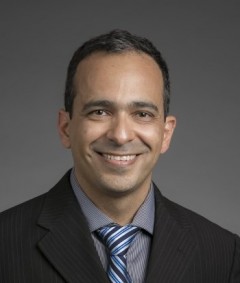
Pedro Teixeira-Dias is a Professor of Particle Physics in the Department of Physics at Royal Holloway, University of London, where he has been a faculty member since October 2000. He serves as the Principal Investigator of the ATLAS UK Collaboration (representing 15 institutions) since 2023, having previously been Deputy PI from 2020-2022. His administrative roles include Senior Tutor for Physics (since 2019), former Head of Department of Physics (2014-2017), and former Associate Dean (Research) for the Science Faculty (2011-2014). Undergraduate: University of Coimbra, Portugal PhD: University of Heidelberg, Germany (Particle Physics) Post-doctoral: University of Glasgow Previous Research: OPAL (1990-94) and ALEPH (1995-2000) experiments at CERN Professor Teixeira-Dias specializes in experimental particle physics, with a primary focus on Higgs boson research. His work centers on the production of Higgs particles in association with top-quark pairs, a rare process that allows study of the direct interaction between the Higgs boson and the top quark (the heaviest known elementary particle). He was involved in the search for and eventual discovery of the Higgs particle announced at CERN in July 2012. His recent research leverages data from high-energy proton-proton collisions at the Large Hadron Collider, particularly through the ATLAS experiment. His publication record shows consistent output in leading journals with recent work focusing on advanced computational techniques for particle detection, supersymmetry searches, and precision measurements of fundamental particle interactions. The research demonstrates a strong emphasis on both theoretical implications and practical detector applications. Professor Teixeira-Dias has secured substantial research funding through multiple Science and Technology Facilities Council (STFC) grants, including the Consolidated Grant for the Centre for Particle Physics and the Upgrade of the ATLAS detector at the LHC. He has supervised numerous students through final year projects and research reviews. His leadership extends to national committees, having served on the STFC Oversight Committee for the CMS detector upgrade project (2010-2018) and the STFC Projects Peer Review Panel (2010-2012). He has taught across the physics curriculum, including Quantum Mechanics, Particle Detectors and Accelerators, and supervision of major research projects.