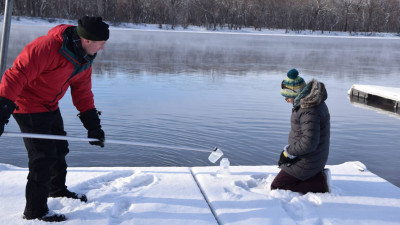
Lee Ferguson is a Professor of Civil and Environmental Engineering at Duke University, with additional appointments as Associate Professor in the Division of Marine Science and Policy. His research focuses on environmental analytical chemistry, particularly using high-resolution mass spectrometry to study per- and polyfluoroalkyl substances (PFAS) , microplastics , and endocrine disruptors . Ferguson Lab develops methods for contaminant detection in water systems and investigates chemical leaching from polymers. Ph.D. in Chemistry from Stony Brook University (2002) Former Assistant Professor at University of South Carolina (2003-2009) Recent work includes PFAS analysis in lithium-ion batteries, glyphosate detection in hard waters, and microplastic dye toxicity studies. Key publications explore urban watershed contamination, Sri Lankan drinking water CKDu links, and novel analytical methods for environmental pollutants. Applied Research Fellowship (2022), Kavli Frontiers of Science Fellow (2011) Testified before U.S. Senate on nanotechnology risks Co-founder of NC PFAS Testing Network As an advisor, he mentors Doctoral Candidates Patrick Faught and Anna Lewis , who investigate microplastic dyes and polymer additives. Lab research spans environmental fate of nanomaterials, contaminant bioavailability, and exposomics for health outcomes.
Angela Sasic Kalagasidis is a Professor and Department Head at Chalmers University of Technology , leading the Building Physics research group. She serves as a board member of the Moisture Center at Lund University of Technology , contributing to interdisciplinary research in building science. Building Physics Heat and Mass Transfer Energy Efficiency Moisture Safety Indoor VOC Emissions Climate Change Adaptation Her recent publications focus on aerogel-based materials for insulation, urban heat island mitigation , and thermal energy storage systems . Key methodologies include CFD simulations , field testing , and life cycle assessment frameworks . Research trends show emphasis on: Advanced computational tools for hygrothermal analysis Integration of phase change materials in building systems Climate resilience in building envelopes Optimization of ventilation and moisture control
Timothy K. Minton is a Professor in the Department of Aerospace Engineering Sciences at the University of Colorado, Boulder, and a member of the Aerospace Mechanics Research Center (AMREC). He holds a PhD from the University of California, Berkeley (1986) and a BS from the University of Illinois, Urbana-Champaign (1980). His research focuses on gas-phase and gas-surface reaction dynamics, particularly in hypersonic flow environments and space material degradation. He has held editorial roles at The Journal of Spacecraft and Rockets and The Journal of Physical Chemistry , and has been recognized with prestigious awards including Fellowships from the American Physical Society (2015) and American Association for the Advancement of Science (2012). Dr. Minton’s work emphasizes understanding atomic oxygen interactions with satellite materials, shock layer chemistry, and material durability in low-Earth-orbit environments. His innovations include the development of the Table-Top Shock Tunnel (TTST) for rapid material testing and durable coatings for space applications. He has also contributed to advancing models for carbon oxidation and nitridation processes. His awards highlight leadership in aerospace and chemistry, including the NASA Monetary Award (1995) for semiconductor etching innovations and the Charles & Nora Wiley Award (2002) for meritorious research. He maintains a courtesy appointment in the Department of Chemistry at CU Boulder and actively collaborates with industry (e.g., Skeyeon, Inc.) and international institutions.
Keyvan Hashtrudi-Zaad is a Professor in the Department of Electrical and Computer Engineering at Queen's University, affiliated with the Smith School of Engineering and the Ingenuity Labs Research Institute. His expertise spans robotics and control systems, with a focus on haptics, telerobotics, tele-rehabilitation, autonomous vehicles, and medical robotics. He holds the email addresses keyvan.hashtrudi-zaad@queensu.ca and khz@queensu.ca, and his office is located in Walter Light Hall, Room 427. Research Interests: His research emphasizes human-robot interaction, haptic interfaces, autonomous systems, and mechatronics. Key areas include kinesthetic haptics, collaborative teleoperation systems, energy storage systems for electric vehicles, and medical robotics applications such as needle deflection estimation and rehabilitation robotics. His work bridges theoretical control systems with practical applications in healthcare and autonomous technologies. Publications: His recent work addresses challenges in haptic system stability, energy-efficient inverters for electric vehicles, and teleoperation networks. Notable projects include a cable-driven parallel robot for stroke rehabilitation and a study comparing DC/BLDC actuators for haptic feedback. His research often integrates sensor fusion, nonlinear control, and dynamic modeling to solve real-world problems. Awards and Recognition: While specific awards are not listed, his extensive publication record and leadership in interdisciplinary robotics initiatives highlight his contributions to the field. He is part of the Interactive Robotics and Intelligent Systems (IRIS) Laboratory, advancing innovations in medical robotics and autonomous systems. Grants and Collaborations: His work likely involves collaborations across engineering and medical disciplines, supported by grants focused on robotics, control systems, and healthcare technologies. The IRIS Lab serves as a hub for developing cutting-edge solutions in haptic training systems and assistive robotics.
Howard Sirotkin is an Associate Professor in the Department of Neurobiology & Behavior at Stony Brook University's Renaissance School of Medicine. His research focuses on neural development, utilizing zebrafish as a model organism to study processes like neural stem cell differentiation, neurodevelopmental disorders (e.g., autism, epilepsy), and the impact of environmental pollutants like PFAS. He holds a PhD from Albert Einstein College of Medicine and has been at Stony Brook since 2002. His lab employs cutting-edge genetic tools and behavioral assays to investigate molecular mechanisms underlying nervous system formation and dysfunction. Education: B.S. Microbiology (University of Florida, 1991); M.S./Ph.D. Molecular Genetics (Albert Einstein College of Medicine, 1993/1996). Research Themes: (1) Neural stem cell regulation, (2) Disease modeling in zebrafish, (3) Chromosome engineering, (4) Environmental toxicant effects Key Technologies: Zebrafish genetics, high-resolution live imaging, CRISPR-based genome editing Lab Members: Includes PhD students (Carly Gomes, Gina Rizzo), MS students, and undergraduate researchers Grants: NIH-funded projects on PFAS toxicity and neural stem cell signaling Facilities: State-of-the-art lab in Stony Brook's Life Sciences Building with dedicated microscopy and behavioral testing suites
Anja Feldmann is Director at the Max Planck Institute for Informatics in Saarbrücken and Professor of Internet Network Architectures at Technische Universität Berlin (since 2006). Previously she held a full professorship at Technische Universität München (2002–2006) and conducted research at AT&T Labs Research , Saarland University , and Carnegie Mellon University , where she earned her Ph.D. in 1995. Education Ph.D. in Computer Science, Carnegie Mellon University, 1995 M.Sc. in Computer Science, Carnegie Mellon University, 1991 Diplom in Computer Science, Universität Paderborn, 1990 Research Interests Anja Feldmann’s research centers on measurement-driven understanding of the Internet. She tackles challenges such as software-defined networking , cloud-network interactions , performance debugging , and traffic characterization . A growing focus is the privacy and security of networked systems, evidenced by recent studies on online tracking, DNS security, and disinformation ecosystems. Her group designs scalable measurement platforms that combine passive and active monitoring , programmable data planes , and machine-learning analytics to dissect phenomena ranging from terabit-scale traffic to covert tracking on illegal streaming sites. Recent Publication Themes The 2021-2025 publications reveal a methodological evolution toward large-scale, longitudinal measurement . Topics include: Impact of global events (COVID-19, CrowdStrike outage) on Internet traffic Cross-country tracking ecosystems and privacy leaks DNS root and routing plane stability and security ML-driven real-time monitoring at terabit speeds Disinformation campaigns on encrypted messaging platforms Scientific Awards Gottfried Wilhelm Leibniz Prize (2011) – Germany’s highest research honor Berliner Wissenschaftspreis (2011) Elected Member of the German National Academy of Sciences Leopoldina (2009) Advising & Grants While individual student names are not listed, Prof. Feldmann leads a vibrant team at MPI-INF’s Internet Architecture department. She has supervised numerous doctoral candidates and post-doctoral researchers whose work is reflected in the co-authored papers. Funding sources include the German Research Foundation (DFG) via the Leibniz Prize and EU Horizon projects, although explicit grant numbers are not provided in the source material. Labs & Teams She heads the Internet Architecture department at MPI-INF, located at the Saarland Informatics Campus . The department operates state-of-the-art measurement infrastructure—including programmable switches, honeynets, and global vantage points—to support empirical network science.
David Lentink is a Full Professor of Biomimetics at the University of Groningen , leading the Biomimetics Group within the Faculty of Science and Engineering. His research bridges biomechanics, aerospace engineering, and robotics, focusing on avian flight mechanics and bio-inspired aerial robotics . Previously at Stanford University, he pioneered the development of the Aerodynamic Force Platform and low-turbulence wind tunnels for animal flight studies. Education : PhD in Aerospace Engineering (Stanford), MSc in Mechanical Engineering (Delft), BSc in Mechanical Engineering (Delft). Research Interests : Understanding bird flight biomechanics to design advanced drones, studying evolutionary adaptations in flight, and developing biohybrid robots with real feathers. Scientific Awards : Dutch Academic Year Prize for the Flight Artists (2013). World Economic Forum Young Scientist under 40 (2013). Alumnus of the Young Academy of The Royal Netherlands Academy of Arts and Sciences. Labs : The Lentink Lab at Groningen’s Linnaeusborg campus integrates bird aviaries, wind tunnels, and maker spaces for bio-inspired robotics development. His team collaborates globally with institutions like Stanford, TU/e, and Sorama.
Prof. Dr.-Ing. David E. Rival is a full Professor at the Institute of Fluid Mechanics within the Faculty of Mechanical Engineering at Technische Universität Braunschweig. His research spans interdisciplinary domains at the intersection of experimental fluid dynamics, data assimilation, network science, and bio-inspiration, with applications in renewable energy systems and bio-mimetic engineering. Former Associate Professor at Queen’s University, Canada Doctoral work on dragonfly flight aerodynamics at TU Darmstadt Alexander von Humboldt research fellowship recipient (2020) Postdoctoral associate at MIT studying shape morphing in nature Research chair at University of Calgary on atmospheric sensing His work focuses on unsteady flow phenomena, bio-inspired design, and advanced measurement techniques. Key projects include: Co-chairing NATO AVT task group on flow separation International collaborations with AFOSR, NATO, and ONR Development of cost-effective flow-tracking sensors for natural environments Investigations into shear-thinning suspension dynamics and vortex ring behavior Recent publications demonstrate a strong emphasis on: Large-scale particle tracking with natural light and UAVs Machine learning for sparse data reconstruction in fluid flows Soft coastal protection methods and ecohydraulics Advanced sensing techniques for atmospheric and industrial applications Scientific Awards: 2020: Alexander von Humboldt Research Fellowship Notable research achievements include textbook authorship on Biological and Bio-Inspired Fluid Dynamics (Springer) and media features in The Nature of Things (David Suzuki) and Discovery Channel’s Daily Planet .
Dr. Greg Huey is a Professor in the School of Earth & Atmospheric Sciences at the Georgia Institute of Technology, where he leads research in atmospheric chemistry with expertise in trace gas measurement and aerosol processes. His work bridges laboratory studies, aircraft campaigns, and global modeling to address air quality and climate challenges. His educational background includes a Ph.D. in Physical Chemistry from the University of Wisconsin-Madison (1992) and a B.S. in Chemistry from the University of Virginia (1986). Dr. Huey's research centers on chemical kinetics of ionic and neutral species, heterogeneous chemistry , and aircraft-based sampling of condensable gases. He specializes in chemical ionization mass spectrometry for trace gas analysis, with applications to wildfire smoke, urban pollution, and stratospheric-tropospheric exchange. Key themes include aerosol formation mechanisms, ozone production pathways, and halogen chemistry impacts on oxidation capacity. Analysis of his 2021-2025 publications reveals dominant research threads in Asian pollution transport , wildfire smoke chemistry , and urban ozone formation . His work frequently integrates NASA field campaigns (KORUS-AQ, FIREX-AQ, ATom) with satellite validation and modeling to quantify pollution impacts across scales. His scientific recognition includes: Outstanding Teaching Award, Georgia Tech (2007) Dr. Huey directs major field campaigns and instrumentation development for atmospheric trace gas measurements. His research is supported by NASA and NSF grants focused on aircraft-based studies of wildfire emissions, monsoon-driven transport, and urban air quality. He actively mentors students through Georgia Tech's atmospheric science programs and a multi-institution REU site. He contributes to international efforts like the Asian Monsoon Chemical and Climate Impact Project (ACCLIP), developing advanced chemical ionization mass spectrometers for deployment on NASA aircraft to study global atmospheric composition.
Professor Markku Kulmala (University of Helsinki) is a leading expert in atmospheric and environmental physics. As Academician of Finland and double ERC Advanced Grant holder, he leads the Institute for Atmospheric and Earth System Research (INAR) and ACCC Flagship. With ~1200 publications and a WoS H-index of 124, his work focuses on atmospheric aerosols, climate interactions, and air quality. Academy of Finland grants (2004-2009, 2011-2015) ERC Advanced Grant (2×) ISI Highly Cited Researcher His research team has published 4 groundbreaking studies in Nature and Science , including: Aerosol formation mechanisms Aerosol-cloud-climate interactions Atmosphere-land surface relationships Climate-air quality feedbacks With over 20 PhD/Master's students supervised, recent work includes Arctic aerosol studies ( Elementa 2025), Beijing air quality analysis ( Nature Communications 2025), and climate modeling applications. He has received multiple international awards including the Fuchs Memorial Award and honors from Stockholm and Tartu universities.
Joseph G. Allen is an Associate Professor at Harvard T.H. Chan School of Public Health, where he directs the Harvard Healthy Buildings Program and serves as Deputy Director of the Harvard Education and Research Center for Occupational Safety & Health . He holds leadership roles in major public health initiatives including as Commissioner for The Lancet COVID-19 Commission and Scientific Advisor to the White House (2022-2024). His work bridges environmental health, building science, and public policy to advance human health in indoor environments. Education: D.Sc. in Exposure Assessment, Environmental Epidemiology & Biostatistics – Boston University MPH in Environmental Health – Boston University BS in Biology – Boston College Certified Industrial Hygienist (CIH) Research Focus: Dr. Allen's work centers on indoor environmental quality and its impact on human health. His research examines: 1) Airborne pathogen transmission mitigation strategies, 2) Chemical exposure pathways in built environments, 3) Climate-resilient building design, and 4) Global health equity in environmental interventions. His studies employ field measurements, computational modeling, and epidemiological approaches to develop evidence-based building standards. Publications: His recent 15 publications demonstrate consistent focus on air quality interventions, chemical exposure assessment, and health-focused building design. Key themes include pandemic-responsive ventilation standards, PFAS contamination mitigation, global health equity in environmental interventions, and technological innovations in exposure monitoring. His work appears in both scientific journals and policy-oriented outlets like Harvard Business Review. Awards & Leadership: Scientific Advisor to White House & Massachusetts Governor Chair of Lancet COVID-19 Task Force for Safe Work/Schools/Travel Co-Chair of Harvard Sustainability Committee's 2050 Subcommittee Program Direction: As Director of the Harvard Healthy Buildings Program, Dr. Allen leads interdisciplinary research translating building science into public health practice. The program collaborates with governments and industries worldwide to implement health-focused building standards and exposure reduction strategies.
Cheng Huang is an Assistant Professor in the Department of Aerospace Engineering at the University of Kansas. His research focuses on computational fluid dynamics, aerospace propulsion, turbulent combustion modeling, and reduced-order modeling techniques. He is affiliated with the Computational AeroPropulsion Laboratory and can be contacted at chenghuang@ku.edu. Education: B.S. from Shanghai Jiaotong University M.S. and Ph.D. from Purdue University Research Interests: LES Modeling of Turbulent Reacting Flows Data-Driven and Reduced-Order Modeling of Complex Fluid Flows Combustion Instability Analysis in Aerospace Propulsion Recent Work Trends: His publications emphasize reduced-order modeling techniques for rocket combustion dynamics, rotating detonation engines, and multiscale fluid systems. Key methodologies include projection-based models, data-driven approaches, and nonlinear approximations of latent dynamics.
Dr. Rose Alani is an Associate Professor and senior researcher at the Department of Chemistry, Faculty of Science, University of Lagos . With over 20 years of experience in environmental and analytical chemistry, she leads Nigeria's Air Quality Monitoring Research Group (AQMRG) and served as the 2024 Nigerian Coordinator for the CLEAN-Air Forum. B.Sc. Industrial Chemistry, Ahmadu Bello University (1988) M.Sc. Industrial Chemistry, University of Port Harcourt (1992) Ph.D. Environmental/Analytical Chemistry, University of Lagos (2012) Her research focuses on environmental pollution monitoring across air, water, and soil, particularly examining contaminant distribution linked to carbon production dynamics. She specializes in air quality modeling, health risk assessments of gaseous and particulate pollutants, and environmental sustainability. Recent publications highlight her work in GIS-based pollution mapping, seasonal air pollution variability, PAHs exposure risks, and economic impact analysis. These studies emphasize solutions for urban environmental challenges in Lagos and broader West Africa. Distinguished Researcher Awards (University of Lagos Golden Jubilee Conferences, 2009-2012) Featured in EPIC's Public Local Actors Registry (2023) Recognized as Air Quality Champion by EPIC (2024) She co-chairs the US-Nigeria Air Quality Technical Working Group and collaborates with institutions across Africa, Europe, and North America.
Prof. Dr. Roland A. Müller serves as Department Head of Systemic Environmental Biotechnology at the Helmholtz Centre for Environmental Research - UFZ in Leipzig, Germany, and holds an Honorary Professorship for Integrated Wastewater Resource Management at Leipzig University of Applied Sciences (HTWK) since 2016. With over three decades of experience at UFZ, he has held progressively senior positions including Head of Department SUBT since 2013, Speaker of the Department from 2010-2012, and Head of Infrastructure Unit from 1996-2010. His educational foundation includes university studies in Technical Microbiology at the Carolo-Wilhelmina Technical University of Braunschweig (1984-1990). This technical microbiology background has informed his interdisciplinary approach to environmental biotechnology. Prof. Müller's research pioneers the integration of ecological principles into urban water management systems, particularly focusing on Multifunctional BlueGreen Water Infrastructures for Water Sensitive Cities. His work spans Decentralized Rainwater & Wastewater Treatment, Ecological Engineering, and Resource-efficient Wastewater Treatment systems, with special attention to applications in water-scarce regions like Jordan. He has developed innovative approaches for implementing nature-based solutions that simultaneously address urban flooding, water scarcity, and climate adaptation challenges. His research combines engineering, ecology, and urban planning to create resilient water systems that enhance urban sustainability. Analysis of his recent publications reveals a consistent focus on implementing the 'Leipziger Modell Blau-Grün' - a comprehensive approach to integrated blue-green infrastructure in urban settings. His work demonstrates how nature-based solutions can simultaneously address stormwater management, irrigation needs, and urban greening. A significant portion of his research examines decentralized wastewater treatment systems, with particular attention to their application in arid and semi-arid regions where water resources are constrained. His publications increasingly emphasize participatory planning approaches involving municipal authorities, housing associations, and research institutions to co-design water-sensitive urban developments. 2018: German Environmental Award for solving a central water problem in a decentralized manner in Jordan 2016: Winner of UFZ Knowledge Transfer Award for contributions to Jordanian wastewater policy framework 2014: UFZ Technology Transfer Award for development of vertical filter systems for groundwater purification 2014: Finalist for Hugo Junkers Prize for innovative groundwater purification research Prof. Müller has been instrumental in advising on water policy frameworks, particularly in Jordan where he served as the German representative in the National Implementation Committee for decentralized Wastewater treatment. His work directly influenced the development of national certification standards for wastewater treatment systems with capacities up to 5,000 PE in Jordan. He leads the 'Leipziger BlauGrün' project, a German model city initiative for resource-efficient urban districts that demonstrates practical implementation of his research concepts. His department collaborates with international partners on projects addressing water challenges across diverse climatic conditions. As head of the Systemic Environmental Biotechnology department at UFZ, Prof. Müller oversees research at the intersection of environmental engineering, microbiology, and urban planning. His department is actively involved in the Technical Biogeochemistry Integration Platform, which focuses on 'Tapping Nature's Potential' for sustainable water management solutions. The department maintains strong international partnerships, particularly with institutions in water-stressed regions, to develop and implement decentralized wastewater management concepts that are both scientifically sound and practically implementable in resource-constrained settings.
Overview Dr. Stephanie Langel is an Assistant Professor in the Department of Pathology at Case Western Reserve University School of Medicine, with a joint appointment in the Center for Global Health and Diseases. Her research focuses on mucosal immune responses, particularly IgA antibodies at maternal-neonatal interfaces and their role in protecting against viral pathogens like influenza, rotavirus, and SARS-CoV-2. She leads a multidisciplinary team using single-cell technologies, animal models, and human clinical samples. Education PhD in Virology/Immunology from The Ohio State University (2018), MS in Immunology from Virginia Tech (2013), BS in Animal Sciences from The Ohio State University (2011). Research Interests Maternal immunization strategies to boost breast milk immunity Mechanisms of maternal antibody interference in vaccine responses Mucosal immunization to block airborne virus transmission IgA immunobiology in the female reproductive tract Publications & Awards Over 20 peer-reviewed publications, including high-impact journals like Cell Host & Microbe and Mucosal Immunology . Recognized with awards including the 2022 Distinguished Alumni Award and Seed Fund Award. Active in professional societies like the Society for Mucosal Immunology. Labs & Collaborations Langel Research Team at the Center for Global Health and Diseases. Collaborates on projects involving mucosal immunity, maternal-neonatal health, and vaccine development for respiratory viruses.