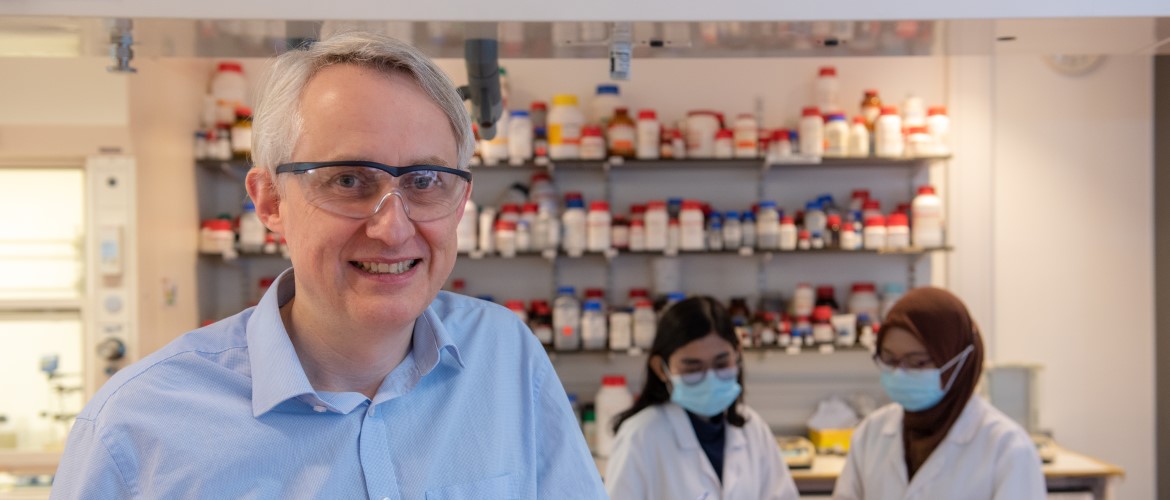
Richard Walton is Professor of Inorganic Chemistry at the University of Warwick, where he also serves as Chair of the Chemistry Research Committee. His career spans over two decades in academia, with positions at the University of Oxford, University of Exeter, and Open University before joining Warwick in 2006. His research group is based in the Materials and Analytical Science Building, providing state-of-the-art laboratory space for materials synthesis and characterization. Walton's research focuses on solid-state chemistry, particularly the synthesis and characterization of inorganic materials including porous materials, transition-metal oxides, and metal-organic frameworks (MOFs). His work bridges fundamental materials science with industrial applications in heterogeneous catalysis and energy. His group has developed solution-mediated crystallization routes for inorganic materials using hydrothermal and solvothermal methods, and has pioneered in situ diffraction studies to monitor crystallization in real time using high-energy X-rays and neutrons. Analysis of Walton's recent publications reveals a strong focus on metal-organic frameworks for catalytic applications, energy storage materials, and the development of novel synthesis methods for functional oxides. His work shows increasing interdisciplinary collaboration, particularly with researchers in Brazil, Indonesia, and across Europe. His group has made significant contributions to understanding structural transformations in MOFs, developing new catalysts for sustainable chemistry applications, and creating advanced materials for energy storage. Part II Thesis Prize from University of Oxford (1994) Postgraduate Chemistry Colloquium Prize from University of Reading (1997) Fellow of the Royal Society of Chemistry (2014) Royal Society Industry Fellow with Johnson Matthey (2015-2019) DSc from University of Warwick (2013) Walton has supervised numerous PhD students and postdoctoral researchers, with current group members working on projects spanning MOF synthesis, battery materials, catalysis, and structural characterization. His research has been supported by multiple grants, including his Royal Society Industry Fellowship, and he maintains extensive industrial collaborations, particularly with Johnson Matthey. The Walton Group is known for its international collaborations, with active projects in Brazil, Indonesia, and across European universities. His laboratory in the Materials and Analytical Science Building houses specialized equipment for materials synthesis, including hydrothermal and solvothermal reactors (100-500°C, 20-250 mL), X-ray diffraction suite, electron microscopy facilities, and thermal analysis suite for TGA-DSC studies. The group also leverages national facilities such as Diamond Light Source and ISIS Neutron and Muon Source for advanced characterization.