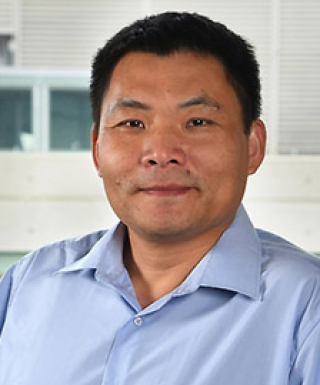
Jianhua 'JC' Cang holds the Paul T. Jones Jefferson Scholars Foundation Professorship in Neuroscience at the University of Virginia. His research focuses on the neural mechanisms underlying vision, particularly how visual stimuli are processed in the brain to guide behaviors. He uses mice and tree shrews as model organisms, employing techniques such as in vivo physiology, two-photon calcium imaging, genetics, and computational modeling. Education: B.S., Peking University (1996) Ph.D., University of Virginia (2001) Postdoctoral Fellowships: UC San Diego (2001-2002), UC San Francisco (2003-2006) Research interests include the development of neural circuits, binocular integration in visual cortex, and the role of superior colliculus in visuomotor transformations. His lab investigates how neural circuits encode visual features like motion direction, stereoscopic depth, and pattern motion. Recent work highlights the importance of recurrent circuits in depth perception and the genetic basis of neuronal subtypes in the superior colliculus. Publications span topics such as binocular integration in mouse V1, motion pattern selectivity, and transgenic tools for studying neuronal subtypes. Collaborations emphasize interdisciplinary approaches, combining experimental and computational methods to dissect complex circuits. Labs/Teams: Cang Lab focuses on integrating molecular, cellular, and systems neuroscience to understand sensory processing and behavior. The lab actively recruits PhD students and postdoctoral researchers.