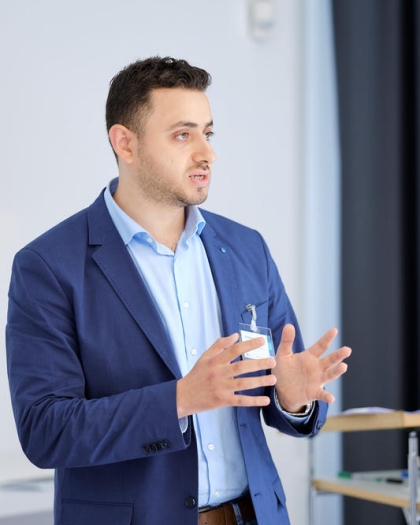
Mohammad Khalil is an Associate Professor of AI and Education at the University of Bergen's Centre for the Science of Learning & Technology (SLATE), affiliated with the Faculty of Psychology. He holds a Master's in Information Security and a PhD (cum laude) from Graz University of Technology. His research focuses on responsible data usage in education, learning analytics, and AI ethics. Affiliations: SLATE, TeLEd research group, Society for Learning Analytics Research (SoLAR) Leadership roles: WorkPackage Leader in AI LEARN Centre, Guest Editor for multiple special issues Grants: Over NOK 25M in funding from Equinor, Trond Mohn, Erasmus+, and others Research interests include privacy-preserving AI, ethical learning analytics frameworks, and human-centered design in educational technology. Notable contributions include over 80 peer-reviewed articles, 6 book chapters, and editorial roles at journals like British Journal of Educational Technology. Awards: 2024 Meltzers Award, multiple best paper awards, and recognition for contributions to MOOC research. Teaching includes courses on Generative AI, Machine Learning, and AI in Education at both undergraduate and PhD levels. Active in international conferences as keynote speaker and workshop organizer.
Daniel Sanchez is a Research Fellow at the Department of Education, University of Oslo, affiliated with the Faculty of Educational Sciences. His research focuses on multimodal technology, analytics, and feedback mechanisms in education. He holds a Master's in Assessment, Measurement, and Evaluation from CEMO (University of Oslo) and a Bachelor's in Electronic Engineering from Federico Villarreal National University (Peru). His work bridges academic feedback with real-world applications, emphasizing how technology can emulate expert feedback processes. He has taught courses including PED4011, PED2104, MIED4020, and others at the University of Oslo. Previously, he served as an Accreditation Specialist in Peru and held roles at the Centre for Educational Measurement (CEMO). Research Interests: Feedback systems, educational technology, data analysis in higher education, and multimodal learning analytics. Publications: Recent work includes 'Unpacking the observational feedback generation process in high-fidelity simulations' (2025), exploring feedback mechanisms in simulation-based learning. Awards: IEEE MGA Innovation Award (2011) for contributions to student engagement in Latin America. Volunteering: Leadership roles in IEEE committees, including chairs of Accreditation Advisory and Education Society chapters in Latin America. Projects: TeamLearn (teamwork analytics in higher education) and collaboration research in problem-solving.
Michail Giannakos is a Professor of Interaction Design and Learning Technologies at the Department of Computer Science, Faculty of Information Technology and Electrical Engineering, Norwegian University of Science and Technology (NTNU). He serves as Head of the Learner-Computer Interaction Lab and has held visiting positions including EAISI Visiting Professor at Eindhoven University of Technology (2023-2024) and Honorary Professor at UCL Knowledge Lab (2022-2023). Previously, he was Associate Professor (2017-2020) and Senior Lecturer (2014-2017) at NTNU, and Assistant Professor at Old Dominion University (2013-2014). Dr. Giannakos's research focuses on the design and study of emerging technologies in online and hybrid education settings, with particular emphasis on student and instructor experiences. His work spans Human-Computer Interaction , Learning Analytics , Learning Technologies , and User Experience Research . He has co-authored over 150 peer-reviewed publications in leading journals including Computers & Education, Computers in Human Behavior, IEEE TLT, and ACM TOCE. His recent publications reveal a strong trend toward multimodal learning analytics, embodied interaction in educational contexts, and the application of generative AI in education. The research increasingly integrates physiological and cognitive measurements with traditional learning data to create more comprehensive educational insights. There's also a noticeable focus on STEM education, particularly in mathematics learning through embodied and multimodal approaches. EAISI Visiting Professor, Eindhoven University of Technology (2023) Honorary Professor, UCL Knowledge Lab, University College London (2022) IDC Best Paper Award (2022) ITiCSE Top 5 papers in 25 Years Award (2020) RCN Young Research Talent grant (2016) ERCIM "Alain Bensoussan" Fellow (2013) Outstanding Academic Award, NTNU (2017-2020) Dr. Giannakos actively supervises multiple PhD students and postdocs, including Giulia Cosentino and Andrew Pulsipher as main supervisees. He has successfully mentored numerous PhD candidates to completion, many of whom have gone on to academic positions. His research is supported by substantial grants from diverse sources including the European Commission (Horizon Europe, Horizon 2020), Research Council of Norway, US-NSF, Microsoft Research, and DAAD. Current major projects include STEAM Learning Ecologies (Horizon Europe, 2022-2025) and SURROUNDEDbySCIENCE (Horizon 2020, 2021-2025). As Head of the Learner-Computer Interaction Lab, Dr. Giannakos leads a multidisciplinary team exploring how emerging technologies can enhance learning experiences. The lab focuses on multimodal data collection, embodied interaction design, and the development of intelligent learning environments that adapt to user needs. Current work emphasizes the integration of generative AI with multimodal analytics to create more responsive educational systems.
Marte Blikstad-Balas is a Professor at the Department of Teacher Education and School Research (ILS) within the Faculty of Educational Sciences at the University of Oslo. Her research focuses on literacy, reading, writing, digital media, and classroom practices, with particular attention to Norwegian didactics and video-based methodologies. PhD in Educational Sciences (University of Oslo): Redefining School Literacy. Prominent literacy practices across subjects in upper secondary school Master's in Language and Cultural Studies Didactics (Hedmark University College) General Teacher Education (Hedmark University College) Her work explores the intersection of technology and education, examining digital competencies, screen vs. paper reading, and critical literacy in classrooms. She leads major projects like QUINT Theme 3 (video-supported teacher learning) and the Nordic Center of Excellence - Quality in Nordic Teaching as Deputy Head. She serves as Editor-in-Chief for the Nordic Journal of Literacy Research and leads the European Educational Research Association Network 27 Didactics . Recent publications highlight her expertise in video-based teacher development (2024), digital literacy challenges (2025), and Norwegian classroom practices (2024). As a member of the Academy for Young Researchers (2017-2021), she contributes to advancing educational research in Scandinavia. Key research areas: Literacy, Digital Media in Education, Classroom Research, Teaching Methodology, Norwegian Didactics Projects: QUINT, VIST, LISA, SISCO
Michail (Michalis) Giannakos is a Professor at the Department of Computer Science, Norwegian University of Science and Technology (NTNU) and an Adjunct Professor at the Department of Information Systems, University of Agder (UiA) . He serves as Head of the Learner-Computer Interaction Lab at NTNU. His career spans multiple institutions, including roles as EAISI Visiting Professor (TU/e, Netherlands), Honorary Professor (UCL, UK), Associate Professor, Senior Lecturer, and Assistant Professor. Giannakos' research focuses on emerging technologies in online/hybrid education , with emphasis on student/instructor experiences, gamification , STEM learning , augmented reality , and multimodal learning analytics . His recent publications explore generative AI for educational feedback , embodied mathematics , and AR applications for autistic children . 2024–present: Adjunct Professor, UiA 2020–present: Professor/Head, NTNU 2023–2024: EAISI Visiting Professor, TU/e 2022–2023: Honorary Professor, UCL He has received prestigious awards, including the RCN Young Research Talents grant , ERCIM Fellowship , and Outstanding Academic Award (NTNU) . His funded projects include AutoTRUST (Horizon Europe), COMnPLAY-Science (Horizon 2020), and Surrounded by Science (Horizon 2020). Giannakos serves as Editor-in-Chief for the International Journal of Child-Computer Interaction and sits on editorial boards of IEEE Transactions on Learning Technologies , Behaviour & Information Technology , and others. He has reviewed for the European Commission and US-NSF .
Fredrik Sundt Breien is an Associate Professor at SLATE (Sustainable Learning and Technology Environment) at the University of Bergen. His research focuses on game-based learning, narrative design in digital environments, and mixed-reality applications in education. He has contributed to frameworks like eLuna for collaborative STEAM education and explored narrative structures in serious games. His work integrates multidisciplinary approaches, combining computer science, educational psychology, and design principles. Key areas include usability of 3D criminal archives in AR, co-design methodologies for learning trails, and the impact of linear vs. non-linear narratives on educational outcomes. Breien's publications span journals like Frontiers in Education and Springer Nature, addressing topics such as engagement metrics in digital learning and cognitive modeling in game-based systems. His research emphasizes practical tools for educators and measurable learning outcomes through innovative technologies.
David Micheron is a Senior Lecturer at UiT The Arctic University of Norway, affiliated with the Department of Physics and Technology. His work spans two distinct research domains: optical nanoscopy and STEM education . Micheron contributes to photonic chip development for biomedical imaging and explores pedagogical strategies for large-group physics instruction. Research Focus : Photonic chip-based super-resolution microscopy, histopathology applications, and STEM education innovations Teaching : Course development for introductory physics (FYS-0100, FYS-1002, FYS-1003) and former FYS-2008 Measurement Techniques Collaborations : Active in the Optical Nanoscopy research group and Realfagsdidaktikk i høyere utdanning (Physics Education in Higher Education) Micheron’s publications highlight advances in on-chip nanoscopy for biomedical analysis and student-active learning methodologies.
Allah Bux is a Research Fellow at the Department of Linguistic, Literary and Aesthetic Studies, University of Bergen. His work focuses on advanced computer vision techniques, medical image analysis, and deep learning applications. He holds expertise in 3D reconstruction, anomaly detection, and surveillance systems. His research interests include developing novel neural network architectures for tasks such as skin cancer diagnosis, head pose estimation, and human action recognition. He also explores spatiotemporal analysis and attention mechanisms in CNN models. Recent trends in his publications emphasize integration of vision transformers, dual attention networks, and transfer learning for solving real-world problems in healthcare, security, and education. No scientific awards or grants are explicitly listed in the provided text. He has no documented advisees. His research involves collaborations in medical imaging, autonomous surveillance systems, and educational data analysis, with a focus on practical applications of AI.
André Mestre is a Research Fellow and PhD Candidate at the University of Bergen's SLATE (Science of Learning & Technology Centre), investigating emerging technologies like AI and VR in education. He holds a doctorate in music composition from Boston University. His research bridges creativity, technology, and learning, with a focus on interdisciplinary projects. Education: PhD in Music Composition, Boston University Research Fellow, University of Bergen Research Interests: Creativity in education, VR environments, dialogic education, new music interfaces, and environmental acoustics. His work explores how technologies reshape learning and artistic practices, often through collaborations with institutions like the Austral University of Chile and NICS. Publications: His articles span creative learning frameworks, sound installations (e.g., A Queda do Céu ), and engineering education reforms. Recent work emphasizes ethical considerations in VR data privacy and interdisciplinary soundscapes. Awards & Grants: No explicit awards noted, but his doctoral project involves grants from InnovING:2030 and SLATE initiatives. Teaching: Courses include Teaching Creativity (UPED688) and Innovation Facilitation (LSCI 649), blending theory and hands-on creativity. Labs & Affiliations: SLATE (UiB), NICS (UNICAMP), and the Arts & Technology Lab (UACh). Collaborates with global networks like Arts Connect International.
Lisbeth Elvebakk is an Associate Professor at Oslo Metropolitan University, Faculty of Education and International Studies, Department of Primary and Secondary Teacher Education. She serves as Head of Studies for Area of Responsibility 3 and is a key member of the Text and Disciplinary Didactics research group. Her work centers on developing critical literacy and thinking in primary and secondary education, particularly through Norwegian language instruction and children’s literature. Her research interests include critical literacy , teacher education , L1 didactics , multimodal text analysis , and pedagogical reflection . She explores how teacher students legitimize their teaching practices, engage with critical texts, and develop narrative and analytical skills. Her recent projects, such as the interdisciplinary KriT project, aim to build educational models for critical thinking using news and literature in classrooms. Her publications from 2018 to 2024 demonstrate a strong trend in analyzing teacher student discourse, promoting cross-curricular teaching, and integrating digital and social media in literacy education. She frequently collaborates with scholars like Marte Blikstad-Balas, Dag Skarstein, and Inger Vederhus, publishing in Nordic journals such as Acta Didactica Norden , L1-Educational Studies in Language and Literature , and Nordic Journal of Literacy Research . She has contributed to teacher training through textbooks like the Salto series and has disseminated her work at conferences including ECER and the Nordic Network for Research in First Language Didactics. Her work in educational innovation includes the use of FeedbackFruits for peer feedback in writing instruction. Associate Professor, OsloMet (current) Head of Studies – Area of Responsibility 3 Research Group: Text and Disciplinary Didactics Project: Critical thinking in primary education (KriT) She has not received any explicitly mentioned scientific awards. She advises no named students in the provided text. Her work involves both research and practical teaching development, with a clear emphasis on improving Norwegian language education through critical and reflective approaches.
Noeska Smit is a Professor in Medical Visualization at the Department of Informatics, University of Bergen , where she has held a tenure-track position funded by the Trond Mohn Foundation since 2017. She is also a senior researcher and member of the leadership team at the Mohn Medical Imaging and Visualization (MMIV) Centre . Her research focuses on novel interactive visualization techniques for exploring and communicating multimodal medical imaging data , particularly in multi-parametric MR acquisitions . She leads projects in gynecologic cancer imaging , Multiple Sclerosis neuroimaging , and human anatomy education through collaborations with institutions like UGent (Belgium) and HVL. 2019: Dirk Bartz Prize for Visual Computing in Medicine 2016: PhD at Delft University of Technology , Netherlands 2012: MSc in Computer Science (Computer Graphics & Visualization) , Delft University Recent publications highlight her work in MRI radiomics , narrative visualization , open-source anatomy platforms , and interactive clustering tools for tumor analysis. Her methods are applied in oncological pelvic surgery planning , neurological disease monitoring , and 3D learning environments . She supervises PhD candidates Eric Mörth and Sherin Sugathan , and has contributed to open-source medical visualization tools like RegistrationShop and Online Anatomical Human (OAH) . Her work bridges clinical practice and computer science through collaborations with radiologists, surgeons, and ML researchers.
Sima Caspari-Sadeghi is an Associate Professor of ICT & Learning at Østfold University College's Department of Education, ICT and Learning. Her academic work focuses on the intersection of educational technology, assessment, and artificial intelligence in learning environments. Her research interests prominently feature Artificial Intelligence in Education (AIED) , Big Data Analytics , Measurement & Evaluation , and Mathematics Education . Caspari-Sadeghi has developed expertise in technology-enhanced assessment methodologies, learning analytics applications in higher education, and the integration of AI in educational contexts. Her work emphasizes student agency, self-regulated learning, and sustainable assessment practices. Analysis of her recent publications reveals a strong trend toward AI applications in educational assessment, with particular focus on machine learning approaches to measuring learning outcomes. Her work spans multiple educational contexts including mathematics instruction, STEM education, and professional development. The integration of learning analytics with traditional assessment methods represents a consistent theme across her research portfolio. As an active member of the academic community, Caspari-Sadeghi serves as a reviewer for prestigious journals including Computers and Education , Computers and Education: Artificial Intelligence , Nordic Machine Intelligence Journal , and EARLI (European Association for Research on Learning and Instruction). She teaches advanced courses including Artificial Intelligence in Learning & Teaching (Ph.D level), Massive Open Online Courses on Digital Competence, Applied Statistics, Evidence-based Evaluation, and Technology-enhanced Learning & Teaching. Her academic journey includes a Habilitation in Technology-enhanced Assessment in Germany (2019-2025) and a Humboldt Postdoc position (2014-2015), demonstrating her international research profile. Caspari-Sadeghi is affiliated with the Research in Digital Education (RIDE) group at Østfold University College, where she contributes to advancing digital education research and practice. Her conference presentations at venues like IEEE EDUCON, EARLI, and NORA demonstrate her active engagement with the international research community in educational technology and AI applications.
Per Henning Uppstad is a Professor in Special Education at the Faculty of Education and Humanities, University of Stavanger. His research focuses on literacy, reading and writing processes, dyslexia, and adaptive testing methodologies. He has co-founded the Nordic conference 'Skriv!Les!' and the Nordic Journal of Literacy Research. Education: Ph.D. in General Linguistics, University of Lund, Sweden (2005) MA in Nordic Language and Literature, University of Bergen, Norway (1993) His recent work explores writing motivation, digitalization's impact on literacy, and machine learning applications for early reading intervention. He has contributed to developing adaptive national reading screening tests and theoretical frameworks for skills development. Research Trends: Analysis of his 15 most recent publications reveals a focus on: Oral reading feedback mechanisms Adaptive literacy assessment tools Digital education's effect on writing Context-specific predictors for reading difficulties Teacher collaboration models Psycholinguistic approaches to literacy
Morgane Barbara Domanchin is a Research Fellow at the University of Oslo, specializing in immersive educational technologies within secondary and higher education contexts. Her work investigates how digital tools like VR and AR reshape social interactions, spatial awareness, and attention in learning environments through sociocultural frameworks. Education: Ph.D. in Applied Linguistics, University of Lyon, France (2020) Research Focus: Domanchin employs multimodal video analysis to examine meaning-making processes in technology-enhanced settings, with particular emphasis on hybrid collaboration and the design of student-centered learning spaces. Her methodology bridges sociocultural theory with practical applications of emerging technologies to reveal how digital tools transform educational practices. Publication Trends: Analysis of her 11 publications (2022-2024) shows concentrated exploration of VR/AR integration in upper secondary education, co-design methodologies for immersive experiences, and group dynamics in hybrid doctoral seminars. Key themes include interdisciplinary collaboration, prototyping in educational innovation, and spatial cognition in virtual anatomy learning. Projects & Teaching: She actively contributes to the DigiLiv project, Immersive Learning across School and Community (ILASC) initiative, and the Living and Learning in the Digital Age (LiDA) research group. Domanchin teaches courses PED4591 and PED2540/PED4501, directly applying her research on technology-enhanced pedagogy in classroom contexts.
Michael Alexander Riegler is a full-time Professor at Oslo Metropolitan University's Faculty of Social Sciences, specifically in the Department of Social Work, Child Welfare and Social Policy. While his formal academic affiliation focuses on social sciences, his research interests span interdisciplinary domains including computer technology, information and communication systems, medical technology, and mathematics/natural sciences. Current research projects: Strengthening solidarity for democratic unity across border (SOLIDEM) addressing trust erosion in European welfare states, and Artificial intelligence in assisted reproduction technology improving embryo/sperm selection Recent publications (2025) focus on AI applications in healthcare (wearable sensors, ECG reconstruction), anomaly detection in time-series data, multimodal healthcare data analysis, and psychiatric motor activity datasets