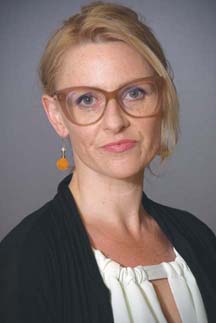
Jade Hoyer is an Assistant Professor of Art at Carleton College, affiliated with the Department of Art and Art History since 2022. She teaches courses such as Silkscreen Printmaking (ARTS 274), Observational Drawing (ARTS 110), Design Fundamentals, Zines, and Artistic Publications (ARTS 276), Junior Studio Art Practicum (ARTS 298), and Advanced Printmaking (ARTS 374). In her multimedia artistic practice, Hoyer employs installation, printmaking, papermaking, and social practice to examine social issues, particularly questions of multiracial identity and environmental justice. Her work has been exhibited internationally and is included in collections such as the Museum at Texas Tech University’s Artist Printmaker Research Collection, the Association of Pinoy Printmakers (Philippines), and the Museu da Gravura de Curitiba (Brazil).
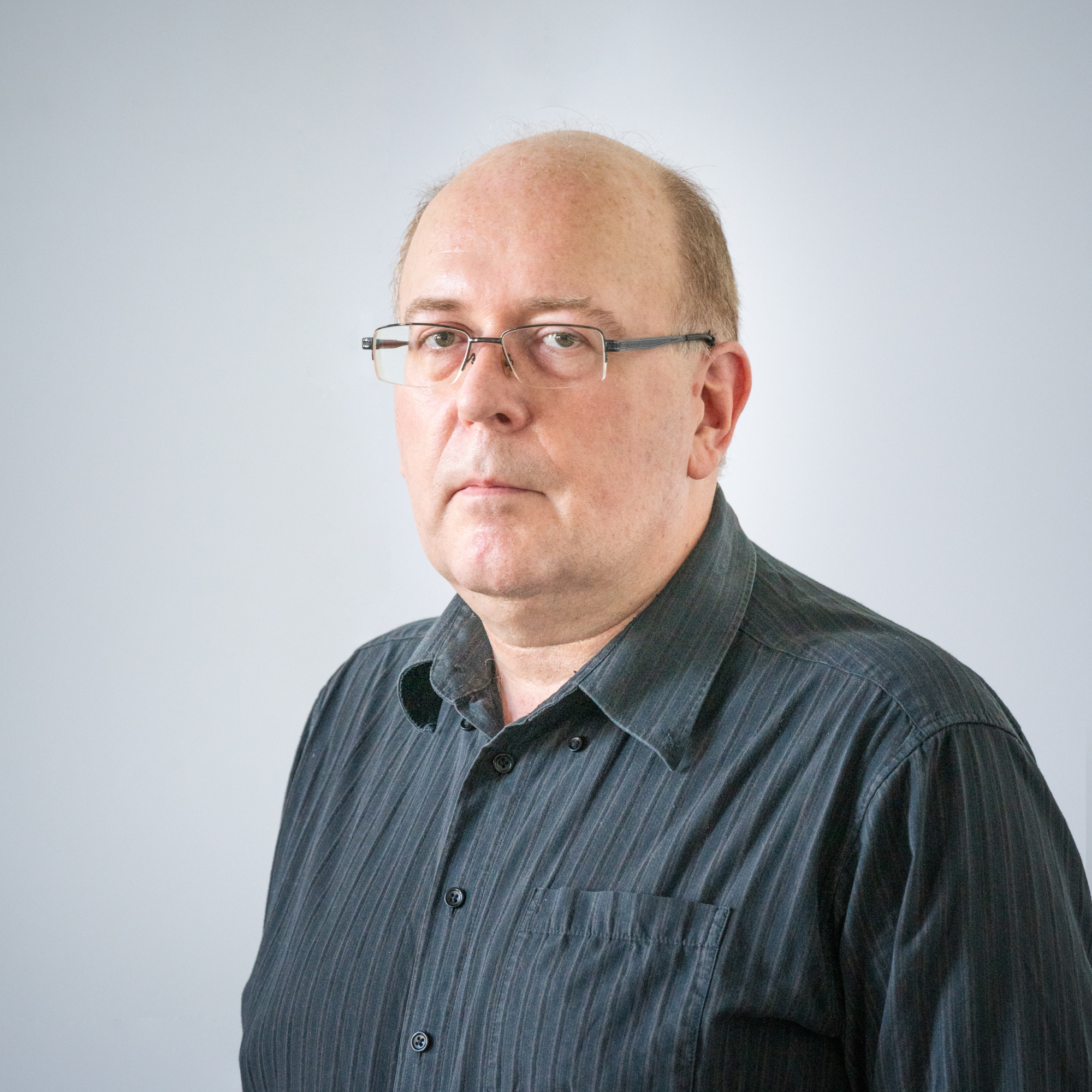
Céline Jost is an Assistant Professor in Computer Science and Human-Technology Interaction at Université Paris 8 within the Engineering, Cognition, Disability department. She leads research at the CHArt - EA 4004 laboratory and is affiliated with the THIM team. Research Focus: Her work spans Multisensory Interaction (including Mulsemedia ), Natural Interaction , Individualized Interaction , Interaction Paradigms , Evaluation Methods , Cognitive Ergonomics , and Disability-Focused Education . She has contributed to Artificial Companion systems and Serious Games for cognitive stimulation. Academic Contributions: Jost has authored 94 publications, with 9 in 2024 alone. Her 2024 ICCHP paper on Scenagrams and her 2024 TeMaCo rehabilitation system demonstrate her focus on accessible interaction design. She received the Best Paper Award at Conference Handicap 2024 and the RJS/KROS Distinguished Interdisciplinary Research Award (2014). Pedagogical Tools: Flipped classroom, projects, mentoring Collaborations: With institutions like Pompeu Fabra University, INSHEA, and Carnot Cognition Institute Technical Expertise: Human-Robot Interaction, Multisensory Interfaces, No-Code Development
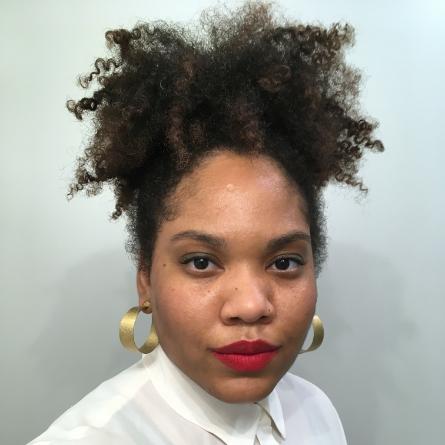
Rajarshi Sengupta serves as an Assistant Professor in the Department of Humanities and Social Sciences at the Indian Institute of Technology Kanpur. With a PhD from the University of British Columbia (2019), his academic journey includes an M.F.A. from University of Hyderabad (2009-11) and a B.F.A. in Printmaking from Rabindra Bharati University, Kolkata (2005-09). Dr. Sengupta specializes in the intersection of art practice and historical research, with particular focus on Indian textile traditions. His research interests span printmaking, art history, artisanal histories, textiles, and the theory-practice interface. His scholarly work examines the cultural, historical, and material dimensions of Kalamkari textiles and related artisanal practices in India. His publications reveal a consistent scholarly trajectory examining traditional Indian textile practices through contemporary academic lenses. His research demonstrates how artisanal knowledge systems function within historical and contemporary contexts, with particular attention to the Coromandel and Deccan regions. His work bridges art history, anthropology, and material culture studies to document and analyze living textile traditions. IARTS Textiles of India Grant, Royal Ontario Museum, Toronto, Canada (2017-18) Curatorial Grant, Korean Cultural Centre, New Delhi (2016) Kau Shao Ching Graduate Travel Award in Art History, University of British Columbia (2015) University of British Columbia Four Year Fellowship (2013-17) Gold medal (Printmaking), University of Hyderabad (2011) Dr. Sengupta's academic profile reflects a strong commitment to both artistic practice and scholarly research. His work connects contemporary art practices with historical traditions, particularly in the realm of Indian textiles. His research methodology combines archival work with field studies of living artisanal communities, creating a bridge between academic scholarship and practical artistic knowledge.
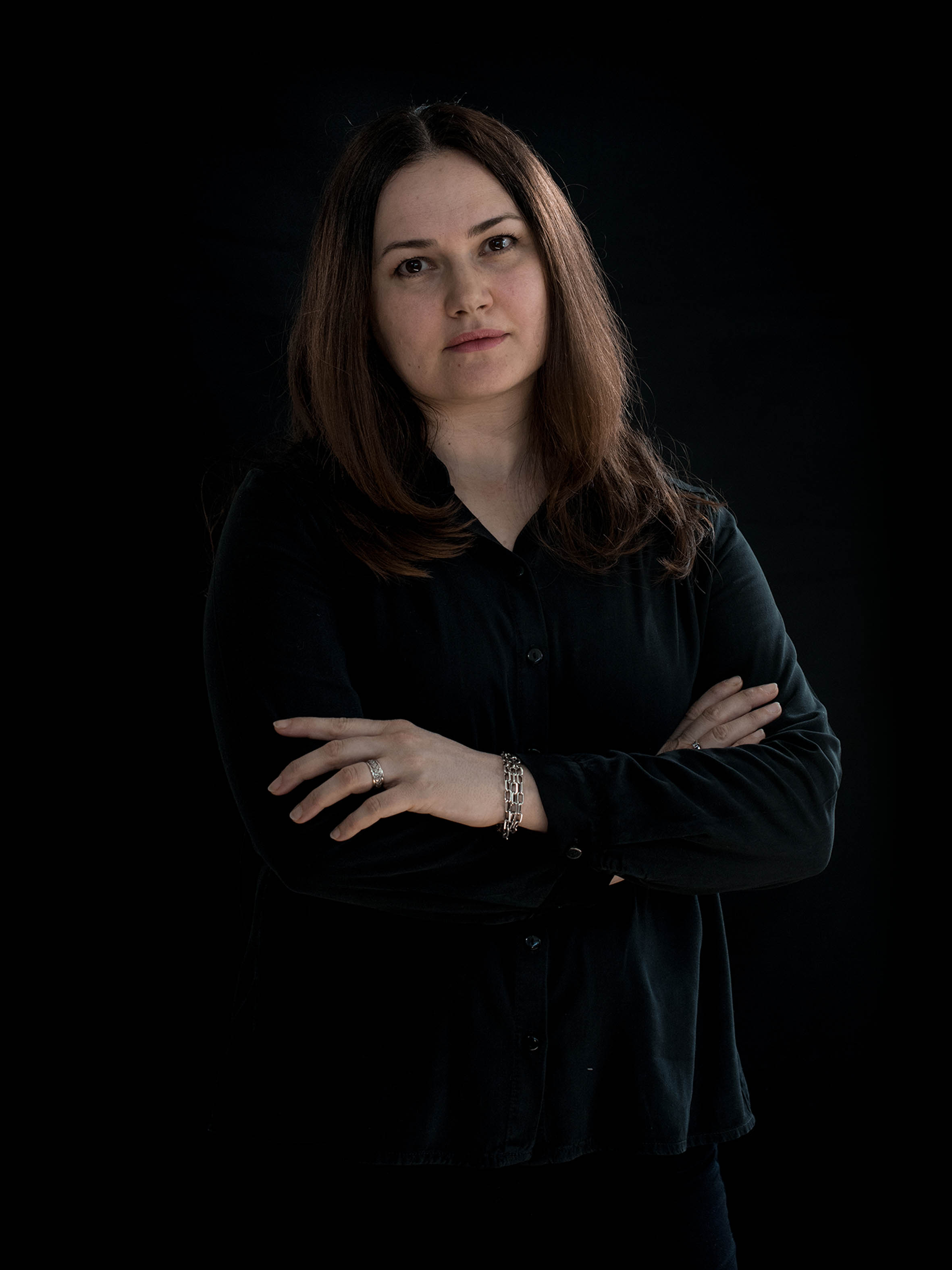
Beth Frances Milles serves as an Associate Professor in the Department of Performing and Media Arts within Cornell University's College of Arts and Sciences. With a career spanning over two decades since joining the faculty in 2001, she maintains active engagement in both academic instruction and professional theatrical production. Her institutional affiliations include significant contributions to Cornell's academic programs and collaborations with major national and international theaters. Milles' research concentrates on experimental performance methodologies, with particular emphasis on interactivity, physical impulse techniques, and experiential experimentation at the boundaries of farce. Her scholarly focus explores the development of clown performance, theatrical adaptation from diverse source materials, and innovative audience-performer relationships. This work manifests in both academic instruction and professional productions that push conventional theatrical boundaries. Her recent creative output demonstrates consistent innovation across multiple performance genres, with notable emphasis on clown performance, adaptation, and experimental staging techniques. Current projects reveal increasing integration of digital elements with physical performance, particularly in works addressing cognitive processes and emotional expression through non-verbal channels. Walt Disney Television Fellowship in Directing Bean Fellowship (awarded twice for current projects) NYSCA Individual Artist Grant (2023) Multiple LA Weekly and Ovation Awards for West Coast productions Society for the Humanities, Einhorn Engagement, and Cornell Council for the Arts grants Milles has secured substantial external funding including NYSCA grants for her 2023 work HEADING INTO NIGHT and multiple institutional grants supporting collaborative creation. Her professional development extends beyond traditional academic advising through mentorship of emerging playwrights and performers in professional settings, particularly through her collaborations with institutions like The Actor's Gang and Playwrights Horizons. Current creative teams include interdisciplinary collaborators such as clown performer Daniel Passer (Cirque du Soleil) and writer/performer Chris Wells.
Nero Chenxuan He is an Assistant Professor at the Huckabee College of Architecture, Texas Tech University. A Beijing-born educator, architectural designer, and multimedia artist, he holds a Bachelor of Science in Architecture from the University of Minnesota Twin Cities and a Master of Architecture from the Southern California Institute of Architecture (SCI-Arc). His creative practice, HeXagōn {分集研究所}, explores quasi-autonomous design procedures merging human and non-human agencies. Education : B.Sc. Architecture (University of Minnesota), M.Arch (SCI-Arc) Prior Roles : Visiting Professor at Virginia Tech School of Architecture, instructor at Central Academy of Fine Arts (CAFA), and collaborator at Testa & Weiser His work has been exhibited internationally, including the 2018 MoMA PS1 Young Architects Program installation Hide & Seek . He focuses on non-rectilinear design workflows, phygital (physical+digital) construction methodologies, and automavisions—automated design systems with artistic potential. He has collaborated with Zaha Hadid Architects and other firms on projects of varying scales.
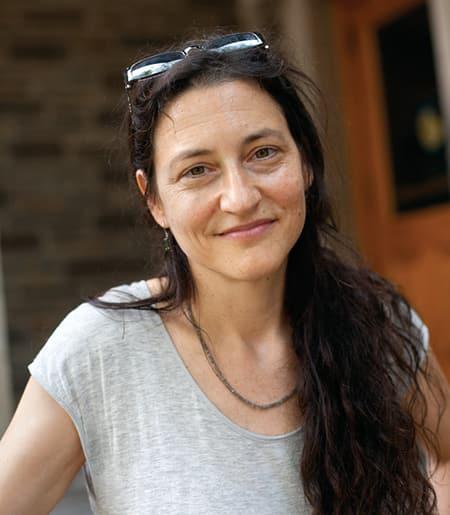
Jane Watt is a Senior Lecturer in Fine Art at the University of Suffolk, affiliated with the School of Business, Arts, Social Sciences and Technology. With a PhD from Manchester Metropolitan University (2002) and academic roles at Roehampton and Middlesex Universities prior to 2010, her career spans three decades of national and international exhibitions and public art commissions. Academic Affiliation: University of Suffolk, Roehampton University, Middlesex University Leadership: Senior Fellow of the Higher Education Academy (SFHEA) Her research integrates practice-based and field methodologies to explore artist-community-place dynamics, focusing on social, heritage, and environmental influences on creative processes. Key projects include: ARISE (2024-2028) : Co-investigator in a UKRI-funded coastal resilience project Blast Radius : Founder of a collaborative art-science initiative with Dr. Susan Barnet Mulberry – Tree of Plenty : Co-led with Sara Heywood and Dr. David Chau (EPSRC-funded) Her work bridges art, environmental science, and heritage through: Art-science-community collaborations Site-specific installations Public art commissions Experimental research methodologies Coastal ecosystem studies Community well-being applications Scientific awards include: Saltire Award for Arts in Architecture (2005) As a primary PhD supervisor, she guides research in: Public and engaged art practice Site-specific installations Practice-based research Case study methodologies Jane collaborates across disciplines with institutions such as: University of Essex University of East Anglia University of Kent Eastman Dental Institute (UCL)
Jenna North is a Lecturer of Studio Art in the Department of Art at the Rome School of Music, Drama, and Art, Catholic University of America. Based in Washington D.C., she is an interdisciplinary artist whose work functions as social aesthetics, focusing on water issues including contamination, drought, sea level rise, and species extinction. Education: M.F.A. in Painting, San Francisco Art Institute B.F.A. in Painting (minor in Printmaking), Kansas City Art Institute North's research and artistic practice spans painting, printmaking, interdisciplinary and performance art, and multimedia installation. She explores themes of environmental crisis through functional eco-art, photography, and performance, often using alter egos such as Wendy Well (a hydrofracking obsessed Post-Apocalyptic Interior Decorator) and Joan Dare (a Senator's wife from Kansas). Her current work includes a full feature film about these personas and projects addressing climate change, such as the "Submersive Gardening" initiative and a rooftop mural/garden in the Maldives designed to simulate ocean rise. Awards and Residencies: CNY Arts NYSCA grant for "Submersive Gardening" project Residency at Sculpture Space Residency at National Art Gallery in Male', Maldives Residency at Children’s Museum with Sculpture Space, Utica, NY Project Grant (social practice residency) in Buffalo, NY Residency at Headlands Center for the Arts, San Francisco Residency at Montalvo Residency at Root Division Art in Embassy program exhibition at US Embassy, Colombo, Sri Lanka North actively collaborates with scientists, designers, and artists on public projects and her studio practice. She has presented solo exhibitions internationally, including at the International Art & Artists at Hillyer, Honfleur Gallery in Washington D.C., and venues in New York, California, and Sri Lanka.
Langh Erik Róbert is an Assistant Professor at the Department of Intermedia, Hungarian University of Fine Arts, where he has taught since 2000. He previously served as an Autonom-video teacher at the College of Applied Arts (1995-1997). His education includes a video artist diploma from Hungarian College of Applied Arts (1988-1992) and a media artist diploma from Hungarian College of Fine Arts (1993-1995). His research explores interactive digital narratives and experimental media , with focus areas including: Nonlinear storytelling in hypertext/hypervideo systems Mechanical interpretation of language in computer installations Cultural documentation through multimedia applications Notable exhibitions include interactive works like Whore's Nest (text-analysis program exploring 'outsidership') and Spatial Time (CD-ROM investigating parallel montage). His multimedia projects span permanent museum installations and international exhibitions across Europe.
Micheal Gregory Moore serves as an Assistant Professor of Graphic Design within the Department of Art & Design at Indiana State University's College of Arts & Sciences. His active institutional roles include Project Manager for the New University Website Migration and service on the Hiring Committee for Web Services Director. His academic credentials are: M.F.A. in Master of Fine Arts (Graphic Design emphasis), Indiana State University, 2022 B.F.A. in Visual Communications - Digital Design, American Intercontinental University, 2004 A.A.S. in Visual Communications - Multimedia, Ivy Tech Community College, 2002 Moore's creative research bridges design and technology through 3D modeling, animation, video production, and virtual reality applications. His work emphasizes practical implementation in user experience design, publication layout, large-format installations, and modern printing methods, driven by a philosophy that sustained curiosity and creative problem-solving are essential for professional growth. His 2024 presentations reveal consistent focus on design communication - exploring artistic inspiration, research poster methodology, and community art engagement - demonstrating his commitment to connecting academic practice with real-world applications and public outreach. Professional recognition includes: Winner, Total Eclipse of the Haute Official Poster Design Contest (Arts Illiana, 2024) With 17 years mentoring students at Ivy Tech Community College, Moore has cultivated professional relationships with numerous graduates now working in design fields. His grant portfolio includes the "Indiana State University Web Editor Summer 2024" project funded at $3,200. He currently leads the university-wide Website Migration Project while collaborating with the Center for Global Engagement and Arts Illiana on community-focused design initiatives and promotional consulting for local organizations.
Emma Campbell is a Lecturer in Photography at Belfast School of Art, Ulster University, within the Faculty of Arts, Humanities & Social Sciences. Her academic work is deeply intertwined with her activism, particularly focused on abortion rights in Northern Ireland. Campbell holds significant external roles including co-convenor of Alliance for Choice (Northern Ireland's largest abortion rights organization), Trustee for Abortion Support Network, and Board Member for Outburst Queer Arts. Practice-based PhD from Ulster University (2024) on photography as an activist tool for abortion rights Member of the 11-strong Turner Prize winning Array Collective (2021) Active in reproductive justice advocacy since at least 2011 Emma Campbell's research centers on socially engaged art practice as a mechanism for social change, particularly regarding reproductive rights. Her work bridges creative methodologies with law and social policy, examining how visual practices can challenge political discourse around abortion. She explores the intersection of photography, activism, and policy-making, with particular focus on Northern Ireland's unique political context. Campbell's approach combines documentary practice with performative elements, creating spaces for dialogue around stigmatized experiences. Her recent publications and exhibitions reveal a consistent trajectory examining the relationship between visual culture and reproductive justice. Campbell's work increasingly incorporates collaborative methodologies, working with community organizations, policy makers, and healthcare providers to develop creative approaches to knowledge sharing. The research demonstrates how artistic practice can contribute to policy development while maintaining critical distance from institutional frameworks. Turner Prize 2021 Winner (as part of Array Collective) Turner Prize Nomination 2021 Campaign of the Year Award 2018 As a supervisor and collaborator, Campbell works closely with community organizations including Alliance for Choice and Abortion Support Network. Her AHRC-funded projects demonstrate significant grant capture, particularly the IAA portfolio examining reproductive citizenship, abortion doulas, and creative practice. These projects involve knowledge exchange with policy makers and healthcare providers, creating practical tools for improving abortion access and understanding. Campbell's creative practice operates through Array Collective, a Belfast-based artist collective that won the Turner Prize in 2021. The collective functions as both an artistic and activist platform, producing work that engages directly with political issues in Northern Ireland. Campbell also maintains a solo practice focused on documentary approaches to abortion journeys and reproductive rights.
Bob Oei-Clark serves as an Assistant Professor in the Communication, Media, & Performance Department at Framingham State University (FSU), where he bridges academic scholarship with professional artistry as an award-winning cinematographer and multimedia creator based in Boston, MA. His educational foundation includes: Bachelor of Arts (B.A.) from Baylor University Master of Arts (M.A.) from Baylor University Master of Fine Arts (M.F.A.) from Emerson College Professor Oei-Clark's research interrogates the ontological nature of visual media through three interconnected lenses: the philosophical foundations of image-making, the dissolution of boundaries between mediated experiences and physical reality, and nuanced explorations of Asian-American identity. His artistic practice manifests these inquiries through cinematography and multimedia installations that challenge perceptual frameworks, with works featured in festivals across Los Angeles, New York, and Boston. While recognized as an award-winning artist, specific honors remain undocumented in available materials. Information regarding academic advising, research grants, laboratory affiliations, or collaborative teams was not provided in source documentation.
Amanda Russhell Wallace is an Assistant Professor of Art at Connecticut College, where she joined the faculty in 2020. As a member of the Art Department, she is developing the lens-based media area of the department, encouraging students to use an expanded, interdisciplinary approach to photography and other lens-based media that combines technical and conceptual concerns. Wallace received her B.A. in Visual Arts and Psychology from Rice University and her M.F.A. in Photography, Video & Related Media from the School of Visual Arts in New York. As a lens-based multimedia artist, Wallace's work ranges from documentary family photography to experiments with time-based media. Her practice primarily engages with the archive (records, cemeteries, oral histories) as a site for 'family reunion,' using what she terms 'historical collaging' to interrogate dissociation and disremembering within the formation of selves across time. She explores the im/mutability of personal and collective identity through photographic imagery and its impact on Black visuality. Her technical approach often incorporates isoluminant colors and perceptual effects like the Troxler Effect to create visual experiences reflecting on trauma and memory. Wallace's artistic output demonstrates consistent engagement with themes of racial trauma, memory practices, and Black visual culture. Her works frequently examine the relationship between color theory, visual perception, and historical narratives, particularly regarding African American experiences. She employs techniques challenging conventional modes of seeing and remembering, using perceptual effects to reflect on trauma and cultural memory. 2025 Creative Capital Award in Visual Arts shortlist 2021 Graham Foundation for Advanced Studies in the Fine Arts Research & Development grant 2020 Center for Documentary Studies at Duke University Documentary Essay Prize 2020 Harnish Fellowship, Smith College 2019 Harnish Grant, Smith College 2015 One-month artist residency, Laboratory, Spokane, WA 2011 Paula Rhodes Memorial Award, MFA Photography, Video & Related Media, School of Visual Arts As an educator, Wallace guides students to become informed practitioners and consumers of photographic images. Her expertise has been shared through numerous presentations and panel discussions at institutions including Dartmouth College, Harvard University, MIT, and MASS MoCA. Her artistic practice has been supported by various fellowships and residencies that have enabled her creative work exploring the intersections of race, gender, and visual culture. Wallace maintains an active exhibition schedule with one-person shows at venues like Out of Office (OOO) in Easthampton, MA, Cummings Art Gallery at Connecticut College, and Leo Model Gallery at Hampshire College. Her work has been presented internationally at venues including the Wattis Institute for Contemporary Arts, El Museu Valencià de la Il·lustració i de la Modernitat (MuVIM), Newark Museum of Art, and Flux Factory, demonstrating her significant contribution to contemporary art discourse.
Georgeta Olimpia Bera is a University Lecturer at the University of Art and Design in Cluj-Napoca, Faculty of Fine Arts, Painting Department. She holds a PhD in Fine and Decorative Arts with habilitation in Visual Arts, specializing in Baroque influences and contemporary artistic practices. Her academic career spans over a decade with progressive appointments from Associate Teaching Staff to current Doctoral Supervisor. Her research interests focus on Visual Arts, Baroque Art, Contemporary Painting, Art Curation, and Transdisciplinary Artistic Research. Bera's scholarly work examines artistic identity formation, particularly the establishment of the Cluj School of Painting, and explores intersections between art education and creativity. Her recent publications analyze historical art movements while engaging with contemporary curatorial practices and artistic expressions of psychological states. Bera's artistic output demonstrates significant international reach with exhibitions across Europe including Paris, Berlin, Rome, and Athens. Her work spans painting, multimedia installations, and conceptual projects often exploring themes of cultural identity, historical narratives, and artistic transformation. She actively contributes to the academic community through editorial work for international art journals and participation in research projects. As an educator, she serves on doctoral committees, coordinates international academic projects, and supervises master's and doctoral students. Her professional activities include extensive Erasmus+ mobility programs across European institutions and leadership roles in major international art initiatives including EuroFabrique Cluj.
Caroline Bernard is a Professor at the National School of Photography (ENSP) in Arles, France since 2015. She also teaches at the École supérieure d'arts appliqués (CEPV) in Vevey, Switzerland, and holds an associate professor position at the School of Visual and Media Arts (EAVM) at the University of Quebec in Montreal (UQÀM), Canada. Education: PhD in Aesthetics, Science and Technology of the Arts from University of Paris 8 Her research focuses on visual arts and photography, particularly examining the creation and circulation of images on social networks through a funded project on buzz and virality conducted with the Geneva School of Art and Design. Caroline actively collaborates with various artists and institutions, including Think Thank Theatre in Geneva and filmmaker Fabrice Aragno. With Damien Guichard, she co-founded the artistic collective Lili Range le Chat over 20 years ago, producing territory-based or travel-inspired works. Her interdisciplinary practice spans film-performance, radio adaptation, and multimedia installations, including notable works like L'urgence (2018) and Eromania (History X) (2019).
Anna Dorota Wardęszkiewicz is a distinguished Polish film editor and lecturer at the National Film School in Łódź with a career spanning over six decades. Born on November 23, 1941 in Seroka, she has established herself as one of Poland's most respected figures in documentary film editing and production. Her academic affiliation with the Cinematography Department at the National Film School in Łódź has been central to her professional identity, where she has mentored generations of filmmakers through both formal instruction and pedagogical supervision of student film projects. Wardęszkiewicz's research and practice focus primarily on film editing, documentary filmmaking, multimedia production, and television production. Her extensive filmography demonstrates a particular expertise in documentary film, where she has developed a distinctive approach to narrative construction through editing. Her work often explores themes of Polish cultural identity, historical memory, and social commentary, reflecting both her artistic sensibilities and her deep connection to Poland's cinematic tradition. Her editing style is characterized by thoughtful pacing, visual storytelling, and an ability to create emotional resonance through precise timing and juxtaposition. Throughout her career, Wardęszkiewicz has been involved with numerous award-winning productions, with her most recent works continuing to demonstrate her innovative approach to documentary filmmaking. Her filmography reveals a consistent engagement with both personal narratives and broader social themes, often blending artistic experimentation with documentary authenticity. The breadth of her work across different decades shows her adaptability to changing cinematic technologies and styles while maintaining a distinctive artistic voice. Her recognition includes the prestigious Bronze Medal for Merit to Culture - Gloria Artis in 2014 and the Gold Medal for Merit to Culture - Gloria Artis in 2025, highlighting her significant contributions to Polish cultural life. These awards acknowledge not only her artistic achievements but also her role in shaping Poland's cinematic landscape through both her creative work and educational contributions. As an educator, Wardęszkiewicz has supervised numerous student film projects, particularly etudes from the Inter-faculty Study of Multimedia Forms and Editing program. Her pedagogical approach emphasizes both technical mastery of editing and the development of a distinctive artistic voice. Her long-standing position at the National Film School in Łódź has made her an influential figure in Polish film education, bridging the gap between academic instruction and professional practice in the film industry.




/prod01/channel_2/media/uniofsuffolk/website/content-assets/images/staff-profile-photos/technology-business-amp-arts/Jane-Watt-2.jpg)