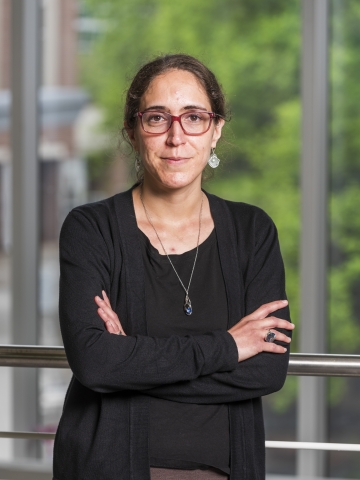
Dr. Dorota Gaskins is a Lecturer in Applied Linguistics at King’s College London’s School of Education, Communication & Society since 2023. Previously, she held a Leverhulme Early Career Fellowship (2020–2023) focusing on metaphor acquisition in young children. With 18 years of teaching experience in TESOL and 14 years as a language examiner, her expertise bridges research and pedagogy. Her research focuses on bilingual first language acquisition (ages 1–10), metaphor development, child-directed speech effects, and methodologies for studying young language learners. She actively contributes to the Cognition, Learning, and Communities Lab and the Language, Discourse & Communication Research Centre. Dr. Gaskins teaches BA and MA courses in linguistics and supervises students in areas like bilingual acquisition, usage-based linguistics, and figurative language. Her recent work explores metaphor production in bilingual children and cross-linguistic code-switching patterns, emphasizing practical implications for multilingual education.
Pavel Trofimovich is a Professor of Applied Linguistics at Concordia University's Department of Education, where he has worked since 2003. His research bridges psycholinguistic, sociolinguistic, and pedagogical dimensions of second language acquisition. PhD in Educational Psychology/Applied Linguistics (University of Illinois at Urbana-Champaign, 2003) MA in Teaching English as an International Language (University of Illinois at Urbana-Champaign, 1998) BA in English Philology (University of Latvia, 1996) Key research areas include cognitive processing in L2 speech acquisition, social variables affecting language learning, and comprehensibility in lingua franca interactions. His Concordia Applied Linguistics Lab (co-directed with Kim McDonough) employs mixed methods including eye-tracking and physiological sensors to study multilingual communication. Recent publications (2023-2025) focus on metaperception in L2 interaction, accent bias in employment, and nonverbal behaviors in communication success. Collaborative projects with students and SSHRC grants (e.g., 2021-2025 foreign accent bias study) demonstrate his applied focus on real-world language challenges. Current PhD students: Anamaria Bodea, Thao-Nguyen Nina Le, Chaoqun Zheng Former students now hold academic positions globally (University of Alberta, Waseda University, etc.)
Dr. Ayça Fackler is an Assistant Professor of Science Education in the Department of Learning, Teaching, and Curriculum at the University of Missouri (MU). Her work bridges science education, literacy, and linguistics to promote equitable and inclusive science instruction for multilingual and multicultural learners. Her research focuses on redefining language use in science practices to support students from diverse linguistic and cultural backgrounds. She advocates for pedagogical approaches that honor students' intersectional identities while fostering deep engagement with scientific concepts. Key areas of expertise include: Linguistic justice in science education Multilingual learners in elementary science classrooms Science teacher education Qualitative research methodologies Dr. Fackler’s scholarly contributions emphasize integrating language and science content instruction to build inclusive classrooms. Her work is particularly impactful for underrepresented groups in science education, reflecting her commitment to equity and justice. She has been honored as a Jhumki Basu and Sandra Abell Fellow and has received recognition from NARST for her dedication to advancing equity in science education. Dr. Fackler mentors preservice and inservice teachers and supports the development of teaching practices that foster meaningful, equitable science learning experiences. While specific grant funding and advising details are not mentioned, her research program is grounded in qualitative inquiry and social justice frameworks. Her academic journey reflects a strong international and interdisciplinary foundation, contributing to her unique perspective in science education research.
Dr. Amy Jo Minett is an Associate Professor in the Department of English at Salem State University, specializing in TESOL (Teaching English to Speakers of Other Languages) and multilingual writing. She coordinates the First Year and Multilingual Writing program and the Graduate Certificate in Writing and Rhetoric. Her international experience spans curriculum development and teacher training in Kurdistan, Afghanistan, Central/Eastern Europe, and China. Peacebuilding through language education Intercultural communication in post-conflict regions Critical discourse analysis English as an international language Teacher education and reflective practice Her scholarly work examines intersections between language teaching, conflict resolution, and social justice. Recent publications focus on virtual intercultural exchanges and critical pedagogy in transitional societies. She has presented at major conferences including AAAL and the International Society for Language Studies.
Soukaina Filali Boubrahimi serves as an Assistant Professor in the Computer Science Department within the College of Engineering at Utah State University. Her academic appointment is based in the SER 332 building located at 4205 Old Main Hill, Logan, UT 84322-0001. She maintains a research-active position with a focus on computational methods for complex temporal data analysis. Dr. Filali Boubrahimi's research program centers on time series analysis , machine learning , and space weather prediction , with particular emphasis on solar flare forecasting and counterfactual explanation systems. Her work bridges theoretical machine learning advancements with practical applications in heliophysics, hydrology, and social media analysis. The research portfolio demonstrates significant expertise in handling imbalanced temporal datasets, developing novel data augmentation techniques, and creating interpretable AI systems for critical prediction tasks. Analysis of her recent publication trajectory reveals consistent contributions to counterfactual explanation frameworks for time series data (Info-CELS, M-cels, ACTS), space weather prediction systems (solar flare and energetic particle event forecasting), and generative modeling approaches (AVATAR, ChronoGAN). Her work frequently addresses the challenges of severely imbalanced datasets through contrastive learning and sophisticated preprocessing techniques, demonstrating methodological innovation in handling rare but critical space weather events. While no specific awards are documented in the available information, her research program appears substantial based on the volume and quality of recent publications spanning multiple high-impact domains. The research demonstrates strong interdisciplinary connections between computer science, space physics, and environmental science. Her laboratory activities focus on developing machine learning frameworks for temporal data analysis, with particular attention to space weather prediction systems. The research group appears to specialize in creating robust models for rare event prediction, explainable AI systems for time series classification, and novel data augmentation techniques for imbalanced temporal datasets. Current projects likely include the development of multimodal fusion approaches for solar energetic particle prediction and spatio-temporal modeling for hydrological applications.
Daria Hemmerling , PhD, Eng., is a Lecturer at the Department of Metrology and Electronics under the Faculty of Electrical Engineering, Automatics, Computer Science and Biomedical Engineering at AGH University of Science and Technology in Kraków. Her research focuses on the intersection of biomedical engineering, voice analysis, and artificial intelligence, particularly for neurological and cardiovascular disease diagnostics. Research Interests : Applying mixed reality and AI for Parkinson’s disease assessment Voice/speech biomarkers for heart failure and neurodegenerative disorders Deep learning techniques in medical imaging (e.g., skull segmentation/reconstruction) Haptic feedback systems for multisensory interaction Simulation training in electrophysiology education Unsupervised learning and modality translation in biomedical signal processing Scientific Trends : Her recent work emphasizes multimodal diagnostic systems integrating voice analysis, VR/MR visualization, and deep learning. She explores explainable AI for medical classification tasks, data augmentation strategies, and innovative haptic/gamification interfaces.
Alastair Henry is a Professor in Language Education at the Centre for Languages and Literature (SOL) , Lund University. His research focuses on the psychology of language learning , particularly motivation, communication behaviors in multilingual contexts, and teacher identity development. Research Focus Motivation in English, Modern Languages, and Swedish as a Second Language Teacher identity and relational practices Multilingualism and post-migration language dynamics Selected Scientific Awards 2024 IAPLL Distinguished Scholar Award 2023 Modern Language Journal Research Article Award 2013 Christopher Brumfit Thesis Award (Runner Up) Supervision & Projects Supervising PhD student Sophia Juul Principal Investigator for Progress in Language Learning (PILL), 2025–2028 (4.5M SEK) Co-PI for Motivation in Modern Languages (MoMS) and Project Leader in TEAM (25.8M SEK)
Christian Mauder is Professor of Islamic Studies at Freie Universität Berlin’s Institute of Islamic Studies, Department of History and Cultural Studies. His research focuses on premodern Islamic religious, intellectual, and social history, particularly the Mamluk Sultanate (1250–1517), Islamic court cultures, historical semantics, Arabophone Christianity, Christian-Muslim relations, and Quranic discourses. He has published extensively on Mamluk military education, legal riddles, Persian and Circassian ethnic identities, and Ottoman-Mamluk transitions, emphasizing transregional interconnectedness. PhD in Arabic and Islamic Studies, University of Göttingen (2017) Postdoctoral research at Yale, Princeton, NYU Abu Dhabi, and University of Bonn Associate Professor at University of Bergen (2018–2023) Mauder’s scholarly work bridges Islamic history and cultural studies, exploring how concepts like mujaddid (renewer) shaped religious authority. His publications include monographs on Mamluk court culture and edited volumes on Quran reception, legal knowledge transmission, and Islamic eschatology. Recent articles analyze Persian identity construction, Hanafi riddles, and Mamluk-Ottoman entanglements. His awards include the 2018 Malcolm H. Kerr Dissertation Award and Christian Gottlob Heyne Award. He supervises doctoral students and participates in international seminars, including the Balzan Seminar on Muslim state formation. His office hours (Tue 4:15–6:00 PM) are open for academic consultation at Fabeckstr. 23/25, Berlin.
PD Dr. phil. Evangelia Kordoni is a research assistant at Humboldt University of Berlin's Faculty of Linguistics and Literary Studies, specifically within the Institute for English and American Studies. Her office is located at Dorotheenstraße 28, Room 3.04, and she can be contacted via email for appointments. She is an active researcher in computational linguistics with a focus on grammar engineering and natural language processing. Kordoni's research primarily explores: Computational linguistics frameworks including HPSG grammar implementation Multiword expression processing and machine translation systems Treebank development for languages including English, German and Bulgarian Lexical acquisition methods for large-scale grammars Semantic parsing and disambiguation techniques Her work bridges theoretical linguistics with practical NLP applications. Kordoni's publication record shows consistent focus on deep linguistic processing, with recent emphasis on: Multiword expression analysis in machine translation systems Parallel treebank development for multilingual applications Verb subcategorization and compound noun disambiguation Dynamic annotation methodologies for Wall Street Journal texts Cross-linguistic studies of Germanic syntax
Maria Nilsson is a Lecturer in Language Didactics at Stockholm University's Department of Subject Didactics, specializing in English language education for younger students (grades F-3 and 4-6). With a PhD in language didactics defended in 2020, she has established herself as a researcher in primary language education, foreign language anxiety, and classroom interaction dynamics. Her research interests include: Ways to promote oral classroom interaction Teaching in knowledge-heterogeneous classrooms Literature didactics, particularly picturebook read-alouds Teacher education and VFU (school-based education) Collaboration between school and academia Foreign language anxiety and sense of agency among young learners Numerous presentations at international conferences (Krakow, Oxford, Portland, Rio de Janeiro, Shanghai, Groningen, Copenhagen, Vienna, Kristiansand, Växjö, Bolzano, Vasa) demonstrate her active participation in the global language education research community. Her work consistently addresses the challenges of teaching English in primary schools, with particular attention to anxiety, learner engagement, and effective classroom practices. Her recent publications (2019-2024) reveal a strong focus on: The potential of picturebooks to enhance engagement and language learning The challenges of teaching in heterogeneous language classrooms The complex relationship between foreign language anxiety and classroom participation How young learners perceive their agency in language learning contexts Maria Nilsson has made significant contributions to understanding how to create engaging and effective language learning environments for young students. Her work bridges theory and practice, drawing from her extensive background as a primary school teacher (grades 4-9 in Swedish, English, and Spanish) before transitioning to academia. She has previously held a post-doc position at Uppsala University working on interactive reading aloud of multimodal authentic literature and has taught in various teacher education contexts including Lärarlyftet, övningsskoleprojektet, and mentor training programs.
Bethany Silva is a Research Assistant Professor of Education and Director of the Community Literacy Center at the University of New Hampshire. She holds an Ed.D. in reading, writing and literacy from the University of Pennsylvania, an M.F.A. in writing for children and young adults from Vermont College of Fine Arts, and a B.A. from Middlebury College. Her research centers on literacy studies through three interconnected pillars: place-based pedagogies examining how physical environments shape learning, practitioner research methodologies that elevate educator expertise, and digital writing processes among diverse youth populations. Dr. Silva's work consistently emphasizes social justice frameworks, particularly in developing literacy programming that honors community-defined goals and addresses systemic inequities in predominantly white educational settings. Analysis of her recent publications reveals a clear trajectory toward intersectional approaches combining multilingual education, STEM integration, and anti-racist pedagogy. Her scholarship increasingly focuses on creating ecosystemic teaching models that bridge formal and informal learning spaces while centering student voice and cultural identity. Her major scientific recognition includes: 2017 Philadelphia Writing Project Award for outstanding commitment to practitioner inquiry and literacy instructional leadership Dr. Silva secures significant external funding through competitive grants, including: Transforming Literacy Equity (Spencer Foundation, 2024-2025) Multilingual Book Clubs (NH Humanities Council, 2023-2024) Book to Art: Book Clubs for the Seacoast’s Early Readers (New Hampshire Charitable Foundation, 2018-2019) Summer Boot Camps in Public Humanities (Mellon Foundation, 2018-2023) Book to Art: Using Children's Literature to Teach for Social Justice Phonics Programming Professional Development As Director of the Community Literacy Center, she orchestrates a statewide network connecting university faculty, K-12 educators, youth, and families through initiatives like drop-in writing clubs, book-art collaborations, and social justice-focused professional development cohorts that transform New Hampshire's educational landscape.
Dr. Wenyu Guo serves as Assistant Professor of Literacy Studies in the College of Education at the University of South Florida, specializing in transnational literacy practices of immigrant youth of Color and their families. Her community-engaged research promotes anti-oppressive multiliteracies education across schools, homes, and digital spaces using critical theories of literacy and decolonization frameworks. Her educational background includes: Ph.D. in Teaching & Learning, University of South Carolina Certificate of Graduate Study in Qualitative Research, University of South Carolina Dr. Guo's research centers on two primary goals: (1) examining how transnational youth of Color engage in sociopolitical learning through literacies, and (2) investigating immigrant parents' family literacy practices and ethnic-racial socialization. She employs participatory action research and multi-sited ethnography to develop justice-oriented literacy interventions that challenge systemic oppression in educational contexts. Her recent publications reveal consistent thematic focus on anti-Asian racism through children's literature, transnational family literacy, and multiracial solidarity development. Methodologically, her work combines critical discourse analysis with community-based participatory design, often centering Chinese American communities in the Southern U.S. and leveraging digital platforms for transnational knowledge exchange. Professional recognition includes: Early Career Educator of Color Leadership Fellow, NCTE (2024-2025) Outstanding Undergraduate Teaching Award, USF (2025) Outstanding International Graduate Student Award, USC (2023) Research funding comprises: ACTFL Research Grant (2023) : Co-PI for $5,000 project on antiracist translanguaging pedagogy using Asian American children's literature SPARC Graduate Research Grant (2020) : PI for $2,900 study on Asian American children's bicultural identity negotiation She co-founded Tampa Bay's Community Literacies Lab, providing biweekly workshops for immigrant families that integrate cultural storytelling, digital literacy, and critical race discussions to foster equitable language practices and unpack transnational experiences.
Rui Zhang is an Assistant Professor in Computer Science and Engineering , with research expertise spanning Natural Language Processing , Large Language Models , and Semantic Parsing . His recent work focuses on enhancing multimodal consistency , fairness in summarization , and mathematical reasoning capabilities of LLMs. Key Research Themes: Text-to-SQL and cross-domain semantic parsing Multimodal learning (vision-language models) Fairness and bias mitigation in NLP tasks Efficient model training and prompt optimization Scientific Awards: National Science Foundation CAREER Award (2024) Grants & Projects: CAREER: Trustworthy Human-Centered Summarization (NSF, 2024-2029) addressing LLM trustworthiness through user-centric summarization frameworks. Article Trends: Recent publications emphasize LLM collaboration , compressed reasoning models , and cross-domain knowledge alignment . He explores multi-agent systems , mathematical reasoning , and vision-language limitations , particularly in geometric perception. Applications span bioinformatics (Alzheimer's biomarker discovery) and democratic AI frameworks.
Verónica E Valdez is a tenured Professor in the Department of Education, Culture & Society at the University of Utah. Her work centers on critical language education, Latinx schooling equity, and culturally sustaining pedagogy, with a focus on dual language bilingual education (DLBE), raciolinguistic ideologies, and teacher practices that challenge systemic inequities. A first-generation U.S. born Latina with deep ties to border communities, her research bridges family/community contexts with macro-level policy analysis. PhD in Curriculum & Instruction (Multilingual Studies) from the University of Texas at Austin Master of Science in Psychology from Emporia State University Bachelor of Arts in Psychology from Southwestern University Her research explores four interrelated strands: 1) Language learning in school and community contexts, 2) Educational language policy at macro/micro levels, 3) Latinx educational inequities, and 4) Teacher education for multicultural justice. Recent work highlights tensions between 50:50 vs 90:10 DLBE models and the marginalization of heritage language families. Key trends in her scholarship include raciolinguistic analysis of teacher practices, translanguaging in adult refugee education, and critical examinations of neoliberalism in language policy. Awards recognize her leadership in bilingual education research and mentorship of emerging scholars. She serves on national AERA and AAAL committees and directs the APEX project, a 5-year federal grant building ESL educator capacity in Utah.
Lynn Kamerlin is a Professor at the Georgia Institute of Technology and co-leads the Kamerlin Laboratory, which operates across Georgia Tech and Lund University. Her work integrates computational chemistry and biophysics to address fundamental questions in enzyme evolution, catalysis, and protein design. Education MNatSc in Chemistry, University of Birmingham (UK) PhD in Chemistry, University of Birmingham (UK) Her research spans computational biophysics , focusing on mechanistic biochemistry , protein evolution , and enzyme engineering . Key methodologies include machine learning , molecular dynamics simulations , EVB/QM/MM modeling , and natural language models for protein structure prediction. Recent publications highlight trends in AI-driven enzyme design , conformational dynamics , and mechanistic studies of phosphoryl transfer reactions . Tools like WatCon and Q-RepEx demonstrate her commitment to method development in computational biology. Scientific Awards Georgia Research Alliance Eminent Scholar (2022-Present) Wallenberg Scholar (2020-2024) ERC Starting Grant (2012-2017) Wallenberg Academy Fellowship (2014-2019, prolonged 2019-2024) Young Academy of Europe Chair (2014-2015) Fellow of the Royal Society of Chemistry (2017) Her lab collaborates with experimental groups worldwide, leveraging enhanced sampling techniques and structural bioinformatics to engineer enzymes with tailored properties. Grants from the Swedish Research Council and European Research Council underpin her research on enzyme evolution and catalytic mechanisms. Current projects include computational design of thermostable enzymes , allosteric modulators for biomedical targets, and modular protein scaffolds . The lab also investigates non-canonical amino acid incorporation and FAIR data principles in biomolecular simulations.