Francisco Proença Garcia is an Associate Professor with Habilitation and Dean for Faculty at the Institute for Political Studies (IEP) of the Portuguese Catholic University (UCP). He holds visiting academic positions at the University of Saint Joseph (Macau), Military University Institute (Lisbon), and Catholic University of Mozambique (Beira). His career includes roles as National Representative to NATO’s Science and Technology Organization (2014-16), Head of Postgraduate Studies at the Military Academy (2014), and Military Advisor to Portugal’s NATO/European Defense Agency delegations (2008-11). He chairs the Lisbon Geographical Society and is an academic member of the International Academy of Portuguese Culture and Brazilian Institute of Geography and Military History. His research focuses on African Studies, Geopolitics, and Security Studies, with 16 authored books and numerous peer-reviewed articles. Recent work includes Authoritarian Power and the Challenges to Liberal Democracy (2022). Research Interests: African geopolitical dynamics Maritime security and Blue Economy NATO/EU defense policies Conflict resolution and peacekeeping Transnational threats and security governance Professional Highlights: Key contributor to Timor-Leste peacekeeping (2000-2004) Advisor to Portugal’s Military High Command Author of influential works on Portuguese military history and modern warfare
Tejinder Billing is Professor in the William G. Rohrer College of Business at Rowan University, specializing in cross-cultural organizational behavior and diversity management. Her research examines: Cross-national variations in work-family conflict and temporal orientation Transgender experiences and inclusive workplace practices Cultural influences on leadership and organizational commitment Billing's publications demonstrate consistent focus on diversity dynamics, with recent work examining resilience strategies during workforce disruptions and sustainability literacy assessment. She maintains an active research profile analyzing organizational responses to gender diversity across cultural contexts.
Horace G. Campbell is a Professor in the Department of African American Studies at Syracuse University. His research focuses on African political dynamics, U.S. foreign policy in Africa, Pan-Africanism, and postcolonial studies. He has held roles including Director of Graduate Studies and University Senate member, and has been a vocal critic of U.S. militarism in Africa through platforms like his work on AFRICOM and NATO interventions. Campbell's scholarship spans books such as Global NATO and the Catastrophic Failure in Libya and Barack Obama and 21st Century Politics , and his recent work addresses themes like the Bandung Conference legacy and China-Africa relations. Teaching includes courses on African politics and international relations, with a focus on critical analysis of power structures. He has secured multiple grants from Syracuse’s Office of Undergraduate Research & Creative Engagement (SOURCE) for archival work on Pan-Africanism and Walter Rodney’s legacy. His media engagements include appearances on Pacifica Radio and participation in high-profile lectures like the Barbara Jordan Lecture at Penn State. Service roles include chairing the International Commission of Inquiry on systemic racist police violence in the U.S. and advising on African development initiatives. His research bridges academic inquiry with activism, emphasizing solidarity movements and decolonial frameworks.
Rachel E. VanLandingham is a tenured full professor at Southwestern Law School, specializing in national security law, military law, and international law. She served as a U.S. Air Force judge advocate, holding roles such as Chief Legal Advisor for International Law at U.S. Central Command and Deputy Department Head of the Department of Law at the U.S. Air Force Academy. Her expertise includes military justice reform, the law of armed conflict, and detainee rights. VanLandingham has testified before congressional panels on sexual assault in the military and contributed to the landmark 2021 military justice reforms. Education: B.S. in Political Science (U.S. Air Force Academy, 1992), M.P.M. in National Security (University of Maryland, 1994), J.D. with high honors (University of Texas, 2000), LL.M. in Military Law (U.S. Army JAG School, 2006). Research interests focus on military criminal law, procedural justice in courts-martial, and the intersection of national security with constitutional rights. Her scholarship emphasizes accountability for war crimes and systemic reforms to enhance due process in military justice systems. She co-authored U.S. Military Operations: Law, Policy and Practice and frequently publishes in top journals like the American University Law Review and Tulane Law Review . VanLandingham has advised policymakers on civilian harm mitigation, military justice reform, and international humanitarian law. She is a media commentator for outlets like the New York Times , CNN, and NPR, addressing contemporary issues such as military vaccine mandates and accountability for war crimes in Ukraine. Professional leadership includes serving as President Emerita of the National Institute of Military Justice, Chair of the AALS Section on National Security Law, and Secretary of the American Society of International Law’s Lieber Society. Her advocacy led to significant legislative changes, including the 2021 Military Justice Act.
Steve Firestone, Ph.D., is an Associate Professor and Director of the Master of Arts in Organizational Leadership program at Regent University's School of Business & Leadership. He retired from the U.S. Navy after 23 years as an officer, naval aviator, and educator. His military career included deployments in the Arabian Gulf and roles as a liaison officer to Mexico, Canada, and the Bahamas. Dr. Firestone holds a Ph.D. in Business Administration (2014, Northcentral University), MBA (2002, Embry-Riddle University), M.A. in History (2017, Southwestern Assemblies of God University), and B.A. in History and Political Science (1993, Vanderbilt University). His research focuses on leadership paradigms integrating spirituality, crisis management, and generational dynamics. Notable works explore biblical principles in crisis leadership, servant leadership in hierarchical systems, and transformational leadership in Chinese higher education. He also examines military mental health strategies and millennial workplace perceptions. Educations: Ph.D., Business Administration, Northcentral University, 2014 M.A., History, Southwestern Assemblies of God University, 2017 MBA, Embry-Riddle University, 2002 B.A., History and Political Science, Vanderbilt University, 1993 Dr. Firestone has received the Instructor Excellence Award (2014) and certificates in online education, instructional design, and college teaching. His career bridges military leadership experience with academic roles, emphasizing faith-integrated leadership approaches.
Sasha Romanosky is a Senior Policy Researcher at RAND Corporation specializing in the economics of cyber security, privacy, insurance, cybercrime, and national security. His work spans policy analysis, risk assessment, and cybersecurity frameworks with significant contributions to industry standards like CVSS and EPSS. Dr. Romanosky's educational background includes: Ph.D. in Public Policy and Management from Carnegie Mellon University B.S. in Electrical Engineering from the University of Calgary, Canada Romanosky's research focuses on the intersection of cybersecurity economics and policy. His work examines how insurance companies price cyber risk, the cost of data breaches to organizations, and whether corporate losses are as severe as commonly believed. He has developed methodologies to identify, collect, and apply regression and NLP analyses to federal civil and criminal cases related to cybersecurity. His research also extends to software supply chain security, which he identifies as a leading risk due to the fragmented nature of modern software development. Romanosky has contributed to understanding cyber collateral damage, vulnerability equities processes, and the integration of cyber risk into enterprise risk management frameworks. Romanosky's publications reveal a strong focus on practical applications of cybersecurity research with emphasis on risk assessment, insurance mechanisms, and policy implications. His work bridges technical cybersecurity issues with economic and legal considerations, providing valuable insights for both private sector organizations and government entities. Notable contributions include: Coauthor of the Common Vulnerability Scoring System (CVSS) Coauthor of the Exploit Prediction Scoring System (EPSS) Throughout his career, Romanosky has advised government agencies including the Department of Defense and the Department of Homeland Security. His previous roles include being a research fellow at NYU's Information Law Institute, a member of DHS's Data Privacy and Integrity Advisory Committee, and a cyber policy advisor at the Pentagon. Romanosky leads research initiatives focused on understanding cyber risk dependencies, developing frameworks for vulnerability management, and analyzing the effectiveness of cybersecurity practices across public and private sectors.
Matthew Sargent is a Professor of Policy Analysis at the RAND School of Public Policy and a management scientist at RAND, where he conducts high-impact research on military strategy, network analysis, and complex systems. His work supports key U.S. defense and homeland security agencies, including the Department of the Air Force and U.S. Space Force. His research focuses on command and control , science and technology management , and the application of network analysis to economic and military systems. He also studies great-power competition , organizational behavior , and illicit markets , using interdisciplinary methods to address national security challenges. Recent publications reveal a strong trend in leveraging complex adaptive systems thinking and artificial intelligence for defense planning, with applications in space systems, agile combat operations, and joint all-domain command and control. His work increasingly integrates data-driven network models to assess policy inertia, industrial base resilience, and cross-border economic structures. Mellon Postdoctoral Research Fellow, University of Southern California Research Associate, Caltech PhD in History and Organizational Behavior, UC Berkeley Matthew Sargent has received no explicitly mentioned scientific awards in the provided text. His advisory roles are not detailed, though his research is often funded by federal defense and homeland security programs. He teaches social network analysis and contributes to strategic policy frameworks. His work is associated with RAND’s national defense and policy analysis teams, particularly in projects involving U.S. military command structures, innovation ecosystems, and regional economic networks. He leads research initiatives that bridge technical modeling and policy implementation.
Col. (ret.) Michel William Drapeau serves as an Adjunct Professor at the University of Ottawa’s Faculty of Law, teaching Access to Information and Privacy Law (Common Law Section, French) and Canadian Military Law (Common Law Section, English) at undergraduate and graduate levels since his 2009 appointment. A retired Canadian Forces Colonel with 34 years of service ending in 1993 as Director of National Defence Headquarters Secretariat, he maintains an active private law practice specializing in military/veterans law, administrative law, and human rights litigation before Federal Courts and tribunals. His academic foundation includes dual law degrees (LL.L. civil law 1999, LL.B. common law 2000) from the University of Ottawa, complemented by advanced military education: CF Command and Staff College (1975), U.S. Armed Forces Staff College (1977), U.S. Army Military Comptrollership School (1978), and National Defence College (1988). He clerked at the Federal Court of Appeal under Justice Gilles Létourneau prior to being called to the Ontario Bar in 2002. Drapeau’s research critically examines military justice systems and privacy/access-to-information frameworks , reflecting his unique soldier-lawyer perspective. His scholarship consistently bridges theoretical legal principles with operational military realities, particularly in sentencing under the National Defence Act and cross-jurisdictional privacy challenges. The recurring theme across his work is the tension between national security imperatives and individual rights within administrative law structures. His 2001-2015 publications reveal two dominant trajectories: foundational military law texts addressing court martial procedures and disciplinary systems, and pioneering privacy/access-to-information works analyzing government transparency mechanisms. Notably, his military law scholarship integrates comparative perspectives from international military jurisdictions, while his privacy research emphasizes practical implementation challenges in federal institutions. Drapeau’s exceptional service has earned significant recognition: Order of Military Merit (OMM) for “outstanding military service” (1990) Canadian Forces Decoration with dual clasps Commemorative Medal for Canada’s 125th Anniversary (1993) Queen Elizabeth II Golden Jubilee Medal (2003) Queen Elizabeth II Diamond Jubilee Medal for veteran welfare contributions (2012) Ontario Bar Association Distinguished Award for “exceptional career contributions” (2022) Though not supervising formal graduate students, Drapeau mentors through high-impact legal advocacy, having argued before the Federal Court of Appeal, Court Martial Appeal Court, and US Congressional panels on military justice reform. His international engagements include Yale Law School seminars and Rhodes Conference presentations, demonstrating sustained influence beyond Canadian borders. Professional leadership includes board service at Collège militaire royal (2007-2012) and Saint-Paul University (2012-2019), plus membership in the International Society for Military Law and the Law of War.
Sharon Christ is an Associate Professor in the Department of Human Development and Family Science at Purdue University, with joint appointments in the Department of Statistics, College of Science, and courtesy appointments in the Department of Speech, Language, and Hearing Sciences. She serves as Co-Director of The Methodology Center at Purdue (MCAP) and is actively involved in research focusing on statistics, statistical modeling, adolescent development, and aging. Her work spans multiple research areas including Health and Well-Being, Interpersonal Relations, and Military Families. Dr. Christ received her PhD in Sociology from the University of North Carolina in 2008, an MS in Statistics from the same institution in 2004, an MA in Sociology in 2002, and a BA in Sociology & Political Science from the University of Minnesota in 1994. Her research primarily focuses on applications in the social, behavioral, and health sciences, with expertise in structural equation modeling (SEM) with latent variables, multilevel (mixed effects) models, longitudinal modeling, and analysis of complex sample data. She investigates measurement of social constructs, missing data, and selection problems, often using large nationally representative datasets as well as data from observation and experimental designs. A significant portion of her recent work examines child maltreatment experiences in adolescence and their impacts on well-being outcomes including academic achievement, aggressive behaviors, and mental health. Analysis of Dr. Christ's recent publications reveals a strong focus on developmental language disorders, military family research, and statistical methodology. Her work increasingly integrates retrieval practice techniques for language learning in children with developmental disorders, examines long-term trajectories of mental health outcomes in military families, and investigates the relationship between physical activity, stress, and health outcomes in diverse populations. There's a clear interdisciplinary trend across her publications, bridging statistics, psychology, speech-language pathology, and military family research. Dr. Christ has received numerous awards and honors including: University Faculty Scholar, Purdue University (2022-present) Christine M. Ladisch Faculty Leadership Award, Purdue University (2022) Faculty Leadership Academy for Interdisciplinary Research (FLAIR) Fellow, Purdue University (2020) Honorable Mention for Disruption Paper Competition, National Foundation to End Child Abuse and Neglect (2019) College of Science Team Award for Statistics Living Learning Community, Purdue University (2015) Center for Aging and the Life Course Outstanding Professor Award for Exceptional Teaching and Mentoring of Emerging Scholars in Aging, Purdue University (2014) Dr. Christ actively mentors graduate students and is accepting applications for the December 1, 2024 deadline. She has secured significant research funding, including as Co-Principal Investigator for the 'Interdisciplinary Summer Institute on the Analysis of Complex, Large-Scale Longitudinal Data' from the National Institute on Drug Abuse ($365,129, 2024-2027) and as Co-Investigator on multiple substantial grants from agencies including the U.S. Army Medical Research & Development Command, National Institute on Deafness and other Communication Disorders, and Eunice Kennedy Shriver National Institute of Child Health and Human Development. Dr. Christ is affiliated with several research centers at Purdue including the Center for Families, The Military Family Research Institute, The Methodology Center at Purdue (MCAP), and the Center on Aging and the Life Course. These affiliations support her interdisciplinary research on family dynamics, military families, statistical methodology, and aging processes.
Col Christopher M. Rondeau is the Commander of Air University Detachment 1 and Deputy Director of the Air Force Institute of Technology (AFIT) at Wright-Patterson Air Force Base. He serves as an Assistant Professor of Electrical Engineering and oversees over 1,800 military and civilian personnel. AFIT under his leadership manages a $231M annual budget, provides graduate education to 1,000+ students yearly, and coordinates 3,500+ students in civilian health and legal programs. Doctorate of Philosophy (2020), Electrical Engineering, AFIT Master of Science (2011), Flight Test Engineering, USAF Test Pilot School Master of Science (2010), Electrical Engineering, AFIT Bachelor of Science (2003), Electrical Engineering, USAFA Rondeau’s research focuses on critical infrastructure cybersecurity , DNA-based wireless device fingerprinting , and malware classification . His work bridges electrical engineering , machine learning , and industrial IoT security through techniques like constellation-based feature extraction and cross-layer forensic analysis. His publications emphasize device authentication in industrial environments (WirelessHART, ZigBee), malware detection via code structure , and ADS-B spoofing prevention . Key methodologies include DNA fingerprinting, L-moments, and hyperparameter optimization for wireless security. Meritorious Service Medal (with 2 oak leaf clusters) Aerial Achievement Medal Air Force Commendation Medal Air Force Achievement Medal U.S. Patent 11,856,012 (2023) for Passive Physical Layer Distinct Native Cyber Security Monitor
Allen Garner is a Professor and Graduate Program Chairman in Purdue University's School of Nuclear Engineering, with courtesy appointments in Electrical and Computer Engineering and Agricultural and Biological Engineering. He holds a Ph.D. in Nuclear Engineering from the University of Michigan (2006) and maintains an active research program at the intersection of plasma physics, pulsed power, and biomedical applications. Education: Ph.D. Nuclear Engineering, University of Michigan, Ann Arbor (2006) M.S. Electrical Engineering, Old Dominion University (2003) M.S.E. Nuclear Engineering, University of Michigan (1997) B.S. Nuclear Engineering, University of Illinois, Urbana (1996) Garner's research focuses on biomedical applications of pulsed power and plasmas , including platelet activation, bacterial inactivation, and stem cell manipulation using electric fields. His theoretical work spans plasma physics (space-charge-limited current in nonplanar diodes), pulsed power (nonlinear transmission lines), and high-power microwaves (crossed-field amplifiers). The BioElectrics and ElectroPhysics (BEEP) Lab conducts multidisciplinary research bridging theory and experiment. Analysis of his recent publications reveals strong trends in mathematical modeling of electron dynamics (particularly space-charge effects in nonplanar geometries) and biomedical applications of electric pulses (targeting cellular/subcellular structures). His work demonstrates consistent innovation in both fundamental plasma physics and translational medical applications. Garner maintains active military service as a Captain in the U.S. Navy Reserves, commanding a unit supporting naval shipyards. His professional affiliations include IEEE (Senior Member), American Physical Society, and nuclear engineering honor societies. He holds multiple patents related to electric pulse generation and biomedical applications. The BEEP Lab drives his research program, developing novel composites for high-power microwave devices while exploring electroporation mechanisms for medical applications. His work demonstrates significant collaboration across engineering disciplines and with medical researchers, particularly in platelet activation and bacterial inactivation studies.
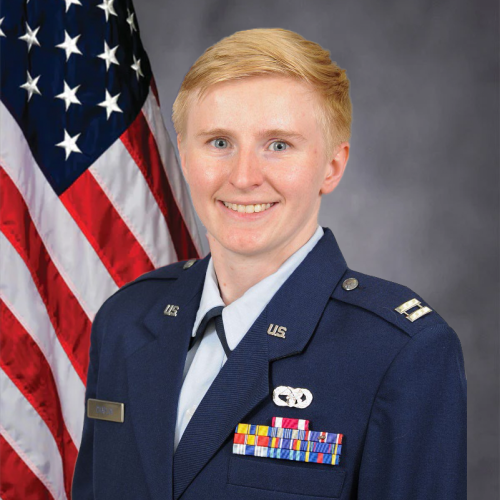
Megan M. Chaplin serves as Operations Flight Commander and Assistant Professor of Aerospace Studies at Air Force Reserve Officer Training Corps (AFROTC) Detachment 485, Rutgers University, New Brunswick, NJ, where she trains and mentors prospective Air Force officers through structured military education programs. Her academic credentials include: 2018: Bachelor of Arts in Psychology/Neuroscience from Hiram College, Hiram, OH 2020: Master of Science in Forensic Psychology from Southern New Hampshire University, Manchester, NH 2023: Squadron Officer School at Air University, Maxwell Air Force Base, AL (Distinguished Graduate) Her professional expertise integrates military science with psychological principles, focusing on leadership development and operational readiness training. The psychology foundation from her degrees directly informs cadet mentorship approaches and officer evaluation frameworks within the ROTC structure, emphasizing cognitive resilience and decision-making under pressure. Captain Chaplin's military service has been recognized with the Air and Space Meritorious Service Medal, Air and Space Commendation Medal (with oak leaf cluster), Air and Space Achievement Medal, Air and Space Outstanding Unit Award (with oak leaf cluster), National Defense Service Medal, Global War on Terrorism Service Medal, Nuclear Deterrence Operations Service Medal, Air and Space Overseas Service Ribbon, and Air and Space Longevity Service Award. As primary trainer for detachment cadets, she oversees flight operations curriculum implementation and officer qualification standards. Her prior role as Deputy Director of the Commander's Action Group at Aviano Air Base's 31st Fighter Wing involved high-level staff coordination, complementing her current educational leadership within Air Education and Training Command's structure.
Laura A. Dickinson serves as the Lyle T. Alverson Professor of Law at The George Washington University Law School, where she focuses on national security, human rights, the law of armed conflict, and foreign affairs privatization. Her distinguished career bridges academic scholarship with significant government service. Education: AB, Harvard University JD, Yale University Professor Dickinson's research centers on the privatization of military and security functions, examining how this trend impacts core public values and developing mechanisms to protect these values. Her work spans international law, national security policy, human rights enforcement, and the legal frameworks governing private military contractors. She has made significant contributions to understanding the intersection of public values and private actors in the international arena, with particular attention to accountability mechanisms and regulatory frameworks. Her recent scholarship (2020-2025) demonstrates continued engagement with pressing national security issues including National Guard deployments, military privatization, and international legal responses to conflict. Her publications reveal a consistent focus on constitutional boundaries, accountability structures, and the evolving relationship between public authority and private actors in security contexts. Scientific Awards: Secretary of Defense Medal for Exceptional Public Service Professor Dickinson maintains an active role in government and policy circles, having served as Special Counsel to the General Counsel of the Department of Defense (2016-17) and as a senior policy adviser at the State Department. She regularly contributes to the national security blog Just Security and has collaborated with the American Bar Association on significant reports, including a 2018 analysis of U.S. military commissions at Guantanamo Bay. Her government service complements her academic work, creating a robust feedback loop between theory and practice in national security law. She has engaged extensively with professional organizations including serving as Co-chair of the International Law and Technology Section and as a member of the Executive Council of the American Society of International Law, demonstrating leadership in her field beyond the classroom and scholarly publications.
Anders Themnér is an Associate Professor at the Department of Peace and Conflict Research within the Faculty of Social Sciences at Uppsala University. His academic work focuses on peacebuilding, conflict resolution, and post-conflict reconstruction with particular expertise in African contexts. He has developed significant research on disarmament, demobilization and reintegration (DDR) of ex-combatants, communal mediation, post-civil war democratization, organized student violence, and transitional justice. Themnér's research interests center on the complex dynamics of post-conflict societies, particularly how informal networks persist after civil wars and impact peacebuilding efforts. His work examines warlord democrats, ex-military networks, and the challenges of building legitimate governance in societies emerging from conflict. He has conducted extensive field research in the Democratic Republic of Congo, Liberia, Republic of Congo, and Sierra Leone, employing qualitative methods, ethnographic research techniques, and social network analysis. His recent publications reveal a consistent focus on the micro-dynamics of peacebuilding, particularly the role of informal networks and brokers in post-conflict settings. Themnér's work frequently analyzes how ex-combatants and former commanders navigate post-war political landscapes, with particular attention to how these dynamics affect democratization processes and security outcomes in African contexts. His research combines theoretical innovation with rigorous empirical analysis based on extensive fieldwork. Themnér serves as principal investigator for multiple research projects funded by the Swedish Research Council and Swedish International Development Cooperation Agency. His current projects include 'Universities at Risk: Explaining Organized Student Violence at African Universities' and 'Communities at Risk: Mediation as a Tool to Defuse Ethnic Tensions in Post-War Liberia and Beyond,' both running from 2023-2025. He collaborates with researchers including Hanne Fjelde, Emma Elfversson, and others across various projects examining peacebuilding challenges in post-conflict societies. His methodological expertise in qualitative field research, particularly in challenging environments, has contributed significantly to understanding the nuanced realities of peace processes beyond official narratives. Themnér's work bridges theoretical debates in political science with practical insights for peacebuilding practitioners working in conflict-affected regions.
Jon R. Lindsay is an Associate Professor at Georgia Tech's School of Cybersecurity and Privacy and the Sam Nunn School of International Affairs. Previously at the University of Toronto, he holds a PhD from MIT and degrees from Stanford University. His research focuses on International Security, Cyber Conflict, and Strategic Studies. Lindsay has authored several books, including Information Technology and Military Power (2020), and is working on Age of Deception: Cybersecurity as Secret Statecraft . He served in the U.S. Navy and contributes to cybersecurity policy discussions. Education: PhD in Political Science from MIT; MS in Computer Science and BS in Symbolic Systems from Stanford University. Research Interests: The intersection of technology and international relations, quantum computing's impact on security, AI's role in warfare, and how technological advancements influence military strategy and intelligence operations. His work explores nuclear deterrence in the cyber era, cybersecurity challenges, and cross-domain deterrence strategies. Affiliations: Online Master of Science in Computer Science program at Georgia Tech. He has published extensively on topics like cyber-nuclear interactions, cybersecurity policy, and the political economy of defense systems.