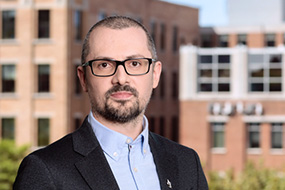
Daniel R. Stalder is a Professor in the Department of Psychology within the College of Letters and Sciences at the University of Wisconsin-Whitewater, where he has been teaching since 2004. He holds a Ph.D. in Personality and Social Psychology from the University of Iowa (1998) and an M.S. in Mathematics from the University of Wisconsin-Milwaukee. Dr. Stalder's primary research interests focus on social-cognitive biases, particularly the fundamental attribution error, individual differences such as the need for closure, and cognitive dissonance theory. His work extends into political psychology, close relationship contexts, and the application of social psychology to reduce bias and conflict. He has published a book titled "The Power of Context: How to Manage Our Bias and Improve Our Understanding of Others" (Prometheus Books, 2018) and maintains a popular Psychology Today blog called "Bias Fundamentals" with over 48 articles and 395,000 views as of October 2025. His recent research demonstrates a consistent trajectory toward understanding how uncertainty mindset cultivation can reduce cognitive biases and improve social judgment. This work builds upon his longstanding interest in attribution theory and individual differences, with applications spanning political psychology, technology interactions, and educational contexts. His publications reveal a researcher deeply engaged with both theoretical foundations and practical applications of social psychology. 2019 UW-Whitewater Outstanding Research Award 2020 Action Teaching Award (Honorable Mention) from the Society for the Psychological Study of Social Issues 2021 UW-Whitewater College of Letters & Sciences Excellence in Teaching Award 2016 UW-Whitewater Letters & Sciences Excellence in Research Award Dr. Stalder has been actively engaged with media, conducting over 13 interviews with major outlets including CBC, NPR, The Atlantic, and The Verge. His expertise in political psychology has led to 7 interviews/consults for news outlets or podcasts, 8 academic or community presentations, and 14 articles at Psychology Today. He teaches courses including Social Psychology, Basic Statistical Methods, and Introduction to Psychology, with a focus on innovative teaching methods incorporating humor, mnemonics, and popular culture.