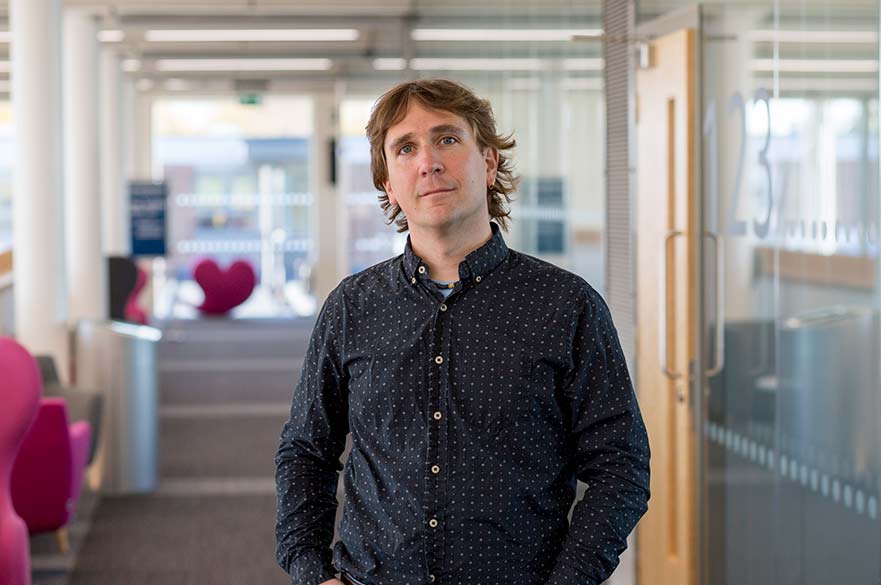
Fabio Nicola is a Full Professor in the Department of Mathematical Sciences (DISMA) at the Polytechnic University of Turin. His research spans mathematical analysis with a focus on harmonic analysis, time-frequency analysis, and applications to quantum mechanics. He serves on the editorial board of the Journal of Fourier Analysis and Applications and has held various evaluative roles for research funds including the Austrian Science Fund (FWF) and Ghent University's Special Research Fund (BOF). Professor Nicola's research interests include: Calculus of variations Harmonic analysis Microlocal analysis Partial differential equations Quantum theory Time-frequency analysis Phase space analysis and applications to quantum mechanics His work demonstrates a strong focus on the intersection of mathematical analysis and quantum mechanics, particularly through time-frequency methods and phase space analysis. Nicola has made significant contributions to the theory of localization operators, the uncertainty principle in time-frequency analysis, and applications of harmonic analysis to partial differential equations. His recent work shows increasing engagement with quantum information theory, as evidenced by his preprint "The wave function of stabilizer states and the Wehrl conjecture" (2024). Professor Nicola has received several prestigious awards and honors: Optime conferred by Turin Industrial Union (2001) Best Master of Science's thesis in Mathematics conferred by University of Turin (2002) Highly Cited Research - J. Math. Pures Appl. conferred by Elsevier (2016) Elected Fellow of the Accademia delle Scienze di Torino (2024) Elected Fellow of the Società Italiana di Scienze e Tecnologie Quantistiche (SISTEQ) (2024) Effective member of the Istituto Nazionale di Alta Matematica (INDAM) since 2004 Nicola actively supervises PhD students, currently guiding Federico Riccardi in the "Scienze Matematiche" program (39th cycle, 2023-present). He has served on PhD committees at both the University of Turin and the Polytechnic University of Turin for multiple cycles from 2012-2019. His teaching portfolio includes advanced courses in time-frequency and multiscale analysis for Mathematical Engineering, as well as mathematical analysis courses for Biomedical and Aerospace Engineering programs. The course "Analisi tempo-frequenza e multiscala" (Time-frequency and multiscale analysis) was first ranked among courses in the Master's Degree Programme in Mathematical Engineering according to student evaluations in 2023/2024. He is a member of the Analysis and Quantum Theory Research Group within DISMA, where his work bridges pure mathematical analysis with applications in quantum mechanics and signal processing. His research has practical implications for understanding quantum systems and developing advanced signal processing techniques.