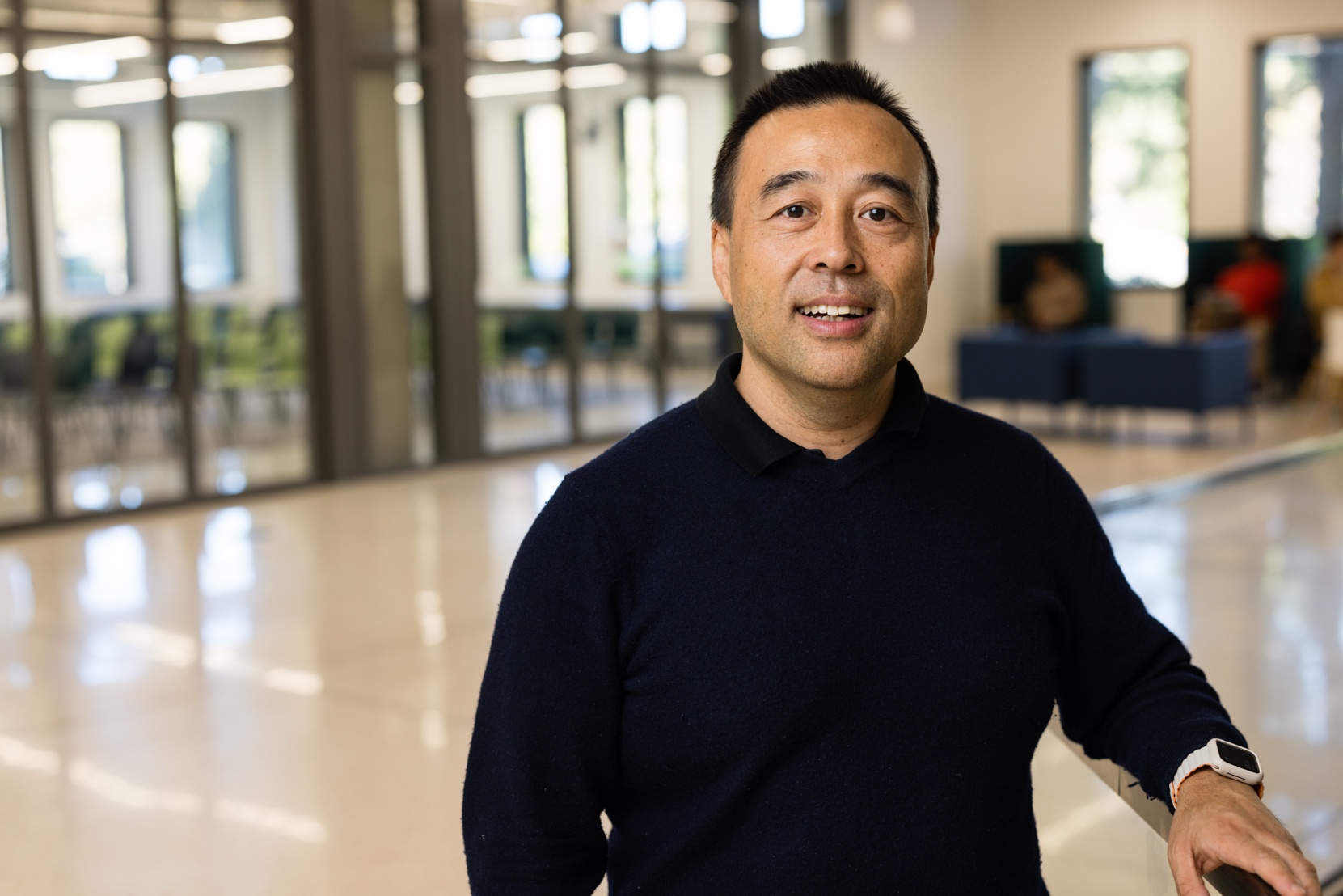
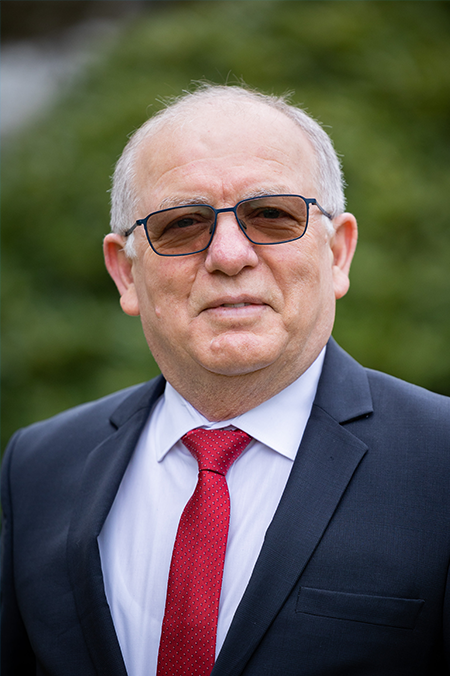
Jeffrey C. Suhling is the Quina Distinguished Professor and Department Chair of Mechanical Engineering at Auburn University . His research focuses on the mechanical and thermal behavior of lead-free solder alloys , particularly in automotive electronics and high strain rate applications . He has extensively studied the reliability of hybrid SAC-LTS solder joints under thermal cycling, vibration, and shock. Scientific awards : Quina Distinguished Professor His work integrates finite element modeling , microstructural analysis , and machine learning to predict solder joint failure and optimize material performance. Key areas include creep behavior , damage accumulation , and interfacial reliability in extreme environments.
Guang Lin is the Associate Dean for Research and Innovation in the College of Science and a Full Professor in the School of Mechanical Engineering and Department of Mathematics at Purdue University. He leads the Data Science Consulting Services and has dual appointments in Statistics and Earth, Atmospheric, and Planetary Sciences. His research focuses on AI, machine learning, uncertainty quantification, and computational science, with applications in fluid mechanics, materials science, and healthcare. Lin holds a Ph.D. from Brown University (2007) and has received numerous awards, including the NSF CAREER Award and Purdue’s University Faculty Scholar distinction. He has authored over 250 publications and secured grants totaling millions, including DOE and NIH funding. His interdisciplinary work bridges academia and industry, emphasizing AI-driven solutions for complex systems. Education: Ph.D. Applied Mathematics (Brown, 2007), M.S. Applied Mathematics (Brown, 2004), M.S. Mechanics (Peking University, 2000), B.S. Mechanics (Zhejiang University, 1997). Research Grants: Includes DOE-funded projects on machine learning for plasma-wall interactions and NSF grants for multiscale modeling. Service: Editorships in SIAM MMS, ASME Journal, and leadership in Purdue’s AI initiatives. Teaching: Courses on Uncertainty Quantification, Fluid Mechanics, and Data Science.
S. Mohadeseh Taheri-Mousavi is an Assistant Professor in the Department of Materials Science and Engineering at Carnegie Mellon University (CMU), part of the College of Engineering. She joined CMU in September 2022 after postdoctoral appointments at MIT and Brown University. Her research is supported by major grants from NASA STRI, DARPA, the Army Research Laboratory, and the Naval Nuclear Laboratory, and she is affiliated with the NextManufacturing Center and the Wilton E. Scott Institute for Energy Innovation. Her educational background includes a Ph.D. from EPFL, Switzerland, and M.Sc. and B.Sc. degrees from Sharif University of Technology, Iran. She was awarded both early and advanced Swiss National Science Foundation fellowships during her postdoctoral studies. Taheri-Mousavi’s research focuses on the intersection of materials science, mechanical engineering, and computer science. She develops multi-scale computational models and AI-driven frameworks—such as AlloyGPT and generative AI agents—to design next-generation structural alloys, particularly for additive manufacturing and extreme environments. Her work emphasizes materials sustainability, industrial decarbonization, and uncertainty quantification in alloy design. The integration of machine learning with Integrated Computational Materials Engineering (ICME) and CALPHAD methods enables rapid exploration of high-dimensional composition and processing spaces. Her recent publications (2023–2025) show a strong trend toward AI/ML applications in alloy discovery, hydrogen embrittlement modeling, and high-temperature aluminum and tungsten alloys. These works reflect a deep commitment to accelerating materials innovation through human-AI collaboration and smart experimental validation. Her scientific honors include prestigious Swiss National Science Foundation fellowships. She has also received seed funding from the Scott Institute for Energy Innovation to study hydrogen embrittlement. She advises a dynamic team of doctoral students and a postdoctoral researcher, working on topics including hydrogen embrittlement, generative AI for welding, and gradient alloys. Her research is funded by high-impact grants from NASA, DARPA, the Army, and the Naval Nuclear Laboratory, supporting transformative projects in structural alloy design. She leads the Taheri-Mousavi Group, which operates within CMU’s Materials Characterization Facility and the NextManufacturing Center. The group focuses on developing novel AI-integrated computational frameworks to guide efficient and intelligent experimentation in alloy development.
Christopher Re is a Professor in the Department of Computer Science at Stanford University, affiliated with the Stanford AI Lab, Machine Learning Group, and Center for Research on Foundation Models. His research focuses on the intersection of machine learning, database systems, and scientific computing, with applications in humanitarian efforts, scientific discovery (e.g., extrasolar neutrinos, DNA foundation model Evo), and industry partnerships with companies like Apple and Google. He has been recognized with prestigious awards, including the MacArthur Foundation Fellowship and multiple test-of-time awards. His work emphasizes advancing thermal materials, phase-change memory, and ultrafast electron microscopy technologies. Re's research contributions span database theory, systems, and machine learning, with best papers at PODS 2012, SIGMOD 2014, and ICML 2016. His lab’s innovations have been incorporated into products globally, and he actively invests in technology startups. Key projects include developing thermal interface materials for 3D integrated circuits and exploring energy-efficient neuro-inspired memory systems. His awards reflect sustained excellence: NeurIPS 2020 and PODS 2022 test-of-time awards, along with recent accolades for student-led initiatives at MIDL 2022 and ICLR22. Re’s interdisciplinary approach bridges academia and industry, driving both scientific and humanitarian impact.
Fu-Kuo Chang is a Professor in the Department of Aeronautics and Astronautics at Stanford University, with a secondary affiliation in the Bio-X program. His research focuses on multifunctional materials, intelligent structures, and structural health monitoring (SHM), emphasizing applications in aerospace, robotics, and medical devices. He has pioneered work on embedded sensors, self-diagnostic systems, and energy storage composites. Academic Appointments: Professor (Stanford), Editor-in-Chief of International Journal of Structural Health Monitoring (since 2012), and Chair of the International Workshop on Structural Health Monitoring (since 1997). Honors: Multiple lifetime achievement awards in SHM, AIAA and ASME Fellowships, and the NSF Presidential Young Investigator Award (1988). Research interests include bio-inspired sensory materials, autonomous systems (e.g., 'fly-by-feel' vehicles), and multidisciplinary integration of structural mechanics, electrical engineering, and materials science. His recent work addresses challenges in smart skins for robotics, thermoplastic composites, and predictive modeling of material degradation. Publications span structural health monitoring, advanced composites, and robotics, reflecting expertise in both theoretical and applied domains. His lab, the Structures and Composites (SACL) laboratory, drives innovation in smart materials and system integration. Advising: Supervises doctoral and master’s students in aeronautics and materials science. Grants/Contributions: Active in industry and government collaborations, including roles on the US Army Research Laboratories Advisory Board and leadership in SHM industry initiatives.
Professor Mohan Lal Kolhe is a distinguished academic at the University of Agder , serving as a Full Professor in Smart Grid and Renewable Energy within the Faculty of Engineering and Science and the Department of Engineering Sciences . With over three decades of international academic experience, he has held positions at prestigious institutions including University College London, University of Dundee, and Hydrogen Research Institute in Canada. His career spans technical innovation, policy development (e.g., as a member of South Australia’s Renewable Energy Board), and extensive research leadership in sustainable energy systems. Research Leadership : Focus on Smart Grid integration, Electric Vehicles, Hydrogen Energy, Solar/Wind Systems, and Techno-Economic Energy Analysis. Global Recognition : Listed in the top 2% of scientists worldwide (2020-2023) by Stanford University, with 10 publications averaging 200+ citations. Recent publications emphasize advanced optimization techniques for renewable integration, EV charging infrastructure, hydrogen production, and power system stability. His work has secured competitive funding from entities like the Norwegian Research Council and EU programs. Awards and Expert Roles : Top 2% Global Scientist (Stanford, 2020-2023) Highly Cited Researcher (Top 10 publications, 200+ avg. citations) Expert evaluator for European Commission, Royal Society London, EPSRC, and Cyprus Research Foundation He actively contributes to international conferences as keynote speaker and editorial board member, with leadership roles in research groups like Autonomous and Cyber-Physical Systems and Energy Systems .
Yusuf Altintas is a Professor in the Department of Mechanical Engineering at the University of British Columbia's Faculty of Applied Science, holding the NSERC–P&WC-Sandrik Coromant Industrial Research Chair and coordinating the Mechatronics Option. An internationally acclaimed scholar, he is a Fellow of 10 prestigious academies including the National Academy of Engineering (NAE), Royal Society of Canada (RSC), and ASME. His academic credentials include a Ph.D. from McMaster University, an Honorary Doctor of Engineering from the University of Stuttgart, and a Doctor of Technical Sciences from Budapest University of Technology and Economics. Professor Altintas's research pioneers the integration of physics-based modeling and data-driven approaches for machining systems. His work spans virtual high-performance machining simulation, machine tool dynamics, chatter stability prediction, and intelligent process control for CNC systems. Current projects focus on digital twin development for machining processes, spindle health diagnostics, ultrasonic vibration-assisted tooling, and adaptive damping systems for aerospace manufacturing applications. His methodologies bridge theoretical mechanics with industrial implementation in die/mold and aerospace sectors. Analysis of his 2022-2025 publications reveals dominant trends in physics-informed machine learning for spindle fault detection, topology-optimized tool design, and chatter avoidance in thin-walled component machining. Key thematic clusters include digital twin implementation (28% of recent work), dynamics modeling of multi-axis systems (35%), and intelligent monitoring algorithms (22%), with growing emphasis on anisotropic material machining and 3D printing process control. Georg Schlesinger Award (2016) NSERC Strategic Research Network in Virtual Machining Grant (2016) NSERC Synergy Award (2013) ASME Blackall Machine Tool and Gage Award (2013) Special Distinguished Scientist Award from Turkey's Scientific and Technical Research Council (2013) He directs the Manufacturing Automation Laboratory at UBC, leading an international research consortium on virtual machining systems supported by NSERC and industry partners including Sandvik Coromant and Pratt & Whitney Canada. His team develops real-time process monitoring frameworks and physics-based simulation tools that have been adopted in aerospace manufacturing for blade machining and die/mold production. The laboratory maintains advanced testbeds for five-axis machining dynamics, spindle health monitoring, and ultrasonic vibration-assisted tooling, serving as a hub for industry-academic collaboration in next-generation manufacturing technologies.
Dr. John W. McClory is a Professor of Nuclear Engineering at the Air Force Institute of Technology (AFIT) , where he has been affiliated since 2008. He serves as the Director of Nuclear Expertise for the Advancing Technology (NEAT) Center, Director of the Nuclear Weapons Effects Graduate Certificate Program, and holds the AFTAC Endowed Term Chair for Materials. His academic career spans military service as a former Army officer and teaching at the United States Military Academy. Education : Ph.D. in Nuclear Engineering (AFIT, 2008), M.S. in Physics (Texas A&M, 1993), B.S. in Physics (Rensselaer Polytechnic Institute, 1984) Dr. McClory’s research focuses on radiation effects on military electronics , nuclear forensics , and nuclear weapon proliferation . His work includes neutron detection , scintillator development , and radiation transport modeling , with applications in nuclear security and materials science . His recent publications emphasize radiation-hardened materials , computational modeling of nuclear effects , and machine learning applications in nuclear forensics . Collaborative projects span neutron spectroscopy , high-power microwave detection , and radiation-induced defect analysis in semiconductors. Scientific Awards : MOAA AFIT Outstanding Military Professor (2010) Dr. Leslie M. Thornton Teaching Excellence Award (2011) Military Legion of Merit (2012) Dean's Distinguished Teaching Professor Award (2019) Ohio Magazine Excellence in Education Honoree (2013) Dr. McClory has advised 22 PhD and 41 MS students and secured 25 research grants . He leads the NEAT Center and contributes to nuclear weapons effects curriculum and AFTAC materials research .
Dr. Brett J. Borghetti is a Professor of Computer Science in the Department of Electrical and Computer Engineering at the Air Force Institute of Technology (AFIT), Graduate School of Engineering and Management, Wright-Patterson AFB, OH. He was promoted to Professor in July 2022, following prior appointments as Associate Professor (2017) and Assistant Professor (2008/2013). His expertise lies in artificial intelligence, machine learning, deep learning, cybersecurity, and human-machine teaming. Education: Ph.D. in Computer Science, University of Minnesota, Twin Cities (2008) M.S. in Computer Systems, Air Force Institute of Technology (1996) B.S. in Electrical Engineering, Worcester Polytechnic Institute (1992) Dr. Borghetti's research focuses on applying machine learning to physical science sensors (hyperspectral, seismic, RF), cybersecurity, and enhancing human-machine team performance. He teaches graduate courses in machine learning, AI, data security, and algorithm design, and advises numerous MS and PhD students in areas such as sensor exploitation, cognitive workload, and cyber situational awareness. His recent publications demonstrate strong trends in deep learning for multimodal sensor fusion, nuclear security, and neuroergonomics. Scientific Awards: AETC Educator of the Year (2021, Civilian) AFIT Ezra Kotcher Teaching Award (2021) AFIT Teaching Excellence Award (2019) AF STEM Outstanding Science and Educator Award (2015) Multiple Eta Kappa Nu Outstanding Instructor Awards Air Force Meritorious Service Medal and other military honors Dr. Borghetti has advised numerous graduate students and led research projects with significant funding and applications in defense and national security. He has directed research in AI-driven sensor analysis, cyber defense systems, and adaptive automation. His work often involves collaboration with national labs and DoD agencies. He has contributed to major research initiatives in human factors, cyber intruder detection, and machine learning for operational environments. Labs and Research Teams: His work is associated with AFIT's research in cyber security, sensor exploitation, and human-machine systems. He collaborates with teams working on the Cyber Intruder Alert Testbed (CIAT), neuroergonomic modeling, and machine learning for defense applications.
Jonas Schorlemer is a Researcher at the Department of High Frequency Systems within the Faculty of Electrical Engineering and Information Technology at Ruhr University Bochum. His work focuses on radar systems, AI integration in sensor technologies, and applications in humanitarian demining. He collaborates with Prof. Dr.-Ing. Ilona Rolfes and contributes to projects like KI-ROJAL and Terahertz-NRW. His research emphasizes radar echo simulation, GPR-based localization, and SAR algorithm development. Research interests include radar-based particle tracking, sensor fusion in indoor environments, and electromagnetic localization in granular materials. Recent work highlights AI-driven approaches for improving training data generation and scenario augmentation in demining applications. Publications span high-impact journals like Sensors and conferences such as IEEE MTT-S and ICEAA. He actively participates in academic events including the Faculty Colloquium and international workshops. He maintains a lab website at www.etit.ruhr-uni-bochum.de/hfs/ and holds an ORCID ID for scholarly tracking.
Nicola Marzari is a Professor of Theory and Simulation of Materials at EPFL, where he also serves as Director of the National Centre for Computational Design and Discovery of Novel Materials (NCCD). He is Chairman of Psi-k, an international network for advanced materials' computational design. Previously, he held the Toyota Chair of Materials Engineering at MIT and leadership roles at the University of Oxford, including Director of the Materials Modeling Laboratory and a Statutory Chair in Materials Modeling. His education includes a Laurea in Physics (summa cum laude) from the University of Trieste, a PhD in Physics from the University of Cambridge under Prof. Michael C. Payne, and postdoctoral work at Rutgers University with Prof. David Vanderbilt. Marzari's research focuses on computational materials science, electronic structure theory, and high-throughput simulations. He develops methods for predicting material properties using first-principles approaches, machine learning, and quantum espresso software. Key areas include energy materials (batteries, thermoelectrics), magnetic materials, and optoelectronic systems. His work bridges fundamental physics and practical material design, emphasizing reproducible workflows and open-source tools like koopmans and AiiDA . His recent articles highlight advancements in machine learning for materials interfaces, dynamical Hubbard functionals, and thermal conductivity modeling. He actively contributes to EuroHPC initiatives for exascale materials design and OPTIMADE standards for materials data exchange. Marzari leads interdisciplinary teams at EPFL and collaborates globally on projects ranging from defect engineering in semiconductors to AI-driven materials discovery. His research aims to accelerate the development of sustainable energy and electronic technologies through computational innovation.
Samuel Leder is a doctoral researcher at the Institute of Computational Design and Construction (ICD) under the Cluster of Excellence IntCDC at the University of Stuttgart. His work focuses on the integration of robotics and architectural design, particularly in developing distributed robotic systems for timber construction. He has been actively involved in research projects such as RP 19-1 – Robotic Kinematic System for Parallel Construction and RP 19-2 – Co-Design for Distributed Cooperative Multi-Robot Systems . Additionally, he serves on the Equal Opportunity Commission at ICD. Bachelor of Design in Architecture (summa cum laude), Washington University in St. Louis Bachelor of Applied Science in Systems Science and Engineering (magna cum laude), Washington University in St. Louis MSc in Architecture via the Integrative Technologies and Architectural Design Research (ITECH) program, University of Stuttgart Samuel’s research explores the synergies between agent-based modeling , robotic systems , and architectural design . His work aims to create minimal robotic machines capable of constructing complex spatial assemblies, particularly with timber structures . He investigates the co-design of robots and the structures they build, emphasizing modular systems and kinematic behaviors . Recent publications highlight advancements in digital twins , adaptive assembly , and human-robot collaboration for timber construction. The 15 most recent articles reveal trends in collective robotic construction , agent-based modeling , and material-robot interaction . These works emphasize timber fabrication , modular systems , and interactive simulation for large-scale construction tasks. Key sub-fields include adaptive assembly , cyber-physical systems , kinematic control , and human-guided robotics . Scientific Awards: German Academic Exchange Service (DAAD) Award for Outstanding Achievement Deutschlandstipendium Samuel’s research is conducted within the ICD at University of Stuttgart , where he collaborates on the Wood Building Systems for Distributed Robotics associated project. His work bridges architecture , robotics , and computational design , aiming to redefine on-site construction methodologies through innovative robotic systems.
Thomas K. Uchida is an Associate Professor in the Department of Mechanical Engineering at the University of Ottawa, a position he has held since May 2024. Prior to this promotion, he served as an Assistant Professor at the same institution from October 2018 to May 2024. Before joining the University of Ottawa, Dr. Uchida was an Engineering Research Associate (April 2015-August 2018) and Simbios Distinguished Postdoctoral Fellow (July 2012-April 2015) in the Department of Bioengineering at Stanford University. Dr. Uchida's research focuses on the modeling and simulation of dynamic systems, with particular emphasis on human movement biomechanics. His work spans multiple areas including: Simulation-guided design of assistive devices for improving mobility Modelling musculotendon dynamics and energy expenditure Parameter identification and model reduction methods Impact and contact dynamics Development of computational tools for biomechanical analysis He is a co-author of the book "Biomechanics of Movement: The Science of Sports, Robotics, and Rehabilitation" published by MIT Press, and actively contributes to the development of OpenSim, an open-source software platform for modeling musculoskeletal systems and generating simulations of human and animal movement. His work on OpenSim was featured on the cover of PLoS Computational Biology. Dr. Uchida's recent publications demonstrate strong activity in biomechanics, robotics, and computational modeling. His work bridges engineering principles with biological applications, particularly in understanding human movement mechanics. Key trends include applying machine learning to gait analysis, developing enhanced spine models, analyzing human balance stability with time delays, and advancing musculoskeletal simulation techniques. As an academic advisor, Dr. Uchida currently supervises seven graduate students: Firas Baklouti (expected completion August 2025) Shahin Sharafi Kazem Alambeigi Jiawei Gao Yuzhen Yan Manuel Lucas De Oliveira Blake Scott Miller Dr. Uchida collaborates with research teams focused on biomechanics and movement science. His work with OpenSim places him within an international community of researchers developing computational tools for biomechanical analysis, connecting mechanical engineering with biomedical applications in sports, robotics, and rehabilitation.
Deyu Lu is a Physicist with continuing appointment at the Center for Functional Nanomaterials (CFN), Brookhaven National Laboratory, a position held since 2018, and concurrently serves as an Adjunct Professor in the Department of Materials Science and Engineering at Stony Brook University since 2012. His work bridges theoretical physics and materials engineering through advanced computational methodologies. Dr. Lu's educational background includes: B.S. in Physics, Tsinghua University, China, 1997 M.S. in Physics, Chinese Academy of Sciences, 2000 Ph.D. in Physics, University of Illinois at Urbana-Champaign, 2000 His research centers on developing first-principles computational methods including density functional theory and many-body perturbation theory to investigate materials properties. Current focus areas encompass catalytic behavior of 2D zeolites, computational modeling of X-ray spectroscopy (XPS/XAS/XES) for catalysis and battery systems, and machine learning applications for structure-property relationship analysis. This work positions him at the intersection of computational physics, materials characterization, and data science. Analysis of his 2017-2024 publications reveals a progressive integration of machine learning with spectroscopic techniques, particularly in X-ray absorption analysis. Key contributions include the Lightshow Python package for computational spectroscopy inputs and methods for decoding structure-spectrum relationships using physically constrained latent spaces, demonstrating significant advancement in data-driven materials characterization. Within Brookhaven's CFN, Dr. Lu actively contributes to the Theory/Computation group and has organized multiple workshops at NSLS-II and CFN User Meetings, including the 2023 Workshop on X-ray Absorption Spectroscopy Curation, the 2022 Symposium on Electronic Structure of Nanomaterials honoring Dr. Mark Hybertsen, and 2021-2022 workshops on machine learning for battery development and X-ray scattering.
Phil Pavilionis is an Associate Professor of Kinesiology in the School of Public Health at the University of Nevada, Reno. With over 20 years of clinical experience as a Certified Athletic Trainer (ATC) and Certified Strength and Conditioning Specialist (CSCS), he bridges academic research with practical applications in sports medicine. His roles include teaching undergraduate/graduate courses, conducting research in the Neuromechanics Laboratory, and serving as an adjunct clinical athletic trainer for Nevada Sports Medicine. Education: Ph.D. in Neuroscience, University of Nevada, Reno (2024) M.S. in Exercise Science, California University of Pennsylvania (2007) B.S. in Health Science, University of Nevada, Reno (1995) Dr. Pavilionis specializes in head injury prevention and virtual reality applications for concussion evaluation. His research leverages clinical experience to develop standardized assessment protocols, focusing on vestibular-ocular motor screening (VOMS) using virtual reality to reduce administrator variability. Key investigations include oculomotor deficits following concussion, head impact biomechanics in football using instrumented mouthguards, and minimal detectable change metrics for neurocognitive tests like ImPACT. His work integrates neuroscience, kinesiology, and engineering to improve concussion diagnosis and management. Analysis of his 45 publications (2022-2025) reveals three dominant trends: (1) Virtual reality standardization of concussion assessments, particularly VOMS protocols; (2) Head impact monitoring using instrumented mouthguards to evaluate protective equipment like Guardian Caps; and (3) Machine learning applications for objective concussion detection through eye-tracking and biomechanical data. These studies consistently address the critical need for objective, standardized tools to overcome subjective symptom reporting in sports concussion management. Dr. Pavilionis actively collaborates with the Neuromechanics Laboratory and Nevada Sports Medicine, translating research into clinical practice. While no specific grants are documented in the provided materials, his extensive publication record (including 15 articles in 2023 alone) demonstrates sustained research productivity and interdisciplinary collaboration across neuroscience, engineering, and sports medicine disciplines.