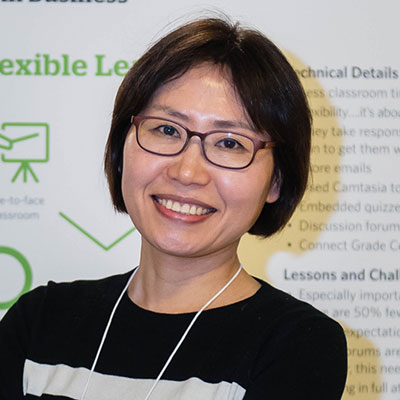
Lauren Margulieux is an Associate Professor of Learning Technologies at Georgia State University in the Department of Learning Sciences within the College of Education & Human Development. She serves as the founding director of the Snap Inc. Center for Computing in Teacher Education, where she coordinates Georgia State University's teacher preparation programs to integrate computing into pre-service teacher training across all disciplines. Her research focuses on computer science education for computing and programming novices, with particular emphasis on promoting computational literacy for all learners. She investigates how to effectively integrate computing into teacher preparation and how to design instructional materials that support novice learners in programming and computational thinking. Her work spans the learning sciences, educational technology, and STEM education, with applications in K-12 teacher preparation and undergraduate computer science education. Margulieux's recent publications reveal a strong focus on instructional design principles for computing education, particularly subgoal labeling, worked examples, and other cognitive load-reducing strategies. Her research examines how these approaches impact learning across multiple STEM disciplines and how spatial skills relate to success in computing. She has also contributed significantly to measurement in computing education research and exploring how to effectively prepare teachers to integrate computing into their classrooms. NSF CAREER Award recipient Principal Investigator on multiple NSF grants totaling over $1.5 million Author of numerous influential publications in computer science education Active contributor to the learning sciences community through blog and professional development As an NSF panelist and CAREER award recipient, Dr. Margulieux actively mentors other researchers in grant writing and research design. She has developed extensive resources for education researchers, particularly those new to the learning sciences, through her blog and professional development activities. Her work bridges theory and practice, connecting foundational learning sciences principles with practical applications in computer science education.