Caterina Cruciani is an Associate Professor at the Department of Management , Venice School of Management , Ca' Foscari University of Venice. She serves as a member of the University Scientific Instrumentation Service Center (CSA) Management Committee and is affiliated with the Research Institute for Social Innovation . Research Interests Trust dynamics in financial advisory Behavioral finance and investor decision-making Sustainability disclosure and ESG integration Digital transformation in financial services Regional economic development and SME financing Agent-based modeling of cooperative behavior Key Article Trends (2009-2024): Span 15 years of research on financial trust (12 publications), behavioral economics (10), sustainability (6), and digital finance (5). Methodologically combines experimental economics , structural equation modeling , and Supervised Topic Modeling for ESG discourse analysis.
Gias Uddin is an Associate Professor at York University's Lassonde School of Engineering and an Adjunct Professor at the University of Calgary . His research bridges Software Engineering (SE) and Artificial Intelligence (AI) , focusing on AI Trustworthiness Assessment (SE4AI) and AI-Driven Productivity Tools (AI4SE) . PhD in Software Engineering & AI, McGill University (2018) MSc in Software Engineering, Queen’s University (2008) BSc in Computer Science & Engineering, Bangladesh University of Engineering and Technology (2004) His research explores: Metamorphic Relations for LLM Hallucination Detection AI-Enhanced Software Documentation Foundational Models for Runtime System Modernization Developer-Centric AI Tooling Recent article trends show expertise in LLM Trustworthiness , Low-Code Platforms , and IoT Developer Communities . Awards include Distinguished Paper at FSE 2025 , multiple IBM Champion recognitions, and York Research Award . He leads the Data Intensive Software Analytics (DISA) Lab and mentors PhD students in SE-AI Intersections .
Michele Cagol is a Professor at the Free University of Bozen-Bolzano , Faculty of Educational Sciences. Their work bridges pedagogy, emotional education, and ecological sustainability, with a focus on relational learning frameworks and multisensory educational practices. Research Themes : Emotional education, educational ecology, sustainability pedagogy, media and communication education, teacher training. Projects : Lead participant in the EU Interreg Alpine Space project FRACTAL , promoting green space awareness in the Alpine region. Recent publications emphasize radical relational pedagogy, ecological ethics, and the role of wonder in learning. Notable methodologies include intra-actionist music composition and microteaching for multilingual competencies. Teaching responsibilities span General Pedagogy , Social Education , and teacher training for primary/middle school contexts.
Gabriella Casalino is an Assistant Professor at the University of Bari Aldo Moro, Department of Computer Science, and a key researcher at CILAB - Computational Intelligence Lab. Her work focuses on Computational Intelligence methods for interpretable data analysis, particularly in eHealth, Data Stream Mining, and eXplainable Artificial Intelligence (XAI) within medical and educational domains. She has contributed to innovative approaches in smartphone-based health monitoring, fuzzy logic applications, and remote vital sign detection via photoplethysmography. Education : Ph.D. in Computer Science, with advanced training at institutions like Universitat de Girona and Université de Mons. Research Trends : Recent publications highlight applications of evolving granular computing, neuro-fuzzy systems, and explainable AI in hypertension prediction, bipolar disorder monitoring, and educational data analysis. Key subfields include remote health monitoring, medical data streams, and hybrid AI models. Grants : Research funded by AIRC (Italian Cancer Research Foundation), focusing on computational methods for healthcare challenges. Labs & Collaborations : Active in CILAB, collaborating on projects involving mHealth solutions, cardiovascular risk assessment, and intelligent educational systems.
Andrea Passerini is a Full Professor in the Department of Information Engineering and Computer Science at the University of Trento, Italy, where he also serves as Coordinator of the PhD programme in Information Engineering and Computer Science (Ministerial Decree 45/2013). His academic footprint spans multiple departments including Mathematics, Sociology, Cellular Biology, and Industrial Engineering, reflecting deep interdisciplinary engagement across computational sciences and life sciences. His research centers on Machine Learning and Data Mining with specialized expertise in Neuro-Symbolic AI , Probabilistic Reasoning , and Statistical Relational Learning . He pioneers methods for graph-based learning, medical AI applications, and explainable systems, with significant contributions to bioinformatics (particularly RNA-protein interactions) and healthcare diagnostics. His work bridges theoretical rigor with practical implementations in critical domains. Analysis of his 2025 publications reveals dominant trends in neuro-symbolic integration for graph data, human-AI collaboration in medical decision-making, and robust recommender systems. His research increasingly focuses on interpretable AI for high-stakes applications like surgical planning and physician support, while advancing foundational techniques in graph neural networks and concept-based modeling. As PhD programme Coordinator, Professor Passerini mentors doctoral candidates across AI and computer science disciplines. His collaborative network extends to medical researchers at CIBIO (Cellular, Computational and Integrative Biology department) and industrial partners, though specific lab structures aren't documented in available materials. Current projects emphasize medical AI validation, temporal network modeling, and LLM integration with structured reasoning frameworks.
Marcella Menegale is an Associate Professor in the Department of Comparative Linguistic and Cultural Studies at Ca' Foscari University of Venice. She is affiliated with the Research Institute for Digital and Cultural Heritage. Her teaching responsibilities include courses on instructional design for language education, theories of language education, and multilingualism, across various degree programs such as Master’s in Languages and Civilizations, and Language Sciences. Her research focuses on multilingual education frameworks (CLIL, intercomprehension), learner autonomy, digital tools in language learning, and well-being in educational contexts. She has contributed to EU-funded projects like DigLit (combating social inequalities via digital tools) and EVAL-IC (evaluating intercomprehension skills). She has also served as an expert evaluator for the European Commission’s Horizon 2020 and ANVUR’s research evaluations. Key research areas include CLIL methodology, learner autonomy development, and the integration of technology in language pedagogy. She collaborates with international teams on projects like Transition from Secondary School CLIL to University EMI (funded by the British Council). Her work bridges theory and practice, addressing challenges in second-language teaching and digital-age curricula.
Alberto Monge Roffarello is an Assistant Professor (RTDb) at the Department of Control and Computer Engineering (DAUIN), Politecnico di Torino, where he is a member of the e-Lite Research Group. He teaches courses including Human-AI Interaction, Digital Wellbeing, and Web Applications across multiple degree programs such as Computer Science and Systems Engineering, Computer Engineering, and Film and Media Engineering. His research centers on Human-Computer Interaction, with a strong focus on Digital Wellbeing and End-User Development in the Internet of Things . He investigates how users can personalize smart environments through trigger-action programming and how design patterns in digital interfaces—such as Infinite Scroll and Never-Ending Autoplay—exploit psychological vulnerabilities to capture attention. His work aims to empower users with tools for self-control, meaningful interaction, and habit mitigation. The recent publications highlight a consistent trajectory in digital self-control tools , attention-aware design , and semantic recommendation systems for IoT. His research bridges theoretical analysis with practical tools, including conversational agents (HeyTAP), debugging platforms (EUDebug, My IoT Puzzle), and ontologies (EUPont) to lower the barrier for non-technical users. Scientific contributions include: Systematic review of digital self-control tools (TOCHI 2022) Typology of Attention-Capture Damaging Patterns (CHI 2023) Design frameworks for meaningful interactions (AVI 2022) Behavioral interventions for smartphone habits (TiiS 2021) He actively supervises PhD students—Francesca Russo, Robert Everett Schwartz, and Luca Scibetta—on topics ranging from AI for education to digital wellbeing in high-schools. His work is supported by competitive research projects such as EMPATHY - Empathetic Mobility Platform . He has contributed to multiple national and international collaborations, notably with Santa Clara University (USA). Alberto leads and participates in research initiatives within the e-Lite - Intelligent and Interactive Systems group, focusing on intelligent interfaces, user empowerment, and ethical design. His lab develops tools that translate high-level user intentions into executable IoT rules, promote digital literacy, and support conscious technology use.
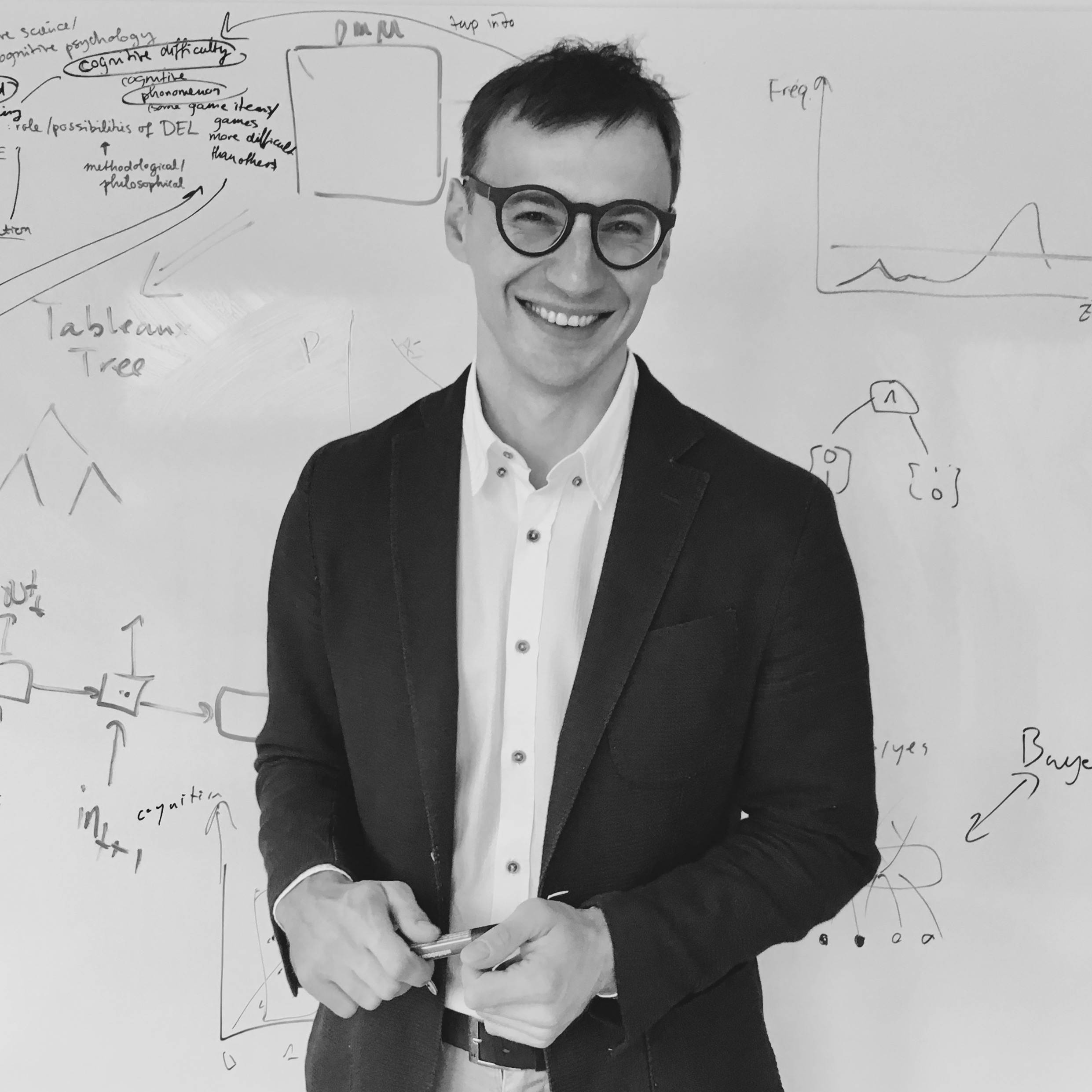
Dr. Jakub Szymanik is an Associate Professor affiliated with the Center for Brain/Mind Sciences and the Computer Science Department at the University of Trento . His research bridges computational modeling, formal logic, and cognitive neuroscience to investigate the relationship between linguistic structures and cognitive processes. Research Focus : Semantic universals, quantifiers, Boolean concepts, and decision-making strategies. Methodology : Combines neural networks, logical complexity analysis, and neurobehavioral experiments. Recent Publications (2020-2023) : Explores quantifier emergence, semantic representation optimization, and computational models of cognitive trade-offs, published in Cognition , Cognitive Science , and Open Mind . Scientific Recognition : ERC Starting Grant: Cognitive Semantics and Quantities NCN Hybrid Reasoning Models NWO VENI Grant: What makes social interactions hard? Research Collaborations : Mentored former group members now at institutions including the University of Washington, Tel Aviv University, and Polish Academy of Sciences.
Federica Burini is a Full Professor of Geography at the Department of Foreign Languages, Literatures and Cultures of the University of Bergamo . She serves as Scientific Coordinator of the Imago Mundi Lab, member of the Center for Territorial Studies, and Scientific Director of OrobieLab. Her academic career spans participatory processes, collaborative mapping, and sustainable territorial regeneration. Full Professor of Geography Imago Mundi Lab Coordinator Center for Territorial Studies member OrobieLab Scientific Director Research Focus : Federica specializes in participatory geography through collaborative mapping techniques for environmental governance in both rural and urban contexts. Her work emphasizes sustainable development in Sub-Saharan Africa and European mountainous regions, with particular attention to landscape valorization via participatory processes and responsible tourism. Key projects include digital co-mapping initiatives for community engagement and territorial regeneration. Participatory mapping tools Sustainable tourism frameworks Mountainous area development Rural community empowerment Digital geospatial applications Landscape perception studies Publications : Recent works explore digital collaborative mapping tools (2024), industrial heritage interpretation for slow tourism (2024), and water resource-driven community regeneration (2024). Earlier contributions examine pandemic impacts on tourism (2020) and participatory cartography methodologies (2016). Her research consistently bridges geographical theory with practical territorial governance solutions.
Fabrizio Falchi is a researcher at the Artificial Intelligence for Media and Humanities (AIMH) Lab of the Institute of Information Science and Technologies (ISTI) within Italy's National Research Council (CNR). He also maintains an associate position at the Biorobotics Institute of Scuola Superiore Sant'Anna. His work focuses on developing advanced multimedia retrieval systems, with the VISIONE platform being his most notable contribution, which has won international competitions including the Video Browser Showdown in 2024 and placed second in 2023. Falchi's educational background includes: Ph.D. in Information Engineering from University of Pisa (Italy) Ph.D. in Informatics from Faculty of Informatics of Masaryk University of Brno (Czech Republic) M.B.A. from Scuola Superiore Sant'Anna in Pisa His research spans deep learning, convolutional neural networks, deep features extraction, similarity search algorithms, distributed indexing systems, multimedia information retrieval, computer vision applications, and peer-to-peer systems. Falchi has made significant contributions to fine-grained visual understanding, cross-modal retrieval (particularly image-text matching), and robustness of deep learning systems against adversarial attacks. His work demonstrates a strong focus on practical applications of these technologies, particularly in video retrieval systems and safety monitoring solutions. Analysis of Falchi's recent publications reveals a strong focus on video and image retrieval systems, with the VISIONE platform being central to his work. His research shows increasing emphasis on fine-grained understanding in computer vision, cross-modal retrieval, and addressing practical challenges like cross-resolution face recognition. Recent work demonstrates innovation in making these systems more efficient through techniques like knowledge distillation (ALADIN) and leveraging virtual worlds for training data. His publications consistently bridge theoretical advances with practical applications in surveillance, safety monitoring, and multimedia search. Falchi's work has received significant recognition: Best paper award at CBMI 2024 for 'Is ClLIP the main roadblock for fine-grained open-world perception?' VISIONE 2024 won the Video Browser Showdown competition in Amsterdam VISIONE obtained second place at Video Browser Showdown 2023 in Bergen Best Paper Award for 'Learning Safety Equipment Detection using Virtual Worlds' at CBMI 2019 Falchi collaborates extensively with researchers at ISTI-CNR, particularly within the AIMH Lab. His work on VISIONE involves collaboration with Giuseppe Amato, Paolo Bolettieri, Fabio Carrara, Claudio Gennaro, Nicola Messina, Lucia Vadicamo, and Claudio Vairo. As co-chair of Ital-IA 2023, the 3rd National Conference on Artificial Intelligence, he plays an active role in the academic community. He is a member of ACM (since 2012), the Computer Vision Foundation, the Italian Association for Computer Vision Pattern Recognition and Machine Learning (CVPL), and the CINI Lab on Artificial Intelligence and Intelligent Systems. Falchi is a key member of the Artificial Intelligence for Media and Humanities (AIMH) Lab at ISTI-CNR, where he leads research on video retrieval systems. The lab has developed the award-winning VISIONE platform, which combines multiple scientific results in content-based video retrieval. His team focuses on developing systems that enable users to search for target videos using textual prompts, drawing objects and colors, or images as query examples. The lab's work demonstrates strong interdisciplinary collaboration, bridging computer science with practical applications in media, safety monitoring, and urban environments.
Dr. Anh Nguyen Nguyen Duc serves as Full Professor at the University of South-Eastern Norway and the Norwegian University of Science and Technology (NTNU), with visiting scholar positions across Norwegian, Finnish, Italian, and Vietnamese institutions. His academic work centers on software engineering with emphasis on human, process, and ecosystem dimensions of development. Education: MS: Technical University of Kaiserslautern and Blekinge Institute of Technology (double degree) PhD: Norwegian University of Science and Technology Research fingerprint analysis reveals dominant focus on software startups (27%), supplemented by software processes (6%) and engineering education (5%). His expertise spans cybersecurity, global software development, business-driven methodologies, and software analytics, consistently addressing human-organizational challenges in dynamic development environments. Recent publications (2024-2025) demonstrate accelerating integration of AI in software engineering, particularly through large language models for startup assistance, generative AI adoption frameworks, and autonomous agent systems. Concurrently, he investigates risk management in software ventures and fairness in educational ML applications, reflecting interdisciplinary work bridging software engineering with business, AI ethics, and educational technology.
Tommaso Feraco is an Assistant Professor at the University of Padova , focusing on the intersection of education , psychology , and behavioral science . His work examines how social, emotional, and behavioral skills (SEBS) influence academic performance, well-being, and developmental outcomes across diverse populations, including adolescents, adults, and individuals with specific learning disabilities. Research trends highlight his contributions to character strengths , self-regulated learning , and adaptability in educational contexts. He has also developed methodological tools to address clustering analysis limitations in data science. His recent publications investigate SEBS applications in career readiness , pro-environmental behavior , and mental health resilience .
Prof. Rocco OLIVETO is a Full Professor at the University of Molise, affiliated with the School of Biosciences and Territory. His research spans software engineering, artificial intelligence, cybersecurity, and healthcare technology. He focuses on empirical studies of developer practices, AI-driven code analysis, vulnerability detection in smart contracts, and human-centric computing. His work also addresses challenges in game development, mobile app optimization, and wearable health monitoring systems. Notable research areas include code readability assessment, machine learning applications in healthcare diagnostics, and the effectiveness of AI tools like GitHub Copilot. He has contributed to projects like QualAI (continuous quality improvement for AI systems) and 2Vita-B (cognitive and physical rehabilitation systems). His empirical studies often bridge academic research with real-world developer workflows, emphasizing practical applicability. Prof. Oliveto's recent work explores topics such as automated gameplay analysis for game debugging, detection of engagement issues in video games, and robust methods for identifying security vulnerabilities. He has also investigated Dockerfile quality, developer frustration metrics, and the ethical implications of AI in administrative document simplification.
Paolo Bussotti is an Associate Professor of History of Science and Technology at the University of Udine's DIUM department. His academic career includes roles at Ludwig Maximilian University (Munich), Bayerische Akademie der Wissenschaften, and Berlin-Brandenburg Academy of Sciences through Humboldt Fellowships. He holds a PhD in Historical Sciences from the University of San Marino (1996). Education : Bachelor of History of Science and Technology, University of Pisa (1991) PhD in Historical Sciences, University of San Marino (1996) Research Interests : 17th-Century Physics/Astronomy (Kepler, Galileo, Descartes, Leibniz, Newton) Mathematics History: Number Theory (Fermat-Gauss), Projective Geometry Philosophy of Mathematics: Foundations at the turn of the 20th century Science Education: Integrating history into math teaching Key Projects : Galileo's Sidereus Nuncius translation (2001) Kepler Commission collaboration (2005) Enriques Study Center directorship (2008-2010) Grants/Awards : Three Humboldt Fellowships (2003, 2013-2014, 2019) Research grants from DIUM and DMIF (Udine) Labs/Teams : Collaborations with Munich Center for Mathematical Philosophy, Berlin-Brandenburg Academy, and Bayerische Akademie der Wissenschaften.
Emiliano Morreale is a Full Professor at Sapienza University of Rome, where he teaches in the Department of Modern Literature and Culture within the Faculty of Humanities. His academic career spans multiple prestigious Italian institutions, having previously served as a Permanent Researcher at both the University of Turin (2011-2015) and Sapienza University of Rome (2015-2020) before his promotion to Professor. His teaching portfolio includes courses such as Theories and Languages of Cinema, History of Cinema, Literature and Cinema, Italian Cinema Forms and Models, and Cinematic Language. Dr. Morreale earned his undergraduate degree from the University of Pisa (1996/1997) and completed his PhD at the University of Teramo in 2009. His scholarly trajectory demonstrates a consistent focus on Italian cinematic culture, evolving from early research on individual filmmakers to broader cultural and historical analyses of Italian cinema. Morreale's research interests center on Italian cinema history with particular emphasis on popular genres, cultural history, melodrama, and nostalgia. His work explores the intersection of cinema with literature, regional Italian identities, and social history. He has made significant contributions to understanding mafia movies, neorealism, and the relationship between Italian cinema and national identity formation. His research demonstrates how cinematic representations reflect and shape cultural memory, particularly regarding southern Italy and post-war Italian society. His extensive publication record reveals a consistent focus on Italian film history, with particular attention to genre studies, director analyses, and the relationship between cinema and broader cultural phenomena. Morreale's work spans from early cinema to contemporary productions, with a distinctive focus on how Italian cinema has represented social change, regional identities, and historical memory. His recent publications increasingly examine gender representation, transnational reception, and the evolving landscape of Italian cinema in the digital age. Premio 'Maurizio Grande' miglior libro di cinema dell'anno (2006) for 'Mario Soldati. Le carriere di un libertino' Premio 'Lo straniero' (2006) for 'Mario Soldati. Le carriere di un libertino' Premio speciale 'Efebo d'oro' miglior libro di cinema dell'anno (2009) for 'L'invenzione della nostalgia' Premio 'Domenico Meccoli' miglior libro di cinema dell'anno (2015) for 'Il cinema di Claudio Gora' Premio 'Diego Fabbri' dell'Ente dello spettacolo per il miglior libro di cinema dell'anno (2015) for 'Racconti di cinema' (with Mariapaola Pierini) Morreale has secured significant research funding through national and international projects, including the PRIN-funded 'CinCit (International Circulation of Italian Cinema)' and 'F-ACTOR. Forme dell'attorialità mediale contemporanea.' He has directed numerous academic conferences focusing on Italian cinema, including events dedicated to The Leopard, Pietro Germi, neorealism, and Mario Soldati. His institutional leadership extends to serving on editorial boards for major film journals and directing publication series such as 'Quaderni della Cineteca Nazionale.' His research supervision has fostered numerous scholarly collaborations and contributed significantly to the field of Italian film studies. Beyond his university responsibilities, Morreale has held significant roles in Italy's cultural institutions, notably serving as Conservatore at the Cineteca Nazionale (2013-2016). His work bridges academic scholarship with cultural preservation, demonstrating commitment to both theoretical analysis and practical engagement with film heritage. His involvement with the 'Il cinema ritrovato' festival programming committee further illustrates his dedication to film preservation and historical contextualization.