Dr. Lin Wencheng is a distinguished academic and policy expert serving as a Professor and Dean of the College of Social Sciences at National Sun Yat-sen University. He holds adjunct roles at institutions such as Central Police University and Kaohsiung Medical University. His expertise spans Chinese diplomacy, U.S. foreign policy, cross-strait relations, Asia-Pacific security, and crisis management. He earned his PhD from the Fletcher School of Law and Diplomacy, Tufts University. His career includes leadership roles such as Director of the Institute of China and Asia-Pacific Studies and Dean of the College of Social Sciences. He advises Taiwan’s National Security Council and chairs the Contemporary Japanese Studies Association. Research focuses on cross-strait negotiations, PLA military strategy, UN security reforms, and China’s maritime ambitions. Notable works include analyses of U.S.-China-Taiwan dynamics, ASEAN security mechanisms, and counter-terrorism strategies. He has authored over 50 journal articles and books on topics ranging from Taiwan’s international status to China’s human rights policies. Awards include the National Science Council’s Class A Research Awards and the Phi Beta Kappa honor society membership. Current projects include studies on China’s maritime expansion and Indo-Pacific competition. His contributions extend to policy roles such as Control Yuan supervisory member and advisory positions in think tanks like the Asia Pacific Peace Research Foundation.
George K. Zestos is a Professor of Economics and Jean Monnet Chair of European Integration at Christopher Newport University, Virginia. He holds a Ph.D. in Economics from Indiana University (1990), an M.A. from Michigan State University, and a B.A. in Economics-Political Science from Saginaw Valley State University. Education: Ph.D. in Economics, Indiana University M.A. in Economics, Michigan State University B.A. in Economics-Political Science, Saginaw Valley State University His research focuses on international economics, European integration, applied econometrics, and macroeconomic policy. He has extensively published in journals like Journal of Economic Integration and Atlantic Economic Journal , with recent work on inflation dynamics in U.S. metropolitan areas and nonlinear ARDL models for Germany's public debt. He has collaborated with scholars from China, Canada, and Greece. Scientific Awards: Jean Monnet Chair (2010) Research Award, International Academy of Business and Public Policy (2014) Best Paper, Global Research Conference (2017) CNU Faculty Award for Scholarship (2018) He has mentored students in research projects and explores topics like the Eurozone crisis, Chinese economic growth, and export dynamics in Germany and Japan.
Alessandro Mantelli serves as an Adjunct Professor at the Department of Asian and North African Studies, Ca' Foscari University of Venice. He specializes in Japanese language education with a focus on integrating technology into pedagogical practices. His research emphasizes sustainable e-learning systems, virtual reality applications, and digital tools for language acquisition. Mantelli teaches Japanese language courses at both undergraduate and postgraduate levels, including 'Lingua Giapponese' modules and 'Informatica (Giappone)' for specialized programs. Key contributions include the development of the JALEA e-learning platform, the Kanji Game application, and VR-based language learning tools. His work on the Bunparser system and the ITADICT dictionary project highlights expertise in computational linguistics and educational software. Recent publications address translation pedagogy, sustainable curriculum design, and advanced kanji learning strategies. Teaching responsibilities span multiple academic years across language proficiency courses, with a focus on structuring authentic learning experiences through technology. His research bridges language education theory with practical software development, aiming to enhance accessibility and engagement in Japanese language studies.
Kostiantyn Ovsiannikov is an Assistant Professor at Kochi University of Technology and a part-time lecturer at the Transdisciplinary Course Program (TRACS), Eberhard Karls Universität Tübingen. He is also an associate researcher at the Fondation France-Japon de l’EHESS (FFJ), contributing to the theme 'Asian Capitalisms: Diversity and Institutional Change.' He holds a Ph.D. in Political Economy and Japanese Studies from the University of Tsukuba (2018), an M.A. in Global Political Economy from the University of Kassel (2014), and a B.A. in Political Science from the National University of Kyiv-Mohyla Academy (2011). His research focuses on labor economics, experimental economics, and political economy. Current projects include examining market perception of corporate innovations in Japan (funded by JSPS Grant-in-Aid for Young Scientists) and analyzing the impact of telework on productivity and job satisfaction. Notable publications include studies on shareholder-value ideologies, corporate governance reforms, and pandemic-related socioeconomic impacts in Indonesia. He has received the 2018 FFJ/SASE Best Paper Award and the 2021 European Commission Seal of Excellence. His teaching includes courses on data analysis, labor market dualism, and economics fundamentals. He collaborates with institutions like the FFJ and employs experimental methods (e.g., oTree) for research. His software skills include statistical analysis, GIS, and text mining tools.
Ryan Gibbs is an Adjunct Instructor in the Live Experience Design program at Pennsylvania College of Art & Design (PCA&D), where he contributes his extensive professional expertise in live theater and entertainment. He is actively engaged in both education and professional practice, bringing real-world experience into the academic environment. His research and professional interests center on live experience design, theatrical direction, stage management, and creative project leadership. With over 20 years in the industry, Ryan has worked on major Broadway productions such as Rent , Wicked , Avenue Q , Harry Potter and the Cursed Child , and School of Rock , and has served as Production Stage Manager, Assistant Director, and Production Supervisor on national and international tours, including Japanese and Austrian productions of Mary Poppins . Ryan has held leadership roles such as Artistic Director of the Allenberry Playhouse and current Producing Artistic Director of the Totem Pole Playhouse. He also founded Gibbsology, a coaching and consulting firm that supports individuals in personal project management, workplace narrative development, and freelance career growth, leveraging his experience working with high-profile creatives like Andrew Lloyd Webber and Disney Theatrical Group. His professional engagements reflect a strong trend in experiential storytelling, production leadership, and creative problem-solving across live entertainment, education, and personal development. Adjunct Instructor, Live Experience Design, PCA&D Producing Artistic Director, Totem Pole Playhouse Former Artistic Director, Allenberry Playhouse Producer, Broadway Cares/Equity Fights AIDS (4 years) Founder, Gibbsology (coaching & consulting) Co-owner, Retrosplat! (nostalgia retail) Ryan is a graduate of Marywood University and Kennard Dale High School. He lives in Lancaster, Pennsylvania, with his wife Amy and their two sons, Anderson and Benjamin.
Michael Eastwood is a faculty member at VanderCook College of Music. He holds an MA in Japanese History from the University of Chicago, an MA in Education from Kyoto University, and a BA in Japanese Studies from Harvard University. His research focuses on how modern monetary systems influence political dynamics and popular power. He teaches NeuroMovement, a practice he developed post-traumatic brain injury (TBI) in 2008, aiding musicians in recovering from repetitive stress injuries and refining techniques. Eastwood also advises graduate students in writing at the University of Chicago and the Institute for Clinical Social Work, and co-founded WritetoDo, a startup supporting project management and team collaboration. Education: BA in Japanese Studies, Harvard University MA in Japanese History, University of Chicago MA in Education, Kyoto University Roles: Teaches in Threat and Response Management MS program (University of Chicago) Advises at Institute for Clinical Social Work Co-Founder of WritetoDo Eastwood’s expertise in embodied intelligence and NeuroMovement addresses both physical rehabilitation for musicians and broader educational writing strategies. He has trained CPS teachers for National Board Certification and contributed to Chicago incubators.
Roslyn Appleby is a Casual Academic at the University of Technology Sydney (UTS), affiliated with the Faculty of Arts and Social Sciences. She holds a PhD and multiple advanced degrees in Linguistics, Education, and Architecture. As an Industry Fellow (honorary) with the School of International Studies and Education, her work bridges applied linguistics, gender studies, and posthumanism. Her research focuses on the intersections of language, gender, sexuality, and power, with notable publications on postcolonial feminist geographies, human-animal relationships, and masculinities in global English language teaching. Key books include Men and Masculinities in Global English Language Teaching (2014) and Sexing the Animal in a Posthumanist World (2019). She has been funded for projects exploring posthumanism and human-animal ethics, and her teaching spans multiliteracy, academic English, and research methodologies. Education: PhD (UTS), MA (Language and Literacy), DipEd (Visual Arts), BSc (Architecture) Research Interests: Posthumanism, gender politics, TESOL, critical applied linguistics, postcolonialism Her funded research includes studying gender dynamics in English teaching in Japan and posthumanist approaches to ecological pedagogy. She advises on Masters/PhD supervision and contributes to interdisciplinary debates on language, power, and global development.
Antonio Manieri is an associate professor at the University of Naples L'Orientale, Department of Asia, Africa and Mediterranean, specializing in Japanese Philology. He teaches Ancient and Medieval Japanese Civilization and the Japanese Language. His academic work focuses on historical Japanese documents, particularly from the Nara period (8th-10th centuries), with emphasis on bureaucratic and geographical texts and their role in early Japanese state formation. Manieri earned his PhD in Japanese Philology from Daito Bunka University (Tokyo) in 2012, with a thesis on practical documents, terminology, and literature related to horses in Japan during the "State of Codes" (8th-10th centuries). His educational journey includes extensive research periods in Japan supported by prestigious fellowships, demonstrating his deep engagement with Japanese language and culture. His research interests span Japanese Philology, Ancient and Medieval Japanese Civilization, and historical documents of Japan. Manieri specializes in fudoki (geographical-bureaucratic texts), court protocols, and technical education systems of the Nara period. His work reveals how multilingual aspects of early Japanese documents reflect complex administrative structures and cultural exchanges between Japan and continental Asia. He examines how Japanese officials incorporated Chinese writing systems while maintaining indigenous terminology, providing insights into Japan's early state formation processes. Analysis of Manieri's recent publications shows a consistent focus on historical Japanese documents from the 8th-10th centuries, particularly bureaucratic and geographical texts. His work demonstrates expertise in translating and interpreting complex historical materials, with emphasis on multilingualism in early Japanese documents. A recurring theme is how geographical knowledge was used for political control in ancient Japan, revealing the connection between administrative structures and cultural development during the Nara period. Manieri has received numerous scientific awards and fellowships: Japan Foundation fellowship (2004) MEXT fellowships (2007-2009 and 2009-2012) Research fellowship at the Institute for Research in Language Teaching in Tokyo (2006) Research grant at the University of Naples L'Orientale (2014-2018) Japan Foundation Japanese Studies Fellowship 2023 Monbukagakushō shōgakukin (2007, 2009) Manieri actively participates in academic service, serving on editorial boards for journals such as "LE FORME E LA STORIA," "LINGUE E LINGUAGGI," and "IL GIAPPONE." He has been involved in multiple research projects including PRIN 2022 "Environmental Anomalies & Political Legitimacy in Global Eurasia, 12th-14th century" and JSPS Grant-in-Aid for Scientific Research. His academic leadership extends to organizing international symposia on Japanese language education and historical documents. Manieri is a member of several research centers (CESET, CETEFIL, CSAO) and international research projects (PRIN, KAKEN). He participates in the "Senchū Wamyōruijushō Study Group" (Tokyo/Kyoto) and is part of the Classical Japanese-English Digital Dictionary Concept Development Team (Yanai Initiative, UCLA/Waseda). These affiliations demonstrate his integration into both Italian and international academic networks focused on Japanese studies and philology.
Tomohiko Inomata is a Professor at Nagoya Institute of Technology, specifically in the Division of Life and Material Chemistry within the Department of Life and Applied Chemistry, Graduate School of Engineering. His research spans multiple interdisciplinary fields at the intersection of chemistry, materials science, and biochemistry, with a particular focus on nanotechnology applications. Dr. Inomata received his Doctor of Science degree from Hokkaido University in 2000, following completion of both his Master's Course (1997) and Doctor's Course at the Graduate School of Natural Science, Hokkaido University. He completed his undergraduate studies at Hokkaido University's Faculty of Science, graduating in 1995. Professor Inomata's research interests primarily focus on nanotechnology and materials science, with specific expertise in biochemistry, inorganic chemistry, and coordination chemistry. His work centers on the development of functional materials and devices, particularly those involving ionic liquid-modified substrates, artificial siderophores, and metal complexes. He has pioneered research in microbial detection technologies using artificial siderophore-FeIII complex-modified substrates, as well as the development of high-efficiency catalyst materials and sensing devices for volatile organic compounds. His research has significant implications for environmental monitoring, healthcare diagnostics, and renewable energy technologies. Analysis of Professor Inomata's recent publications reveals a strong focus on interdisciplinary research at the chemistry-materials-biology interface. His work demonstrates consistent innovation in developing novel metal complexes for catalytic applications, particularly involving iron and nickel complexes. A significant portion of his research involves the application of ionic liquids to modify electrode surfaces for improved performance in energy conversion devices like dye-sensitized solar cells and CO2 reduction systems. Another major theme is the development of artificial siderophores for microbial detection and fuel cell applications, showcasing his ability to bridge fundamental chemical research with practical technological solutions. 9th Wakasyachi Prize (2015) from Aichi Prefecture, Science and Technology Exchange Foundation, and Hibi Science and Technology Promotion Foundation Professor Inomata has successfully secured numerous research grants, including multiple Grants-in-Aid for Scientific Research from the Japanese government. His current projects include 'Development of Microbe Fuel Cell using artificial siderophores' (2019-present) and 'Surface Spectroscopic Analysis of Fundamental Factors that Promote Catalytic Reactions by Ionic Liquid-Modified Electrodes' (2021-2024). He also leads the Aichi Prefecture 'Knowledge Hub Aichi Key Research Project IV' focused on developing E. coli detection technology and devices using artificial siderophore technology (2022-2025). His research team collaborates extensively with industry partners including DENSO Corporation and Tsuzuya Corporation, demonstrating the practical applications of his fundamental research. Professor Inomata's laboratory focuses on the development of functional electrodes using ionic liquid-modified substrates, artificial siderophore technologies for microbial detection, and novel catalyst materials. His team works at the intersection of inorganic chemistry, materials science, and biochemistry, creating innovative solutions for energy conversion, environmental monitoring, and healthcare applications. Current projects include the development of rapid and highly sensitive microbial detection technology using artificial 'bait' modified substrates, as well as high-functionality electrodes for microbial fuel cells.
Professor Kanako Ishizuka is a faculty member at Nagoya Institute of Technology's Health Center, where she serves as Director of the Health Center and Head of the Disability Student Support Division. With a Doctor of Medicine from Nagoya University (2017), she specializes in child and adolescent psychiatry, clinical genetics, and special needs education. Her educational background includes: April 2014 - March 2017: Nagoya University Graduate School of Medicine April 1998 - March 2004: Nagoya University, School of Medicine Professor Ishizuka's research focuses on genetic counseling, neurodevelopmental disorders, ADHD, gene-environment interactions, and special needs education. She applies informatics to life and health sciences, with particular expertise in medical technology assessment, genetics, psychiatry, and special needs education. Her work bridges clinical practice with research to improve understanding and treatment of developmental disorders. Her publication record demonstrates a strong focus on autism spectrum disorders, ADHD, depression assessment using AI technologies, and genetic factors in mental health. She has pioneered research in using machine learning algorithms for depression severity assessment and has conducted significant work on prescription patterns for psychiatric medications in Japanese populations. Her notable awards include: Nagoya Institute of Technology Staff Award (2023) 2017 International Conference Presentation Encouragement Award (2018) Nagoya University President's Award (2003) Professor Ishizuka has secured multiple research grants, including a Japan Society for the Promotion of Science Grant-in-Aid for Early-Career Scientists (2020-2025) for research on autism spectrum disorders originating from comorbid anxiety disorders. She also serves as Principal Investigator for several projects related to psychiatric disorders and genetic research. She actively contributes to various committees including the Aichi Prefectural Mental Health Review Board, the National University Health Management Association, and the Nagoya City Education Board's Bullying Countermeasures Discussion Committee. Her work extends to community service as a special needs education supervisor and advisor to various child development centers.
Makoto Iwata serves as Professor in the Department of Physical Engineering within the Faculty of Engineering at Nagoya Institute of Technology, where his research centers on ferroelectric phenomena, dielectric properties, and structural phase transitions in condensed matter systems. His experimental work focuses on electric field-induced critical behavior in crystals and liquid crystals, utilizing advanced characterization techniques including scanning force microscopy and X-ray fluorescence holography. He earned both his Master of Engineering (1991) and Doctor of Engineering (1994) degrees from Nagoya University, where he subsequently served as Research Assistant from 1994 to 2001 before joining Nagoya Institute of Technology. Professor Iwata's research program investigates field-driven phase transitions in complex oxides and liquid crystals, with particular emphasis on relaxor ferroelectrics, crystal growth of perovskite materials, and the development of tunable dielectric devices. His experimental approach integrates dielectric spectroscopy, structural analysis, and phase diagram mapping under electric fields to understand critical phenomena near morphotropic phase boundaries. Analysis of his publication record reveals consistent high-impact output spanning ferroelectric critical endpoints, aging effects in relaxor systems, and electric field manipulation of liquid crystal phases. The work demonstrates strong methodological coherence across condensed matter physics and materials science, with recent efforts focusing on KTN solid solutions and nematic liquid crystals exhibiting positive dielectric anisotropy. His honors include the JPEX/JJAP Editorial Contribution Award (2009) and consecutive Excellent Teacher Awards from Nagoya Institute of Technology (2016, 2018). JPEX/JJAP Editorial Contribution Award (2009) Excellent Teacher Award (2016) Excellent Teacher Award (2018) Professor Iwata currently leads a JSPS Grant-in-Aid for Scientific Research (C) project (2024-2028) on temperature-electric field-concentration phase diagrams in KTN crystals for tunable capacitor applications, while collaborating as Co-investigator on a Grant-in-Aid for Scientific Research (B) (2022-2026) developing 3D structural analysis of piezoelectric materials via X-ray holography. His academic leadership includes service as Associate Editor of the Journal of the Physical Society of Japan (2018-2025), committee roles in the Dielectric Society of Japan (including chairing the Best Young Researcher Award committee), and membership in the Japanese Physical Society and Applied Physics Society of Japan. He actively engages with the broader community through high school outreach programs including model lectures and hands-on physical engineering demonstrations at Nagoya Institute of Technology.
Naoto Kamata is a Professor at the Graduate School of Agricultural and Life Sciences, The University of Tokyo, specializing in forest science with a focus on plant-fungi-insect interactions and forest ecosystem dynamics. His research centers on population dynamics of forest insects including defoliators, seed insects, and ambrosia beetles, with emphasis on Japanese oak wilt and beech ecosystems. He investigates phenological relationships influencing tree mortality, water physiology, and pathogen transmission, while developing innovative monitoring methodologies using environmental DNA, hyperspectral imaging, and multi-sensor systems for sustainable forest management. Professor Kamata has secured substantial research funding through Japan's Grant-in-Aid program, leading projects on ambrosia beetle-induced tree mortality mechanisms (2016-2018), natural landscape conservation approaches (2020-2022), and current studies (2022-2025) examining phenology in plant-fungi-insect interactions driving Japanese oak wilt mortality. His work bridges theoretical ecology with practical forest health monitoring solutions.
ABE Hiroyuki serves as a Lecturer at the Graduate School of Medicine, The University of Tokyo, specializing in Human Pathology with dual expertise in molecular oncology and forensic imaging. His work bridges cancer pathology and radiological sciences, focusing on Epstein-Barr virus mechanisms and postmortem diagnostic innovation. His research portfolio spans: EBV-associated gastric cancer pathogenesis with emphasis on chromatin remodeling complexes (ARID1A) and miRNA dysregulation Development of autopsy imaging protocols for forensic radiology and cause-of-death determination AI-driven pathological analysis of gastrointestinal cancers using deep learning methodologies Integration of molecular pathology with radiological diagnostics for clinical and forensic applications These interconnected domains reflect his commitment to advancing diagnostic precision in both oncology and medico-legal contexts. Dr. ABE directs multiple Japanese Grant-in-Aid projects including principal investigations into gastric cancer immune interactions (2018-2020) and AI pathology development (2023-2025), while co-leading pioneering work on postmortem CT diagnostics (2020-2028). His sustained funding since 2014 demonstrates significant research impact despite the absence of explicitly listed scientific awards in available records. Current initiatives focus on establishing standardized autopsy imaging frameworks and machine learning systems for gastrointestinal cancer diagnosis, with upcoming projects extending through 2028 to refine hospital death diagnostics using advanced radiological techniques.
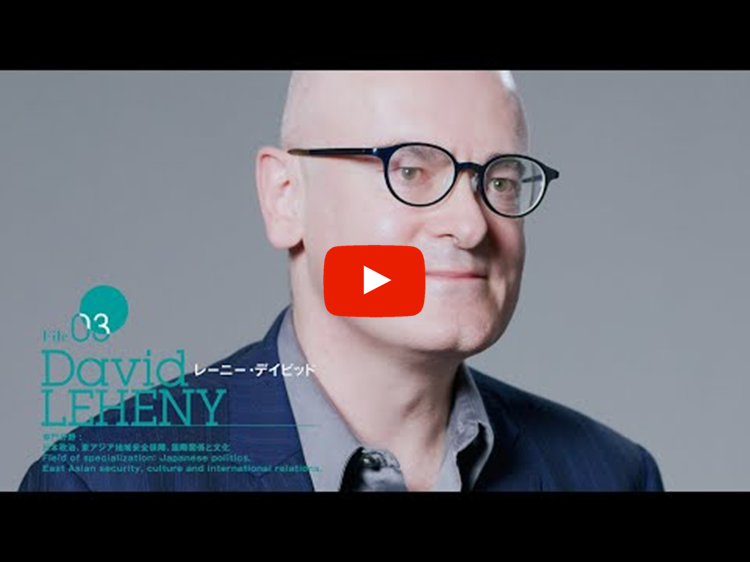
David Leheny is Professor in the Graduate School of Asia-Pacific Studies at Waseda University in Tokyo. Previously he held faculty positions at the University of Wisconsin-Madison (Assistant & Associate Professor of Political Science) and Princeton University (Henry Wendt III ’55 Professor of East Asian Studies). He is also listed as an affiliated member of Cornell’s Society for the Humanities and the College of Arts and Sciences. Education Ph.D. in Government, Cornell University (1998) M.A. in Government, Cornell University (1994) B.A. in Government, Wesleyan University (1989) Research Focus Leheny’s work integrates political science, cultural studies, and area studies to examine how culture, affect, and narrative shape politics in East Asia—especially Japan. His current project, “Scaling Affects: Digital Garden Cities and Imagining Lives in Contemporary Japan,” investigates the affective politics of Japan’s new rural-repopulation schemes, analyzing how policy discourse reimagines rural towns as scaled-down versions of metropolitan life. He also explores cases such as the 2020 Tokyo Olympics and the 2022 state funeral of Abe Shinzō to interrogate the intersection of emotion, narrative, and political legitimacy. Publications & Impact Leheny is the author of three monographs with Cornell University Press— Empire of Hope: The Sentimental Politics of Japanese Decline (2018), Think Global, Fear Local: Sex, Violence, and Anxiety in Contemporary Japan (2006), and The Rules of Play: National Identity and the Making of Japanese Leisure (2003)—and co-editor of Japanese Aid and the Construction of Global Development (Routledge, 2010). His dozens of journal articles and book chapters have advanced debates on Japanese politics, East-Asian security, and the cultural dimensions of international relations. Honors & Fellowships Council on Foreign Relations International Affairs Fellowships Harvard U.S.–Japan Advanced Research Fellowship Smith Richardson National Security Fellowship Abe Fellowship Chancellor’s Distinguished Teaching Award (UW-Madison) Toshiba International Prize Cotsen Faculty Fellowship (Princeton) Toyota Visiting Professorship (University of Michigan) Service & Professional Roles Leheny serves as co-editor (with Amitav Acharya) of the Studies in Asian Security series at Stanford University Press and sits on the editorial board of the American Political Science Review . He has held advisory roles for the Japan Foundation and the Institute of Social Science at the University of Tokyo, and previously worked as a Regional Affairs Officer for Counterterrorism at the U.S. Department of State.
Yoshimi Kikuchi is a Professor at Waseda University's Faculty of Law, specializing in Social Security Law. She holds a Doctor of Laws from Hokkaido University and has maintained continuous academic appointments since 1992, progressing from Research Fellow to her current professorship. Her professional memberships include the Japan Pension Society, Japan Labor Law Association, Japanese Society of Social Security Law, and Japan Adult Guardianship Law Association. Professor Kikuchi's research focuses on Social Security Law, Pension Systems, Healthcare Law, and Disability Law. Her scholarship examines the legal frameworks governing social welfare, with particular attention to sustainability, disaster response, and the evolving needs of Japan's aging population. She has extensively analyzed pension reform, medical insurance systems, and the intersection of law and social policy in contemporary Japan. Her recent publications demonstrate consistent scholarly output examining current issues in social security, including disaster victim support, pharmaceutical coverage, foreign residents' access to healthcare, and community-based approaches to social welfare. Her work bridges theoretical legal analysis with practical policy considerations, often providing commentary on contemporary social issues through regular contributions to professional journals. 1st Japan Social Security Law Association Encouragement Award (1999) 12th Yoshimura Award (1998) Professor Kikuchi teaches Social Security Law courses at both undergraduate and graduate levels, including specialized seminars. Her research projects address sustainable social security systems, with particular focus on post-disaster communities and population decline challenges. She has led interdisciplinary studies examining human rights indicators in social security and conducted comparative research on welfare systems internationally, including a study period at UCLA from 2003-2005.