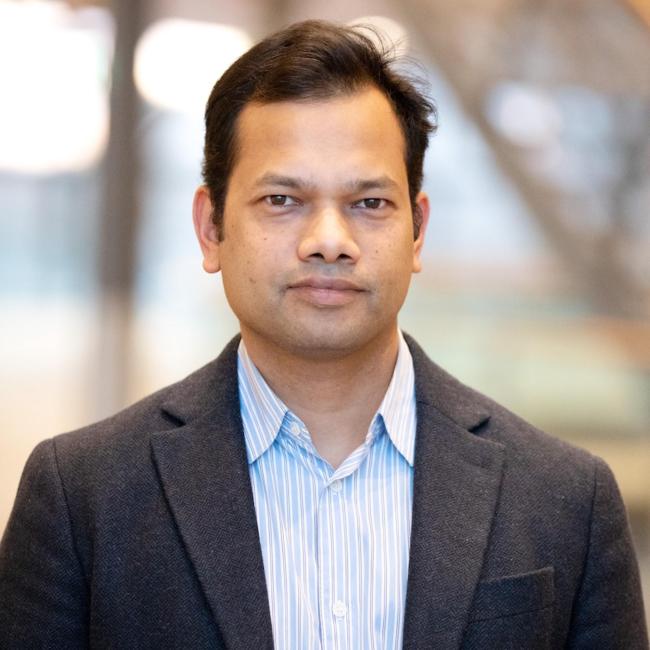
Professor Ranjana Das holds a Professorship in Sociology at the University of Surrey's School of Social Sciences. She serves on the University Senate and the Research and Innovation Committee. Her research focuses on technology use, digital datafication, and their intersections with parenthood, families, and media audiences. With a PhD from LSE (2011), she previously held roles at the University of Westminster and Royal Holloway. Key areas include user-centric algorithm studies, digital parenting practices, and media literacy. She leads the Leverhulme Trust-funded project on news use and chairs the Communication and Technology division at the International Communication Association. Her teaching includes digital sociology, media power, and platform societies. Education: PhD/MSc in Media/Communications (LSE), MA in Mass Communication (New Delhi), BSc in Geography (University of Calcutta). Awards and grants include Leverhulme Trust funding and roles in major academic associations. She supervises PhD topics in digital sociology, parenthood, and media technologies.
Nikhil Kalyanpur is an Assistant Professor in the Department of International Relations at the London School of Economics and Political Science (LSE). His research focuses on economic statecraft, business-government relations, and global governance, exploring how legal frameworks and institutional mechanisms are used for geostrategic purposes. He holds a PhD in Government from Georgetown University and completed a postdoctoral fellowship at Princeton University’s Niehaus Center for Globalization and Governance. His work has been published in leading journals such as International Organization and Perspectives on Politics. Key research interests include the role of domestic institutions in international politics, the proliferation of global rules as tools for economic protectionism, and the intersection of law, finance, and governance. His publications analyze topics such as sanction spillover effects, transnational legal authority, and the financialization of international law. Kalyanpur’s academic trajectory includes a BA in Philosophy, Politics, and Economics from Brown University and early career work at Harvard Business School. He has contributed to policy debates on economic coercion, elite strategies, and the paradoxes of global governance. Despite no explicitly listed awards, his prolific publication record reflects sustained scholarly impact in international political economy.
Jos Darling is a Senior Lecturer in the Department of Mechanical Engineering at the University of Bath, specializing in vehicle dynamics and engineering education. He serves as Undergraduate Admissions Tutor and has held leadership roles including Director of Teaching for 20 years. His research focuses on hydraulic systems, active suspensions, tilting three-wheeled vehicles, and innovative teaching methods. Education: PhD in Mechanical Engineering (pressure ripple in hydraulic pumps), followed by industry experience in automotive engineering. Research Interests: Vehicle dynamics (active suspensions, tilting vehicles), hydraulic actuation systems, and game-based learning in engineering education. His work addresses urban mobility solutions, durability loads prediction, and educational technology integration. Key Projects: Collaborations via Knowledge Transfer Partnerships (KTP) with companies like Bailey Caravans and Moulton Bicycle Co. Focused on improving manufacturing processes and product development through applied research. Awards: National Teaching Fellowship (2008), multiple teaching awards, and recognition for educational game development (Racing Academy). Labs/Centers: Affiliated with The Foundry: Centre for Digital, Manufacturing & Design Innovation, emphasizing cross-disciplinary research and innovation.
María Cioè-Peña is an Assistant Professor at the University of Pennsylvania’s Graduate School of Education. Her work focuses on bilingual/biliterate education, disability studies, and equity in education policy, particularly for minoritized children. She holds a PhD and has served as a Community-Engaged Teaching Fellow at Montclair State University before joining Penn GSE. Her research investigates the intersectional experiences of bilingual Latinx children with disabilities and their families, emphasizing inclusive education and parental advocacy. Education : Doctoral training in education and linguistics (details not specified in text). Former bilingual special education teacher. Research Interests : Bilingualism, disability inclusion, parent-school partnerships, raciolinguistics, and the political economy of education. Current projects include studies on remote schooling impacts during the pandemic, gentrification of bilingual education in NYC, and advocacy for Latinx mothers of emergent bilinguals with disabilities. Awards : Recipient of NABE’s Outstanding Dissertation Award (2019), AERA Bilingual Education SIG Early Career Award (2022), and the Inaugural Outstanding Publication Award from CEC’s Division for Culturally & Linguistically Diverse Exceptional Learners (2022). Advising & Grants : Principal Investigator (PI) of studies such as 'From Mother to Teacher: Experiences of Spanish-Speaking Mothers During Remote Schooling' and co-PI on the 'Gentrification of Bilingual Education in NYC' project. Her work emphasizes community-engaged methodologies and policy advocacy. Labs/Teams : Collaborates with institutions like CUNY on bilingual education research, focusing on equity, language access, and systemic barriers faced by marginalized communities.
Professor Yu Shi is the Chair of Textiles Innovation & Smart Composite Materials at the School of Design, University of Leeds. His research focuses on smart textiles, wearable electronics, and smart composite materials for applications in aerospace, healthcare, and renewable energy. He leads the Smart Composite Materials Research Group and has secured over £10M in grants from Innovate UK, EU Horizon, and others. Key projects include Deloneliness (smart textiles to combat loneliness in older adults), Romain (robotic inspection of wind turbine blades), and Batman (wearable devices for wildlife monitoring). He holds fellowships from the Institute of Materials, Minerals and Mining (FIMMM), Chartered Engineer (CEng), and Fellow of the Higher Education Academy (FHEA). Education: PhD in Composite Materials (University of Sheffield, 2010–2013), followed by postdoctoral roles at the University of Sheffield, University of Exeter, and AFRC, University of Strathclyde. Became a lecturer at the University of Chester in 2015 and promoted to Professor in 2019 before joining Leeds in 2023. Research Interests: Smart textiles for healthcare (e.g., musculoskeletal monitoring), energy harvesting in composites, structural health monitoring, and sustainable materials. Projects integrate printed electronics and computational modelling for aerospace, automotive, and renewable energy sectors. Grants and Projects: Current funding includes EPSRC’s £1.5M Deloneliness project, EU Horizon’s €3M Romain project, and Leverhulme Trust’s £500k Batman initiative. Past projects include Innovate UK’s SmartBlade (£500k) and REMASTER (£260k). Awards: Best Poster Prize at Poweremes 2019 for work on smart composites. Active reviewer for composites journals and associate editor for advanced materials.
Mohamed Atef Tawfik Abdelkader serves as a Postdoc researcher at the Centre for Industrial Electronics within the Institute of Mechanical and Electrical Engineering at the University of Southern Denmark. He holds a Ph.D. in Energy and Industrial Electronics and maintains an active research profile with 17 publications to date. Dr. Abdelkader's research expertise centers on the design, analysis, control, optimization, and implementation of high-power and high-frequency power electronics converters. His work spans photovoltaic generation systems (both standalone and grid-connected), on-board charger converters, and plasma generation for semiconductor manufacturing. Specific technical contributions include volume reduction of Isolated Multilevel Inverters through electrolytic capacitorless topologies, frequency-independent power decoupling circuits for MMC-based motor drives, and development of 6.78MHz-13.56MHz power electronic circuits. His research also addresses efficiency optimization through RMS current minimization and extended ZVS of isolated dc/ac converters, as well as high-voltage pulse generators for semiconductor applications. His publication record demonstrates consistent contributions to high-impact journals including IEEE Transactions on Power Electronics and IEEE Journal of Emerging and Selected Topics in Power Electronics. The research shows a clear trajectory toward higher frequency operation (reaching MHz ranges), improved power density, and innovative circuit topologies that reduce component count while maintaining performance. His work bridges theoretical modeling with practical hardware implementation, as evidenced by his focus on building and programming hardware prototypes. Dr. Abdelkader has established productive research collaborations, as reflected in his co-authored publications with international researchers. His work has garnered academic attention with citations across multiple publications, and at least one of his research contributions has been referenced in patent literature, indicating potential commercial applications of his innovations.
Francesco Tani is a Group Leader at the Max Planck Institute for the Science of Light (MPL), where he heads the Ultrafast & Twisted Photonics research group. Based in Erlangen, Germany, his work lies at the forefront of nonlinear and ultrafast photonics, leveraging advanced fiber technologies to generate and control light across extreme spectral ranges—from the deep ultraviolet to the mid-infrared. His research has significant implications for attosecond science, molecular spectroscopy, and quantum optics. His research interests center on ultrafast laser physics , soliton dynamics in gas-filled hollow-core photonic crystal fibers , attosecond pulse generation , twisted light and orbital angular momentum control , and frequency comb applications . He explores novel light-matter interactions, such as plasma-induced soliton fission and backward jet propulsion of microparticles, pushing the boundaries of nonlinear optical phenomena in confined geometries. Tani's recent publications (2023–2025) demonstrate a strong trend toward field-resolved metrology , ultra-broadband spectroscopy , and chiral photonics , with work appearing in high-impact journals such as Nature Photonics , Optica , and Physical Review Letters . His group has pioneered techniques for generating intense, isolated attosecond pulses and achieving giant helical dichroism in twisted fibers, enabling new routes for sensing and optical communication. While no scientific awards are listed in the provided text, his leadership of an independent research group at a Max Planck Institute reflects recognition of his scientific excellence. He has collaborated extensively with leading researchers, including Philip Russell, Ferenc Krausz, and John Travers, and has contributed to breakthroughs in high-harmonic generation, mid-IR OPCPAs, and soliton-based frequency conversion. His work is supported by cutting-edge infrastructure at MPL, including fiber production and nanostructuring facilities. The Ultrafast & Twisted Photonics group operates within the broader ecosystem of the Max Planck Institute for the Science of Light, a world-renowned center for photonics research. The group benefits from interdisciplinary collaborations and access to state-of-the-art laboratories in fiber technology and ultrafast optics.
Per Stenstrom is a Professor of Computer Engineering at Chalmers University of Technology, Sweden since 1995. His research focuses on computer architecture, particularly high-performance memory systems and energy-efficient computing. He has authored/co-authored four textbooks, over 200 publications, 20 patents, and supervised approximately 25 PhD students. Awarded ACM Fellow and IEEE Fellow. Member of Academia Europaea and the Royal Swedish Academy of Engineering Sciences. Co-founder of the HiPEAC Network of Excellence. Served as Editor or Associate Editor for journals like ACM Transactions on Architecture and Code Optimization and IEEE Transactions on Computers . Program Chair for major conferences including ISCA, HPCA, IPDPS, and ACM International Conference on Supercomputing. His research innovations include cache compression techniques, memory optimization strategies, and energy-aware resource management in multicore systems. Ongoing work emphasizes secure and scalable cache partitioning, hybrid memory systems, and defense mechanisms against microarchitectural attacks.
Efrén Díez Jiménez is a Professor at the Universidad de Alcalá , affiliated with the Department of Signal Theory and Communications. His research focuses on interdisciplinary engineering challenges at the intersection of mechanical systems, electromagnetism, and energy technologies. He is part of the TM Group (Mechanical, Thermal, and Electrical Engineering & Technologies), exploring innovations in magnetic systems, renewable energy, and biomedical applications. He holds a PhD from Universidad Carlos III de Madrid (2012) on Foundations of Engineering of Mechatronic Systems with Magnets and Superconductors , advised by Dr. José Luis Pérez Díaz. His work emphasizes practical applications such as geothermal cooling for photovoltaics, microfabrication of magnetic components, and wireless power transfer for medical devices. Key research areas include: Magnetic gearboxes and superconductor-based devices MEMS and micromotor design Energy-efficient systems for aerospace and biomedical use Model-based systems engineering for microdevices His recent publications (2023–2024) highlight advancements in miniaturized antennas, cryogenic magnetorquers, and geothermal-enhanced solar panels. He has contributed to educational initiatives integrating project-based learning in mechanical design. Labs/Teams: TM Group (Mechanical, Thermal, and Electrical Engineering & Technologies).
Jorge Pérez Aracil is an academic researcher at the Department of Signal Theory and Communications at the University of Alcalá. His work focuses on applying artificial intelligence and optimization algorithms to solve complex problems in climate science, renewable energy systems, structural engineering, and extreme event prediction. He leads the GHEODE research group, specializing in modern heuristic optimization techniques for network design and environmental modeling. His research interests span multiple disciplines including machine learning for weather prediction, metaheuristic algorithms for engineering design, vibration isolation systems, and the integration of AI with numerical models for climate analysis. Notable contributions include hybrid deep learning frameworks for energy forecasting, spatio-temporal analysis of droughts, and AI-driven models for understanding heatwaves and their socio-economic impacts. Recent work emphasizes extreme event modeling through projects like Spain on fire (wildfire risk assessment via satellite data) and Autoencoder-based flow-analogue methods for reconstructing heatwaves. He also explores pedagogical innovations, such as hybrid flipped/project-based learning models for AI-era education. Key technical contributions include the CRO-SL optimization algorithm, used in applications ranging from smart grid management to structural design optimization. His publications often bridge theory and practice, with a focus on explainability in AI systems and real-world implementation challenges.
Jana Sämann is a Researcher at the University of Siegen's Department of Social Sciences within Faculty I, specializing in Political Education and Youth Work. She holds concurrent roles as a Lecturer at the University of Bremen's Social Work program. Her research focuses on neutrality postulates in youth work, right-wing political interventions, and the professional autonomy of educators. She currently leads the DFG-funded Research Training Group 2493 'Consequences of Social Assistance' and contributes to the 'Von und Miteinander Lernen' project. Education: MA in Educational Sciences (Carl von Ossietzky University of Oldenburg) and BA in Social Work (University of Applied Sciences Bremen). Prior experience includes 6 years as a youth education officer in Bremen, emphasizing extracurricular political education and youth cultural work. Research Interests: Neutrality in education, right-wing delegitimization strategies, democracy education, conspiracy theories in social work, and participatory pedagogical methods. Her work interrogates how external pressures shape professional identities and youth engagement. Publications (2024 highlights): Analyzes neutrality demands as political weapons, explores youth work under pressure, and critiques organizational constraints. Recent works appear in FORUM für Kinder- und Jugendarbeit and Springer VS publications. Professional Networks: Member of German Society for Social Work (DGSA), Forum for Critical Political Education, and Scientific Network for Child and Youth Work. Active in public lectures addressing conspiracy theories, memory politics, and neoliberal challenges to youth work.
Claudia Lenz is a Professor at MF University College of Theology, Religion and Society and affiliated with UiT Arctic University of Norway's Department of Archaeology, History, Religious Studies, and Theology. Her academic background includes a Doctorate in Political Science from the University of Hamburg. Her research focuses on memory culture, historical politics, antisemitism, and social studies didactics with an emphasis on prejudice prevention in educational settings. Key research areas include the intersection of historical memory and identity formation, mechanisms of antisemitism in modern Norway, and democratic citizenship education. She leads projects addressing the societal impact of the 2023 Hamas terror attacks and subsequent Gaza war, including Holocaust education efficacy and interfaith community engagement. Her pedagogical work emphasizes critical thinking and inclusive learning environments, developing methodologies for teaching controversial issues through theater-based action research. She has held leadership positions including Research Director at the European Wergeland Center and as a policy advisor to the Council of Europe's Network of Policy Advisors. Publications span memory studies, educational theory, and social science with over 50 peer-reviewed articles and book chapters since 2001. Current projects include analyzing conspiracy theory belief systems among socially alienated groups and the ethical boundaries of Israel criticism in Norwegian public discourse.
Amit Levy is an Assistant Professor in the Department of Computer Science at Princeton University. He leads the Praxis lab and co-leads the SNS group, focusing on systems and security research. His work bridges practical system design with rigorous security guarantees, often leveraging programming language tools. Education: BSc in Computer Science and Economics, University of Washington (2009) PhD in Computer Science, Stanford University (2018) Research Interests: Secure system design for embedded and distributed environments Memory and type safety in low-level systems Trade-offs between security and performance Language-driven hardware-software co-design End-to-end data privacy Project Leadership: Principal developer of Tock OS , an embedded operating system written in Rust Co-founder of the Hails framework for web application data privacy Creator of Beetle for Bluetooth Low Energy access control Designer of Stickler for CDN integrity verification Architect of LARPs (Leak-Avoidant Resource Provisioners) for side-channel mitigation Scientific Awards: National Science Foundation CAREER award (2025) PhD Advisees: Natalie Popescu Anja Kalaba Shai Caspin Christopher Branner-Augmon Jingyuan (Leo) Chen Gongqi Huang Leon Schuermann Alumni: David Liu (PhD 2022), Ryan Torok (Masters 2022), Yue Tan (PhD 2024)
Mohammad Rajiullah is a Senior Lecturer in Computer Science at Karlstad University, Sweden. His research focuses on low latency networking, 5G/6G systems, satellite internet integration, and IoT optimization. He leads major EU initiatives including the MAGDALENA (6G-SANDBOX) project (Principal Investigator) evaluating LEO satellite-5G integration, and the XR health training use case in the 6G-PATH project for immersive medical education. Currently PI of the EU IMAGINE-B5G SIMONE project developing AR/VR platforms over 5G/6G. Active in national projects like DRIVE (8-year initiative for latency-sensitive mobile services) and international collaborations such as the 5G-DiGITs curriculum development. His work spans over 50 peer-reviewed publications, with recent focus on Starlink performance analysis, NB-IoT optimization, and 5G non-standalone network evaluations. He maintains the CARL-W testbed for hybrid 5G/satellite testing. Teaching includes core courses in Operating Systems, Computer Networking, and IoT. His research emphasizes cross-disciplinary projects involving academia-industry partnerships across Europe and Asia. He has contributed to EU deliverables like 6G-SANDBOX D6.3 and NEAT D3.1 , showcasing leadership in collaborative network research.
Teresa Vazão is an Associate Professor at the Department of Electrical and Computer Engineering, Higher Technical Institute. Her research focuses on wireless networks, network slicing, vehicular networks, and emergency communication systems. She has contributed to advancements in routing protocols, sensor networks for volcanic monitoring, and quality of service (QoS) optimization. Her work spans interdisciplinary projects such as the MIAVITA initiative, exploring telecommunications' role in volcanic risk mitigation. She has extensive experience in protocol design (e.g., HRAN, Bloom filter-based routing), network simulation (ns-3, Cooja integration), and resource allocation strategies for beyond 5G systems. Publications highlight her expertise in network performance analysis, synthetic data generation for mobile networks, and adaptive priority schemes for network slicing. Her research often addresses real-world challenges, including disaster response communication, low-power networks under mobility, and vehicular network architectures. Key projects include the development of the Service Platform for Vehicular Networks and contributions to the 'Last Mile' challenges in volcanic data transmission. Her work integrates machine learning for green resource allocation and emphasizes scalable solutions for large-scale mobile ad hoc networks.