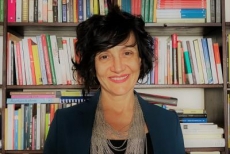
Ruba Salih is a Full Professor of Anthropology at the Department of the Arts, University of Bologna. She holds a Laurea in Political Science from the University of Bologna (1994) and a PhD in Social Anthropology from the University of Sussex (2000), supported by a Marie Curie grant. Previously, she served as Full Professor at SOAS, University of London (2010–2022), and as Senior Lecturer at the University of Exeter (2007–2010). Her work focuses on transnational migration, diasporas, colonialism, Palestinian refugee politics, gender, and trauma studies. Research highlights: aesthetics of waiting among Palestinian refugees, decolonial environmental justice, and intersectional solidarity movements Leadership roles: Board Member of the Arab Council for the Social Sciences (2015–2019), Executive Board member of Insaniyyat (Palestinian Anthropologists Association) Publications include Gender in Transnationalism and Musulmane Rivelate (winner of Premio Pozzale 2011). Recent work explores the Anthropocene through colonial ecological destruction in Palestine.
Caterina Stefania Romeo is an Associate Professor in the Department of Modern Literature and Culture at Sapienza University of Rome's Faculty of Letters and Philosophy. She teaches courses including Introduction to Literary Criticism, Gender, Race, and Mobilities: Narratives and Counternarratives, and Literature, Migration, Inequality. Her office is located on the 4th floor of the Faculty of Letters and Philosophy in Studio B. Dr. Romeo specializes in Postcolonial Studies, Gender Studies, Migration Studies, and Race and Ethnicity Studies, with particular focus on Italian literature and transnational perspectives. Her research explores the intersections of race, gender, and postcoloniality in contemporary Italian contexts, examining how these dynamics shape national identity, urban spaces, and literary production. She has made significant contributions to understanding postcolonial Italian literature, Black Italian experiences, and intersectional approaches to cultural studies. Her scholarly work demonstrates consistent engagement with contemporary issues in Italian society, particularly regarding migration, race relations, and gender dynamics. She has developed innovative frameworks for analyzing how postcolonial perspectives reshape understandings of Italian national identity and cultural production. Premio nazionale di divulgazione scientifica (2014) - finalista John Fante Prize (2009) for La pelle che separa di Kym Ragusa Acerbi Special Prize for Women's Writing (2008) for Vertigo di Louise DeSalvo American Italian Historical Association Award for best doctoral thesis in Italian American Studies (2000) Dr. Romeo has supervised numerous doctoral students including Christina Maraboutaki, Giulia Fabbri, Valentina Quaresima, Barbara De Vivo, Emily Marogi, and Karisma Wilson. She has received multiple research grants including Transliteratures Fellowship, Princeton-Pettoranello Foundation Dissertation Grants, and various post-doctoral fellowships. Her work demonstrates sustained engagement with both theoretical frameworks and practical applications in postcolonial, gender, and migration studies. She is actively involved in organizing academic events, conferences, and seminars focused on postcolonial studies, gender studies, and migration. Dr. Romeo has collaborated extensively with international scholars and institutions, reflecting her transnational approach to research and teaching.
Cristina Bettinelli is a full professor in the Department of Management at the University of Bergamo. She serves as Director of the MSc Program in International Management and Marketing (IMM) and Director of the Center for Young and Family Enterprise (CYFE). Her research focuses on family business governance , entrepreneurial firm innovation , and internationalization , with publications in journals like Family Business Review , Entrepreneurship Theory and Practice , and Journal of Family Business Strategy . Member of editorial boards: Family Business Review , Journal of Family Business Strategy Professional activities: Innovative training projects, Marketing Lhab research group (since 2024) Scientific Awards: Best Contribution to Practice Paper (2024) - IFERA Best Unpublished Research Paper Award (2022, 2015) - FFI Multiple Best Paper Awards/Nominations - IFERA, EIASM, ICSB Family Business Review Best Paper Award (2012) Recent Research Trends: Analyzes family firm dynamics, pandemic response behaviors, cross-border e-commerce strategies, and B corporation ethics. Her 2024-2025 publications emphasize organizational identity , crisis management , and strategic governance .
Barbara Poggio is a Full Professor at the Department of Sociology and Social Research, University of Trento, and serves as Vice-Rector for Equity and Diversity Policies. She holds a PhD in Sociology from the University of Trento and has held leadership roles, including Head of the Center for Interdisciplinary Gender Studies (2007–2021) and Chair of the Central Committee for Equal Opportunities (2015–2021). Her research focuses on gender, work, organizations, and inequality, with emphasis on narrative analysis, gender policies, and structural change in academia. Education: PhD in Sociology and Social Research, University of Trento (1997) Laurea cum laude in Sociology, University of Trento (1992) Postdoctoral Fellowship at Trento’s Department of Sociology (1999–2004) Research Interests: Gender asymmetries in organizations, gender and scientific careers, work-life balance, narrative analysis, diversity management. Key Projects: Coordinated FP7, Horizon 2020, and national projects on gender equality in academia, work-life balance, and organizational welfare. Led the GARCIA project (2013–2015) addressing gender disparities in research careers. Awards: Thesis award from Federazione Italiana Donne Arti Professioni Affari (1992). Grants & Grants Management: Extensive experience in securing and managing EU and national grants, including Horizon 2020 projects like EDIRE (2022–2024) and EFFORTI (2016–2018). Her publications span gender equality policies, academic careers, and organizational sociology, emphasizing methodological innovation and interdisciplinary approaches. She is a leading voice in gender studies, advocating for structural reforms in academia and the workplace.
Emanuela Ghignoni is an Associate Professor at Sapienza University of Rome's Department of Economics and Law. She teaches Labor Economics and Policies and a STATA Lab. Her research focuses on Labor Economics, Education Economics, and Public Economics, addressing topics like over-education, gender wage gaps, and healthcare disparities. Her work examines social norms influencing childbirth decisions, the impact of international programs (e.g., ERASMUS), and economic disparities in Italy and globally. Research Interests: Over-education and labor market mismatches Gender and immigration-related labor discrimination Healthcare systems efficiency Public policy evaluation Educational expenditure dynamics Her articles analyze labor market transitions, wage gaps, and the interplay between family background and education access. She explores how social norms and economic policies shape labor participation, fertility choices, and STEM/non-STEM wage disparities. Advising & Grants: No formal advisees listed. Grants details not provided. Labs/Teams: Not explicitly mentioned, but her STATA Lab suggests involvement in quantitative research methods.
Vera Tripodi is an Associate Professor at the Department of Electronics and Telecommunications (DET) at Politecnico di Torino. Her academic career spans multiple institutions including the University of Milan 'La Statale,' University of Turin, University of Barcelona, University of Oslo, and Columbia University. She serves on the Single Guarantee Committee and is actively involved in gender equality initiatives. Dr. Tripodi earned her PhD in Logic and Epistemology from Sapienza University of Rome. Her academic journey includes postdoctoral research positions at prestigious international institutions and a research position at the University of Milan from July 2021 to March 2022. Her research focuses on the intersection of philosophy, technology, and gender. She specializes in bioethics, ethics of technology, feminist philosophy and ethics, and social ontology. Her work addresses critical contemporary issues including climate change ethics, reproductive technologies, AI ethics, and gender equality in philosophy and academia. She has made significant contributions to understanding the ethical dimensions of emerging technologies and their social implications. Dr. Tripodi's publication record demonstrates a consistent focus on ethical frameworks for technological development, gender issues in philosophy and society, and the philosophical implications of medical and technological innovations. Her work bridges theoretical philosophy with practical ethical concerns in rapidly evolving technological landscapes. Vice President of SWIP Italia (Society for Women in Philosophy) for two terms (2018-2021, 2021-2024) Member of the Bioethics Committee since 2019 Member of SIFA (Italian Society of Analytical Philosophy) since 2008 Associate Editor of AESTHETICS MAGAZINE since 2022 Member of the APHEX editorial board since 2010 Dr. Tripodi advises PhD students in philosophy programs at the University of Pavia and University of Eastern Piedmont. She teaches courses on Research Ethics in Dual-Use Technology, Gender and Diversity in Research, Ethics of Technology, and Bio- and Nanotechnologies in Medicine across various engineering programs at Politecnico di Torino. She also serves on course committees for Biomedical Engineering and Electronic, Telecommunications and Physics Engineering programs. She leads the NOW research project (2023-2025) titled 'Understanding Natural History: Nature, Evolution and Human Beings. A New Philosophical Framework' funded through the National Research PRIN program.
Valentina Zambrano is an Associate Professor at the Department of Political Science of Sapienza University of Rome , specializing in international law, human rights, and migration studies. She teaches International Organization (MZ channel) and International Health Governance courses, with classes held in Room C/D and Room T01/XI of the Department during AY 2024/2025. Office hours: Mondays (online via Google Meet) and Wednesdays (in-person, Room 7, 4th floor) in the first semester; Mondays (online) and Tuesdays (in-person) in the second semester. Email: valentina.zambrano@uniroma1.it Her research focuses on international humanitarian law , gender-based violence , climate justice , and anti-corruption frameworks . She has published extensively on topics like state immunity, migrant rights, and the European Union's human rights obligations, with recent work analyzing the legal implications of the Quirinale Treaty and vaccine distribution during the pandemic. Key trends in her 15 most recent publications (2015–2025) include: Human rights enforcement mechanisms Intersection of migration law and gender equality Environmental obligations under international treaties Legal responses to corruption and peacekeeper misconduct Global health governance and intellectual property rights EU legal frameworks for data protection and sanctions
Luca Carollo is an Associate Professor of Organizational Studies and Change Management at the Department of Management, University of Bergamo, Italy. He holds a Master's degree in Work, Organization and Information Systems from the University of Trento and a Ph.D. in Economic Sociology and Labor Studies from the University of Milan. Key Research Areas Organizational Culture & Change Industrial Relations & HRM Control & Resistance Dynamics Sustainability & Business Ethics Unconventional Research Materials His recent work explores the use of comics, poetry, and films as critical research tools for analyzing organizational phenomena. He has published in journals like Human Resource Management, Organization, Work, Employment and Society, and Journal of Business Ethics. Publications highlight trends in: Apocalyptic Reflexivity in Organizations Democracy in Organizational Structures Diversity & Inclusion Challenges Dirty Work Dynamics Visual Methods in Management Research Cross-Cultural Organizational Identity He teaches organizational theory, change management, and negotiation at undergraduate, graduate, and doctoral levels.
Ersilia Francesca is a Full Professor of Islamic History at the University of Naples 'L'Orientale', where she is affiliated with the Department of Asia, Africa and Mediterranean. She teaches Gender Politics in an Islamic Context and Contemporary Economic History of the Middle East and North Africa across multiple graduate programs including Relazioni e Istituzioni dell'Asia e dell'Africa, Lingue e Culture Comparate, and Lingue e Culture dell'Asia e dell'Africa. Her research focuses on three main interconnected areas: Islamic law, gender studies in Islamic contexts, and the history of Islamic economics. Professor Francesca has established herself as a leading scholar in Ibadi studies, particularly through her early work on medieval Islamic commerce and more recent publications exploring the role of Ibadi minority in Islamic history. She has published five monographs including her seminal 2002 work 'Theory and Practice of Commerce in Medieval Islam' and 'Economy, Religion and Morality in Islam' (2013), which was the first comprehensive reconstruction of Islamic economic thought in Italian. Recent publications demonstrate her evolving research trajectory toward contemporary issues, particularly the intersection of gender, climate change, and politics in the MENA region. Her 2024 publications examine labor ethics in classical Islamic texts while also addressing modern challenges facing women in North Africa and the Middle East. Professor Francesca has increasingly focused on the gendered impacts of climate change, positioning herself at the intersection of environmental policy and Islamic feminist scholarship. Editor of Studi Magrebini/North African Studies (Class A journal) Co-editor of the series Studies on Ibadism and Oman with Abdulrahman al-Salimi Member of the scientific committee of the International Association on Ibadi Studies Member of editorial boards for Donne fedi culture and Manifesta Professor Francesca has maintained an active international scholarly presence through visiting positions at SOAS (London, 2015), EPHE (Paris, 2018), and École Pratique des Hautes Études (Paris, 2024). She currently participates in the French Institute of Islamic Studies project 'Faire société: modèles normatifs et hétéronomie dans les islams minorityitaires' and has coordinated research on post-revolutionary North Africa, particularly examining gender mobility and social activism.
Valentina Di Stasio is a Full-time Professor and Project Director in the Department of Political and Social Sciences at the European University Institute (EUI). She previously held positions at Utrecht University, including co-founding the Interuniversity Network on Diversity, Equity & Inclusion. Her research focuses on labour market inequalities, gender/ethnic/racial discrimination, and intersectionality, employing experimental and quantitative methods. Key projects include the ERC-funded TARGETS and Horizon Europe’s EqualStrength. Education: PhD from the University of Amsterdam (2014), postdoctoral research at Nuffield College (Oxford) and WZB Berlin Social Science Centre. Research Interests: Di Stasio examines Islamophobia, anti-Muslim discrimination, and ethnic stereotypes. Her work compares these issues across Europe, emphasizing methodological rigor through field experiments. Recent studies analyze employer discrimination in Germany, the Netherlands, and Spain. Grants & Projects: Leads TARGETS (ERC) and co-leads EqualStrength (Horizon Europe). Active in comparative studies of discrimination mechanisms and policy implications. Advising: Supervises PhD candidates Chiara Guasti and Maša Krajnc. Her work integrates sociological theory with empirical evidence to address systemic inequities.
Persio Tincani is an Associate Professor at the University of Parma within the School of Law, Political and International Studies . His academic career focuses on philosophy of law, legal interpretation, and interdisciplinary intersections with literature and ethics. Current courses: Person and Institutions (AY 2023-24), Philosophy of Law (LAW, 5-year Master's), Law, Politics and Literature (Bachelor's in Political Sciences). Research emphasizes legal hermeneutics, law's relationship with fiction, and ethical frameworks in legislation. Recent publications analyze: 2024: Legal interpretation methodologies 2024: Kafka's narratives as critiques of justice systems 2024: Philosophical construction of freedom 2023: Camus' La Peste as a lens for crisis-era legal norms 2023: Internal enemies and political criminality theories He maintains a public Academia.edu profile for sharing selected works.
Carlo Fantoni is a researcher at the Department of Life Sciences, University of Trieste, focusing on visual perception, cognitive psychology, and multisensory integration. His work spans developmental psychology, human factors, and computational modeling, with a particular emphasis on how visual and cross-modal cues influence perception and decision-making. His research trends include studies on visual perception (e.g., amodal completion, 3D surface orientation), developmental psychology (e.g., age correction in preterm infants), and human factors (e.g., acoustic comfort in ship cabins, BUS design framework). He has developed advanced tools like the Active Multisensory Perception tool (AMPt) for immersive studies in ergonomics.
Luisa De Vita is an Associate Professor of Economic Sociology at Sapienza University of Rome, working within the Department of Social and Economic Sciences. She holds significant leadership positions as coordinator of the doctoral program in Applied Social Sciences and vice coordinator of the doctoral school in Social and Economic Sciences. Her institutional responsibilities extend to serving as head of the Internship and Training Activities Office for Sociology, membership in the Global WEP Women Entrepreneurship Platform under the European Parliament's Interest Group, and participation in Minerva - Laboratory on Gender Diversity and Inequalities. Her research expertise spans multiple critical areas in contemporary sociology, with primary focus on the analysis of inequalities through various theoretical frameworks including equal opportunity, diversity management, and intersectionality. Dr. De Vita investigates these concepts across multiple domains, particularly within labor markets and complex organizations. Her work examines self-employment patterns, female entrepreneurship trajectories, and women's career paths in STEM professions. Additionally, she conducts significant research on care work across both skilled and unskilled sectors, analyzing working conditions, market regulation mechanisms, gender-ethnicity intersections, and the transformative impact of platform economies on traditional care arrangements. The analysis of Dr. De Vita's recent scholarly output reveals a consistent focus on gendered labor market dynamics, with increasing attention to digital transformation and platform economies. Her publications demonstrate methodological diversity, employing both quantitative and qualitative approaches to examine how structural inequalities manifest in specific occupational contexts. A notable trend in her recent work is the examination of crisis impacts (particularly the COVID-19 pandemic) on women entrepreneurs and care workers, highlighting adaptive strategies and systemic vulnerabilities. Her research increasingly integrates intersectional perspectives, examining how gender interacts with other social categories to shape labor market experiences. Dr. De Vita serves on the scientific committees of several prominent academic journals including the International Review of Sociology (Taylor & Francis), Studi Organizzativi (Franco Angeli Milano), and Quaderni di Rassegna sindacale (Ediesse), demonstrating her standing within the academic community. Her institutional involvement extends to significant research projects focused on domestic and care work in public spaces, as well as studies examining new self-employed workers and their representation challenges. As an educator, Dr. De Vita teaches multiple courses including Sociology of Labor Markets, Social Research on Work and Organizations, Sustainability Work and Gender, and Diversity Management Laboratory. She maintains regular office hours and utilizes Google Classroom to facilitate student communication and resource sharing across her various courses. Her teaching approach emphasizes the integration of supplementary materials that form an integral part of the examination program, reflecting her commitment to comprehensive student learning.
Tatiana Mazali is an Associate Professor at the Interuniversity Department of Regional and Urban Studies and Planning (DIST) of Politecnico di Torino. She serves as Academic Advisor for the Bachelor's and Master's Degree in Film and Digital Media Engineering and coordinates the course since 2022. Her institutional roles include Vice-Coordinator of the European Sociological Association's Research Network 18, leadership in the Third Mission and Public Engagement Commission at DIST, and membership in the Politecnico's Equality Committee. Research Interests: Mazali specializes in digital creativity, immersive cinema, and cultural/creative industries. Her work examines digital media aesthetics, socio-cultural impacts of Industry 4.0, and labor transformations in creative sectors. She conducts qualitative research on XR technology applications in cultural storytelling and digital work sociology. Recent Publications & Projects: Her 2025 article ESTE addresses sustainable events in cultural sectors. Projects like MEI - Interactive Egyptian Museum and ItARTS (PNRR-funded) highlight her focus on digital cultural heritage. She leads the AVENUE Erasmus+ project on vocational education. Honors and Roles: Erasmus+ Staff Mobility Teaching Program (2017) Deputy Editor of DIGITCULT journal Advisory Board member for ICOM Italia and IMT Atlantique Director of Mediascapes Journal (2012-2015) Labs and Teams: Mazali contributes to the Visionary LAB (DAUIN) and STUDIO IREOS , collaborating with researcher Irene Prencipe. She mentors students in courses like Immersive Cinema and Interactive Media since 2019.
Andrea Carnaghi is a Full Professor in Social Psychology at the University of Trieste, with a focus on intergroup relations and social cognition. He holds key roles in doctoral programs (Coordinator for Neural and Cognitive Sciences, Cycles XXXVIII-XXXIX) and serves on multiple Boards of Studies. Education: Ph.D. in Psychological Science (Catholic University of Louvain, 2004); Clinical Psychology degree (University of Padova, 2000) Research Interests His work spans: Language's role in social perception (noun vs adjective effects) Homophobic epithets and their impact on prejudice Objectification of women and neural correlates Bullying/cyberbullying prevention programs Stereotype revision and acculturation barriers for immigrants Scientific Recognitions IAS Fellowship (University of Surrey, 2018) Gordon Allport Prize (2008) for intergroup research He supervises a research group analyzing social exclusion, dehumanization, and hormone-behavior interactions, with funding from Regione Friuli Venezia Giulia and national grants.