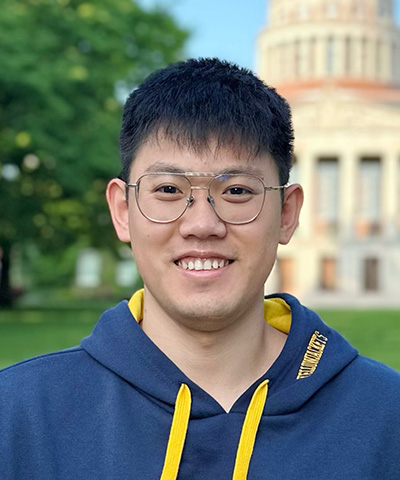
Suren Jayasuriya is a highly active faculty-level researcher in computer vision and computational imaging, with 79 refereed publications (2014-2025) in leading venues such as CVPR, ICCV, ECCV, NeurIPS, IEEE TPAMI and ACM TOG. His work integrates physics-based models with modern machine learning to tackle problems like non-line-of-sight imaging, atmospheric turbulence removal, neural 3D reconstruction, and speech enhancement, while also advancing STEM education through AI. Education & Affiliation: No explicit institutional details are contained in the supplied DBLP extract; however, the sustained publication record and extensive student mentoring indicate a tenured or tenure-track professorship within an engineering or computing department. Research Interests: Jayasuriya’s interests sit at the intersection of computer vision, computational photography, and physics-based machine learning . He develops algorithms that exploit optical and acoustic phenomena for tasks such as seeing around corners, correcting atmospheric distortion, and reconstructing 3D scenes from sparse sonar or radar data. Additional threads include energy-efficient tracking, robust speech processing, and AI-supported pedagogical innovation. Publication Trends: Across the 15 most recent works (2022-2025) his papers exhibit a clear thematic arc: neural representations for multimodal fusion (camera-sonar, radar-vision), unsupervised video restoration under atmospheric turbulence, attention-driven non-line-of-sight tracking, and evaluation of large multimodal models for perceptual reasoning. These contributions simultaneously advance core vision methodologies and demonstrate interdisciplinary applications spanning robotics, environmental monitoring, underwater perception, and education. Students & Mentoring: Jayasuriya has advised an active cohort of graduate researchers who appear repeatedly as co-authors, including Sreenithy Chandran, Ripon Kumar Saha, Albert W. Reed, Joshua D. Rego, Dehao Qin, Jianwei Zhang, Odrika Iqbal, Sameeksha Katoch, Md. Farhan Tasnim Oshim, and Shenbagaraj Kannapiran, among others. Scientific Awards: No awards are listed in the supplied extract; the awards field is left empty. Labs & Teams: While specific laboratory names are not disclosed, the collaborative scope—encompassing hardware-software co-design, field deployments, and educational outreach—suggests he leads or co-leads a research group with access to specialized imaging and robotics facilities.