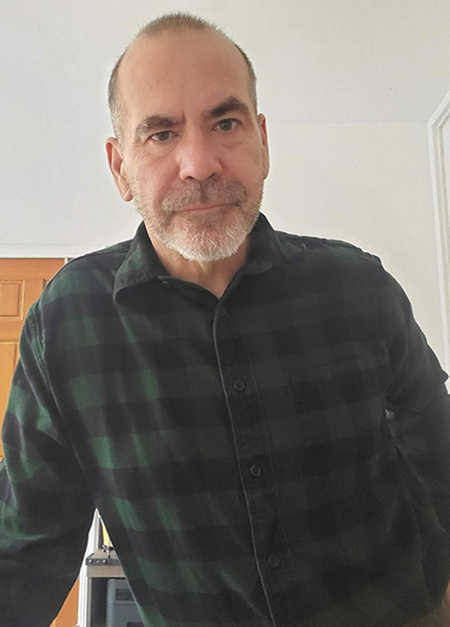
Robert Leston is a Professor in the Department of English at City Tech, CUNY. His scholarly work bridges avant-garde arts with rhetorical invention, continental philosophy, and decolonial theory. He teaches courses in introductory and advanced composition, technical writing, journalism, film studies, and literature. Education: Ph.D. in Rhetoric and Critical Theory (University of Texas at Arlington, 2007), M.A. in Literature (University of West Florida, 1999), BA in Creative Writing and Philosophy (Florida State University, 1992) His research focuses on decolonial rhetorics , Deleuze and Guattari studies , and multimodal rhetorics , often exploring intersections between sound, image, film, and critical theory. His recent publications analyze posthumanism, Buen Vivir, Zapatismo, and the politicization of rhetorical frameworks. In his multimodal projects , Leston integrates experimental media with rhetorical theory, exemplified in works like The RHIZ-cade and A Table without Organs , which interrogate digital artifacts and game studies. His critical writings address issues such as white language supremacy, horror in digital composition, and temporal theories of kairos.
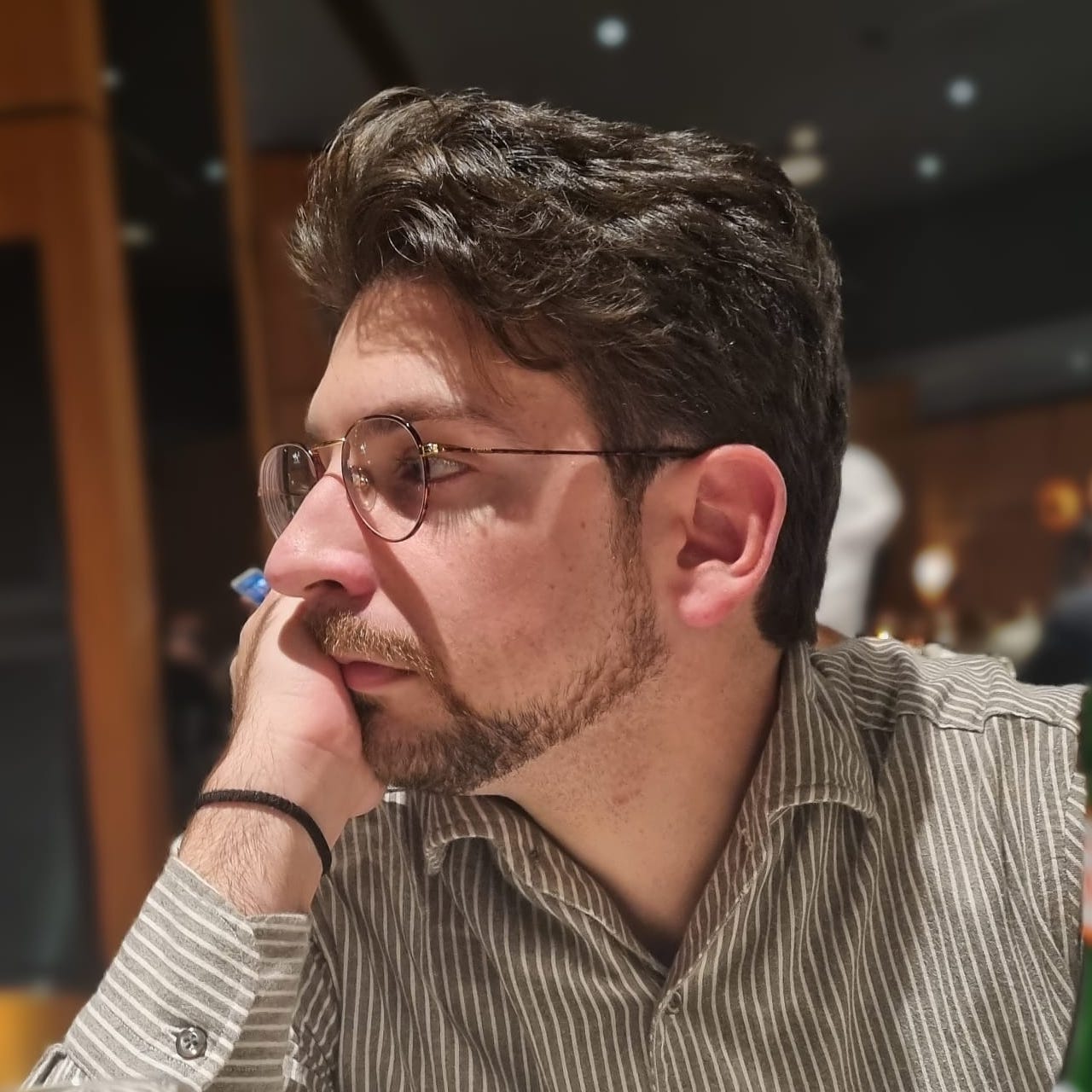
Jeffrey Howard is an Assistant Professor of English at Converse University, where he also serves as the Director of the University Writing Center and Director of Composition. He joined the university in 2022 and teaches courses in introductory and multimodal composition, while providing pedagogical support to faculty teaching English 101. Educational Background: PhD in English and the Teaching of English, Idaho State University Graduate Certificate in TESOL, Idaho State University MA in English (Literature and Writing), Utah State University BA in English (Professional Writing), Brigham Young University Jeffrey's research centers on writing center leadership, literacy narratives, and writing centers as collaborative spaces. His work emphasizes critical self-reflection, mentorship of student consultants, and the curation of writing support resources. He has published in journals such as WLN , The Peer Review , and Composition Studies , and his creative nonfiction and poetry appear in Broad River Review , JAMA , and Wordgathering . His recent publications reflect a strong focus on writing pedagogy, collaborative learning, and creative expression. Themes include multimodal composition, regional identity in tutoring, and the intersection of poetry with medicine, disability, and faith. His work bridges academic scholarship and literary artistry. Scientific Awards: Excellence in Teaching Award, South Carolina Independent Colleges and Universities (SCICU) Professor for Affordable Learning Award, Partnership Among South Carolina Academic Libraries (PASCAL) Undergraduate Faculty Learning and Collaboration Award, Converse University Jeffrey mentors undergraduate and graduate writing consultants through the Writing Center. He supports faculty development and curriculum innovation in composition. Though no grants are listed, his leadership roles indicate active involvement in academic support and pedagogical advancement. He leads the University Writing Center, a hub for one-on-one writing consultations across disciplines, fostering student growth in rhetorical knowledge and writing skills. The center serves as both a support service and a training ground for student leaders in writing.
Stefano Lambiase is a researcher in Computer Science currently affiliated with Aalborg University in Denmark, where he holds an institutional email address (stla@cs.aau.dk). He earned his PhD in Computer Science from the University of Salerno at the Software Engineering Laboratory (SESA Lab), with a doctoral project titled "Longitudinal Data-Driven Software Project Management" focusing on the social and human aspects of Software Development and Management. His educational background includes: PhD in Computer Science from University of Salerno (2019-present) Master's Degree in Computer Science from University of Salerno (2019-2021), with thesis on "Cultural and Geographical Dispersion Impact on Communication and Collaboration of Software Development Teams" Bachelor's Degree in Computer Science from University of Salerno (2015-2019), with thesis on "Test Smell Detection and Suggestions (TESEUS)" Stefano's research interests center around the human and social dimensions of software engineering , with particular focus on cultural and geographical dispersion in software development teams, community smells (socio-technical anti-patterns), and their impact on productivity and software quality. His work bridges theoretical frameworks with practical applications, developing tools like CADOCS (a conversational agent for community smell detection) and DARTS (a test smell detection and refactoring plugin). He has also explored emerging areas including quantum software communities, metaverse development, and the integration of large language models in software engineering practices. His publication record demonstrates a consistent focus on socio-technical aspects of software development, with recent work examining cultural dispersion effects, community smells in various contexts (including machine learning systems and quantum computing), and educational applications in the metaverse. His research employs diverse methodologies including empirical studies, surveys, interviews, and tool development. Stefano has received recognition for his work, including a Best Paper Award at the 25th Euromicro Conference on Software Engineering and Advanced Application (SEAA 2022) for his paper "'There and Back Again?' On the Influence of Software Community Dispersion Over Productivity". He has been actively involved in the software engineering research community, serving on program committees for major conferences including ICSE-SEET 2024, SANER 2024, ICSEA 2023, MSR 2023, and SCAM-NIER 2023. Additionally, he served as Social Media and Web Chair for the Third Workshop on Gender Equality, Diversity, and Inclusion in Software Engineering (GE@ICSE 2022). Stefano has developed several research tools and projects: DARTS (Detection And Refactoring of Test Smells): An IntelliJ plugin for detecting and refactoring test smells CADOCS : A conversational agent for community smell detection and refactoring in Slack Erwin Bot : A chat bot for management support built with Azure Cloud Services BiblioNet : A Spring Boot Web App for library support QuantuMoonLight : A low-code platform to experiment with quantum machine learning SENEM : A software engineering-enabled educational metaverse SERGE : A serious game for risk management education in software project management
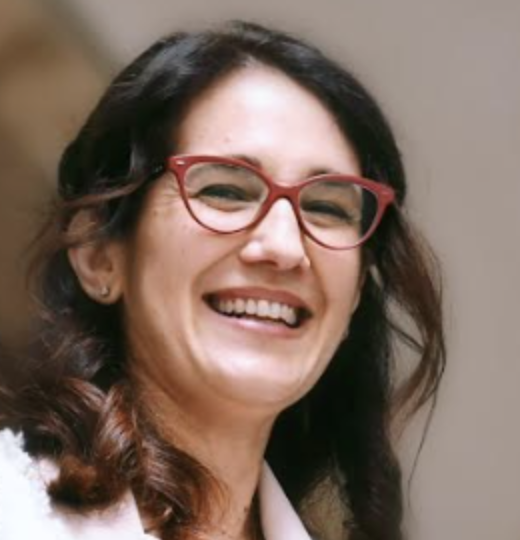
Raffaella Bernardi is an Associate Professor at the Faculty of Engineering, Free University of Bozen-Bolzano, Italy. She previously held academic positions at the University of Trento and the Free University of Bozen-Bolzano. Her research is centered on Computational Linguistics, with a focus on the interplay between language and reasoning in multimodal and conversational contexts. Research Interests: Her primary research areas include Natural Language Processing, Visually Grounded Conversational Models, Large Language Models (LLMs), Vision-Language Models (VLMs), and the cognitive abilities of AI systems. She investigates how language and reasoning interact, particularly in dialogue and multimodal settings. The analysis of her 15 most recent publications reveals a strong emphasis on multimodal reasoning, human-AI interaction, and the cognitive evaluation of language models. Her work frequently explores how AI systems understand and generate language in context, particularly in grounded and interactive environments. There is a consistent trend toward benchmarking, evaluation, and understanding the reasoning capabilities of modern LLMs and VLMs. Fellow of ELLIS (European Laboratory for Learning and Intelligent Systems) Best Paper Award, INLG 2023 Best Paper Nomination, Clic-it 2020 Best Paper Nomination, NL4AI 2020 Raffaella Bernardi has supervised numerous PhD and Master’s students, including Leonardo Bertolazzi, Claudio Greco, Alberto Testoni, and Sandro Pezzelle. She has been involved in significant research projects, often funded by industrial partners like SAP and EU initiatives. She has also been active in organizing scientific events and serving in leadership roles within the ACL and AILC communities. She leads a research group focused on multimodal language understanding and grounded interaction. Her team has developed benchmarks such as BD2BB (Be Different to Be Better) to evaluate the complementarity of language and vision in AI systems.
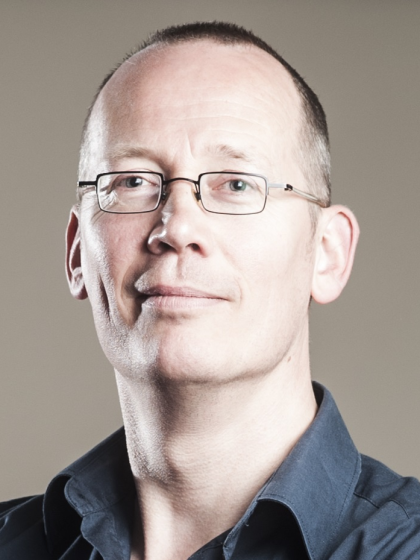
Alfonso Emilio Gerevini is a Full Professor of Information Processing Systems at the Department of Information Engineering, University of Brescia, Italy. He has been a leading figure in Artificial Intelligence research for decades, with a focus on automated planning, knowledge representation, machine learning, and neurosymbolic AI. He has held visiting positions at the University of Rochester (USA) and the University of Freiburg (Germany), and is a Fellow of both the European Association for Artificial Intelligence (EurAI) and the Asia-Pacific Artificial Intelligence Association. His research interests span a broad spectrum of AI, including automated planning, knowledge representation and reasoning, machine learning, data mining, natural language processing, and applications in healthcare and industry. He has made seminal contributions to the development of planning systems such as LPG, PbP, and PbP2, which have achieved top rankings in international planning competitions. He has served on the editorial boards of premier journals including Artificial Intelligence and JAIR , and has organized major conferences such as ICAPS and AI*IA. The recent publications highlight a strong trend toward integrating large language models (LLMs) with classical planning, neurosymbolic reasoning, bias detection in AI, and medical applications of machine learning. His work increasingly bridges symbolic AI with deep learning, focusing on robustness, explainability, and real-world deployment. Fellow of the European Association for Artificial Intelligence (EurAI) Fellow of the Asia-Pacific Artificial Intelligence Association Best Fully-Automated Planner of IPC-3 (2002) for LPG Winner of Learning Track at IPC-6 (2008) for PbP Winner of Learning Track at IPC-7 (2011) for PbP2 Gerevini has advised numerous researchers and collaborators, many of whom are now active in AI research. His leadership in organizing international competitions and conferences has significantly shaped the AI planning community. He has been deeply involved in projects applying AI to real-world problems, including prognosis estimation in healthcare, bias detection in language models, and automated scoring systems for safety training. He leads a vibrant research group focusing on planning, learning, and reasoning. His lab is engaged in developing unified planning frameworks, neurosymbolic integration methods, and applying AI to healthcare and industrial domains. Current efforts include the Unified Planning framework in Python, GPT-based planning policies, and explainable AI for medical reports. Future work is expected to further advance hybrid neurosymbolic architectures, robust planning under uncertainty, and ethical AI systems.
Luís Miguel Botelho is an Associate Professor at the Department of Information Science and Technology (ISTA), ISCTE – IUL (Instituto Universitário de Lisboa), where he actively contributes to teaching and research in Artificial Intelligence and Intelligent Agents. He teaches courses in Artificial Intelligence and Intelligent Systems Technology, using Prolog as the implementation language. PhD in Business Organization and Management, ISCTE-IUL (1997) Master’s in Electrical and Computer Engineering, Higher Technical Institute – UTL (1990) Bachelor’s in Electrical Engineering, Higher Technical Institute – UTL (1983) His research focuses on autonomous agents, multi-agent systems, context-aware computing, semantic web services, and affective interactions. He has led and participated in major projects including CASCOM, Agentcities, SAFIRA, and MODEST, contributing to architectures for service coordination, agent communication, and intelligent surveillance. His recent publications (2021–2022) explore rhetoric modeling, automatic story generation, and enhancements to business tools, reflecting a trend toward cognitive modeling, narrative AI, and practical AI integration. Earlier works (2008–2013) emphasize service discovery, composition, and execution in agent-based systems, grounded in semantic technologies and distributed coordination. He has held academic leadership roles, including Director of the PhD in Information Science and Technology and 3rd Year Coordinator for multiple undergraduate programs. His work is published in top AI venues such as AAMAS, IJCAI, and IEEE conferences. Research Projects: CASCOM – Context-aware Service Coordination (FP6) KnowledgeAndCulture.org – Intelligent Team Selection (FCT) Agentcities – Worldwide Agent Network (FP5) SAFIRA – Affective Interactions (FP5) MODEST – Surveillance Video Analysis (FP4) He advises students and leads research in agent-based systems, with a strong emphasis on open, dynamic, and semantically rich environments. He is affiliated with the Instituto de Telecomunicações and maintains active profiles on Scopus, ORCID, and Google Scholar.
Dr. Mahmoud Hassan Elbasir is a Lecturer in Information Systems at De Montfort University, affiliated with the School of Computer Science and Informatics within the Faculty of Computing, Engineering and Media. He holds a PhD in Computer Science and an MSc in Information System Management, both from DMU, and teaches modules such as Systems Building: Methods and Systems Building Management. He is also the module leader for key undergraduate courses and contributes to programs in computer ethics and privacy. PhD in Computer Science, De Montfort University, UK MSc in Information System Management, De Montfort University, UK Higher Diploma in Control Engineering, Got Al-Shaal Faculty of Computer Science, Libya His research focuses on e-services , particularly e-payment systems and e-learning, along with mobile learning and qualitative methodologies such as grounded theory . He aims to enhance service delivery, teaching effectiveness, and technological adoption in educational and financial contexts. His work often explores user trust, security, and system reliability, especially in developing regions like Libya and Jordan. The analysis of his recent publications reveals a consistent focus on technology adoption in education and finance, with strong emphasis on qualitative research methods. His work bridges technical design and human factors, particularly in mobile learning environments and electronic payment systems. Themes include user experience, trust, security, and the impact of multimedia platforms like YouTube on language learning during crises such as the pandemic. SCHOLARSHIP: Postgraduate study (M.Sc.) from the Libyan government, 2005-2008 SCHOLARSHIP: Postgraduate study (PhD) from the Libyan government, 2009-2015 Dr. Elbasir supervises undergraduate and postgraduate students and has contributed extensively to curriculum development and assessment in information systems. While specific grant details are not mentioned, his government-funded scholarships supported his advanced studies. He is actively involved in teaching and research without indication of external funding or large-scale grants. He is affiliated with the Centre for Computing and Social Responsibility (CCSR) , which underscores his commitment to ethical computing, privacy, and socially responsible technology design. His work integrates technical innovation with social impact, particularly in educational equity and digital inclusion.
Arvind Satyanarayan is an Associate Professor of Computer Science at MIT, leading the Visualization Group within MIT CSAIL. His research focuses on intelligence augmentation through interactive data visualization, exploring how computational tools can amplify human cognition and creativity while respecting user agency. He holds a PhD from Stanford University, advised by Jeffrey Heer. Key research themes include visualization design tools, machine learning interpretability, accessible visualization for visually impaired users, and behavioral principles for information systems. His work has been recognized with an NSF CAREER Award and a 2024 Alfred P. Sloan Fellowship, alongside best paper awards at CHI and IEEE VIS. Education: PhD in Computer Science from Stanford University (Interactive Data Lab) Notable Achievements: Developed widely-used systems like Altair and Vega-Lite, impactful in data science communities Advising: Mentors over 20 graduate and undergraduate researchers, with notable alumni advancing to faculty roles at Brown CS and Utah CS Recent projects include tactile visualization systems (Tactile Vega-Lite), semi-formal programming frameworks (Pluto), and cultural interpretability of AI models. His lab emphasizes collaboration with diverse stakeholders to ensure inclusive design practices.
Dr. Jan-Jaap Reinders is a Lecturer and Researcher at the Faculty of Medical Sciences, University of Groningen (RUG). He also works at the University Medical Center Groningen (UMCG), Hanzehogeschool, and Kaunas University of Applied Sciences (Kaunas UAS). His expertise lies in Organizational Psychology, focusing on interprofessional collaboration and education in healthcare. He developed the Extended Professional Identity Theory (EPIT) and the EPIS psychometric tool to assess interprofessional identity, available in multiple languages (Dutch, English, Turkish, German, Lithuanian, Indonesian). He co-created the Meta-Model of Interprofessional Development , a framework integrating interprofessional practice, education, and research. His research spans over 10 healthcare professions, emphasizing the alignment between professional practice, education, and interprofessional identity. Recent studies include qualitative analyses of interprofessional internships in rehabilitation care, cross-cultural validation of identity measures, and grounded theory investigations into malnutrition management in elderly care. He serves as Board Member of Interprofessional.Global , promoting interprofessional collaboration worldwide. Reinders' work bridges theoretical frameworks with practical applications in healthcare systems, emphasizing synergy between professions to enhance patient care and educational outcomes.
Brendon Larson is a Professor at the Department of Environment and Resource Studies, University of Waterloo, Canada. His research focuses on the social dimensions of biodiversity conservation in the Anthropocene, emphasizing the intersection of ecological practices with cultural, ethical, and communicative frameworks. Research Interests: Reconceptualizing conservation, invasive species dynamics, assisted migration, novel ecosystems, metaphor analysis in environmental communication, and stakeholder engagement in urban-rural ecological management. Teaching: Offers an introductory ecology course and a field course on natural history at the Bruce Peninsula. Key Publications: Investigate invasive species management, climate adaptation strategies, and the role of language in shaping conservation discourse. His recent studies address: Pragmatic frameworks for invasive species in cities (2015) Empirical analyses of public and professional attitudes (2015) Novel approaches to ecological restoration (2015) Critical evaluations of metaphorical language in conservation (2014) While no specific scientific awards or student advisement details are mentioned, his work bridges ecological practice with social integration, policy clarification, and Indigenous perspectives.
Xiaocheng Feng is a prominent researcher in computational linguistics and large language models (LLMs), with extensive contributions to multilingual systems, vision-language integration, and knowledge alignment. His work spans from 2016 to 2025, focusing on advanced topics like Mitigating hallucinations in multimodal models Efficient knowledge editing across multiple models Length-controlled text generation for black-box LLMs Improving contextual faithfulness via retrieval heads Cross-lingual connection mechanisms for fine-tuning His recent publications address critical challenges in LLMs, including knowledge misalignment, entity-level unlearning, and Pareto optimization in multilingual translation. He has explored probability density estimation for text control, adaptive context modeling in visual storytelling, and cross-lingual annotation projection for low-resource languages. Collaborations with researchers like Bing Qin, Lei Huang, and Weitao Ma highlight his central role in advancing NLP methodologies.
Dr. Andy Lücking is a postdoctoral researcher at Goethe University Frankfurt, specializing in multimodal communication and cognitive semantics. He serves as Principal Investigator for the GeMDiS project within the ViCom SPP initiative, and previously held research fellowships at Université Paris Cité's Laboratoire de Linguistique Formelle and Frankfurt's Text Technology Lab. Current research focuses on neurocognitive semantics Developed iconic gesture theory with TTR/RTT frameworks Created multimodal corpora (FraGA, DoTT, TGVCorp) Active in computational educational linguistics Contributed to annotation tools (TextAnnotator, DependencyAnnotator) His work combines theoretical modeling with experimental methods, spanning over a decade of contributions to dialogue semantics, gesture-speech integration, and semantic role labeling. Recent projects explore VR-based multimodal research (Va.Si.Li-Lab) and diachronic dependency parsing. He has co-authored 20+ publications including proceedings in SemDial, LREC, and Springer HCI volumes. Collaboration network includes: Jonathan Ginzburg (dialogue theory), Alexander Mehler (computational linguistics), Alexander Henlein (VR research), and Max Planck Institute researchers. Key methodologies involve corpus creation, machine learning, and cognitive modeling of referential phenomena.
Theodor Wulff is a Marie Curie Early Stage Researcher in the Department of Computer Science, actively researching transparent communication methods and grounding abstract concepts in autonomous agents. His work bridges theoretical AI frameworks with practical implementations in agent-based systems. He earned a Master of Science in Informatics from the University of Hamburg, specializing in capturing long-term dynamics during salient video representation learning, and completed his Bachelor of Science at the same institution. His academic foundation combines computer vision with temporal modeling techniques. Wulff's research spans Artificial Intelligence , Machine Learning , and Explainable AI , with specific focus on language modeling for policy execution and noise-free explanation generation. His investigations into black-box decision models aim to enhance interpretability in autonomous systems while maintaining performance integrity through quantitative evaluation frameworks. His publication trends reveal concentrated efforts in language generation for policy execution and explanation systems for driving prediction , demonstrating cross-disciplinary applications in autonomous vehicles and multi-agent coordination. Both recent works emphasize transparency without performance degradation in AI decision-making. Marie Curie Early Stage Researcher Fellowship As an Early Stage Researcher, Wulff operates within collaborative EU-funded frameworks but shows no current evidence of grant leadership or student supervision activities. His research trajectory suggests emerging contributions to explainable autonomous systems through language-based interfaces.
Rose Yu is an Associate Professor in the Department of Computer Science and Engineering at the University of California, San Diego. She serves as a primary faculty member with the AI Group and is affiliated with the Halıcıoğlu Data Science Institute. Previously, she was a faculty member at Northeastern University where she taught advanced machine learning courses. Her research focuses on machine learning for large-scale spatiotemporal data, with particular emphasis on AI for scientific discovery. She develops physics-guided deep learning models that integrate physical principles with neural networks, with applications spanning climate science, healthcare, and dynamical systems. Her work on symmetry in neural networks has led to significant advances in model generalization and optimization. Dr. Yu's recent publications demonstrate a strong trend toward grounding large language models with physical laws, developing symmetry-aware learning frameworks, and applying AI to climate science. Her work bridges theoretical advances in machine learning with practical applications in scientific domains, particularly in spatiotemporal forecasting and scientific discovery. Major Awards and Honors: Presidential Early Career Award for Scientists and Engineers (PECASE) DARPA Young Faculty Award NSF CAREER Award MIT Technology Review Innovators Under 35 Hellman Fellowship Multiple faculty awards from major tech companies (Google, Amazon, Meta, etc.) Dr. Yu actively mentors PhD students, postdocs, and undergraduate researchers, with many of her former students now holding positions at leading institutions and companies. She serves as program chair for major conferences including ICLR 2025 and has received substantial research funding from agencies including DARPA, NSF, DOE, and CDC. Her research group develops tools for scientific machine learning, with particular focus on climate informatics, symmetry-aware learning, and physics-integrated AI systems.
Nikolaos Laskaris serves as Assistant Professor at the University of West Attica's Department of Industrial Design and Production Engineering, specializing in Electronics with Applications in Art and Environment through Non-Destructive Testing and Systems Diagnosis Methodologies. His academic foundation includes: Bachelor's in Electronics (Industrial Electronics specialization) from Technological Educational Institute of Lamia Doctoral/postdoctoral research in non-destructive analysis techniques for cultural heritage and environmental applications Dr. Laskaris pioneers Archaeometry and Cultural Heritage Science , revolutionizing obsidian hydration dating to redefine Aegean navigation timelines. His research integrates Electronics and Materials Science for pigment identification in Byzantine icons, 3D heritage digitization, and micro/nano-electronics fabrication. Recent expansion into Robotics for environmental monitoring and Health Technology for aphasia rehabilitation demonstrates exceptional interdisciplinary range. Publication trends reveal strategic diversification: while maintaining core expertise in cultural heritage diagnostics (evident in 2024 sarcophagus and sigillia studies), he now leads cutting-edge work in unmanned vehicle systems (2025 defense/environmental applications), human-robot interfaces (2025 speech recognition), and neurorehabilitation technologies (2024 aphasia studies). His research portfolio includes: Characterization of CdTe/CdZnTe defect structures Non-destructive analysis of Thessalian ecclesiastical metalwork Development of modified XRF/Raman techniques Sediment pollution studies in Gulf of Elefsina He serves as NSF USA reviewer (2019-2020) and journals reviewer for Elsevier/Springer/MDPI. Dr. Laskaris directs the Non-Destructive Testing and Systems Diagnosis Methodologies laboratory, driving innovation in heritage preservation through advanced electronics and robotics integration.