Tracy Camp is a Professor and Founding Department Head of Computer Science at the Colorado School of Mines. She leads the Toilers research group, focusing on ad hoc networks and wireless sensor systems for geosystems. With over 20 NSF grants and $20M in funding, her work has produced 12 software tools used globally. She holds ACM and IEEE Fellowships, a Fulbright Scholarship, and the Mines Outstanding Faculty Award. Education: B.S. Mathematics, Kalamazoo College (1987) M.S. Computer Science, Michigan State University (1989) Ph.D. Computer Science, The College of William & Mary (1993) Research Interests: Her work bridges machine learning and geosystems, including dam integrity monitoring via seismic data, UAV communication protocols, and secure encrypted traffic classification. She emphasizes interdisciplinary approaches for real-world challenges like disaster response and environmental safety. Awards: ACM Fellow (2017) IEEE Fellow (2015) NSF CAREER Award (2007) Fulbright Scholar (2006) Grants & Impact: Over 80 refereed publications and 12 invited articles, cited ~7,000 times. Her grants include initiatives to broaden participation in computing, such as the S-STEM scholarship program. Software tools developed under her grants have been adopted by 3,000+ researchers in 86 countries. Labs & Teams: Directs the Toilers group, advancing ad hoc network evaluation and geophysical monitoring. Collaborates on projects like the ADMIRE dam monitoring system and the DREAM master’s program for underrepresented students.
Nathaniel Alan Brunsell is a Professor and Director of the Environmental Studies Program at the University of Kansas. His research focuses on biometeorology, remote sensing of surface energy balance, and climate change impacts. He leads the Environmental Studies Program, overseeing interdisciplinary environmental research and education. Key research areas include land-atmosphere interactions, turbulence measurements using scintillometry and eddy covariance, and the ecological consequences of regional climate change. He collaborates on NASA missions like ECOSTRESS to advance evapotranspiration measurement capabilities. His grants include leadership in the Konza Cluster for the AmeriFlux Network and contributions to studies on urban heat islands and carbon cycle science. Brunsell teaches courses such as Land-Atmosphere Interactions, Atmospheric Turbulence, and Microclimatology, integrating theoretical and applied aspects of environmental science. His work bridges field observations, remote sensing, and numerical modeling to address challenges in climate science, sustainable agriculture, and environmental policy.
Dr. Marcia Schulmeister serves as Director and Teaching Professor in the Environmental Geology Programs at the University of Kansas Edwards Campus, with a dual appointment in the Department of Geology. With over 30 years of experience, she specializes in applied hydrogeology and geochemistry, focusing on contaminated site remediation and groundwater management. Her professional work spans government agencies in the U.S., China, Thailand, and Germany, addressing soil and groundwater contamination challenges. Dr. Schulmeister holds prestigious titles including Fellow of the Geological Society of America and Fulbright Scholar. She contributes to academic leadership as associate editor for professional journals and serves on multiple boards. Her research explores innovative methods like electrical resistivity tomography and direct-push geochemical profiling, with recent emphasis on virtual geology education and international environmental projects in Thailand and Vietnam. Key Expertise: Hydrogeology field methods, contaminant transport modeling, karst terrain studies International Experience: Collaborations in China, Thailand, Germany, and Vietnam Teaching Innovation: Pioneering online geoscience education for non-traditional students Her work integrates field-based learning through the Robert P. Harrison Field Station and virtual museum tours. Current research trends emphasize climate change impacts on groundwater systems and geohazard mitigation for infrastructure protection.
Joel E. Cohen is the Abby Rockefeller Mauzé Professor at The Rockefeller University, where he leads the Laboratory of Populations. With over five decades of research experience, Cohen has pioneered innovative mathematical approaches to study biological populations and variability. His work bridges mathematics, biology, and environmental science, fundamentally changing how scientists understand population dynamics and the significance of biological variability. Dr. Cohen's research focuses on developing new mathematical tools to address population problems in demography, epidemiology, and ecology. He has made seminal contributions to the understanding of heavy-tailed distributions that describe extreme events like hurricanes and disease outbreaks, challenging traditional statistical approaches. His laboratory has conducted groundbreaking research on the spatial distribution of human populations in relation to geophysical factors, with unexpected practical applications ranging from soap formulation to semiconductor manufacturing. Cohen has also developed mathematical models for Chagas disease control in rural Argentina and created algorithms to predict international migration patterns. Analysis of Cohen's recent publications reveals a sustained focus on Taylor's law of fluctuation scaling, population dynamics, and ecological statistics. His work consistently demonstrates how abstract mathematical concepts can transform our understanding of biological systems, from cellular processes to global population trends. The research spans theoretical mathematics to practical applications in disease control, conservation biology, and environmental management. Olivia Schieffelin Nordberg Prize for excellence in writing in the population sciences (March 1997) Gheorghe Lazar Prize of Romanian Academy (December 2000) As director of the Laboratory of Populations, Cohen has led research on human population growth, infectious diseases, food webs, and international migration. His methods for assessing the uncertainty of population projections have been applied in court cases for predicting future claimants of asbestos-related diseases. Cohen's laboratory has collaborated with the United Nations Population Division on migration studies and developed mathematical models that account for more than half of the variability in annual migration numbers among 229 countries. Current research directions include understanding how demographic, economic, and cultural changes interact with Earth's physical, chemical, and biological environments. The Laboratory of Populations employs a multidisciplinary approach that combines mathematical modeling, statistical analysis, and field studies to address complex population issues. Their work exemplifies how basic quantitative research on populations frequently yields unexpected practical applications, demonstrating the profound connections between theoretical mathematics and real-world challenges in public health, environmental science, and resource management.
Dr. Nicholas Kevlahan is a Professor in the Department of Mathematics and Statistics at McMaster University. He holds a BSc in Physics from the University of British Columbia (1985–1989), a PhD in Applied Mathematics from the University of Cambridge (1990–1994), and completed a Marie Curie postdoctoral fellowship at École Normale Supérieure in Paris (1998). He has held visiting positions at institutions including Université Grenoble-Alpes, INRIA, and the University of Cambridge. His research focuses on advanced computational and mathematical methods for fluid dynamics, including the development of the WAVETRISK code for adaptive climate modelling, data assimilation techniques, fluid-structure interaction, and compressive sampling. His work integrates interdisciplinary approaches across applied mathematics, geophysics, and engineering. Key research areas include geophysical fluid dynamics, numerical analysis, partial differential equations, and wavelet-based methods. He has published extensively on topics such as ocean circulation models, turbulence simulation, and adaptive numerical methods. Dr. Kevlahan teaches courses in numerical methods, differential equations, asymptotic analysis, and mathematical physics. He mentors a diverse group of PhD, MSc, and BSc students in his active research laboratory.
Ching-Yao Lai is an Assistant Professor of Geophysics at Stanford University, leading the Lai Research Group. His work integrates mathematical and machine-learned models with observational data to study ice dynamics, geophysics, and fluid mechanics across vast spatial scales. Key focuses include understanding ice-sheet behavior under climate change, fluid-elastic interactions, and interdisciplinary collaborations. He holds a Ph.D. (2018, Princeton University) in Mechanical and Aerospace Engineering and a B.S. (2013, National Taiwan University) in Physics. Research interests span ice dynamics, climate science, and fluid mechanics, with emphasis on machine learning applications to uncover missing physics in ice-sheet models. Notable contributions include discovering self-similar blow-up solutions for Euler equations and developing physics-informed neural networks. His work bridges theory and observation, addressing global challenges like ice-sheet vulnerability. Scientific awards include the 2024 Sloan Research Fellowship and 2023 Google Research Scholar Award. He leads NSF-funded projects on singularities in incompressible flows and Greenland meltwater pathways. Advising highlights include mentoring students like Yongji Wang (Science publication, 2025) and Yuno Iwasaki (2024 Soros Fellow). Labs/Teams: Lai Research Group at Stanford, collaborating across geophysics, engineering, and computer science. Active in open science, with a YouTube channel and Google Scholar profile.
Mike Burton is a Professor and Chair in Volcanology at the University of Manchester's Earth and Environmental Sciences department. His research focuses on volcanic processes, gas emissions, and eruption forecasting, with emphasis on remote sensing and numerical modeling. He collaborates closely with volcano observatories to improve monitoring techniques. Key areas include magma dynamics, degassing processes, and the impact of volcanic activity on climate. Recent work includes studies on the 2021 Cumbre Vieja eruption (La Palma), Fagradalsfjall (Iceland), and Soufrière Hills (Montserrat). His projects involve advanced remote sensing technologies and satellite data analysis to quantify gas emissions and eruption dynamics. Burton has been a Principal Investigator in major initiatives like the EUROVOLC network and CarbSens remote sensing system development. Publications highlight contributions to understanding magma degassing, volcanic plumes, and the role of volatiles in eruptions. His interdisciplinary approach integrates field observations, lab experiments, and computational models to address global volcanic hazards and climate interactions. Media engagements include expert commentary on recent eruptions worldwide.
Professor Mads Huuse is a leading academic in Earth and Environmental Sciences at The University of Manchester, specializing in glaciology, carbon storage, and seismic interpretation. He holds roles such as Chair of the Energy Group at The Geological Society (2021–2023). His research focuses on subsurface processes, offshore renewable energy, and fluid flow dynamics, with contributions to UN Sustainable Development Goals related to energy and climate action. Key research areas include ice-sheet dynamics, North Sea geology, and CO2 storage feasibility. He leads projects on geophysics, geomorphology, and sedimentary systems, involving collaborations across Europe and beyond. Notable work includes studies on tunnel valleys, methane migration, and seismic analysis of glacial landforms. He has supervised numerous PhD students and contributed to datasets on North Sea Basin evolution and polygonal fault systems. His recent publications (2023–2025) address topics like glacial seismic geomorphology, CCS site characterization, and methane venting mechanisms. Awards and recognitions are not explicitly listed, but his extensive contributions to energy and environmental research highlight his academic standing.
Lyesse Laloui is Full Professor and Director of the Soil Mechanics Laboratory at EPFL's School of Architecture, Civil and Environmental Engineering. A world-renowned expert in geomechanics and sustainability, his research develops nature-inspired solutions for climate change mitigation and renewable energy adoption. His distinguished career includes ERC Advanced and Proof of Concept Grants, two honoris causa doctorates, and leadership roles in Academia Europaea and International Society of Soil Mechanics. Research focuses on: Thermo-hydro-mechanical behavior of energy geostructures Bio-inspired geotechnical solutions for soil improvement Radioactive waste repository safety CO₂ sequestration caprock integrity Urban underground space utilization Recent publications demonstrate innovations in geothermal metro station design, shale behavior characterization for energy applications, and bio-mediated soil stabilization. His laboratory has supervised over 35 PhD graduates now advancing geotechnical engineering globally. Professor Laloui founded 5 EPFL spin-offs including Enerdrape (Swiss Top 100 startup) and serves as European Director of the International Associated Research Centers for Urban Underground Space. His awards include the ASCE Kersten Lecture and InterPore Kimberly-Clark Distinguished Lectureship.
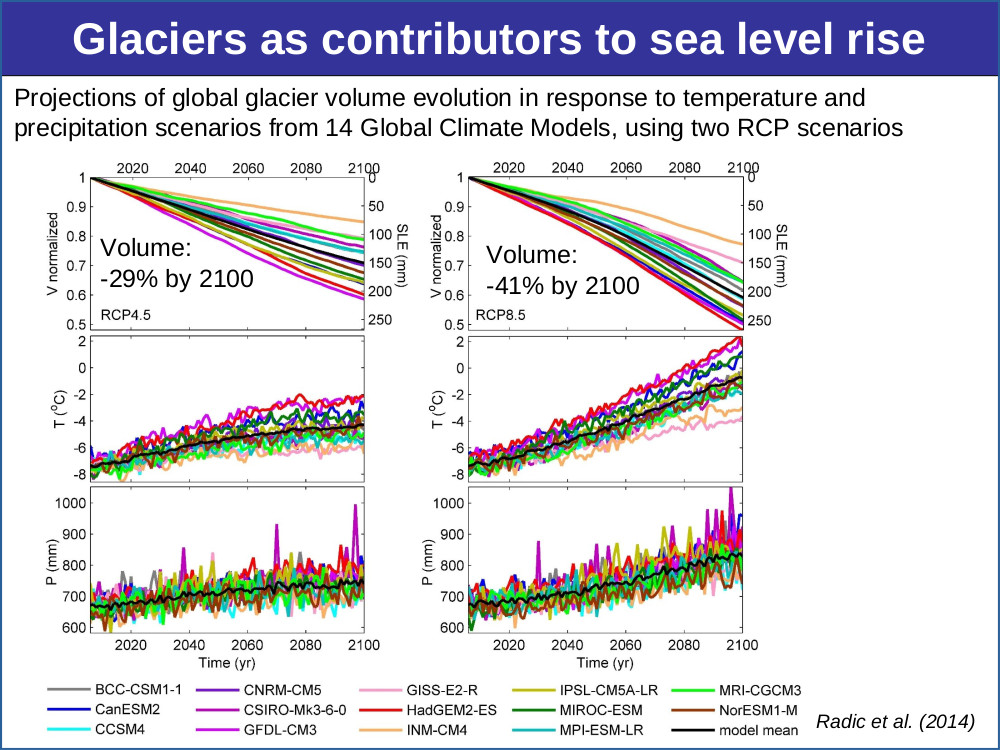
Valentina Radic is an Associate Professor in the Department of Earth, Ocean and Atmospheric Sciences at the University of British Columbia. Her research focuses on quantifying the response of mountain glaciers to climate change, including projections of sea-level rise and regional hydrology impacts. She holds a PhD from the University of Alaska Fairbanks and has led major initiatives like the updated global glacier contribution projections featured in the IPCC Fifth Assessment Report. Education: PhD, Geophysical Institute, University of Alaska Fairbanks (2007–2008) Licentiate, Stockholm University, Department of Physical Geography and Quaternary Geology (2004–2007) MSc & BSc, University of Zagreb, Department of Geophysics (1998–2004) Research Interests: Glacier dynamics, climate modeling, energy balance processes, turbulent fluxes at glacier surfaces, and applications of machine learning in geosciences. Her work bridges field observations, numerical models, and data analysis to address uncertainties in glacier melt projections. Grants & Collaborations: Leads projects on glacier mass balance modeling, turbulent heat flux parameterization, and hydrological impacts of deglaciation. Ongoing collaborations involve PhD students in dynamical downscaling and katabatic flow modeling. Labs & Teams: Directs research groups focusing on glacier evolution modeling, surface energy balance studies, and interdisciplinary approaches combining physics-based models with machine learning.
Monica Kohler is a Research Professor in the Department of Mechanical and Civil Engineering at the California Institute of Technology (Caltech). She holds a B.A. from Harvard University (1988) and a Ph.D. from Caltech (1995). Prior to her current role, she served as an Assistant Research Engineer at UCLA (1998–2011), Visiting Associate at Caltech (2007–2011), and Research Assistant Professor (2011–2017). Her work focuses on earthquake engineering, seismic tomography, and structural health monitoring using advanced sensor technologies. Her research integrates observational seismology and engineering principles to detect damage in buildings and infrastructure through dense sensor networks like the Community Seismic Network (CSN). Projects include developing methods for damage identification using seismic data, tsunami early warning systems, and real-time monitoring of urban vibrations from human activity (e.g., concerts). Key areas of exploration include earthquake-induced building response, wave propagation analysis, and the application of Bayesian learning and Gaussian process regression for ground-motion modeling. She advises graduate students at UCLA in civil engineering and collaborates on interdisciplinary projects involving oceanography, structural dynamics, and computational modeling. Her contributions span over 150 publications, including studies on the 2019 Ridgecrest earthquakes, tsunami wavefront mapping, and high-rise structural identification. She also leads efforts to deploy seafloor sensors and improve early warning systems for natural disasters. Labs/Teams: Active in the Caltech CSN project, structural health monitoring initiatives, and tsunami hazard research groups. Her team includes researchers like Viviana Vela, Gloria Hyun, and Richard Guy.
Joann Stock is a Professor of Geology and Geophysics at the California Institute of Technology. Her research focuses on global tectonics, deformation zones, and planetary geology, particularly comparing Earth and Venus. She has held faculty positions at Caltech since 1990, including roles as Visiting Assistant Professor, Associate Professor, and full Professor since 1998. B.S., Massachusetts Institute of Technology, 1981 M.S., Massachusetts Institute of Technology, 1981 Ph.D., Massachusetts Institute of Technology, 1988 Stock's research explores structural geology, tectonics, and geophysical hazards. Key themes include marine geophysical studies of plate boundary evolution, stress and deformation in the lithosphere, and volcanic hazard analysis. Her work bridges field observations with planetary-scale geodynamics. Recent publications analyze fault interactions, hydrothermal systems, and seismic hazards in the Gulf of California and Salton Trough. These studies emphasize tectonic deformation, sedimentation dynamics, and geophysical processes in active plate boundary zones. She teaches advanced field geology, plate tectonics, and earthquake science courses at Caltech, including Ge 121 abc – Advanced Field Geology and Ge 161 – Plate Tectonics .
Jie Li is the Rodney C. Ewing Collegiate Professor of Earth and Planetary Sciences and Professor of Earth and Environmental Sciences at the University of Michigan. She holds a Ph.D. in Earth and Planetary Sciences (Harvard University, 1998) and an M.A. in Geophysics (Harvard University, 1997). Her research focuses on Earth and planetary materials under extreme conditions, leveraging high-pressure techniques like diamond-anvil cells and synchrotron facilities. Key interests include terrestrial planet evolution, core composition, and dynamics of planetary interiors. Recent studies explore light elements in Earth’s core, Mercury’s magnetic field origin, and early Earth crust formation. Her work bridges experimental geochemistry, mineral physics, and computational modeling to understand planetary interiors. Notable contributions include pioneering studies on iron spin states in the lower mantle and the role of metallic melts in mantle dynamics. She collaborates globally, advancing methodologies for high-pressure experiments. Her research has been featured in outlets like Mashable India , highlighting her insights on Earth’s core dynamics and planetary science. Li’s lab emphasizes interdisciplinary approaches to unraveling the origins of planetary materials and their evolution over geological time.
Peter Constantin is a Professor in the Department of Mathematics at Princeton University, specializing in mathematical physics and applied mathematics. His research focuses on fluid dynamics, partial differential equations, and nonlinear systems, with particular emphasis on Navier-Stokes equations, surface quasi-geostrophic (SQG) equations, and magnetohydrodynamics (MHD). He explores critical aspects of fluid behavior, including singularity formation, turbulence, and inviscid limits. Key areas of study include global regularity analysis for hydrodynamic models, stability of plasma equilibria, and coupled systems such as Nernst-Planck-Navier-Stokes. His work bridges theoretical analysis and applications in geophysical fluid dynamics and plasma physics. Recent research highlights include studies on the inviscid limit of vorticity distributions, magnetic relaxation in MHD systems, and the mathematical foundations of complex fluid models. He has contributed to understanding electrokinetic phenomena, electrodiffusion, and the interplay between fluid dynamics and particle interactions. His publications reflect a deep engagement with both foundational PDE theory and applied problems, addressing topics like singularity conditions in Euler equations, blow-up criteria, and the role of symmetry in fluid and plasma systems.
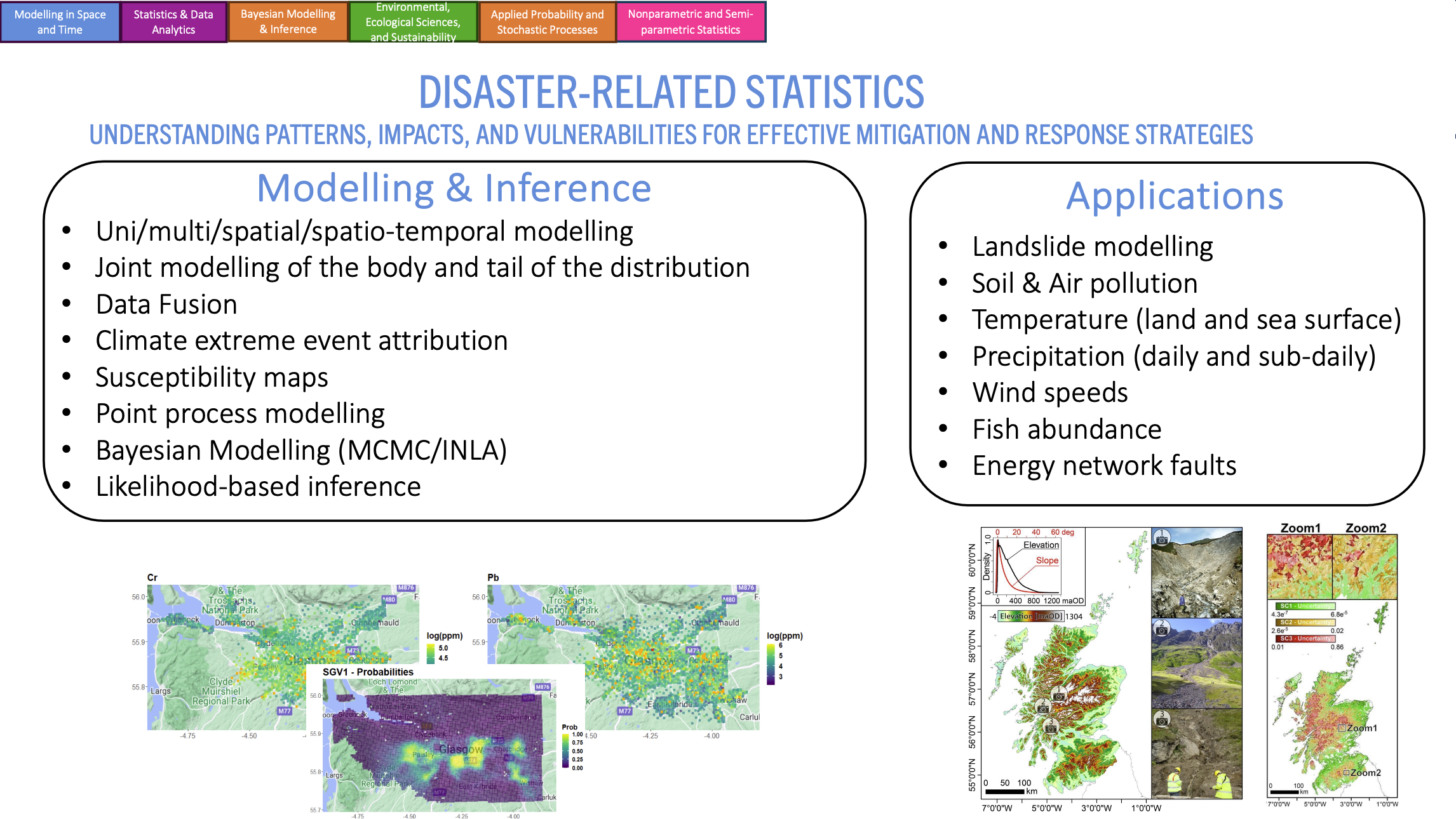
Dr. Daniela Castro Camilo is a Senior Lecturer in Statistics at the University of Glasgow's School of Mathematics & Statistics. Her research focuses on extreme value theory applied to environmental hazards, including landslides, climate extremes, and risk assessment. She leads projects like the Mitigating Landslides Impacts in Scotland (MLIS) and Geostatistical Binary Models for Extremes (GEOBEx) , funded by the Scottish Government and EPSRC. She collaborates with institutions such as the British Geological Survey and the Met Office. Her work bridges statistical methodology and environmental applications, with notable contributions to landslide hazard modeling and spatial extremes. She actively participates in international conferences and organizes events like the ESS-sponsored session at the 2024 RSS Conference. She is a core member of GLE²N (Glasgow-Edinburgh Extremes Network), fostering interdisciplinary research in statistical risk analysis. Recent projects include developing probabilistic forecasting tools for weather-driven faults in electricity networks and advancing Bayesian methods for extreme event prediction. Her research emphasizes practical solutions for resilience to environmental disasters, combining cutting-edge statistical techniques with real-world data challenges.