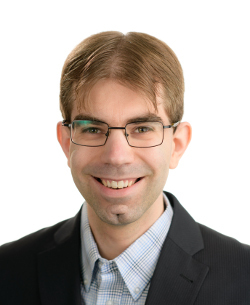
Andre van Renssenمشاهده پروفایل
مدرس ارشد
Dr. Andre van Renssen is a Senior Lecturer at the School of Computer Science, University of Sydney, where he has been working since 2018. He is a member of the Sydney Algorithms and Computing Theory (SACT) research group, contributing to both research and teaching in theoretical computer science. Dr. van Renssen earned his Ph.D. in Computer Science from Carleton University in Canada. His academic journey has focused on computational geometry and algorithms research with applications to real-world network problems. His primary research focuses on geometric networks, particularly network construction, augmentation, and routing algorithms. He designs efficient algorithms for finding shortest paths through various networks - from computer communications to transportation systems - while accounting for dynamic constraints like traffic congestion and obstacles. His work considers time-varying conditions where the optimal route might change based on time of day or unexpected closures, aiming to optimize network performance without requiring additional physical infrastructure. Analysis of his recent publications reveals a strong emphasis on computational geometry problems, particularly related to spanners, routing algorithms in constrained environments, Voronoi diagrams, and geometric optimization. His work bridges theoretical foundations with practical applications, with research already influencing technologies like Google Maps' navigation functionality. Awarded Australian Research Council (ARC) Discovery Project grant in 2024 for "Algorithms for Future-Proof Networks" Dr. van Renssen supervises research students including Zijin HUANG (working on "Utilisation of Realistic Input Models and the Computation of Their Input Parameters") and Shuei SAKAGUCHI (working on "Geometric Spanner Networks and Local Routing Algorithms"). His teaching portfolio includes advanced courses in data structures, algorithms, and computational geometry across undergraduate and graduate levels. He is actively involved in the international computational geometry research community, collaborating with researchers worldwide on geometric network problems that have both theoretical significance and practical applications.