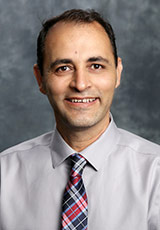
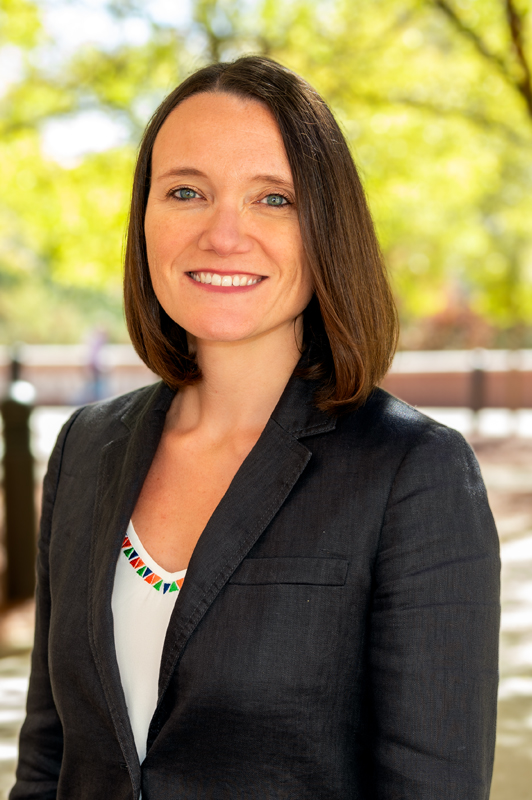
Othman Nasir is an Associate Professor and Director of Undergraduate Studies in Civil Engineering at the University of New Brunswick. He holds a Ph.D. in Geotechnical Engineering from the University of Ottawa and is a licensed Professional Engineer. Research Focus: Dr. Nasir develops numerical models simulating coupled thermal-hydraulic-mechanical-chemical (THMC) processes in geotechnical systems. His applications focus on nuclear waste containment in deep geological repositories, bentonite seal performance, gas migration in repository host rocks, and climate change impacts on geological storage systems. Additional work addresses cemented paste backfill technology for mining applications. Technical Contributions: His research advances predictive capabilities for long-term repository safety through sophisticated simulations of glaciation impacts on sedimentary rocks, bentonite barrier behavior, and gas transport mechanisms. Recent publications establish modeling frameworks for assessing climate change effects on near-field rock properties in nuclear waste disposal.
Maciej Bazanowski is an Adjunct Professor and Research Assistant at the Department of Geodesy and Geomatics Engineering, University of New Brunswick (UNB), Fredericton. He holds an M.Sc.E from UNB (2010) and an M.Eng in Mining Surveying from the University of Mining, Krakow (2005). Currently a Ph.D. candidate at Wrocław University of Technology, his expertise focuses on geodetic monitoring systems, deformation analysis, and numerical modeling in mining and geotechnical projects. His research emphasizes deformation monitoring in mining areas, geodetic control surveys, and subsidence studies. Notable projects include automation of robotic total station systems, the ALERT deformation monitoring system, and PCS potash mine subsidence analysis. He has contributed to studies on large earth dams (e.g., Diamond Valley Lake Reservoir) using integrated geodetic and finite element methods. Key awards include 2nd place in UNB's 2008 Graduate Student Paper Competition. His work bridges geomatics engineering with practical applications in mining, tunnelling, and infrastructure safety. Current affiliations include the Centre for Concrete Structures and Geotechnical Engineering (CCGE) at UNB.
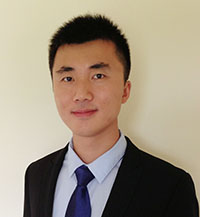
Dr. Qiushi Chen is a Professor of Civil Engineering at Clemson University's College of Engineering, where he leads the Computational Geomechanics Lab. His research spans multiple interdisciplinary fields including computational mechanics, geotechnical engineering, and materials science with applications in biomass processing, extraterrestrial exploration, and earthquake engineering. Dr. Chen received his B.S. in Civil Engineering from Shanghai Jiaotong University (2006), followed by an M.S. (2009) and Ph.D. (2011) in Theoretical and Applied Mechanics with a focus on Geomechanics from Northwestern University. His academic journey has positioned him at the intersection of computational science and practical engineering applications. His primary research interests include computational geomechanics, discrete and finite element methods, extraterrestrial regolith characterization, biomass feedstock preprocessing, and liquefaction hazard assessment. Dr. Chen's work integrates advanced computational techniques with experimental validation to address complex engineering challenges across multiple scales - from particle-level interactions to regional hazard mapping. His research group develops sophisticated numerical models that bridge the gap between theoretical mechanics and practical engineering solutions. Analysis of Dr. Chen's recent publications reveals a strong focus on computational methods for granular materials, with particular emphasis on discrete element modeling (DEM) applications. His work spans terrestrial applications in biomass processing and earthquake engineering to extraterrestrial applications involving lunar and Martian regolith. The integration of machine learning techniques with traditional computational mechanics represents an emerging trend in his research, enabling more efficient and accurate modeling of complex material behaviors. Dr. Chen actively contributes to the professional community as an Associate Member of the American Society of Civil Engineers, Member of the Engineering Mechanics Institute, Member of the Geo-Institute, Member of the Soil Properties and Modeling Committee (ASCE), and Vice-Chair of the Computational Geotechnics Committee (ASCE). In addition to his research, Dr. Chen teaches courses including Introduction to Geotechnical Engineering, Inelastic Materials Modeling, and Computational Mechanics of Granular and Porous Materials. He mentors graduate students interested in computational geomechanics, which sits at the interface of geotechnical engineering, applied mechanics, computational science, and material science. The Computational Geomechanics Lab, directed by Dr. Chen, maintains active research programs in multiple areas including biomass feedstock modeling, extraterrestrial regolith characterization, multiscale liquefaction hazard mapping, and multiphysics problems in porous geomaterials. The lab's work is supported by various funding sources including the U.S. Department of Energy, NSF, NASA, and other federal agencies.
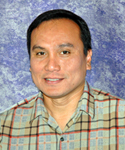
Victor Ginting is a Professor of Mathematics at the University of Wyoming, Department of Mathematics & Statistics since 2007. He specializes in numerical analysis and multiscale phenomena, particularly in porous media flow. His research bridges mathematical theory and computational methods for complex physical systems. He holds a Ph.D. in Mathematics from Texas A&M University (2004), an M.S. in Ocean Engineering (1998), and a B.S. in Civil Engineering from Institut Teknologi Bandung, Indonesia (1995). Prior to UW, he was a postdoctoral associate at Colorado State University. His research focuses on numerical methods for partial differential equations, including finite element methods, multiscale modeling, and flow in porous media. He has contributed to applications in subsurface flow, contaminant transport, and uncertainty quantification. Notable work includes studies on two-phase flow instabilities, fractional diffusion equations, and Bayesian frameworks for subsurface characterization. Dr. Ginting serves as an Advisory Editor for the Journal of Computational and Applied Mathematics . His publications span 2004–2023, emphasizing computational mathematics, fluid dynamics, and interdisciplinary challenges in geosciences. His methodologies often address challenges in multiscale systems and data-driven simulation frameworks. Grants and collaborations involve advanced numerical techniques for reservoir engineering, environmental modeling, and mathematical software development. His work integrates theoretical rigor with practical applications in energy and environmental sectors.
Dr. Jeonghun Lee is an Associate Professor of Mathematics at Baylor University's College of Arts & Sciences. His research focuses on numerical methods for partial differential equations—particularly finite element techniques—preconditioners for multiphysics problems, and computational methods for solid/fluid mechanics. He develops robust discretization schemes for complex physical systems like poroelasticity and wave propagation. He holds a Ph.D. from the University of Minnesota and completed postdoctoral research at Aalto University, University of Oslo, and UT Austin's Institute for Computational Engineering and Sciences. His publications advance computational mathematics through error analysis, hybridizable methods, and multiphysics solvers, with applications in geomechanics and materials science.
Dr. Laureano R. Hoyos is a Professor in the Department of Civil Engineering at The University of Texas at Arlington (UTA). He holds a Ph.D. from the Georgia Institute of Technology (1998) and has held academic positions at UTA since 2000, advancing through ranks to Full Professor in 2014. His expertise lies in experimental and computational geomechanics, particularly in unsaturated soils and geotechnical engineering challenges. Education: PhD, Civil Engineering, Georgia Institute of Technology (1998) MS, Civil Engineering, Georgia Institute of Technology (1996) MS, General Engineering, University of Puerto Rico Mayaguez (1993) MS, Highway Engineering, Universidad del Cauca (1991) BS, Civil Engineering, Universidad del Cauca (1988) Research Interests: Dr. Hoyos focuses on advancing understanding of unsaturated soils through experimental and computational methods. His work addresses geotechnical challenges in infrastructure, including slope stability, soil stabilization, and pavement engineering. He leads projects funded by federal and state agencies, such as the Texas Department of Transportation (TxDOT), and collaborates on international initiatives through committees like ISSMGE’s TC106. Awards & Recognition: Recipient of UTA's Lockheed Martin Aeronautics Excellence in Teaching Award (2014) Multiple Research Excellence Awards from UTA (2006–2009) Outstanding Early Career Faculty Award (2003) Grants & Advising: Dr. Hoyos has secured over $3M in research funding, leading projects on soil stabilization, slope erosion control, and pavement materials. He has advised numerous Ph.D. and master’s students through fellowships like the Dwight David Eisenhower Transportation Fellowship Program. Notable grants include studies on cemented recycled aggregates and intelligent compaction technology. Labs & Teams: He directs geotechnical research activities within UTA’s Civil Engineering Department, leveraging advanced testing facilities for soil mechanics and unsaturated soil behavior. His work integrates computational modeling with field investigations, contributing to resilient infrastructure design.
Paul Wetmore is an Associate Professor in the Department of Geology at the University of South Florida (USF), affiliated with the School of Geosciences within the College of Arts and Sciences. His research focuses on structural geology, tectonics, and magmatic systems, with global fieldwork extending to regions like Mexico, Armenia, Canada, and the U.S. Cordillera. He teaches courses such as Structural/Tectonics and Geological Field Studies. Education: B.S. in Geology, SUNY College at Brockport (1994) M.S. in Geology, Idaho State University (1998)—specializing in volcanism, geochemistry, and tectonics Ph.D. in Geology, University of Southern California (2003)—specializing in structure-tectonics and petrochemistry Research Interests: Wetmore’s work examines the structural and magmatic evolution of continental margins, including the Peninsular Ranges Batholith and the Snake River Plain. He investigates processes like pluton emplacement, mass transfer, and the tectonic integration of accreted terranes. Recent projects include geophysical studies of volcanic fields (e.g., Idaho’s Lost River Valley) and fault slip rates in California and Baja California. Publications & Trends: His 15 most recent articles (2025–2014) emphasize geophysical methods (e.g., gravity inversion, LiDAR), fault dynamics, and magmatic systems. Key themes include 3D subsurface imaging of volcanic domes, seismic analysis of the Stanley earthquake, and tectonic evolution of the Peninsular Ranges. Awards: Best Professional Paper (Peninsular Geological Society, 2002) USC Dissertation Fellowship (2002–2003) Multiple teaching awards at USC (2000–2001) Advising & Grants: Wetmore advises graduate students on projects ranging from fault slip rates to pluton emplacement. He collaborates with institutions like the University of Arizona (BATHOLITHS project) and contributes to field camps in Idaho and Mexico. His research is supported by NSF grants and international partnerships. Labs & Teams: Active in USF’s Crustal Dynamics Group and the Petrology, Geochemistry, and Planetary Science Group. Collaborators include Helge Alsleben, Scott S. Hughes, and Mihai Ducea.
Shun Uchida is an Associate Professor in the Department of Civil and Environmental Engineering at Rensselaer Polytechnic Institute (RPI), joining the Geotechnical Group in 2014. He specializes in multiphysics problems at the intersection of Energy Geotechnics , Computational Geomechanics , and Environmental Geotechnics . Education: BSc in Civil Engineering, Waseda University (2006) MPhil and PhD in Geotechnical Engineering, University of Cambridge (2008, 2013) Postdoctoral Research, Technion – Israel Institute of Technology His research focuses on coupled thermo-hydro-mechanical (THM) processes in geomaterials, particularly methane hydrate-bearing sediments , seismic-induced submarine landslides , and contaminant barrier systems . His work integrates advanced numerical modeling with experimental validation. Key trends in his publications include gas hydrate extraction optimization , sand migration dynamics , and AI-driven geotechnical analysis . Recent studies emphasize CO2 injection for methane recovery and environmental impacts of hydrate dissociation.
Dr. Jason Rabinovitch is an Assistant Professor in the Department of Mechanical Engineering at Stevens Institute of Technology. He directs the Rabinovitch Research Group, which integrates computational fluid dynamics with space exploration challenges. His research focuses on spacecraft plume-surface interactions, supersonic parachute inflation modeling, high-speed multiphase flows, and geophysical phenomena on celestial bodies like Enceladus and Mars. Research interests span computational methods for space systems, including: hypersonic fluid dynamics, multiphase flow physics, hybrid rocket propulsion, planetary entry-descent-landing technologies, and cryovolcanic processes. Current projects investigate shock-droplet interactions, Mars parachute permeability, and Enceladus plume dynamics through NASA and ONR-funded initiatives. Recent publications demonstrate strong focus on experimental and computational validation of aerospace systems, with 15 peer-reviewed articles since 2020 covering parachute FSI modeling, Mars landing erosion analysis, rocket combustion studies, and extraterrestrial rotorcraft effects. The research consistently bridges fundamental fluid mechanics with spacecraft engineering applications. Honors include multiple NASA Group Achievement Awards, the Ernest E. Sechler Memorial Award in Aeronautics, and selection for the Humboldt Research Fellowship. Patent #11,578,682 covers a SmallSat hybrid propulsion system. Supervises 3 PhD candidates (Danial Ghasimi, Nikk Lao, Andrew Sayad) and multiple undergraduate researchers through the Provost's Research Fund. Leadership includes Principal Investigator roles on ONR and NASA grants supporting hyperspeed multiphase flow research and Enceladus plume modeling collaborations with JPL/SWRI. The Rabinovitch Research Group maintains active collaborations with Cornell University's Computational ThermoFluds Lab, Stanford University, JPL, and Johns Hopkins APL on projects involving high-fidelity simulations and experimental validation.
Paul Cupillard is an Associate Professor at the University of Lorraine's GeoRessources laboratory. His research focuses on computational geophysics, particularly seismic wave propagation, homogenization techniques, and inverse problems in complex geological media. Research Focus: Dr. Cupillard develops advanced numerical methods to simulate seismic phenomena and interpret geophysical data. His work bridges theoretical seismology with practical applications in subsurface characterization and hazard assessment, employing techniques like homogenization, time-reversal, and transdimensional inversion. Publication Trends: Recent articles (2022-2024) demonstrate consistent innovation in wave simulation methodologies, with applications ranging from basin seismicity studies to archaeological geophysics. Key advancements include adaptive mesh techniques, uncertainty quantification in inversion, and integrated geological-geophysical workflows. No awards, students, or grant information is documented. He collaborates with the RING research consortium on geophysical computational challenges.
Oyuna Rybdylova is a Senior Lecturer at the School of Computing, Engineering and Mathematics, University of Brighton, and part of the Advanced Engineering Centre. She holds a PhD in Physics and Mathematics from Lomonosov Moscow State University (2012). Her research focuses on multiphase flow dynamics, with expertise in droplet dynamics, heat/mass transfer, and numerical modelling. She has contributed to projects on spray simulation, geomechanics, and fluid-structure interactions. Key affiliations include the Sir Harry Ricardo Laboratories and collaborations across multiple universities. Her work is supported by grants from EPSRC, UKRI, and the Royal Society. She actively supervises PhD students in mathematical and numerical modelling of multiphase systems, with completed student Dr Abbas Al-Ameeri and current student Mr Zuhaib Nissar. Research interests span: Gas-droplet interactions Evaporation and heating of droplets Lagrangian modelling approaches Shock wave particle focusing Her recent projects include the TITANZ initiative (Net Zero shipping applications), Next-Gen Spray Simulation Models, and studies on nanofluid evaporation. She has pioneered the Fully Lagrangian Approach (FLA) for dispersed multiphase flows, implemented in OpenFOAM and ANSYS Fluent.
Lauren Beckingham serves as the W. Allen and Martha Reed Associate Professor (Environmental) and Associate Department Chair in Civil and Environmental Engineering at Auburn University's Samuel Ginn College of Engineering. Her research pioneers geochemical processes in porous media for subsurface energy storage and carbon sequestration, integrating experimental, computational, and machine learning approaches to address critical energy and environmental challenges. Her educational background includes: Ph.D. in Civil and Environmental Engineering from Princeton University M.S. in Civil and Environmental Engineering from Princeton University B.S. in Environmental Engineering from Michigan Technological University Beckingham's research focuses on mineral reaction kinetics, multi-scale imaging of dynamic porous media, and porosity-permeability evolution. She investigates subsurface energy systems including compressed air storage, geologic CO2 sequestration, enhanced oil recovery, and hydraulic fracturing. Her innovative work employs 3D-printed reactive porous media to control and observe geochemical reactions at pore scales, bridging fundamental science with practical energy applications. Analysis of her recent publications reveals a dominant focus on carbon and hydrogen storage in geological formations, with increasing integration of machine learning for reactive transport modeling. Her work demonstrates methodological evolution from traditional geochemical analysis toward multi-scale experimental platforms combining nanotomography, 3D printing, and computational modeling to unravel complex subsurface processes. Her scientific recognition includes: NSF Faculty Early CAREER Development Award (2019) NSF Major Research Instrumentation Award (2020) DOE Early Career Award for subsurface hydrogen storage Emerging Investigator Award from the Journal of Applied Geochemistry Beckingham has secured over $1.7 million in competitive funding, including leadership of an NSF CAREER project, an NSF MRI grant for an X-ray Computed Nanotomography system, and a DOE Early Career award. She co-leads a $139,375 NSF renewable energy education initiative with Tuskegee University and serves as Co-PI on an $887K FTA project optimizing zero-emission bus materials. Her doctoral advisee Nora Lopez Rivera received a DOE SCGSR award, reflecting her mentorship impact. Her laboratory utilizes a state-of-the-art X-ray Computed Nanotomography system for in-situ mechanical and thermal testing, complemented by custom 3D printing capabilities for fabricating reactive porous media. She collaborates extensively through Auburn's National Center for Additive Manufacturing Excellence and interdisciplinary teams addressing energy storage challenges.
Dr. Khaled Altarawneh is a Lecturer in Engineering at Charles Sturt University's School of Computing, Mathematics and Engineering. He holds a PhD in Civil Engineering from the University of Newcastle (2011) with research focusing on geotechnical, environmental, and water engineering. His expertise includes sustainable infrastructure, geothermal energy, groundwater management, and advanced computational geomechanics. Altarawneh has extensive teaching experience in civil engineering programs both in Australia and internationally. Research Interests: Sustainable Infrastructure Development, Geotechnical Modeling, Environmental Pollution Control, Multi-Scale Engineering Systems, Soil-Structure Interaction, and Geothermal Energy Applications. He has collaborated on projects involving experimental geotechnical studies, numerical modeling, and field investigations. His research outcomes have been published in 7 peer-reviewed articles between 2009-2022, focusing on pollutant mechanisms, wastewater management, and chemical reaction kinetics. Altarawneh is affiliated with the Sustainability in Engineering Research Group (SERG) at CSU.
Dr. Yifan Wang is an Assistant Professor in the Department of Mathematics and Statistics at Texas Tech University. His research focuses on computational fluid dynamics, fluid-structure interaction, artificial intelligence, machine learning, and numerical solutions of PDEs, with applications in biomedical engineering and high-performance computing. His research interests include developing numerical methods such as Galerkin finite elements, spectral element methods, discontinuous Galerkin methods, and smoothed particle hydrodynamics to solve complex fluid-structure interaction problems. Specific applications include cardiovascular modeling, blood flow analysis in stented arteries, microfluidic systems for cancer detection, and bioartificial organ design. Wang's publications demonstrate a strong focus on multiscale modeling in biomedical contexts, including computational studies of drug effects in carcinogenesis, stents, and tumor cell dynamics. Recent work explores machine learning applications in biological data regression, medical diagnostics, and predictive modeling of disease outbreaks. He contributes to cardiovascular engineering through computational analysis of stent geometries in tortuous arteries and hemodynamic modeling of stenotic vessels, with emerging work in geothermal energy systems and multiphysics modeling techniques.
Ashutosh Sutra Dhar is Professor and Acting Department Head in Civil Engineering at Memorial University, specializing in geotechnical and infrastructure engineering. With over 20 years of academic and industry experience, his research focuses on soil-pipe interaction, pipeline integrity, and infrastructure assessment methodologies. Previously holding positions at New Mexico State University and Bangladesh University of Engineering & Technology, he maintains professional engineering licensure in multiple provinces. Research domains include: Municipal pipeline failure mechanisms Full-scale testing of buried infrastructure Acoustic emission leak detection Geotechnical instrumentation Publications demonstrate advanced computational modeling of pipeline behavior under ground movement, corrosion, and buckling stresses. Awards recognize contributions to geotechnical research and professional service. Current research groups investigate polymer pipe mechanics, offshore pipeline stability, and machine learning applications in infrastructure management. Funded projects include NSERC CRD and Engage grants with industry partners.