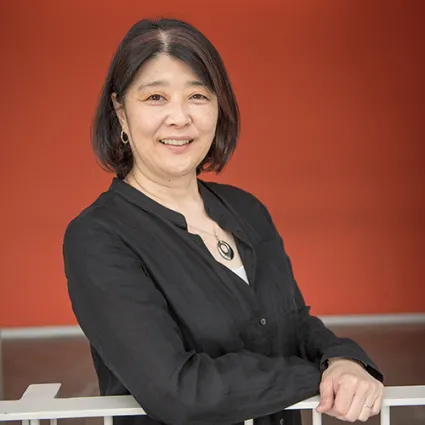
Susan Sayehli is an Associate Professor at the Department of Swedish Language and Multilingualism , Stockholm University. She specializes in psycholinguistics and second language acquisition, with a focus on crosslinguistic influence and morphosyntactic processing. Research Interests: Neurocognitive aspects of language learning Focus intonation development in Swedish children Policy impact on SFL (Spanish/French/German) education ERP and eye-tracking methodologies for language processing Urban-rural educational disparities in language programs Current Projects: TAL – Alignment study on oral proficiency in Swedish schools Att lära sig fokusera – Intonation perception in Stockholm/Skåne children Prior Projects: SWOP2 – Swedish word order processing in L2 learners PSUII – Precursors of sign use in intersubjectivity
Natalia Nagler serves as a Lecturer in Russian at the Central Language Center of Humboldt University of Berlin, operating under the Vice President for Teaching and Learning. She delivers Russian language instruction and academic support across the university community. Her research focuses on Russian Language Teaching, Slavic Linguistics, and Second Language Acquisition, with expertise in language pedagogy and applied linguistics. Her work centers on effective methodologies for teaching Russian as a foreign language within higher education contexts. She maintains regular office hours in Room 3.64 at Dorotheenstraße 65 during academic semesters and designated dates in semester breaks (July-October 2025), accessible via email appointment for virtual consultations through Zoom. Professional engagement includes participation in university-wide language initiatives such as the UNIcert certification program and events like the Long Night of Science 2025, reflecting active contribution to Berlin's academic community.
Zane M. Diamond is a Professor at Monash University within the School of Education Culture & Society . His research focuses on integrating wisdom pedagogies into modern education systems, drawing from Indigenous Australian traditions, Asian Dharmic philosophies, and sustainability frameworks. Contributed to the UN Sustainable Development Goals in education and sustainability Developed the Wisdom Method for pedagogical reform Collaborated with Indigenous experts in Australia, Thailand, Sri Lanka, India, and Japan Research Interests include: Wisdom Development in Globalized Education Cross-Cultural and Comparative Education Indigenous and Dharma Education Transformative Teaching-Learning Practices Cultural Safety in Foreign Language Teaching Community-Engaged Pedagogy Teaching Commitments : EDF1062 Approaches to teaching and learning EDF3065 Indigenous perspectives and learning EDF5613 Research Approaches in Education EDF5761 Education in contemporary contexts Leadership Roles : Past President, Oceania Comparative and International Education Society Board Member, Japan International Education Society Research Leader, Daylesford Dharma School Member, Indigenous Cultural Competency Critical Focus Group
Marina Schramm is a researcher and doctoral candidate specializing in foreign language didactics, with a focus on spelling education for German as a second language and implicit learning through classroom interactions. She is affiliated with a university's Department II (English Studies team) and teaches English and German at a Realschule plus, operating in multilingual and multicultural settings from early childhood to tertiary education. Educational Background: MA in European Bilingual Education (Karlsruhe) 1st and 2nd State Examinations for primary/secondary school teaching (Karlsruhe/Pforzheim) European teaching qualification for Content and Language Integrated Learning (CLIL) Research Focus: Her work explores tacit knowledge acquisition in teacher education, the role of lyrical/narrative texts in authentic classroom practices, and the integration of linguistic chunks in second language processing. Recent projects include action research on skills-oriented literary English lessons and didactic frameworks for future tense instruction. Publications: Three peer-reviewed works center on second language didactics, spanning nominal compounds in language teaching, future tense pedagogy, and the interplay between tense/mood in language acquisition.
Aurelia Rio is an Assistant Professor of Spanish at the University of Delaware. She has been affiliated with the College of Arts & Sciences and the Languages, Literatures & Cultures department since 2003. Dr. Rio holds a Ph.D. in Spanish from Temple University (2015) and an M.A. in Foreign Languages and Literature from the University of Delaware. Education: Ph.D., Spanish, Temple University (2015) M.A., Foreign Languages and Literature, University of Delaware Her research focuses on Spanish for professional contexts, online pedagogy, second language acquisition mechanisms, and cultural studies via film. She actively advises the Spanish for Healthcare Minor program and has led multiple study abroad initiatives. Teaching responsibilities include courses in Spanish language proficiency, healthcare Spanish, Latin American cultures, and oral communication. She employs both in-person and online modalities across undergraduate and graduate programs.
Laura Collins is an Associate Professor in the Department of Education at Concordia University, specializing in applied linguistics. Her research focuses on input processing in second language acquisition, pedagogical grammar, and cross-linguistic influence among bilingual speakers. She has extensive international teaching experience across diverse age groups and serves as the 2nd VP of the American Association for Applied Linguistics and Chair of the IRIS digital repository advisory board. PhD in Humanities, Concordia University MEd in Second Language Teaching, University of Ottawa BEd in Second Language Teaching, University of Toronto BA in History, York University Collins' current projects examine the use of speech technologies to extend second language classrooms and document longitudinal grammatical development in school programs. Funded by SSHRC Insight Grants, her work bridges cognitive approaches with practical pedagogical applications. Recent publications highlight trends in classroom input optimization, frequency-based phonological learning, and intensive language program efficacy, with subfields spanning morpheme perception, vocabulary distribution, and task-based interaction dynamics. Her academic leadership includes editorial roles in The Modern Language Journal and contributions to major handbooks. She teaches courses ranging from classroom-based SLA research to pedagogical grammar, emphasizing practical applications of theoretical insights.
Peter Sayer is an Associate Professor in the Department of Teaching and Learning at The Ohio State University’s College of Education and Human Ecology. He specializes in sociolinguistics, bilingual education, and language policy, particularly in Mexico and the U.S. His work emphasizes translanguaging, equity, and the sociopolitical dimensions of language education. Education: Ph.D., Language and Literacy, Arizona State University (2007) M.A., Applied Linguistics, Universidad Autónoma de Oaxaca (2002) B.A., Philosophy, University of Oregon (1994) Research Interests: Dr. Sayer investigates language education policy, translanguaging practices, and the intersection of technology (e.g., AI) with pedagogy. He has conducted extensive research on early English programs in Mexico, addressing issues of equity, neoliberalism, and language ideologies. His work often critiques systemic barriers to multilingual learners and advocates for inclusive policies. Recent Activities: Organized panels on AI in education at AERA 2025 and AAAL 2025. Hosted the Multilingual Grandmaster Showdown with polyglot XiaomaNYC, showcasing students’ language abilities. Conducted workshops in Indonesia, the Philippines, and Paraguay on translanguaging and AI in language teaching. Awards: Fulbright Scholar-in-Residence (Puebla, Mexico, until 2012) Advising & Grants: Advised doctoral students including Onur Ozkaynak, Zeynep Arslan, and Charlize Wang. Collaborated on projects such as the Linguistic Landscape mapping initiative funded by GSIRI, integrating GIS data with demographic studies. Labs/Teams: Active in the Buckeye Language Education Resource Center and co-organized the Ohio Dual Language Summit, fostering statewide educator collaboration.
Sophie Othman is a Lecturer at the University of Franche-Comté, affiliated with the Centre de Linguistique Appliquée (CLA) and the DEFLET department. She is actively engaged in research and teaching in language didactics, digital education, and innovative pedagogical practices. Her work spans multiple roles in research coordination, program leadership, and international academic collaboration. Research Interests: Her primary research areas include digital technology in language teaching and learning, design of online and distance learning environments, digital engineering in education, pedagogical innovation, comodal and hybrid training models, MOOCs, e-portfolios, and teacher training in ICT. She explores how digital tools transform language education, especially in multilingual and multicultural contexts. The recent scholarly output shows a consistent focus on post-pandemic educational transformation, AI integration in learning systems, and the design of flexible pedagogical scenarios. Her publications appear in journals such as ALSIC and in international conference proceedings, reflecting a strong engagement with digital pedagogy and language education innovation. Leadership and Service: Vice-President, Scientific and Pedagogical Commission, CLA – University of Franche-Comté (2021–present) Co-Responsible, TIPED Research Program, ELLIADD (2017–present) Scientific Coordinator, Innov'FLE Thematic Thursdays (2022–present) Former Coordinator, Master 2 FLE 'Political and Digital Environments' and FLE Track at CTU Besançon (2018–2020) Scientific Committee Member for international conferences (e.g., ADCUEFE, CEDIL, UBEST, EIAH) Expert reviewer for language didactics journals and collective works International trainer for the French Ministry and OIF in over 15 countries Projects and Grants: #ApproprIA: AI Appropriation in Education (2025–...) UNPEAA: Digital Use by Allophone Adults (2024–...) Innov'FLE: Innovation in FLE Teaching (2022–...) HUMANE: Digital Humanities for Education (2019–2022) ANR-IDEFI Innovalangues (2013–2016) Advising and Grants: While no formal students are listed, she has supervised research teams and mentored junior researchers through collaborative projects and editorial roles. She has secured national and international funding, notably through the ANR-IDEFI program, and contributes to large-scale educational initiatives supported by governmental and Francophone institutions. Labs and Teams: She is affiliated with the ELLIADD research laboratory (University of Franche-Comté) and was previously associated with LIDILEM (Université Grenoble Alpes). She leads and participates in interdisciplinary research groups focused on digital language education, teacher training, and innovation in didactics.
Viktória Dabóczi is a lecturer in the Department of German Studies at the University of Siegen, Faculty I. She holds a doctorate from the University of Siegen (2016) and has been actively involved in teaching and research in German linguistics since 2012. Her current academic role as AOR aZ (Akademische Oberrätin auf Zeit) began in June 2025, indicating a senior academic position. She teaches courses such as Introduction to German Linguistics, Grammatical Variation, and Language Acquisition. Research Interests: Her work focuses on word classes, spoken language, grammar theory, language acquisition, and lexical change in German, often with comparative insights from Hungarian. She investigates how words are conceptualized in speech and writing, the evolution of discourse markers, and grammatical variation in contemporary usage. The analysis of her recent publications (2005–2025) reveals a consistent focus on theoretical and applied German linguistics, with increasing attention to sociolinguistic phenomena such as pandemic-related neologisms and ideological word formations. Her research bridges empirical analysis, cognitive linguistics, and language teaching, often in interdisciplinary or contrastive frameworks. Reviewed works on German morphology and grammar Contributed to international projects like EuroGr@mm and ProGr@mm Participated in interdisciplinary conferences on ellipsis and language processing Advising and Grants: While no formal students are listed, her editorial and collaborative roles suggest mentorship and academic leadership. She has been involved in long-term research projects, including EuroGr@mm (2004–2012), indicating sustained grant-supported activity. Her current role at Siegen reflects ongoing institutional support for her research and teaching. Labs and Teams: She has collaborated with researchers at Justus Liebig University of Giessen, University of Szeged, and IDS-Mannheim. Her work with the Diskursmonitor research group and participation in interdisciplinary conferences highlight her integration into active research networks in German linguistics.
Ji-young Shin serves as an Assistant Professor in the Teaching Stream within Education Studies at the University of Toronto Mississauga's Department of Language Studies. Her position integrates teaching, research, and practical application in language education with emphasis on assessment innovation and technology integration. Her academic credentials include: PhD in English / Second Language Studies & ESL from Purdue University, USA MS in Educational Psychology & Research Methodology from Purdue University, USA MA in Teaching English to Speakers of Other Languages (TESOL) from Hankuk University of Foreign Studies, South Korea BA in English Education (Japanese minor) from Hankuk University of Foreign Studies, South Korea Shin's research program focuses on language assessment, corpus linguistics, and technology-mediated pedagogy. She employs mixed methods with quantitative emphasis, utilizing corpus-informed computational analysis and latent-trait modeling complemented by qualitative discourse analysis. Her work addresses critical gaps in second language acquisition, educational measurement, and digital learning environments, particularly regarding AI applications and test validation across diverse language contexts. Her publication trajectory from 2017-2025 demonstrates consistent innovation in language assessment methodologies and technology integration. Key themes include AI-powered chatbots for L2 Korean instruction, online vocabulary testing for Spanish, and corpus-based writing pedagogy. Her work shows increasing focus on artificial intelligence applications and cross-linguistic validation studies, reflecting evolving priorities in language education research. Shin has secured competitive research funding including: Global Classrooms Grant (2025–2026) for VR-enhanced intercultural competence Black, Indigenous, and/or Racialized Scholar Grant (2025–2026) for cross-border AI language learning IRCC Engage3 Project (2022–2024) as Co-PI on VR/AI educational advancement Advancement Fund Plus (2022) for generative AI in teacher education British Council Award (2019) for technology-mediated assessment development She teaches advanced courses including 'The Future of Ed Tech: Active Learning Classrooms and Artificial Intelligence' (EDS285) and supervises community-based experiential learning (EDS388). Her grant portfolio indicates active supervision of research assistants and collaboration with international teams focused on AI implementation and assessment validation. Current projects explore generative AI for language learning across diverse contexts and virtual reality applications in teacher education. While specific laboratory infrastructure isn't documented, her collaborative publications with researchers across Korea, Spain, and the United States suggest participation in international research networks focused on language assessment technology and corpus applications.
Yuri Kumagai is a Senior Lecturer in Japanese at Smith College, where she has been teaching Japanese language to college students in the United States for more than 20 years. She teaches all levels of Japanese language courses as well as culture courses, demonstrating her comprehensive approach to language education within the Department of East Asian Languages and Cultures. Her educational background includes: Ed.D. from University of Massachusetts Amherst M.Ed. from University of Massachusetts Amherst B.A. from University of Massachusetts Amherst Dr. Kumagai's research focuses on critical approaches to language education, with particular emphasis on critical literacy and multiliteracies in foreign language contexts. Her work examines classroom discourse and interactions, exploring how ideology shapes language learning experiences. She has developed project-based language and culture learning curricula through international collaboration with other language teacher-researchers, integrating sociocultural theories and applied linguistics into her pedagogical approach. Her research bridges theoretical frameworks with practical classroom applications, challenging traditional notions of language standardization and cultural representation. Analysis of Dr. Kumagai's publication record reveals a consistent focus on critical multiliteracies, linguistic landscapes, and the intersection of language learning with social justice. Her work increasingly emphasizes agency, criticality, and wellbeing in language education, moving beyond traditional language instruction to address broader social implications. She explores how learners can develop a sense of ownership over language while navigating complex cultural and ideological landscapes, with particular attention to Japanese language education contexts. Dr. Kumagai has been active in presenting her research findings nationally and internationally, with publications appearing in numerous journals and edited books in both English and Japanese. Her collaborative work demonstrates her commitment to advancing the field through scholarly dialogue and international cooperation. With over two decades of teaching experience, Dr. Kumagai has likely mentored numerous students in Japanese language and culture. Her project-based curriculum development suggests engagement with student-centered learning approaches, though specific student names are not mentioned in the available information. She maintains office hours for student consultation during the Spring 2025 semester on Thursday from 11 a.m. to noon and Friday from 9:30 to 10:30 a.m., or by appointment.
Prof. Dr. Claudia Schlaak is Professor of Language Teaching and Learning Research: Didactics of French and Spanish at the University of Kassel, where she serves as Head of the Department of Foreign Language Teaching and Learning Research. She has held this position since September 2020, following an acting professorship at the same institution from October 2018 to December 2019. Her academic work bridges theoretical research and practical application in foreign language education, with particular focus on inclusive teaching methodologies and multilingual contexts. Dr. Schlaak's research centers on foreign language teaching and learning, with special emphasis on didactics of French and Spanish, inclusive education approaches, multilingualism in educational contexts, and the integration of digital technologies in language acquisition. Her work examines how diverse language backgrounds influence learning processes, with particular attention to bilingual learners (especially German-Turkish bilinguals) acquiring Romance languages. She investigates pronunciation acquisition, text complexity, intercultural competence development, and the implementation of inclusive teaching strategies that recognize learner diversity as a resource rather than a challenge. Analysis of her recent publications reveals a strong trend toward digital learning environments, with increasing focus on virtual reality applications, 360-degree learning environments, and digital tools for pronunciation training. Her research consistently addresses multilingual contexts and inclusive approaches, with growing attention to potential-oriented teaching methodologies that shift focus from deficits to learner strengths. The interdisciplinary nature of her work connects linguistics, educational psychology, and technology-enhanced learning. Dr. Schlaak serves as co-editor of the journal Romance Language and its Didactics (since January 2019) and the series French Didactics in Dialogue (since April 2020). She has contributed significantly to academic discourse through numerous edited volumes, special journal issues, and collaborative research projects that bridge theoretical insights with practical classroom applications. Her work demonstrates strong commitment to teacher education, with multiple publications addressing pre-service and in-service teacher training, particularly regarding inclusive practices, intercultural competence development, and the integration of digital tools in language teaching. She has developed practical teaching materials, including method cards for foreign language instruction and inclusive teaching resources for Spanish language classrooms.
Assoc. Prof. Dr. Ali Şükrü Özbay currently serves as an Associate Professor at Karadeniz Technical University's Faculty of Arts, Department of English Language and Literature. He earned his PhD and MA in Applied Linguistics from Karadeniz Technical University and holds a BA in English Language and Literature from Ankara University. Education : PhD (2015) and MA (2004) from Karadeniz Technical University; BA (1996) from Ankara University Dr. Özbay's research focuses on Corpus Linguistics , Learner Corpora , Academic Writing , Translation Studies , and Language Pedagogy . His work investigates lexical bundles, support verb constructions, and pragmatic markers through computational corpus analysis. Recent publications analyze four-word recurrent expressions in educational technology contexts, collocational priming in Turkish EFL learners' mental lexicon, and semantic prosody of intensifiers in academic corpora. He supervises theses on data-driven learning applications and corpus-based teaching materials. Dr. Özbay has held managerial roles including Deputy Head of Department (2019–present) and Assistant Coordinator for Erasmus+ programs (2017–2021). He actively participates in international conferences and has published in journals like Turkish Studies , Australian Journal of Applied Linguistics , and Hacettepe Eğitim Dergisi .
Dr. Frank Thomas Grub is Professor of German and Head of the Department of Modern Languages at Uppsala University. Educated at Universität des Saarlandes (Dr. phil. 2003) and promoted to Associate Professor at Gothenburg University (2012) before joining Uppsala as Professor (2018), he has been recognized as Excellent Teacher (2021). As founder of the Landeskunde Nord network since 2012 and editor of the Peter Lang book series since 2013, his career bridges academic research, educational innovation, and international collaboration. His research focuses on contemporary German-language literature , GDR cultural studies , and transcultural didactics . Key projects explore autobiographical writing, post-Wall literary representations, and the intersection of travel literature with cultural memory. Recent publications (2024-2025) examine media narratives of reunification and cultural stereotypes in language pedagogy. Prof. Grub contributes to German as a foreign language curriculum development Intercultural competence frameworks Editorial leadership in Northern European Germanistics His 2023-2025 works analyze graphic novels in education, migration discourse in literature, and media transitions during the Cold War.
Rosemary Fisher is a Senior Lecturer in Entrepreneurship and Innovation at Swinburne University of Technology's School of Business, Law and Entrepreneurship. She holds a PhD from Swinburne and multiple advanced degrees in business and arts disciplines. Her career spans academic leadership roles including Head of Commerce at Box Hill Institute and Course Director for the Master of Entrepreneurship at Swinburne. Fisher combines teaching with impactful research in entrepreneurship education, higher education pedagogy, and innovative teaching strategies like flipped learning. Education: PhD, Swinburne University of Technology MBA, University of Melbourne Master of Business (Professional Accounting), Victoria University Bachelor of Arts, Canberra College of Advanced Education Research Interests: Focuses on pedagogical innovations such as flipped learning's impact on student outcomes, entrepreneurial resilience, and strategies to enhance teacher status. Active in curriculum design for entrepreneurship programs and digital education solutions. Current projects explore AI's role in business education and EFL teaching methodologies. Awards: 2017 Faculty Teaching Excellence Award Academy of Management Distinguished Reviewer (2012, 2014) 2011 Outstanding PhD Thesis Award Grants & Projects: Lead researcher on initiatives addressing teacher retention, aged care feedback systems, and migrant business training. Recent grants include "$60K for AI in Entrepreneurial Education" and "$45K for EFL Flipped Learning Research". Professional Engagement: Editorial Board member for Active Learning in Higher Education and Journal of Effective Teaching . Serves on international committees for entrepreneurship education and pedagogical innovation. Active in policy development for social entrepreneurship and educational technology adoption.