Lei Panمشاهده پروفایل
دانشیار
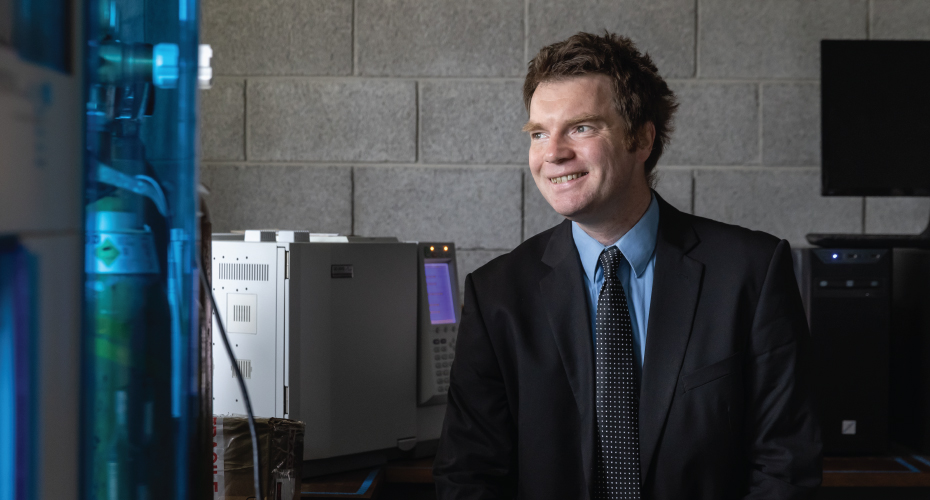
Lei Pan serves as Associate Professor in the Department of Chemical Engineering within Michigan Technological University's College of Engineering. He joined the department in Fall 2016 after completing postdoctoral research at Virginia Polytechnic Institute and State University, where he also earned his advanced degrees in Mining Engineering. His research focuses on surface chemistry and process modeling to enhance mineral processing efficiency while reducing environmental impacts. Dr. Pan's academic credentials include: PhD in Mining Engineering from Virginia Polytechnic Institute and State University MS in Mining Engineering from Virginia Polytechnic Institute and State University BS in Mineral Processing Engineering from Central South University, China His research spans mineral processing fundamentals and applied sustainable technologies, with current projects targeting lithium extraction from primary/secondary resources, industrial decarbonation through mineral carbonation, and circular economy solutions for electric vehicle battery recycling. This work directly addresses critical challenges in critical minerals supply chains and industrial sustainability. Analysis of Dr. Pan's 2010-2016 publications reveals a cohesive research trajectory centered on fundamental mechanisms in particulate separation processes. His work consistently investigates bubble-particle interactions, hydrophobic forces, and wetting film dynamics through experimental measurement and first-principles modeling, establishing foundational knowledge for advancing mineral processing technologies. No scientific awards were documented in the provided materials. Dr. Pan actively recruits fully funded PhD candidates through research grants, offering stipends starting at $24,000 (with inflation adjustment) and full tuition coverage ($27,702). His research group provides substantial professional development including conference travel support, entrepreneurship training, and structured leave policies, with graduates securing industry positions at $120K-$210K starting salaries. He directs the Laboratory of Multiscale Separation Technologies (LAMST), which integrates experimental wet chemistry with computational modeling to develop next-generation separation processes for critical materials and decarbonization applications.