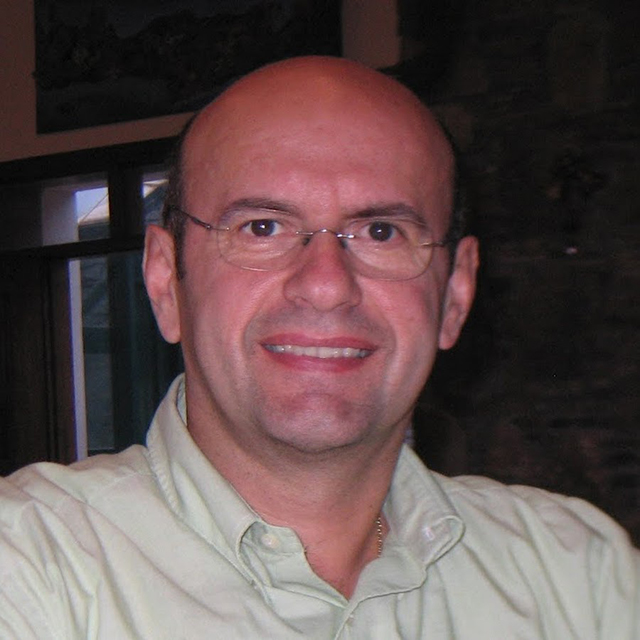
Kitsopoulos Theofanis is a Professor in the Department of Chemistry at the University of Crete. He holds a Ph.D. in Physical Chemistry from the University of California at Berkeley (1991) and has been affiliated with the university since 1993, progressing from Assistant to Professor by 2007. His research spans molecular photodissociation, surface reaction kinetics, and interdisciplinary applications in medical spectroscopy. He collaborates with institutions like the Max Planck Institute of Biophysical Chemistry. Education: B.Sc. (1986) - University of Illinois at Chicago Ph.D. (1991) - University of California at Berkeley His scientific interests include photodissociation dynamics of molecules and clusters, ion imaging , and velocity mapping . His team developed the Slice Imaging method for quantum angular momentum measurements and extended its use to molecular electronics , dye-sensitized photovoltaics , and laser-based keratoconus treatment . Since 2013, he has pioneered surface reaction kinetics methods, notably revealing the true mechanism of CO oxidation on Pt(111)/(332) in a Nature publication. The 15 most recent articles (2025-2021) show a focus on surface reaction mechanisms , quantum effects , and adsorbate interactions . Key trends include velocity-resolved kinetics, ion imaging advancements, and heterogeneous catalysis studies for industrial applications (e.g., Ostwald process, hydrogen oxidation). Collaborative work with institutions like the Max Planck Institute dominates recent publications. His laboratory (IT/ITE) at the University of Crete employs ion imaging and velocity mapping to study elementary chemical reactions on surfaces. He has authored high-impact studies in journals like Nature , J. Chem. Phys. , and Phys. Chem. Chem. Phys. , with a 2018 Nature paper on CO oxidation kinetics.