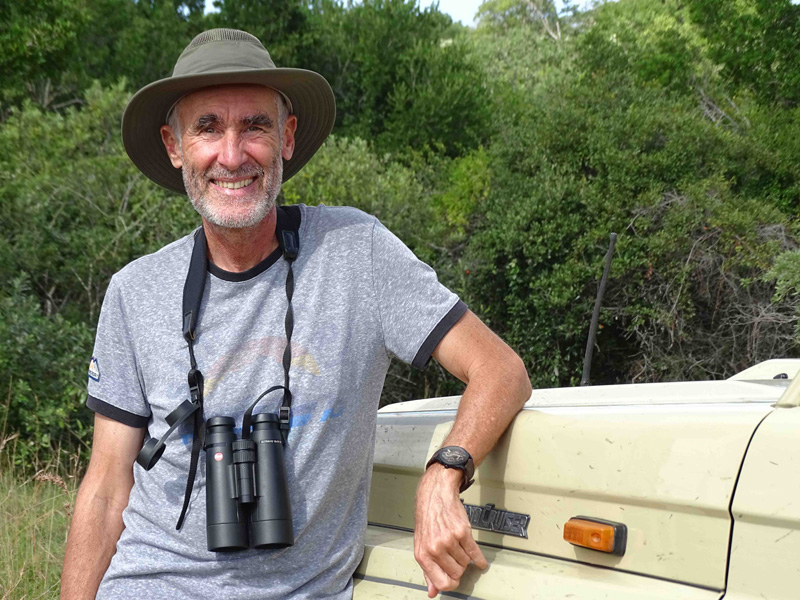
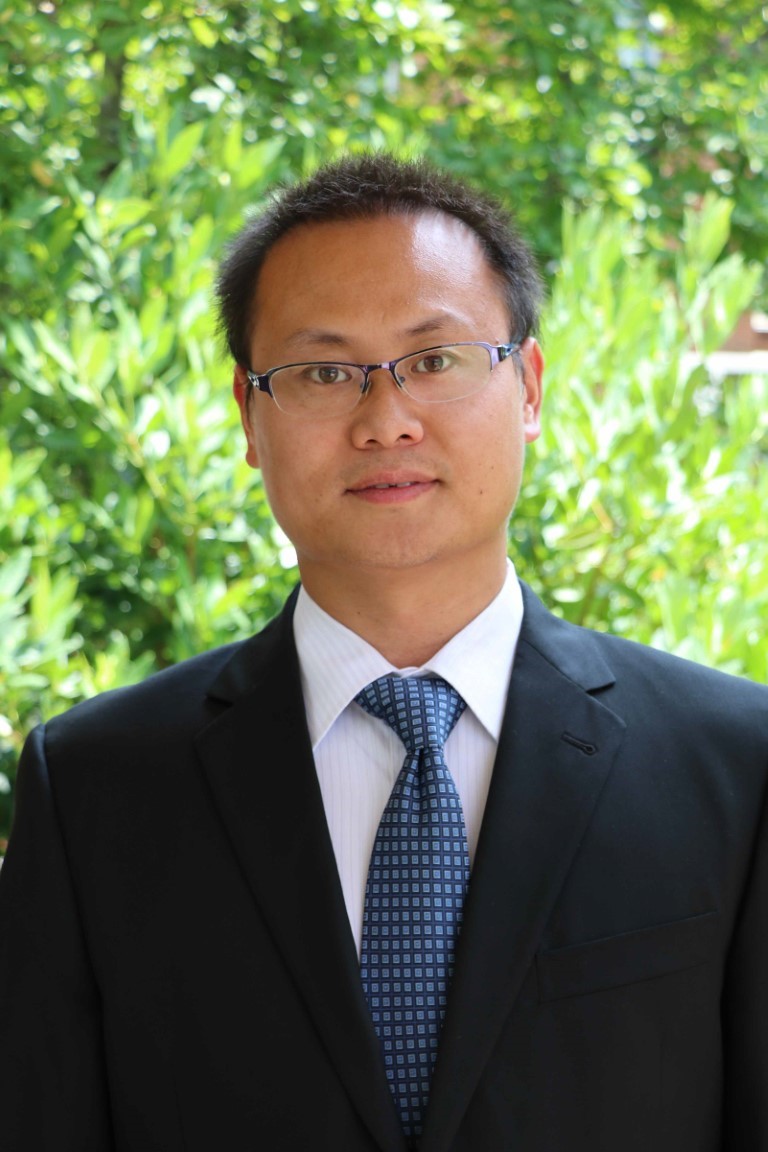
Dr. Guillermo Amador is an Assistant Professor in the Experimental Zoology department at Wageningen University & Research. His research focuses on understanding how animals interact with complex environments through locomotion, adhesion, and fluid dynamics. He investigates biological systems like insects, plants, and marine organisms to inspire bio-engineered solutions for robotics, microfluidics, and material science. Amador received his PhD in Mechanical Engineering from Georgia Institute of Technology (USA), followed by postdoctoral research at the Max Planck Institute for Intelligent Systems (Germany) and a Marie Sklodowska-Curie fellowship at TU Delft (Netherlands). His expertise spans biophysics, biomaterials, and biomechanics, with a focus on self-cleaning mechanisms and bioadhesion. He collaborates with the 4TU consortium on Dutch Soft Robotics to develop bio-inspired designs. His work bridges fundamental biology with engineering applications, emphasizing interdisciplinary approaches to solve challenges in robotics and environmental science. Amador teaches courses including Biomimetics and Functional Zoology , integrating his research into education. His research highlights include studies on cuttlefish suction cups, stick insect adhesion, and pollen transport mechanisms in pollinators.
Nicolas Mathevon is a Professor at the University of Saint-Etienne and a Senior Member of the Institut universitaire de France (IUF). His research focuses on bioacoustics and animal communication, spanning from marine mammals to birds. He has held visiting positions at Hunter College (City University of New York) and the University of California, Berkeley. Education Habilitation à diriger les Recherches (2002, University of Saint-Etienne) PhD (1996, University of Lyon 1) Master's Degree (ranked 2nd, University of Lyon 1) Agrégation in Life and Earth Sciences (ranked 8th) Mathevon's research explores how animals use sound for social interactions, mate selection, and environmental adaptation. His work bridges bioacoustics, neuroethology, and behavioral ecology, with a focus on decoding vocal signals' complexity. His publications cover diverse topics including animal soundscapes, vocal memory in seals, and neural encoding of communication calls. The articles highlight interdisciplinary approaches combining neuroscience, behavioral studies, and acoustic signal analysis. Scientific Awards Prose Award for Excellence in Biological and Life Sciences, AAP (2024) Chevalier des Palmes Académiques (2017) IUF Senior Member (2015-present) IUF Junior Member (2005-2010) Mathevon has supervised 17 PhD students, 10 postdocs, and contributed to public outreach through media, documentaries, and public lectures. He leads the International Master of Bioacoustics program and serves as President of the International BioAcoustic Society.
Alexandra Horowitz is a Senior Research Fellow and Adjunct Associate Professor at Barnard College. She has been teaching since 2004, specializing in dog cognition and olfactory research. Her academic roles span the Departments of English and Psychology, reflecting her interdisciplinary focus on animal behavior and human-animal interactions. Education: M.S. and Ph.D. in Cognitive Science from UC San Diego; B.A. in Philosophy from the University of Pennsylvania. Research interests include naturalistic observations of dog social play, testing anthropomorphic assumptions, and characterizing canine olfactory abilities. She has authored influential books like Inside of a Dog and Being a Dog , exploring how dogs perceive the world. Her work frequently appears in top journals and media outlets, including the New York Times and TED-Ed. Recent articles highlight studies on dog navigation, play behavior, and olfactory perception. She has been recognized as among the Top 2% of Cited Authors globally. Her presentations and lectures span academic conferences, museums, and public forums, emphasizing science communication.
Hang Lu is a Professor and holds the Cecil J. "Pete" Silas Chair of Chemical & Biomolecular Engineering at the Georgia Institute of Technology. Dr. Lu also holds a Love Family Professorship and leads the Lµ Fluidics Group, which focuses on engineering microfluidic systems and machine learning tools to address complex questions in neuroscience, developmental biology, and cell biology that are difficult to address with conventional techniques. Dr. Lu's research lies at the intersection of engineering and biology, with primary interests including: Microfluidic systems for high-throughput screens and image-based genetics and genomics Systems biology: large-scale experimentation and data mining Microtechnologies for optical stimulation and optical recording Big data, machine vision, and automation Developmental neurobiology, behavioral neurobiology, and systems neuroscience Cancer biology, immunology, embryonic development, and stem cells Her laboratory engineers microfluidic devices and BioMEMS to study neuroscience, genetics, cancer biology, and biotechnology. These miniaturized Lab-on-a-chip tools operate at scales comparable to biological systems, leveraging unique micro and nano-scale phenomena to gather large-scale quantitative data about complex biological systems. Current projects include Microfluidics for Life Sciences, Optical Neuron Recordings and Manipulations, Machine Learning Tools for Neuroscience, Measuring and Modeling Behavior, and High-throughput, High-content Cell-based Assays. Analysis of Dr. Lu's recent publications (2024-2025) reveals a strong trend toward integrating microfluidics with advanced computational methods: Development of deep learning frameworks for biological image analysis Advanced neuron tracking and functional imaging techniques Non-invasive characterization of 3D organoid cultures Sophisticated neuromechanical modeling of locomotion Microfluidic temperature control systems for in vivo studies Label-free imaging pipelines for neural development Dr. Lu's significant professional honors include: Cecil J. "Pete" Silas Chair of Chemical & Biomolecular Engineering Love Family Professorship The Lµ Fluidics Group actively mentors students and postdocs, currently accepting new postdoctoral researchers. The lab receives substantial funding for interdisciplinary projects at the engineering-biology interface, with research implications spanning fundamental biological understanding to therapeutic development. The group operates within Georgia Tech's School of Chemical & Biomolecular Engineering, with specialized facilities for microfluidic device fabrication, biological experimentation, and advanced imaging, maintaining strong collaborative ties across engineering, neuroscience, and biological disciplines.
Dr Dominic McCafferty is a Senior Lecturer in Physiology, Ageing & Welfare at the University of Glasgow, based at the Scottish Centre for Ecology and the Natural Environment. He holds academic roles including Editor-in-Chief of the Journal of Thermal Biology and previously Ibis . His research focuses on thermal adaptation, behavioral thermoregulation, and urban wildlife ecology, particularly using thermal imaging techniques. He has a Ph.D. and BSc in Ecological Science from the University of Edinburgh (1989–1993 and 1985–1989). His work spans physiological studies in mammals, birds, and marine species, emphasizing conservation applications. Notable projects include habitat suitability modeling for urban water voles and thermal physiology studies in elephant seals. His educational background includes advanced studies in ecological science, complemented by post-doctoral research at institutions like the British Antarctic Survey (1993–1998). He has contributed to over 99 publications, advancing methodologies in non-invasive wildlife monitoring and ecological field studies. His editorial roles reflect expertise in thermal biology and avian science. McCafferty has led projects on carrion dynamics, stress physiology, and behavioral adaptations in diverse species, with a focus on applying findings to conservation challenges. Labs/Teams: Scottish Centre for Ecology and the Natural Environment (SCENE), part of the broader University of Glasgow's ecological research network. Collaborations include the Muséum National d’Histoire Naturelle in France and the National Trust for Scotland.
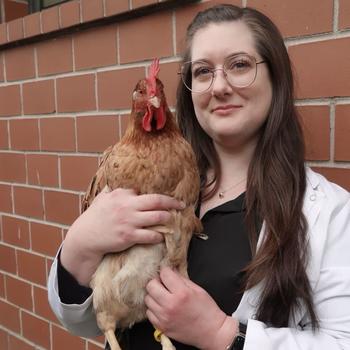
Larissa Schlegel-Pape serves as a Scientific Associate at the Department for Ornamental and Pedigree Poultry within the Farm Animal Clinic of Freie Universität Berlin's Faculty of Veterinary Medicine. Her work focuses on developing innovative methods for assessing chicken welfare through the creation of the "Stressed Chicken Scale," which aims to systematically identify stress indicators in poultry. Her research interests center on animal welfare science, specifically stress assessment in chickens using both behavioral observation and computer vision technology. She investigates how body posture, movement patterns, and other visual indicators can reliably signal discomfort or stress in poultry, with the goal of creating practical assessment tools for veterinarians and poultry farmers. Her work bridges veterinary medicine, ethology, and technological innovation, contributing to refinement research (one of the 3Rs principles) in animal husbandry. Analysis of her publications reveals a strong focus on developing and validating the Stressed Chicken Scale across multiple contexts. Her work spans methodological development, practical implementation studies, and technological integration with computer vision systems. The research demonstrates progression from conceptual framework to validation studies and practical application, with increasing sophistication in assessment techniques and broader implications for animal welfare standards in poultry farming. Schlegel-Pape actively collaborates with the Federal Institute for Risk Assessment (BfR) and participates in interdisciplinary projects involving artificial intelligence applications in agriculture. She presents her findings regularly at major German veterinary conferences including the DVG (Deutsche Veterinärmedizinische Gesellschaft) events, DACh Epidemiology conferences, and specialized poultry medicine gatherings. Her work contributes significantly to advancing animal welfare assessment methodologies and promoting refinement in poultry husbandry practices.
Krista Milich is an Assistant Professor of Biological Anthropology at Washington University in St. Louis, specializing in primate behavioral ecology and socioendocrinology. She holds a PhD from the University of Illinois at Urbana-Champaign and has conducted postdoctoral research at the University of Chicago and the University of Texas at Austin. Her work integrates field studies with laboratory analyses to understand primate social systems, reproductive strategies, and conservation challenges. Her research focuses on reproductive physiology, sexual selection, and zoonotic diseases in nonhuman primates. Key projects include long-term studies of red colobus monkeys in Uganda’s Kibale National Park, collaborative community conservation efforts to reduce human-wildlife conflict, and investigations into Zika virus in Amazonian primates. She also examines hormonal correlates in spider monkeys and woolly monkeys, linking social behavior to ecological and physiological factors. Her academic trajectory includes postdoctoral fellowships at the Institute for Mind and Biology (University of Chicago) and the Department of Anthropology (UT Austin), where she expanded into genetics and microbiome research. Her lab emphasizes comparative approaches to primate behavioral ecology, with fieldwork in Africa, South America, and Puerto Rico.
Dr. Lilong Chai serves as an Associate Professor & Engineering Specialist in the Department of Poultry Science at the University of Georgia's College of Agricultural and Environmental Sciences, with affiliate status at the UGA Institute of Integrative Precision Agriculture. His work integrates engineering principles with animal science to advance sustainable poultry production systems through climate-resilient practices and precision farming technologies. His academic foundation includes a Ph.D. in Agricultural and Bio-environmental Engineering from China Agricultural University (2005-2011), B.S. from Anhui Agricultural University (2001-2005), joint Ph.D. studies at Purdue University (2008-2010), and postdoctoral research at Iowa State University (2015-2018) and Agriculture and Agri-Food Canada (2012-2015). Dr. Chai's research program centers on precision poultry farming, climate-smart animal production, and animal welfare enhancement. He pioneers applications of deep learning, computer vision, and environmental engineering to develop real-time monitoring systems for poultry behavior, health indicators, and housing conditions. His work addresses critical industry challenges including floor egg management, footpad dermatitis detection, air quality control, and disease prevention in cage-free systems, emphasizing practical solutions that balance productivity with ethical animal husbandry. Analysis of his 2023-2025 publications reveals dominant themes in AI-driven behavioral monitoring (dustbathing, perching, foraging), thermal imaging for welfare assessment, and sustainable waste management. These studies consistently bridge agricultural engineering, veterinary science, and data analytics to create scalable precision farming tools applicable across commercial poultry operations. His scientific recognition includes 20 major awards such as: Educational Aids Blue Ribbon Award from ASABE (2024) NACAA Communications Award for Precision Poultry Farming Education (2023) Georgia Research Alliance's Georgia Greater Yield selection (2023) ASABE Outstanding Associate Editor Award (2022) Dr. Chai has secured $5 million through 40 competitive grants from USDA-NIFA, NSF, and international agencies as PI/Co-PI. He actively translates research into practice through leadership roles including Coordinator of the Georgia Precision Poultry Farming Conference, Chair of ASABE's Environmental Air Quality Committee, and reviewer for major research foundations. His extension work directly impacts industry stakeholders through annual training programs serving Georgia's poultry sector. His research infrastructure operates within UGA's Poultry Science Department and the Institute of Integrative Precision Agriculture, where he collaborates with interdisciplinary teams to develop next-generation monitoring systems integrating robotics, thermal imaging, and foundation models for real-world poultry applications.
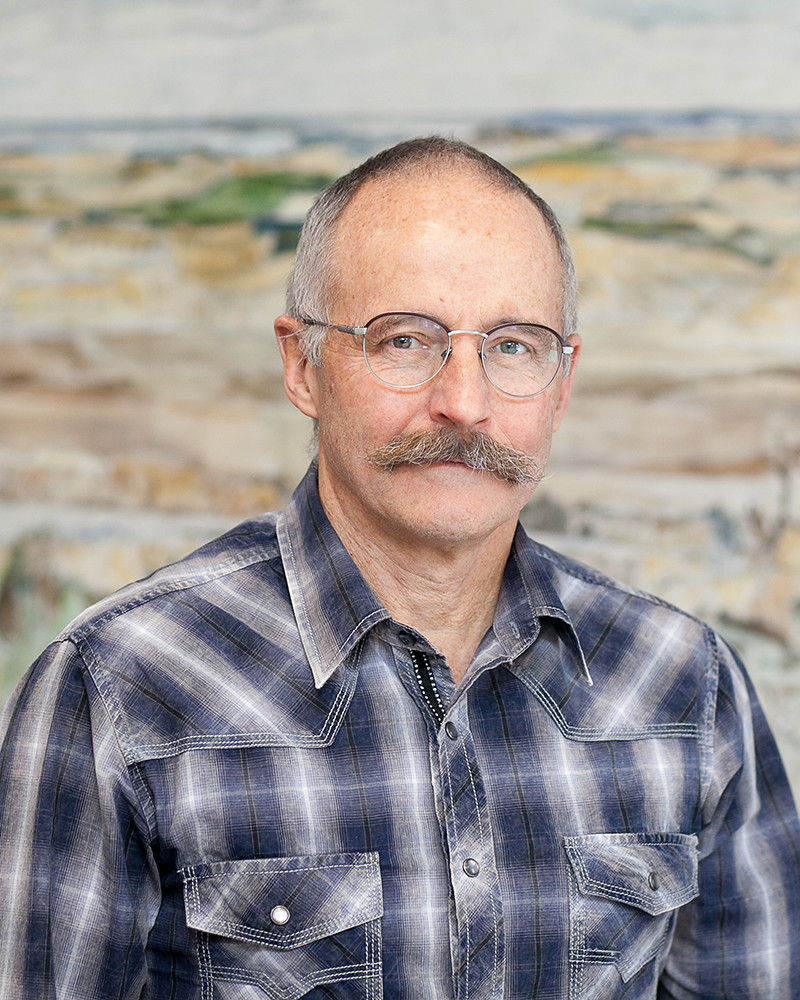
Trent K. Bollinger is a Professor in the Department of Veterinary Pathology at the University of Saskatchewan's Western College of Veterinary Medicine (WCVM), and serves as Regional Director for the Western/Northern Region of the Canadian Wildlife Health Cooperative (CWHC). His academic credentials include a BSc (Honours) from the University of Saskatchewan (1984), a DVM (Distinction) from the University of Saskatchewan (1988), and a DVSc in Pathology from the Ontario Veterinary College (1992). Dr. Bollinger's research focuses on the pathology and epidemiology of diseases in wildlife and fish, with particular emphasis on chronic wasting disease in deer/elk and white-nose syndrome in bats. He has conducted extensive studies on disease transmission dynamics, wildlife population health, and the ecological impacts of emerging pathogens. His work bridges veterinary science, ecology, and conservation biology. His publications demonstrate expertise in viral and bacterial zoonoses, fungal pathogens affecting bats, and spatial epidemiology of wildlife diseases. Recent research highlights include investigating sylvatic plague in prairie dogs, coronavirus persistence in hibernating bats, and landscape connectivity's role in chronic wasting disease spread. His studies often combine molecular diagnostics, field observations, and ecological modeling. Dr. Bollinger collaborates with national and international wildlife agencies, contributing to disease surveillance and management strategies for endangered species. His work emphasizes the interconnectedness of wildlife health, ecosystem health, and public health concerns.
Jonny Kohl is a Group Leader at the Francis Crick Institute , where he established the State-dependent Neural Processing Laboratory in 2019. His work bridges neural circuits and internal physiological states (e.g., hunger, pregnancy) to decode instinctive behaviors like parenting and aggression in mice. PhD: MRC Laboratory of Molecular Biology, Cambridge (2013) Postdoc: Harvard University (2014–2019) with support from EMBO, HFSP, and Wellcome Trust fellowships Research Interests : Kohl investigates how hormonal and metabolic states dynamically rewire neural circuits to drive adaptive behaviors. His lab combines circuit neuroscience , molecular biology , and behavioral profiling to study: State-dependent neural processing in parental behavior Chemosensory dominance hierarchies in mice Plasticity mechanisms in aggression circuits Development of ultrafast tissue labeling and cryoanesthesia tools Scientific Trends : His recent publications highlight hormone-mediated synaptic remodeling (2023), cost-effective lab tools (2023), and brain-wide activity mapping (2016). Collaborative work spans computational biology , metabolism , and imaging disciplines. Honors: NARSAD Young Investigator Award (2019), ERC Starting Grant (2019), Wellcome Trust Discovery Award (2025) Grants: BBSRC Research Grant (2025), BBSRC Pioneer Grant (2023) His lab mentors PhD and MSc students and has developed open-source neuroscience tools (e.g., cryoanesthesia device, 2023). Kohl's research has been featured in Nature , Science , and Cell .
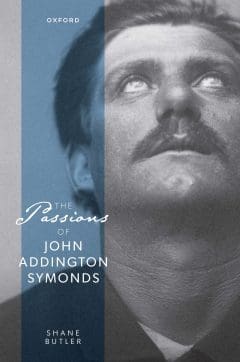
Shane Butler is the Nancy H. and Robert E. Hall Professor in the Humanities and Professor of Classics at Johns Hopkins University, where he also directs the Classics Research Lab and serves as Director of Graduate Studies. He holds a PhD from Columbia University (2000) and has taught at the University of Bristol, UCLA, and the University of Pennsylvania. His research spans Latin literature, classical reception, sensation studies, aesthetics, queer theory, and media history, focusing on the interplay between embodiment and art. Education: PhD in Classics from Columbia University (2000). Prior to Hopkins, he held faculty positions at the University of Bristol, UCLA, and UPenn. He has been a residential fellow at the American Academy in Rome, Villa I Tatti, the Getty Villa, and the MPIWG Berlin. Research focuses on Latin literature from antiquity to early modernity, classical reception theory, and the sensory dimensions of ancient aesthetics. Notable works include The Passions of John Addington Symonds (2022), The Ancient Phonograph (2015), and Sound and the Ancient Senses (2019). He co-edits the Classical Philology special issue on 'Philology Transfigured' and directs the John Addington Symonds Project. Awards include fellowships at leading institutions and editorial roles, including Associate Editor of the I Tatti Renaissance Library. His recent work explores queer philology and the intersection of sound studies with ancient literature.
Dr James Herbert-Read is an Associate Professor and Whitten Lecturer in Marine Biology at the Department of Zoology, University of Cambridge. He serves as Deputy Head of Department (Postgraduate Education) and leads the Marine Behavioural Ecology Group. His research focuses on understanding how animals, particularly marine organisms, collect and process information from their environments to make behavioral decisions, with emphasis on social interactions, adaptation mechanisms, and ecological constraints. His group employs theoretical frameworks, controlled experiments, and quantitative field studies to investigate behavioral diversity in marine species. Key themes include collective behavior, predator-prey dynamics, camouflage strategies, and the impacts of environmental stressors on animal decision-making. Recent publications highlight work on lionfish vocalization mechanisms, cuttlefish camouflage, citizen science applications in marine research, and behavioral responses to visual and acoustic noise. Scientific awards and affiliations include: Whitten Lecturer in Marine Biology Associate Professor, University of Cambridge He has supervised research projects on topics such as: Social attraction in invasive fish species Evolution of coordinated movement Neurophysiological basis for leadership in shoals Maternal effects on offspring exploration
State University of New York at BuffaloUnited States
Dr. Silu Wang is an Assistant Professor in the Department of Biological Sciences at the University at Buffalo. Her research focuses on speciation, adaptation, and forest evolutionary genomics, particularly in avian species. She leads the Forest Speciation Lab, studying the genomic and ecological mechanisms underlying species divergence in North American and global forest ecosystems. Her work integrates field studies, genomic analyses, and computational modeling to address biodiversity conservation challenges under climate change. Education: BS in Behavior Genetics and Neurobiology, University of Toronto MA in Ecology, Evolution and Behavior, University of Texas, Austin PhD in Zoology, University of British Columbia Postdoctoral Research at University of California Berkeley and UC Davis Research Interests: Dr. Wang investigates how hybridization, climate adaptation, and reproductive isolation shape avian biodiversity. Her lab uses old-growth forest bird species as models to study early-stage speciation processes, including mate choice, genetic incompatibilities, and mitochondrial-nuclear interactions. Key themes include understanding organismal responses to environmental changes and developing genomic tools for conservation prioritization. Lab and Teams: The Forest Speciation Lab collaborates with institutions globally, focusing on fieldwork in temperate and tropical forests. Current projects include studies on warbler hybrid zones, tinamou speciation, and the genomic architecture of mitonuclear coevolution. Teaching: Dr. Wang teaches courses on Speciation, Tropical Ecology, and Evolutionary Biology, emphasizing hands-on research training for students.
Tom Greaves is an Associate Professor in Philosophy at the University of East Anglia (UEA), affiliated with the School of Politics, Philosophy and Area Studies. He holds a PhD from Warwick University (2007) and has been at UEA since 2008. His research focuses on ecological phenomenology, environmental ethics, and the philosophical engagement with nature, particularly through the lens of thinkers like Heidegger and Collingwood. His work explores how aesthetic, ethical, and historical perspectives shape human-nature relationships. Greaves teaches courses on phenomenology, environmental philosophy, Nietzsche, and the philosophy of art. His recent publications (2023–2025) address topics such as ecological finitude, the role of movement in animal aesthetics, and the rewilding paradigm. He actively participates in academic events, including conferences on environmental humanities and workshops on nature valuation. His research emphasizes the intersection of ecological communities and valuation processes, advocating for an ecologically grounded understanding of value that transcends traditional economic frameworks. Greaves’ academic activities include editorial roles, hosting academic visitors, and examining PhD theses.
Bertram Müller-Myhsok is a Research Professor and Research Group Leader at the Max Planck Institute of Psychiatry in Munich, Germany. His research focuses on statistical genetics and transcriptomic data analysis in psychiatric disorders, particularly major depression, PTSD, schizophrenia, and their treatment responses. He integrates machine learning with genetic and clinical data to develop predictive models and stratified treatment approaches. Professional activities include leadership roles in the International Max Planck Research School for Translational Psychiatry and collaborations with institutions like the Institut du Cerveau (Paris) and Bernhard Nocht Institute (Hamburg). His work spans genetic epidemiology, psychiatric genomics, and precision medicine, with over 400 publications in high-impact journals. Key research areas include identifying genetic risk factors for mental disorders, developing polygenic scores, and leveraging omics data to uncover disease mechanisms. He leads projects like Psych-STRATA, a Horizon Europe-funded initiative advancing personalized psychiatry through pharmacogenomics.