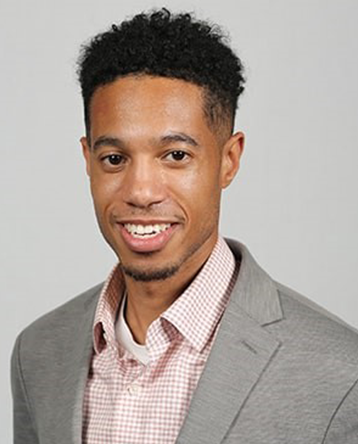
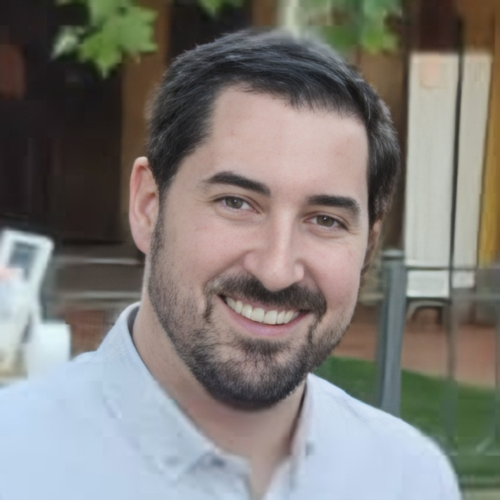
Corey Harper is an Assistant Professor at Carnegie Mellon University, holding dual appointments in the Department of Civil and Environmental Engineering (College of Engineering) and the Heinz School of Information Systems and Public Policy. He directs the Future Mobility Systems Lab, focusing on equitable, environmental, and policy impacts of transportation technologies. His research employs modeling, simulation, and data analytics to address challenges like climate resilience, automation, and EV infrastructure gaps. B.S. Civil Engineering, Morgan State University (2013) M.S. & Ph.D. Civil and Environmental Engineering, Carnegie Mellon University (2014 & 2017) Research interests span sustainable transportation systems, equity in mobility, and smart infrastructure. Recent work includes analyzing EV charging coverage, ride-hailing equity, and micromobility’s congestion reduction potential. Articles highlight themes like climate adaptation, algorithmic fairness in transit, and pandemic-related travel behavior shifts. Recipient of Elsevier ATLAS Best Paper Award (2016 TRB Young Member) Advising Ph.D. student Sofia Martinez (DOT Fellowship recipient). Prior experience includes consulting at Booz Allen Hamilton on cyber-physical systems for the USDOT. His lab’s projects include decarbonization strategies and EV policy analysis. Led studies on e-bike adoption in Seattle and EV charger network gaps, emphasizing equity and sustainability. Collaborates on Scott Institute seed grants for energy research and interdisciplinary teams like the Transportation Research Board.
Professor Dianne Wiley is a Chemical Engineer and Honorary Professor at the University of Newcastle , where she serves as Dean of Engineering . She is a global leader in membrane systems for water treatment and technoeconomic analysis of carbon capture and storage (CCS) technologies . Her work spans fundamental research and industrial applications, focusing on climate resilience, energy systems, and sustainable engineering solutions. Key Affiliations: University of Newcastle (2022–present) University of Sydney (2016–2022) UNESCO Centre for Membrane Science and Technology Research Interests include: Carbon capture, transport, and storage (CT, pipeline optimization) Membrane science for water/wastewater treatment Technoeconomic modeling of industrial decarbonization Flexible CCS operation and renewable energy integration Advanced oxidation and photocatalytic processes Publication Trends reveal a focus on CO2 mitigation strategies (2016–2025), membrane fouling/scaling (1985–2021), and catalyst design (2022–2025). Her work bridges chemical engineering, environmental systems, and industrial decarbonization. Education : PhD, University of New South Wales Bachelor of Applied Science (Distinction), Darling Downs Institute of Advanced Education Graduate Diploma in Education, Armidale College of Advanced Education
Assoc. Prof. Ali Yavari is an Associate Professor of Computer Science at Swinburne University of Technology's School of Science, Computing and Emerging Technologies. He also serves as Director of the 6G Research and Innovation Lab and Radiofrequency Lab. His academic journey includes a PhD in Computer Science from RMIT University (Australia) and a Master's in Communication Systems from KTH Royal Institute of Technology (Sweden). His research focuses on IoT, Cyber-Physical Systems (CPS), 5G/6G communication technologies, renewable energy systems, and health informatics. He leads collaborative projects funded by entities like Future Energy Exports CRC, Australian Radiation Protection & Nuclear Safety Agency (ARPANSA), and the Victoria State Government. Notable contributions include developing AI-driven IoT platforms for environmental monitoring (e.g., ArtEMon) and cybersecurity frameworks for Industry 4.0. Key achievements include the Victoria Fellowship in Physical Sciences (2020), Vice-Chancellor’s Research Excellence Awards (2021, 2023), and a Best Paper Award at the Hawaii International Conference on System Sciences. His work spans over 65 publications in top journals/conferences such as IEEE Sensors , Sustainable Energy Technologies and Assessments , and Environmental Research . Professional activities include program committee roles at IEEE conferences and memberships in ACM and IEEE (Senior Member). He actively supervises PhD candidates and teaches courses in IoT programming and advanced computing topics.
Nicolas Kelly is an Associate Professor in the Department of Mechanical And Aerospace Engineering at the University of Strathclyde. He holds roles as Reader and leads initiatives such as the Strathclyde Energy Theme. His expertise spans energy systems in the built environment, with a focus on net-zero technologies, building simulation, and decarbonization strategies. Education: PhD in Energy Systems, University of Strathclyde (1998) MSc in Energy Systems and Environment, University of Strathclyde (1993) BEng (Hons) in Environmental Engineering, University of Strathclyde (1992) Research Interests: Specializes in building energy modeling, renewable energy integration, thermal energy storage, and probabilistic modeling of energy demand. His work addresses challenges in urban energy systems, agricultural decarbonization, and hydrogen technologies. Awards: Best Paper Award - World Renewable Energy Congress X (2008) ICE Baker Medal (2011) Advising & Grants: Supervises PhD projects in net-zero energy and building performance. Current projects include the UKRI Green Economy Centre (CENZ-HighDB) and the GreenShed initiative. Engages in strategic roles with organizations like IBPSA-Scotland and the Power Networks Demonstration Centre. Labs/Teams: Coordinates the Strathclyde Energy Theme, collaborates on international projects, and contributes to policy through roles in the International Building Performance Association (IBPSA) and East Ayrshire Council CORE project.
Chungen Yin is an Associate Professor in Thermal Engineering at Aalborg University, affiliated with the Faculty of Engineering and Science. He holds a PhD in Thermal/Fluids Engineering from 1998, specializing in Clean and Efficient Solid Fuel Combustion Technologies. His research focuses on advanced modeling of thermal/fluids systems for green transition, including CFD, digital twins, reacting flows (bioenergy, carbon capture), and heat transfer applications. He has contributed to over 137 publications and led 12 major projects, such as the BioNETzero initiative for net-zero emissions. Recognized as a top 1% scientist globally (Elsevier 2024), he also excels in teaching, winning multiple 'Teacher of the Year' awards and developing extensive course materials. His work spans biomass combustion, waste-to-energy, and industrial decarbonization. Education: PhD in Thermal/Fluids Engineering (1998): Clean and efficient solid fuel combustion for CHP, fluidized bed and fuel blending technologies. Research Interests: Modeling & Simulation for Green Transition, CFD/Digital Twins, Reacting Flows (Bioenergy, Carbon Capture), Heat Transfer Innovations, and Biomass/Waste Energy Systems. His work addresses challenges in boiler performance, combustion efficiency, and emissions reduction. Projects & Grants: BioNETzero (2024–2027): Oxy-combustion for bio-based CHP and negative emissions. Virtual Testing of Ammonia Marine Burners (2025–2028). Self-ignition Risks in Biomass Storage (2022–2025). Awards: World’s Top 1% Scientists (Elsevier/Stanford 2020–2024). Multiple 'Teacher of the Year' awards at AAU. Teaching & Advising: Supervised numerous PhD/MSc projects, served as international PhD opponent (Austria, China, Denmark, Norway, Singapore, South Africa, Sweden), and contributed to course development with over 3,500 slides across 10+ thermal/fluids courses.
Agneta Ghose is an Assistant Professor at the Department of Sustainability and Planning within Aalborg University's Technical Faculty of IT and Design. Her work focuses on advancing Life Cycle Assessment (LCA) methodologies, data sharing practices, and sustainability science, particularly in bio-based systems and circular economy frameworks. She leads and contributes to projects such as ASCCENT (CO2 storage in construction materials) and ALIGNED (harmonizing LCA methods for bio-based sectors). Her research interests include FAIR data principles for LCA, ontology development for sustainability data integration, and environmental impact assessments for buildings and bio-based products. She has published extensively on topics like EPD harmonization, LCA methodological challenges, and carbon flux modeling in forests. Key contributions include the core ontology for Life Cycle Sustainability Assessment on the Semantic Web and frameworks for bio-based product evaluation. Recipient of the ESWC 2019 Best Poster Award for open dataset and ontology work Active in initiatives like the LCS group's LCA reading club and international conferences Collaborates with institutions globally on bioeconomy, climate mitigation, and sustainable construction Her projects emphasize translating academic research into actionable tools for industries, such as standardized LCI data templates and frameworks for net-zero construction products.
Neil Beattie is a Professor of Energy Innovation and Director of the EPSRC Centre for Doctoral Training (ReNU) at Northumbria University. He holds a PhD in Physics from the University of Cambridge (2005), with prior work as an Innovation Consultant (2005–2009) for companies like Shell and Rolls-Royce. His research focuses on photovoltaics, particularly solution-processed inorganic thin films and product-integrated PV. He leads initiatives such as the EPSRC-ISCF North East Centre for Energy Materials (NECEM) and Energy Futures, fostering interdisciplinary decarbonization research. Key achievements include advancing CZTSSe and antimony selenide solar cell technologies and securing grants like the EPSRC Adventurous Manufacturing award (EP/T005491/1). Education: BSc (Hons) Physics (1996), PhD Physics (2005, University of Cambridge). Affiliations: EPSRC CDT ReNU, Photovoltaics Research Group, Energy Futures. Research Interests span semiconductor physics, thin film fabrication, and sustainable energy systems. His work addresses material characterization, device optimization, and scalable manufacturing techniques for next-generation photovoltaics. Grants and Projects: Led the £3M Advanced Thin Film Sputtering Fabrication Facility (TF-FAB) project (2023–2026). Supervised 8 students, with research outputs spanning 59 publications. Labs/Teams: EPSRC CDT ReNU focuses on renewable energy innovation; Energy Futures unites multidisciplinary researchers at Northumbria for decarbonization.
Jennie C. Stephens is the Dean's Professor of Sustainability Science and Policy at Northeastern University's School of Public Policy and Urban Affairs. She holds adjunct roles at Maynooth University (Ireland) and Harvard University. Her work focuses on climate justice, renewable energy transitions, energy democracy, and equity in climate policy. She is author of Climate Justice and the University (2024) and Diversifying Power (2020), advocating for antiracist, feminist leadership in sustainability. Education: PhD, Environmental Science and Engineering, California Institute of Technology (2002) MS, Environmental Science and Engineering, California Institute of Technology (1998) BA, Environmental Science and Public Policy, Harvard University (1997) Research Interests: Stephens integrates feminist, antiracist, and decolonial perspectives into climate policy, fossil fuel phase-out, energy democracy, and university reform. Key areas include: Climate justice frameworks Renewable energy equity Higher education's role in climate activism Fossil fuel industry influence on universities Awards: Radcliffe-Salata Climate Justice Fellowship (2023-2024) Leopold Leadership Fellowship (2015-2016) Arab-American Frontiers Fellowship (2017) Key Projects: Co-founder of the Climate Justice Universities Union Leadership in the Global Resilience Institute and Northeastern Environmental Justice Research Collaborative Advocacy for energy justice through policy and community engagement
Jess Tindall is a Lecturer in the School of the Built and Natural Environment at Northumbria University. With a focus on sustainability and efficient engineering systems, they bridge academic pedagogy with practical building services engineering. Jess’s career includes industrial experience at a multidisciplinary consultancy, contributing to projects like public transport interchanges and commercial office developments.
Katrina M. Wyman is the Wilf Family Professor of Property Law at New York University School of Law. She serves as Director of the Environmental and Energy Law LLM Program and Faculty Director of the Frank J. Guarini Center on Environmental, Energy and Land Use Law. Her expertise spans Environmental Law, Natural Resources Law, and Property Law, with a focus on urban sustainability and climate policy. Wyman holds a BA, MA, and LLB from the University of Toronto, and an LLM from Yale Law School. Education: BA (1992), MA (1994), LLB (1999) from University of Toronto; LLM (2001) from Yale Law School Key Roles: Director of Environmental & Energy Law LLM Program, Faculty Director of Guarini Center Recent Honors: Podell Distinguished Teaching Award (2020) Her research addresses cities’ roles in global environmental governance, innovative property frameworks, and climate mitigation strategies. She teaches courses on Environmental Law, Property Law for 1L students, and advanced seminars like the Space and Planetary Law Colloquium. Wyman’s work bridges legal scholarship with practical policy solutions for sustainability challenges.
Dr. Yashar Ghiassi-Farrokhfal is an Associate Professor at the Rotterdam School of Management (RSM), Erasmus University, in the Department of Technology and Operations Management. He holds key leadership roles as Academic Director of Smart Energy and Sustainability at the Erasmus Center for Data Analytics (ECDA) and as Erasmus University Scientific Lead at the Centre of Energy System Intelligence (CESI). His work bridges academia and policy, contributing significantly to energy transition research and sustainability initiatives. Ph.D., University of Toronto, Canada Dr. Ghiassi-Farrokhfal's research centers on the energy transition, leveraging a multi-disciplinary approach to explore electricity markets, renewable integration, energy storage, hydrogen systems, microgrids, and digital energy data. His recent focus includes the role of data in digital energy transition and market mechanisms at retail, wholesale, peer-to-peer, and bilateral levels. He investigates sector coupling, electric vehicles, and decarbonization strategies to enable sustainable energy systems. His recent publications reveal a strong trend toward modeling and optimizing energy systems for sustainability, particularly in pricing mechanisms, battery market participation, and decision support for heating systems. These works emphasize economic efficiency, environmental impact, and technological integration in modern energy markets. Dr. Ghiassi-Farrokhfal has secured multiple grants for significant projects including FlexSUS (municipal heat transition), MAGPIE (energy transition in ports), HyTROS (hydrogen market), Com2Heat (composite-based heat networks), and MODES (data layer in energy markets). He has supervised academic work and actively organizes conferences and workshops. He is a frequent guest speaker at major forums like the World Energy Congress. He is involved with research labs and centers including the Erasmus Center for Data Analytics (ECDA) and the Centre of Energy System Intelligence (CESI), where interdisciplinary teams work on data-driven energy solutions and intelligent system design for future energy networks.
Pauline Anderson is a Senior Lecturer at the University of Strathclyde's Department of Work, Employment and Organisation. Her research focuses on skills ecosystems, green transitions, and the future of work. She has held roles in the OECD Expert Advisory Group and is part of Scotland's Climate Emergency Skills Action Plan steering group. Education: BA (Hons) Psychology & Sociology (University of Strathclyde) MSc Occupational Psychology (Strathclyde/Heriot-Watt) PhD in Human Resource Management (ESRC Case Studentship) Chartered Occupational Psychologist (BPS) Research Interests: Green skills and net-zero transitions Skill ecosystems for subsurface technologies Labour market impacts of digital/green shifts Remote/hybrid work dynamics Gender equity in emerging green sectors Grants & Collaborations: Funded by UNDP, Scottish Government, SDS Co-investigator on "Graduating in a Pandemic" (2020-ongoing) Partnerships with UK Major Ports Group and Close the Gap Professional Engagement: Member of UN SDGs 8 (Decent Work) and 13 (Climate Action) Speaker at Net Zero Industrial Cluster Exchange (2023) Editorial board roles and peer review activities
Ali Darudi is a Project Lead and Researcher at the Center for Energy and Environment within the School of Management and Law at ZHAW Zurich University of Applied Sciences. His work focuses on energy economics, electricity market design, and system adequacy. Research Interests: Energy economics, electricity market modeling, system adequacy, and integration of renewable energy sources. Projects: Co-leading studies on utility-scale energy storage, grid tariffs for load control, and decentralized renewable energy integration in Switzerland. Expertise: Energy systems modeling, policy analysis, and market design for sustainable electricity grids. His recent publication in Energies (2024) evaluates future electricity markets under decarbonization scenarios, emphasizing flexibility and sector coupling.
Miguel de Simón Martín is an Associate Professor in the Department of Electrical Engineering, Systems and Automation at the University of León, Spain, within the School of Industrial, Informatics and Aerospace Engineering. His research focuses on Renewable Energy, Electrical Power Systems, and Electrical Energy Management, with particular emphasis on solar energy, photovoltaic systems, and energy communities. His educational background includes: Doctorate from the University of Burgos (2015) with thesis on "Characterisation of solar diffuse irradiance on vertical surfaces" Industrial Engineering from the University of León (2009-2011) Mechanical Engineering from the University of Burgos (2006-2009) Professor de Simón Martín's research centers on sustainable energy systems, particularly renewable energy integration, microgrid management, and energy communities. His work spans from fundamental solar resource characterization to practical energy management systems for buildings and communities. He has made significant contributions to the understanding of solar energy potential on building facades, photovoltaic system performance, and the economic feasibility of renewable energy projects. His recent work increasingly focuses on the integration of energy storage, electric vehicles, and hydrogen technologies into sustainable energy systems, addressing both technical and economic aspects of the energy transition. His publication record shows a clear evolution from fundamental solar energy research toward integrated energy systems and energy communities. The most recent publications demonstrate a strong focus on practical applications of renewable energy technologies, with particular attention to economic viability, system resilience, and the integration of multiple energy vectors. His work often combines technical analysis with economic assessment, reflecting a holistic approach to sustainable energy systems. His notable scientific achievements include: 2022 Award for the Transfer of Research Results to Society, Consejo Social de la Universidad de León 2021 and 2019 1st Prizes in Open Data Competitions, Junta de Castilla y León 2016 Doctorate Extraordinary Award from the University of Burgos 2015 Award T-CUE Doctorate from the University of Burgos and Knowledge Transfer Office Professor de Simón Martín has supervised numerous theses and final projects in electrical engineering, with a focus on renewable energy applications. His teaching has been recognized with "Very Favorable" ratings in the University of León's Teaching Activity Evaluation Process. His research has been supported by multiple funding sources, including participation in collaborative projects focused on smart grids, energy communities, and renewable energy integration. He has been actively involved in the GISIGE research group (Sistemas Inteligentes de Gestión de la Energía) and has collaborated with international research teams on energy systems analysis. His laboratory work centers around the analysis and simulation of Smart Microgrids, with a flexible test-bed pilot facility for research purposes. He has been involved in the development of tools for high precision PV degradation monitoring and supervision, as well as software applications for optimizing solar tracking systems. His team's work bridges theoretical research with practical implementation, often collaborating with industry partners to ensure real-world applicability of their findings.
Sofie Hellberg is a Senior Lecturer and Associate Professor in Peace and Development Research at the School of Global Studies, University of Gothenburg. Her research focuses on water governance, environmental policy, biopolitics, and the intersections between sustainability, security, and development. She leads projects on climate policy in Gothenburg, Education for Sustainable Development (ESD) in Sweden, Rwanda, and South Africa, and post-apartheid water governance. Her work combines theoretical frameworks from political ecology and governmentality studies with empirical research in Southern Africa and Sweden. Key areas include the politics of water scarcity, mobility transitions in urban contexts, and the biopolitical dimensions of education policy. Teaching includes Global Development Studies, International Relations, and African Studies at both BA and MA levels. She supervises PhD students at Chalmers and the University of Gothenburg, emphasizing power theories and critical methodologies. Her recent publications (2021–2025) address topics like car traffic reduction in cities, equity in ESD frameworks, and the governance of water infrastructure. Ongoing projects explore how climate policies intersect with social sustainability and urban planning. Labs/Teams: Collaborates with the Global Studies Research Group on Environment & Development. Grants: Swedish Energy Authority, Swedish Research Council, FORMAS (Swedish Research Council for Sustainable Development).