Rakotonirainy Andry is a Professor at Queensland University of Technology (QUT), affiliated with the Centre for Accident Research & Road Safety - Queensland (CARRS-Q). His research focuses on transportation safety, automated vehicles, human factors, and intelligent transportation systems (ITS). He leads interdisciplinary projects exploring driver behavior, connected vehicle technologies, and the societal impacts of automation. Key areas include accident prevention, human-vehicle interaction, and equity in transport systems. His work integrates machine learning, simulation studies, and behavioral analysis to address challenges in road safety. Notable contributions include studies on driver stress detection, automated vehicle acceptance, and the Australian Naturalistic Driving Study (ANDS). He collaborates with institutions globally, advancing innovations like connected vehicle pilots and multimodal AI for traffic safety. Research interests span automated driving systems, vulnerable road user protection, and policy implications of emerging technologies. His findings contribute to safer transportation policies and technologies, emphasizing both technical and human-centric perspectives.
Iman Nematollahi is a PostDoc in Robot Learning at the University of Freiburg under Prof. Dr. Abhinav Valada, having completed his PhD under Prof. Dr. Wolfram Burgard. He holds a MSc in Embedded Systems from the University of Freiburg and a BSc in Electrical Engineering from Shahid Beheshti University. His research focuses on robot learning, world models, and reinforcement learning, particularly in enabling robots to understand physics through world models and adapt skills in unstructured environments. Education: PostDoc in Robot Learning, University of Freiburg (2025–Present) PhD in Robot Learning, University of Freiburg (2019–2024) MSc in Embedded Systems, University of Freiburg (2015–2018) BSc in Electrical Engineering, Shahid Beheshti University (2010–2015) Research Interests: Robot manipulation, world models, reinforcement learning, computer vision, and self-supervised learning. His work emphasizes intuitive physics understanding, skill generalization, and sample-efficient policy improvement. Key Articles: Recent work includes LUMOS (language-conditioned imitation learning), Bayesian optimization for policy refinement, and 3D video prediction (T3VIP). These contributions bridge theory and real-world robotic applications, emphasizing long-horizon tasks and cross-environment adaptation. Awards & Grants: No explicit awards mentioned. His research has been supported through projects like OML (Organic Machine Learning). Teaching: Taught Deep Learning Lab (2020–2022) and Introduction to Mobile Robotics (2019).
Currently a Research Fellow at Harvard University & MIT , Fangneng Zhan specializes in Neural Rendering and Generative AI . His research focuses on developing evolutive rendering frameworks, 3D-aware generative models, and multimodal synthesis techniques. Previously, he was a postdoctoral researcher at the Max Planck Institute for Informatics under Prof. Christian Theobalt. He earned his Ph.D. in Computer Science & Engineering from Nanyang Technological University, Singapore and a Bachelor's in Communication Engineering from the University of Electronic Science and Technology of China . His work spans 3D reconstruction, robotics applications , and lighting estimation , with significant contributions to SIGGRAPH , NeurIPS , and CVPR conferences. Recent research highlights include evolutive gauge transformations for neural fields, generalizable 3D style transfer via Gaussian splatting, and multimodal synthesis frameworks leveraging pre-trained models like CLIP and Stable Diffusion. He has co-authored Top50 Popular Paper in TPAMI 2023 and organized workshops at CVPR 2024 on generative models. Scientific Awards: Top50 Popular Paper, IEEE Transactions on Pattern Analysis and Machine Intelligence (TPAMI) 2023 Collaborative Network: Mentored students at institutions like Harvard, NTU, and ETH Zurich. His projects include datasets for lighting estimation and real-time scene text detection systems.
Dr. Sian Vaughan serves as Associate Professor in Research Practice at Birmingham City University and leads RAAD (Research in Art, Architecture, and Design) center. She holds strategic leadership roles in research communities, doctoral education, and large-scale academic projects. Current research focuses on research practices and cultures in creative disciplines Co-leader of Creative Pedagogies research cluster Active in CHEAD as Trustee and RIKE Alliance Chair Her expertise spans: Research practice methodologies Pedagogies in doctoral education Creative practice as knowledge generation Academic leadership in art/design Institutional research frameworks Hybrid teaching-research models Key project insights reveal: Development of flexible researcher communities Innovation in digital-physical supervision models Critical analysis of archival engagement in creative research Advocacy for para-academic research frameworks Recent publications and projects demonstrate her focus on: Transformative research supervision practices Archival materiality in art research Employability of creative researchers Institutional praxis in art education
Benjamin Willmore serves as a Departmental Lecturer at the University of Oxford, affiliated with the King Group within the Department of Physiology, Anatomy and Genetics (DPAG) and St Peter's College. His research investigates neural representation and processing of sensory information under naturalistic conditions, utilizing electrophysiological recordings and computational modeling to decode auditory and visual system mechanisms. His academic background includes: PhD in Computational Neuroscience from the University of Cambridge supervised by David Tolhurst MSc and MA degrees from the University of Cambridge (Cantab) Willmore's research spans sensory neuroscience with primary focus on auditory processing, examining how neurons encode complex sounds through electrophysiological measurements and model-based analysis. His work explores neural adaptation to reverberation, subcortical contributions to cortical sound encoding, and cross-modal principles in visual motion processing. This integrative approach bridges experimental neurophysiology with theoretical frameworks to understand sensory computation in natural environments. Analysis of his 2020-2024 publications reveals consistent emphasis on auditory neuroscience, particularly nonlinear sound encoding mechanisms and adaptive processing in cortical/subcortical circuits. His work demonstrates methodological integration of in vivo electrophysiology, computational modeling, and behavioral paradigms across auditory and visual domains, highlighting interdisciplinary innovation in sensory systems neuroscience. Scientific Awards: No awards mentioned in source materials Willmore actively contributes to Oxford's academic mission through lecturing for the MSc in Neuroscience and BA in Biomedical Sciences programs, while providing specialized tutorials on sensory neuroscience and neural coding to second- and third-year medical students. His teaching integrates cutting-edge research concepts into core neuroscience curricula, though specific grant funding details remain unreported in available sources. He operates within the King Group, a leading neuroscience research team investigating neural circuit mechanisms of sensory perception using multidisciplinary approaches including in vivo electrophysiology, imaging, and computational analysis. The group focuses on how auditory, visual, and multisensory information is processed in behaving systems, with Willmore contributing expertise in computational modeling of naturalistic sensory encoding.
Andreas Huth is a prominent researcher at the Helmholtz Centre for Environmental Research (UFZ) in Leipzig, Germany, where he works within the Department of Ecological Systems Analysis. His research focuses on developing and applying computational models to understand complex ecological systems, with particular emphasis on vegetation dynamics, biodiversity patterns, and environmental interactions. Huth is actively involved in several major research initiatives including the FORMIND project, which simulates forest growth using individual-based vegetation models, and contributes to the UFZ's research program on Smart Models and Monitoring. Huth's research interests span ecological modeling, vegetation dynamics, biodiversity assessment, and environmental system analysis. He specializes in developing sophisticated computational frameworks that integrate atmospheric, ecological, and spatial data to model complex environmental processes. His work often involves coupling different modeling approaches, such as connecting atmosphere and vegetation radiative transfer models to study cloud-vegetation interactions. Huth is particularly interested in understanding spatial patterns in ecological systems, species-habitat relationships, and the impacts of environmental change on biodiversity. His methodological expertise includes agent-based modeling, individual-based modeling, and developing digital twin technologies for environmental systems. Analysis of Huth's recent publications reveals a strong focus on integrating different modeling approaches to address complex environmental questions. His work demonstrates a progression from basic ecological modeling toward more sophisticated integrative frameworks that connect atmospheric processes with vegetation dynamics, and social systems with ecological outcomes. A notable trend is his increasing involvement in digital twin technology for environmental systems, particularly for biodiversity monitoring and prediction. His research spans multiple scales - from microbial ecosystems to continental-scale species distributions - while maintaining a consistent methodological thread of spatially explicit modeling and causal analysis in complex systems. Huth collaborates extensively with researchers across the UFZ and internationally, as evidenced by his co-authorship on numerous interdisciplinary publications. While specific awards are not mentioned in the available information, his consistent publication record in high-impact journals and leadership in major modeling initiatives like FORMIND indicate significant recognition within the ecological modeling community. His work has practical applications for environmental policy, conservation planning, and climate change adaptation strategies. Huth is an active member of the Ecological Systems Analysis research group at UFZ, which develops and applies computational models to investigate key mechanisms in ecological systems. He contributes to several major research platforms including FORMIND (an individual-based vegetation model for species-rich forests) and participates in the UFZ's broader research initiatives on environmental monitoring and sustainable technologies. His work is integrated within the UFZ's research program on Smart Models and Monitoring, which aims to develop innovative approaches for understanding and predicting environmental change.
Belen Masia is a tenured Associate Professor in the Computer Science Department at Universidad de Zaragoza , Spain. She is affiliated with the Graphics & Imaging Lab (part of the I3A Institute ) and the Vision, Image and Neurodevelopment Group (within the IIS Aragon Institute ). Her research bridges computational imaging , applied perception , and virtual reality , focusing on modeling human visual behavior and improving graphics/vision algorithms through perceptual insights. Education : Ph.D. in Computer Science (Eurographics PhD Award 2015), postdoctoral work at Max Planck Institute for Informatics . Research Highlights : Virtual Reality : Studying user behavior, saliency prediction, multimodal perception, and cinematography in VR. Appearance Modeling : Developing intuitive material representations and metrics for editing. Applied Perception : Leveraging human vision insights to diagnose defects in non-verbal patients. Computational Displays : Exploring HDR imaging and display optimization. Scientific Awards : Eurographics Young Researcher Award 2017 Eurographics PhD Award 2015 MIT Technology Review Top Ten Innovators Below 35 in Spain 2014 NVIDIA Graduate Fellowship 2012 Leonardo Fellowship from BBVA Foundation 2020 Leadership & Editorial Roles : Co-chair of Full Papers track at Eurographics 2026 Associate Editor for ACM Transactions on Graphics, Computers and Graphics, and ACM Transactions on Applied Perception Co-founder of DIVE Medical , a startup for automated visual function diagnosis PhD Students : Dario Lanza (2025, Modeling, Perception and Editing of Volumetric Materials ) Daniel Martin (2024, Computational Models of Visual Attention in VR , Best PhD Thesis Award EGSE) Julia Guerrero-Viu (2023, WiGRAPH Rising Star) Sandra Malpica (2023, VR Gaze Behavior ) Manuel Lagunas (2021, BBVA/SCIE Young Researcher Award) Ana Serrano (2019, Eurographics PhD Award & Unizar Outstanding Thesis) Collaborations & Grants : Involved in the EU-funded PRIME Innovative Training Network (predictive rendering and appearance reproduction) and leading projects on deep learning for pediatric visual diagnosis.
Dr. Kevin A. Adkins is a Professor in the College of Aviation at Embry-Riddle Aeronautical University , where he teaches aerodynamics, aircraft performance, and uncrewed aircraft systems (UAS) courses. He pioneered the first collegiate Advanced Air Mobility (AAM) course in the U.S. in 2023 and directs two labs: the Advanced Air Mobility Research and Innovation Lab (AAMRIL) and the Uncrewed Vehicle and Atmospheric Investigation Lab (UNVAIL) . Education : Ph.D. in Aerospace Engineering (Mississippi State University), M.Eng. and B.S. in Aerospace Engineering (University of Michigan-Ann Arbor) His research focuses on atmospheric boundary layer meteorology using UAS, AAM concepts of operation (ConOps), and flight test engineering. He collaborates extensively on sensor development for environmental monitoring, including low-cost particulate matter sensors and bioaerosol sampling mechanisms. Recent publications emphasize UAS applications in wildfire detection, urban microclimate analysis, and wind farm humidity studies. Dr. Adkins serves on advisory committees for the Florida Department of Transportation's AAM initiative and ASTM International's UAS standards. Awards : Fellow of the Royal Aeronautical Society, ERAU Researcher of the Year (2020), PIEoneer Real Life Learning Award (2019), AUVSI Best Paper Award (2019) He mentors numerous student projects on UAS sensor development and atmospheric research, with teams winning symposium awards. His labs integrate experiential learning with international fieldwork in Puerto Rico, Norway, and Lithuania.
Prof. Jeanette Hoffmann holds a full professorship in the Didactics of German Literature at the Faculty of Educational Sciences , Free University of Bozen-Bolzano. Her academic journey includes studies in German, mathematics, and educational science at the University of Münster, followed by research roles at the Free University of Berlin and Technical University Dresden. She earned her doctorate with an award-winning study on intercultural literary dialogues and completed teaching qualifications in Montessori education. Previously a professor in Dresden, she now leads educational initiatives focusing on multilingualism, graphic storytelling, and intercultural learning. Education & Professional Path: Studied at University of Münster (German, Mathematics, Protestant Theology, Educational Science) Doctoral research at Free University Berlin (awarded for study on literary conversations) Second State Examination at Montessori elementary school Berlin Professor positions at Technical University Dresden and University of Teacher Education Upper Austria Research Interests: Focuses on children's literature didactics , graphic storytelling , multilingual education , and intercultural learning . Her work bridges empirical research with practical pedagogy, emphasizing dialogue-based learning and innovative classroom methodologies. Awards & Recognition: Double award for her doctoral thesis (2011) 2024 Prize for Excellent Doctoral Supervision by the Symposium on German Didactics Lab & Teaching Activities: Directs the KinderLiteraturWerkstatt (ChiLiLab), a research lab exploring literary aesthetics through children's books. Engages in projects like the IMAGO initiative promoting multilingual storytelling in South Tyrol. Teaches courses on literary learning, media socialization, and early literacy pedagogy.
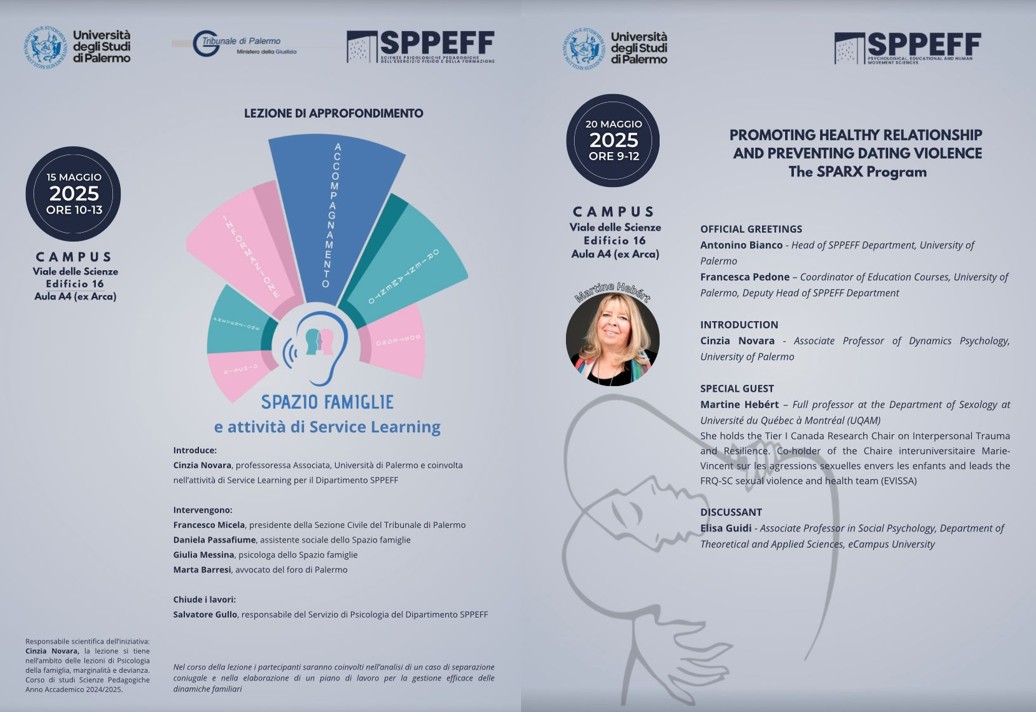
Cinzia Novara is an Associate Professor in the Department of Psychological, Pedagogical, Physical Exercise and Training Sciences at the University of Palermo. She is actively engaged in teaching and research, focusing on community psychology, family dynamics, intercultural education, and youth mental health. Her teaching includes courses such as Family Psychology, Marginality and Deviance, and Network Interventions in Community Work. Her research interests center on community wellbeing, migration, school inclusion, and the psychological impact of digital technologies. She explores how social support, school climate, and intercultural dynamics influence the lives of adolescents, migrants, adopted children, and LGBTQ+ individuals. Her work often integrates participatory methods and service learning to foster social transformation. Her recent publications (2023–2025) show a strong focus on emotional intelligence, vulnerable narcissism, social media use, and the psychological effects of the pandemic on university students. The research consistently emphasizes community resilience, inclusion, and the role of educational environments in shaping psychological outcomes. Themes such as sense of community, coping strategies, and identity in multicultural families recur across her work. Scientific Projects: PRIN 2022 - CURA: Children as vulnerable users of IoT and AI-based technologies T@les at home - Multilingual Families Erasmus K2 Project “CARE” CORI 2017 & 2019: Civic engagement and migrant acculturation Micropolis: Community welfare model Prevention of pathological addictions among university students Work Addiction and Community Psychology Family Space and Service Learning She supervises internships and thesis work, advising students through direct engagement and institutional portals. She leads initiatives under the Third Mission of Unipa, including the UNIPA Parents' Service and Family Space, promoting community-based learning and social inclusion. Her projects often involve cross-cultural collaboration, particularly with Spain, and focus on building inclusive educational cultures.
Nicole Kalms is a Professor in the Department of Design at Monash University’s Faculty of Art, Design and Architecture, where she also serves as Associate Dean of Research. She is the founding director of the XYX Lab, a pioneering research group focused on Gender and Place, leading national and international projects on gender equity in urban environments. PhD in Architecture, Monash University (2017) Masters in Landscape Architecture, RMIT University (2006) Bachelor of Architecture (Honours), RMIT University (1998) Nicole Kalms’ research lies at the intersection of urbanism, feminism, spatial practice, and media. Her work critically examines how gender, sexuality, and power shape urban spaces, advocating for design as a tool for social justice. She emphasizes interdisciplinary and co-design approaches to address systemic inequities in cities, particularly for women and marginalized communities. Her recent publications and projects reveal a strong thematic focus on gender-sensitive urban design, digital interventions for public engagement, and inclusive mobility. The 15 most recent works include books, chapters, and research outputs centered on feminist urbanism, crowd-sourced safety mapping, visual communication of gender inequality, and participatory design. These contributions reflect a consistent commitment to translating academic research into public discourse and policy impact. Dean's Award for Research Impact (2018) Premier's Design Awards Finalist – 'SHEcity' (2019) Good Design Award Gold Winner – 'Yours, Mine, Ours' (2020) AGDA Award Distinction – 'HyperSext City' (2021) Designers Australia Award Winner – 'HyperSext City' (2021) Nicole Kalms actively supervises research and leads externally funded projects such as the Safer Cities Crowd Mapping Project and PETAL: Pedalling Towards Active Living. She has secured grants from government bodies and international partners, and her work informs public policy on urban safety, transport, and inclusivity. She regularly serves on advisory boards and contributes to public discourse through media and lectures. She leads the XYX Lab, a dynamic research team dedicated to gender and place, which produces innovative design-led research, public exhibitions, and policy recommendations. The lab fosters collaboration across disciplines and with community stakeholders to co-create equitable urban futures.
Martha S. Feldman holds the Johnson Chair for Civic Governance and Public Management at the University of California, Irvine, where she is a Distinguished Professor in Urban Planning and Public Policy, Management, Political Science, and Sociology. She earned her PhD from Stanford University in 1983. Her work focuses on organizational routines, public management, and qualitative research methods. Her research explores how organizational routines drive stability and change, with a focus on their role in decision-making and institutional adaptation. She has pioneered frameworks for understanding routine dynamics, integrating practice theory and process studies. Feldman has served as Senior Editor for Organization Science (2006–2018) and sits on editorial boards of leading journals including Academy of Management Journal and Journal of Management Studies . Her contributions have been recognized with major awards, including the 2009 Administrative Science Quarterly award and two honorary doctorates from the Universities of St. Gallen and Hanken. Her scholarship bridges theory and practice, addressing topics like collaborative governance, inclusive management, and narrative analysis. She has produced over 100 peer-reviewed articles, with a focus on organizational learning, public policy implementation, and methodological innovation in qualitative research.
Norbert M. Schmitz is a Professor of Aesthetics at the Muthesius Academy of Fine Arts in Kiel, Germany. He has held academic roles at institutions including the University of Wuppertal (1992-1996), University of Siegen (2000), Ruhr University Bochum (1991-2000), and the University of Art and Design in Zurich (1999/2000). His international lecture activities span Austria, Switzerland, France, USA, and Pakistan. Institute of Art, Design and Media Studies: Aesthetics Muthesius Academy of Fine Arts (Faculty) Research and Publications: Schmitz’s work focuses on intersections of modernist art , film studies , media theory , and visual culture , with particular emphasis on topics like interactive media art , cinematic artist portraits , and synthetic realities . His edited volumes include works on embodiment , temporal media , and design anthropology . Academic Collaborations: Frequent co-editor with Lars C. Grabbe and Patrick Rupert-Kruse , contributing to the Yearbook of Moving Image Studies (YoMIS) and other key publications. His editorial work spans institutions in Darmstadt, Marburg, and Vienna. Key Themes: Explores media as aesthetic strategy , evolutionary perception , intermediality , and technological materiality across film, art, and design. Analyzes modernist paradigms in works by Eisenstein, Tarkovsky, and Bauhaus theorists.
Marian Sauter is a researcher at Ulm University's Institute for Psychology in Germany, specializing in the intersection of psychology, human-computer interaction, and educational technology. Her work primarily focuses on eye-tracking methodologies and gaze analysis to improve online teaching and learning environments. She frequently collaborates with colleagues from the Institute of Media Informatics at Ulm University, indicating strong interdisciplinary connections between psychology and computer science departments. Her research interests center on understanding visual attention patterns in educational contexts, particularly how gaze behavior correlates with learning outcomes in digital environments. Dr. Sauter investigates how eye movement data can be visualized and utilized to optimize instructional design, with specific attention to gaze-laser pointer relationships, gaze synchronicity among students, and attention monitoring in virtual classrooms. Her work bridges cognitive psychology theories with practical applications for e-learning platforms and remote education systems. Analysis of her recent publications reveals a strong trajectory in applying eye-tracking technology to solve real-world educational challenges, particularly those emerging during and after the pandemic-driven shift to online learning. Her research spans both theoretical investigations of visual attention mechanisms and practical implementations for educational technology. The consistent focus on webcam-based eye-tracking demonstrates her commitment to developing accessible methods that don't require specialized hardware, making her research particularly relevant for widespread educational applications. Best Paper Award at ETRA '22 Symposium on Eye Tracking Research and Applications Berlin Health Award (2023) Dr. Sauter's collaborative approach is evident in her frequent co-authorship with Tobias Wagner from Ulm University's Institute of Media Informatics and Anke Huckauf from General Psychology. Her research appears to be supported by institutional resources at Ulm University, though specific external grants are not mentioned in the available information. She appears to be actively mentoring students given her involvement in educational psychology research and student-focused studies. Her work suggests involvement with research groups focused on human-computer interaction, educational technology, and cognitive psychology at Ulm University, though specific lab names are not provided in the available information. The interdisciplinary nature of her publications indicates collaboration across psychology and media informatics departments.
Justin Owen Rawlins is an Associate Professor in Media Studies and Film Studies at The University of Tulsa's Kendall College of Arts & Sciences . His research explores the ideological work of screen texts through reception studies, media history, and Arctic media analysis. Education: Ph.D. in Media Studies, Indiana University Bloomington M.A. in Media Studies, Indiana University Rawlins investigates how media shapes identity through Method acting discourse , Alaskan reality TV , and celebrity paratexts . His work reveals tensions between neoliberal self-sufficiency and media production networks . Recent publications include the monograph Imagining the Method (2024), which maps Method acting's cultural politics, and articles on Joaquin Phoenix's Joker (2019), Tom Cruise's stunt performances (2021), and Arctic media representation (2022). His scholarship appears in Celebrity Studies , FLOW , and The Terror 's critical companion materials. At TU, Rawlins serves as Faculty Advisor and Executive Producer for the TUTV Media Lab , mentoring students in television production, podcasting, and cross-platform media. He has expanded the lab into a collaborative space with 500% membership growth since 2016.