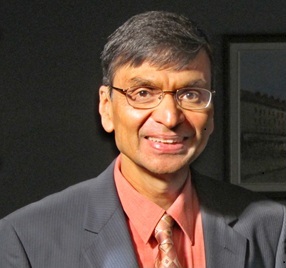
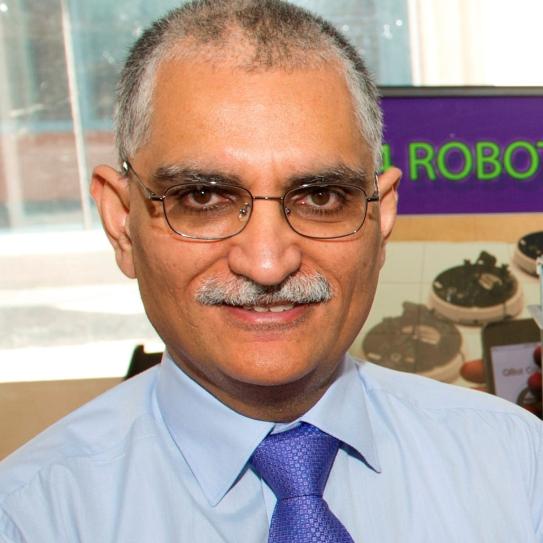
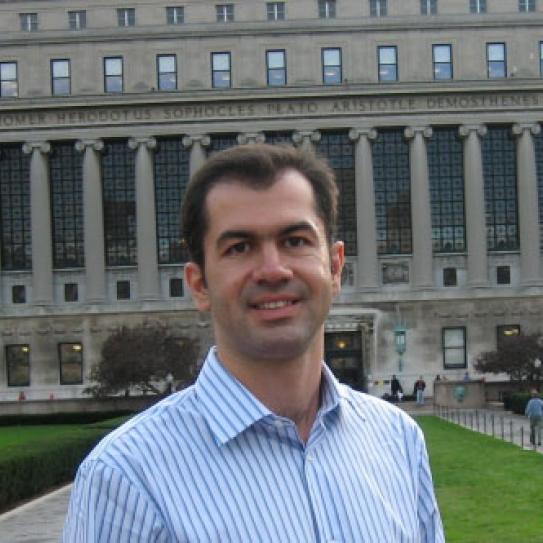
Akhil Kumar is Professor of Supply Chain & Information Systems at Penn State's Smeal College of Business, with research spanning blockchain applications, process mining, and healthcare informatics. His work develops analytical frameworks for business process optimization and compliance management. Publications demonstrate theoretical contributions to workflow management systems and practical applications in supply chain transparency. Recent blockchain research evaluates technical feasibility in commercial logistics networks. He received the Fulbright Scholar Award and INFORMS best paper recognition, and serves as associate editor for ACM Transactions on Management Information Systems.
Dr. Najam Ul Hasan is a Senior Lecturer at the Department of Computing, Sheffield Hallam University. He holds a PhD in Information and Communication Engineering from Sejong University (2014), and prior roles included Assistant and Associate Professor at Dhofar University (2015–2020). His expertise spans IoT, 5G/6G networks, mobile edge computing, and machine learning, with applications in smart cities, disaster management, and healthcare. He has authored over 40 Web of Science-indexed papers and 25 IEEE conference papers, with 1,100+ citations (h-index 18). Awards include IEEE Senior Member and Fellow of Advance HE. Education: B.Sc. & M.Sc. in Computer Engineering (2006–2008), University of Engineering and Technology & NUST, Pakistan Ph.D. in Information and Communication Engineering (2014), Sejong University, South Korea Research & Expertise: IoT, Wireless Sensor Networks, 5G/6G, Mobile Edge Computing Applications: Smart Cities, UAVs for Disaster Management, Remote Healthcare Blockchain in Healthcare (e.g., SHealth system), Fraud Detection Teaching: Modules: Computer Programming, IoT Systems, Foundations in Computing Program Design, Quality Assurance, Academic Management Awards & Grants: Secured grants for IoT projects in smart cities, agriculture, and UAV-based disaster management Lead Research Committee at College Level Labs & Collaborations: Research Assistant at MINES Lab (Sejong University) Researcher at Multidimensional Insight Lab (Yonsei University)
John Collomosse is a Professor of Computer Vision and AI at the University of Surrey, leading DECaDE (UKRI/EPSRC Centre for the Decentralised Digital Economy) and the Centre for Vision, Speech and Signal Processing (CVSSP). He also serves as a Principal Scientist at Adobe Research, managing the Cross-Modal Representation Learning (XRL) group. His research focuses on AI, Distributed Ledger Technology (DLT), media provenance, and blockchain applications to combat misinformation and enhance data integrity. Collaborations include the Content Authenticity Initiative (CAI) and the ARCHANGEL project, which pioneered AI and blockchain for tamper-proof archives. He holds a PhD, is a Fellow of the IET, and has advised UK/EU bodies on digital economy policies. His work bridges academia and industry, with contributions to generative AI, watermarking, and decentralized systems. Publications span content authenticity, style transfer, and generative models. Awards include a 2024 prestigious fellowship. His labs include Surrey Institute for People-Centred AI (PAI) and DECaDE, fostering interdisciplinary research in AI ethics, provenance, and digital economy frameworks.
Peng Zhang is an Associate Professor of the Practice of Computer Science at Vanderbilt University's School of Engineering, serving as Director of Graduate Studies for the Online MS Degree Program in Computer Science. His research focuses on distributed ledger technologies, healthcare interoperability, and data science education. He holds a leadership role in advancing interdisciplinary applications of blockchain and AI in healthcare systems. Education details are not explicitly provided in the text, but his academic roles suggest advanced qualifications in computer science and related fields. His research portfolio emphasizes blockchain-based healthcare solutions, including decentralized identity frameworks, interoperable data exchange, and generative AI applications in medicine. Notable projects include HealthBridge and FHIRChain, which address challenges in rare disease management and clinical data sharing. Articles from 2021–2024 highlight trends in blockchain-driven healthcare systems, generative AI in clinical contexts, and privacy-centric data architectures. These works underscore his contributions to improving healthcare interoperability through decentralized technologies and advancing patient-centered data management. No scientific awards are explicitly mentioned, but his active publication record reflects recognition within his field. His educational leadership shapes online graduate programs focused on modern computing challenges. While specific grants or lab affiliations are not detailed, his research collaborations likely involve interdisciplinary teams addressing healthcare IT and data science. His work bridges academic research with practical applications in medical technology and distributed systems.
Vikram Kapila is a Professor of Mechanical and Aerospace Engineering at New York University's Tandon School of Engineering, serving as Director of the Ph.D. Hub. His research focuses on robotics, control systems, digital health, and STEM education. He holds a B.Tech from Regional Engineering College (India), M.S. from Florida Institute of Technology, and Ph.D. from Georgia Institute of Technology. Professor Kapila’s work bridges robotics, AI, and blockchain with applications in healthcare and education. He leads the Mechatronics, Controls, and Robotics Lab, emphasizing hands-on learning and technology integration. His grants include NSF support for projects like wearable sensors for rehabilitation and remote control systems for dialysis machines. He has mentored numerous Ph.D. and master’s students and received awards such as the Jacobs Excellence in Education Award (2011, 2008, 2002) and NYU-Poly’s Leadership Award (2012). His research spans exergames for movement assessment, tele-rehabilitation, and robotics in K-12 education. Collaborations include projects with Johns Hopkins University and clinical partners. He advocates for inclusive STEM education and has contributed to professional development programs for educators.
Thomas Puschmann is a Researcher at the University of Zurich's Department of Finance and concurrently holds a Professorship at the University of the Fraser Valley in Vancouver, Canada. He serves as Director of the Swiss FinTech Innovation Lab, focusing on advancing digital finance solutions. His teaching includes courses like 'FinTech & InsurTech – Digitization of the Financial Services Industry' (starting October 2025). His research spans FinTech, sustainable finance, blockchain technologies, and climate change mitigation in financial systems. Education & Affiliations: PhD (Dr. title) Affiliated with the University of Zurich and University of the Fraser Valley Research Interests: FinTech Innovation & Regulatory Frameworks Blockchain Applications in Finance Sustainable Digital Finance Taxonomies Climate Change Mitigation via Financial Mechanisms BigTech's Impact on Financial Services Publications Trends: Recent work emphasizes green fintech research agendas, decentralized finance taxonomies, and the transformative role of technology in reshaping global financial systems by 2030. His 2024 Springer publication 'Financial System 2030' explores digitalization and regulatory dynamics. Advising & Grants: No formal advisees listed; however, his lab fosters collaborative research projects with industry partners. Funding sources include academic and private sector collaborations. Labs & Teams: Leads the Swiss FinTech Innovation Lab, a hub for applied research in digital finance innovation, bridging academia and industry.
Kishore Thapliyal is a Research Fellow at the University of Oslo, Norway, and previously held the same position at Palacky University in the Czech Republic. His research focuses on theoretical aspects of quantum optics, photonic quantum technology, and quantum information processing. Key areas include nonclassical state generation, entanglement quantification, decoherence suppression, and applications in quantum communication and cryptography. He collaborates with experimentalists to design models for multimode optical field experiments and explores non-Hermitian physics for quantum sensing enhancement. His academic journey includes postdoctoral roles since 2018, with a strong emphasis on advancing theoretical frameworks for quantum systems. Research interests span non-Hermitian dynamics, quantum resource optimization, and secure multiparty computation. He is affiliated with the Solid-state Physics and Quantum Technology research group at the University of Oslo. While no scientific awards are explicitly mentioned, his contributions to quantum photonics and theoretical models have been published extensively. Collaborations with experimental groups highlight his interdisciplinary approach to bridging theory and application in quantum technologies.
Thanasis Korakis is a Research Assistant Professor in the Electrical and Computer Engineering Department at NYU Tandon School of Engineering, affiliated with the Center for Advanced Technology in Telecommunications (CATT). He holds a Ph.D. in Computer and Communication Engineering from the University of Thessaly and has been involved in visiting research roles at UC Riverside and CATT. His research focuses on wireless networks, with an emphasis on access layer protocols, cooperative networks, directional antennas, and QoS provisioning. Education: Bachelor of Technology in Informatics, University of Athens (1994) M.S. in Data Networks and Telecommunications, University of Athens (1997) Ph.D. in Computer & Communication Engineering, University of Thessaly (2005) Research Interests: Dr. Korakis’ work spans experimental testbeds (e.g., Witest Lab), 802.11/802.16 standardization, and implementation of cooperative MAC protocols. His contributions include frameworks for cooperative handoff in wireless mesh networks, MAC protocols leveraging directional antennas, and dynamic rate adaptation for video multicast. Recent work explores 5G V-RAN reliability, AI-driven security systems, and IoT testbeds. Publications: His articles cover topics like 5G network optimization, blockchain applications in telecom, and AI in forensic investigations. Notable trends include experimental validation of network functions, security-enhanced systems, and cross-layer protocol design. Scientific Awards: Ericsson Award of Excellence in Telecommunications (2006) Advising & Grants: He leads the Witest Lab and has served on technical committees for ICC, WCNC, and SECON. His work includes grants related to wireless testbeds and standardization efforts. Collaborations involve institutions like CATT and NYU’s Tandon School. Labs & Teams: He directs the Wireless Implementation Testbed Laboratory (Witest Lab), focusing on real-world experimentation with wireless protocols and technologies.
Rei Safavi-Naeini is a Professor in the Department of Computer Science at the University of Calgary. She is a Fellow of the International Association for Cryptologic Research (IACR) and held former leadership roles as Co-Founder and Director of the Institute for Security, Privacy and Information Assurance (ISPIA) until December 2018. Previously, she served as a Professor and Director of the Telecommunication and Information Technology Research Institute at the University of Wollongong, Australia. Educational Background: PhD in Electrical Engineering from the University of Waterloo, Canada. Her research focuses on information-theoretic security, quantum-safe cryptography, distributed ledger systems, cloud security, and IoT security. She has over 400 peer-reviewed publications and has held editorial roles at IEEE Transactions on Information Theory, ACM Transactions on Information and System Security, and others. She has chaired major conferences such as Crypto 2012 and ACNS 2013. Awards include prestigious chairs in information security and recognition as an IACR Fellow. She has contributed to academic leadership through roles in research institutes and editorial boards.
Dr. Shujie Cui is a Lecturer in the Department of Software Systems & Cybersecurity at Monash University's Faculty of Information Technology. They hold a PhD in Computer Science from the University of Auckland (2019) and previously conducted postdoctoral research in the Large-Scale Data & Systems (LSDS) group at Imperial College London. Their research focuses on applied cryptography, cloud computing security, trusted execution environments, and privacy-preserving machine learning. Notable collaborations include projects on quantum information technology applications, privacy-preserving machine learning, and sustainability informatics for the Pacific. Current research interests span blockchain-based energy trading systems and unbiased recommendation algorithms. They are actively involved in supervising PhD students and contributing to interdisciplinary initiatives such as the Algorand Centre of Excellence. Key projects include the Quantum Information Technology: Industry Readiness & Applications (2023-2027) and CSIRO Privacy-Preserving Machine Learning (2023-2027). Their work emphasizes practical cryptographic solutions for modern distributed systems and emerging technologies. Dr. Cui's research has produced impactful publications in areas like privacy-preserving face recognition (CryptoMask) and fault-tolerant blockchain-based search mechanisms. These contributions highlight their expertise in balancing security, privacy, and computational efficiency in complex systems.
Barbara Guidi is an Associate Professor at the Department of Computer Science, University of Pisa. Her research focuses on Decentralized Online Social Networks, Blockchain Technology, NFTs, and the Metaverse. She is a founding member of IEEE METASIG (IEEE SIG on Metaverse) and collaborates with the IEEE Social Networks Technical Committee. Dr. Guidi has led projects like HELIOS under the H2020 initiative and serves on editorial boards for journals such as Plos One and IEEE Access. Her work explores blockchain applications in social media, economic dynamics in decentralized platforms, and bot detection in Web3 environments. Education: She studied at the Department of Computer Science, University of Pisa. Research interests include peer-to-peer networks, decentralized storage, and social network analysis. She has advised students on topics like Blockchain Technology applied to Social Media and NFT/Metaverse integration. Key contributions include frameworks like AWESOME for Web3 social media analysis and studies on Axie Infinity's economic models. She actively participates in workshops like OASIS, addressing challenges in online social networks. Her work emphasizes ethical blockchain applications and decentralized systems for social good. Labs/Teams: She contributes to the IEEE METASIG community and collaborates with institutions like the University of Bicocca - Milan on text-mining in decentralized social media.
Andrea Michienzi is an Assistant Professor in the Department of Computer Science at the University of Pisa. His research focuses on decentralized social networks, blockchain technology, and the metaverse, with an emphasis on improving privacy, security, and economic dynamics in Web3 environments. He has contributed to frameworks like AWESOME for analyzing Web3 social media and has explored challenges in NFT security, P2E gaming economies, and community management in decentralized systems. Teaching: He instructs the course Basi di dati e Laboratorio di programmazione Web within the Bachelor of Digital Humanities program, emphasizing practical coding and database applications. Research awards: He received a Best Paper Award in 2018 for work related to dynamic community detection in decentralized networks. His publications span topics like bot detection in blockchain games, wealth distribution analysis, and cryptographic protocols for secure messaging. His work integrates computer science, economics, and sociology to address scalability, trust, and ethical challenges in emerging decentralized platforms.
Dr. Omid Haass is a Senior Lecturer at the School of PCPM, RMIT University, based at the City Campus in Australia. His research focuses on project management, blockchain technology, knowledge management, and public sector innovation. He actively supervises research students in areas like front-end planning for government projects. Research Interests: Project Evaluation and Lifecycle Management Blockchain Applications in Public Procurement Agile Frameworks in Education Cybersecurity in Industrial Systems Medical Tourism Policy Publications highlight interdisciplinary work across project management, digital transformation, and organizational behavior. He is open to supervising Master’s and PhD candidates in project-related fields.
Rod Garratt is a Professor of Economics at the University of California, Santa Barbara (UCSB), holding the Maxwell C. and Mary Pellish Chair in Economics. He has held senior roles at institutions such as the Federal Reserve Bank of New York, Bank for International Settlements (BIS), and Bank of England. His research focuses on cryptocurrencies, central bank digital currencies (CBDCs), payment systems, and fintech innovations. Garratt earned his Ph.D. from Cornell University and has published in top journals like the American Economic Review and Journal of Political Economy. Education: PhD in Economics (Cornell University, 1991), MA in Economics (Cornell, 1990), Honours BA in Economics and History (University of Waterloo, 1986). Research Interests: Garratt’s work bridges theoretical economics and practical policy, emphasizing CBDC design, crypto-asset dynamics, and financial infrastructure resilience. He explores how decentralized technologies like blockchain can enhance payment systems while addressing risks such as systemic instability and privacy concerns. His recent work includes analyses of DeFi lending behavior and the implications of CBDCs on monetary policy. Key Contributions: Co-led the Federal Reserve’s Virtual Currency Working Group, contributed to Project Jasper (wholesale CBDC prototype), and advised multiple central banks on digital currency strategies. His research on privacy in electronic cash and the crypto multiplier effect has influenced policy debates globally. Awards: Recognized for contributions to CBDC research, including the 2021 Latin American Journal of Central Banking Best Article Prize and the 2020 NeurIPS Best Paper Award. Professional Roles: Editor of the European Economic Review and Digital Finance, and member of advisory boards for the World Economic Forum and BIS Innovation Hub. Garratt frequently testifies before legislative bodies, including the U.S. House Subcommittee on Monetary Policy. Labs/Initiatives: Active in BIS’s Project Agorá (cross-border payment systems) and collaborates with institutions like the IMF and ECB on digital currency frameworks.
Professor Ellie Rennie is a Professor in the School of Media & Communication at RMIT University. She holds positions as an ARC Future Fellow and Principal Research Fellow, affiliated with RMIT's Blockchain Innovation Hub and the Digital Ethnography Research Centre. She is also an Associate Investigator at the ARC Centre of Excellence for Automated Decision-Making and Society, and Research Director at Metagov. Her research focuses on blockchain governance, digital inclusion in Indigenous communities, and ethnographic methods applied to decentralized systems. Key areas include validator governance, climate action through blockchain (ReFi), and Indigenous knowledge systems' integration with distributed technologies. She contributed to the Australian Digital Inclusion Index and serves on the First Nations Digital Inclusion Advisory Group. Selected publications include analyses of blockchain's environmental impact, validator participation, and participatory ethnography in governance. Awards include the prestigious ARC Future Fellowship. Supervision interests span Web3 socio-economic strategies, decentralized governance, and digital inclusion in creative industries. Affiliated research centers include the Platform Economies Research Network and Blockchain Innovation Hub.