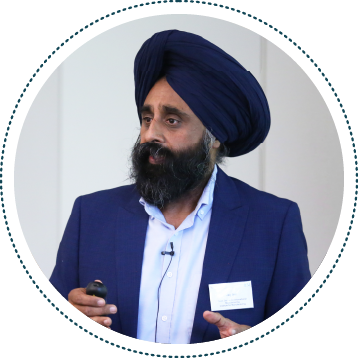
Christoph Schmidt is a Senior Lecturer in the Department of Management Information, Decisions & Operations at the University of Bath. His research focuses on the intersection of operations and information systems, particularly digital technology adoption in business and supply chains. Expertise in blockchain and additive manufacturing Contributions to UN Sustainable Development Goals (SDGs) Employs empirical methods with secondary and textual data Key research areas include supply chain risk management, data privacy, and digitalisation. His work often addresses humanitarian aid logistics and pandemic-related disruptions. Current research explores the physical-digital interface in blockchain applications and public reactions to supply chain glitches. Collaborations span multiple institutions and industries.
Dr Olatunji Adekoya is a Senior Lecturer and Course Leader for the MSc Human Resources and Organisational Development at Sheffield Business School, part of Sheffield Hallam University. He holds multiple academic credentials including a PhD in Management (University of East London), an MBA (University of Wales Trinity Saint David), a Harvard Business School Diploma in Business Analytics, and a Bachelors in Economics (University of Lagos, Nigeria). His research focuses on global south workplace dynamics, particularly in work-life balance, employee wellbeing, green HRM, gender issues, and gig economy challenges. He has published extensively in journals like the British Journal of Management and Gender, Work & Organisation, co-edited books on African career studies and international HRM, and serves as an external examiner for UK and international universities. His academic leadership includes mentoring doctoral researchers and advancing inclusive teaching practices as a Senior Fellow of Advance HE and Certified Management and Business Educator. He actively consults on organisational resilience and diversity initiatives, leading projects that bridge academic research with practical business solutions. His work often critiques cultural and institutional barriers in workplaces, advocating for equitable policies and sustainable HRM practices. Dr Adekoya’s research awards include recognition for his contributions to teaching excellence (SFHEA) and HRM education (CMBE). His research explores intersections between technology, environment, and labour, with a focus on Nigeria, the UK, and other Global South nations. His current projects address AI’s impact on gig economies, digital HRM adoption challenges, and gender equity in entrepreneurial ecosystems.
Dr. Amara Cynthia Ajaegbu is a Senior Teaching Fellow in the Operations and Information Management Department at Aston Business School (Aston University). Her expertise spans technology innovation, servitisation in manufacturing, and digital transformation. She holds a PhD in Digitalisation, IoT, Servitisation, and Value Co-Creation from Aston University (2019). Education: BSc. Business Information Systems MSc. Information Systems and Business Analysis PhD: The role and impact of digital capabilities on value co-creation of servitising organisations (Aston University) Her research focuses on AI, IoT, data sharing, and servitisation's impact on value creation. She is a Senior Fellow of the UK Higher Education Academy (SFHEA) and actively contributes to teaching enterprise systems, digital transformation, and technology management. Awards: 2017 Mentor of the year award Her grants include projects on hybrid learning environments using game-based methods. She supervises PhD topics on ERP systems in digital transformation and supply chain resilience. Amara is involved with professional bodies like the British Academy of Management and British Computer Society.
Dr. Jagjit Singh Srai is a Director of Research (Professor equivalent) in the Department of Engineering at the University of Cambridge and Head of the Centre for International Manufacturing at the Institute for Manufacturing (IfM). His research focuses on the analysis, design, and operation of international manufacturing supply networks, with an emphasis on advanced production and digital technologies. He leads IfM’s Digital Supply Chains Consortium, collaborating with global firms like Caterpillar, IKEA, and Unilever, and teaches on the course 'Digitalisation of End-to-End Supply Chains.' Dr. Srai is Co-Chair of the World Economic Forum Council on the Future of Advanced Manufacturing and Production and contributes to UNCTAD’s annual industrial development reports. His interdisciplinary work spans healthcare and food/FMCG sectors, supported by grants including EPSRC Made Smarter Innovation projects and Innovate UK Smart Pharma Supply Chain. He has held senior roles at Unilever prior to academia, managing complex supply chains across global operations. Expertise Areas: Supply Chain Management, Digital Manufacturing, Sustainable Supply Chains, Advanced Manufacturing, Network Design, Food Security. Selected Scientific Awards: Fellow, Institute of Chemical Engineers (FIChemE) Chartered Engineer (CEng) Highly Commended Paper Award, Emerald Publishers (2016)
Tom DE LEYN is a Tenure Track Assistant Professor at Hasselt University's School of Social Sciences, where he contributes to the Capacity group Social Sciences and the Research group Research for Digitalisation, Diversity and Democracy. His work bridges media studies, sociology, and digital anthropology with a focus on youth experiences in technology-mediated environments. Based at Campus Hasselt in the Faculty of Law building, he actively engages in interdisciplinary research examining the societal implications of digital transformation. His research centers on Digital Media, Media and Communication, and the Sociology of Youth, with particular emphasis on Privacy and Surveillance dynamics across diverse cultural contexts. He investigates how children, adolescents, and ethno-religious minorities navigate digital spaces, parental mediation, and mobile technologies through qualitative and ethnographic approaches. Key themes include digital disconnection practices, intimate surveillance, and the socio-cultural construction of technology use, often comparing Global North and South contexts like Belgium and Liberia. Recent publications (2024-2025) reveal a cohesive trajectory examining digital harms assessment scales, children's perspectives on surveillance, and the paradoxes of digital disconnection policies. His work consistently employs innovative methodologies like the 360° interview technique while addressing critical gaps in understanding racial, gendered, and age-based digital inequalities. This scholarship demonstrates strong thematic continuity across media sociology, youth studies, and critical technology assessment. No scientific awards were mentioned in available sources. Tom DE LEYN actively contributes to academic training as a coordinating lecturer for courses including Media and Communication Studies I, Digital Media and Civil Society, and Qualitative Research Methods. He currently leads the 'Environmental analysis digital skills' research project (2025) focused on community service learning contexts, demonstrating practical engagement with digital inclusion initiatives. Within Hasselt University's research ecosystem, he operates through the Research group Research for Digitalisation, Diversity and Democracy, which examines technology's societal impacts through lenses of diversity, democratic processes, and digital transformation. This affiliation positions his work at the intersection of theoretical innovation and real-world policy relevance, particularly regarding youth digital rights and inclusive technology design.
Dr. Chaitanya Patil is a Lecturer in the Department of Naval Architecture, Ocean and Marine Engineering at the University of Strathclyde, UK, advancing intelligent maritime systems through AI-integrated digital twin development for marine operational resilience. His educational background includes: PhD in Optimization of performance and emission in real driving from Universitat Politecnica de Valencia (2021) MSc in Reciprocating engines from Universitat Politecnica de Valencia (2016) MSc in Automotive Engineering for Sustainable Mobility from Université Bourgogne Franche-Comté (2015) B.Tech in Industrial Engineering from Veermata Jijabai Technological Institute (2012) Research focuses on three interconnected domains: Sensing and Perception (neuromorphic underwater object detection via sensor fusion), Cognition (AI-driven diagnostics/prognostics for predictive maintenance), and Decision-Making (intelligent control for emission reduction and engine optimization). His work directly supports UN Sustainable Development Goals for sustainable industry and climate action. Recent publications demonstrate a cohesive trajectory applying machine learning to marine engine health assessment, emphasizing feature extraction techniques and digital twin validation for fault diagnosis in maritime systems. Funding includes EPSRC, Innovate UK, and SPF grants, with current leadership as Co-investigator on the EPSRC IAA project Neuromorphic Sensor Fusion for Under Water Object Detection (SENSE) (2022-2026) and Principal Investigator on multi-sensor deep sea exploration systems. He actively supervises PhD students in intelligent marine systems research. With professional experience across UK, Spain, France, China and India, he maintains extensive industry collaborations through conference presentations including Digitalisation of Maritime Industry in India (2023) and Application of AI in Engineering symposia (2022).
Professor Barbara Casu is the Deputy Dean, Faculty and Research at Bayes Business School (formerly Cass), part of City, University of London. She holds the academic rank of Professor of Banking and Finance and serves as Head of the Faculty of Finance. Her research expertise spans systemic risk, banking strategies, financial regulation, and gender diversity in finance. She leads the prestigious Centre for Banking Research and collaborates with global institutions like the IMF, European Commission, and SWIFT Institute. Professor Casu’s leadership focuses on fostering research excellence, attracting top talent, and enhancing academic environments. Her contributions were highlighted in the 2021 Research Excellence Framework (REF2021), where Bayes ranked 5th in the UK for research quality. She advocates for policies that balance financial stability with innovation, particularly in post-pandemic contexts. In her role as Deputy Dean, she emphasizes resource allocation, peer support, and creating an optimal environment for researchers. Her academic leadership includes overseeing faculty development and strategic initiatives. Notable contributions include authoring the globally recognized Introduction to Banking (Pearson FT) and organizing major finance events such as the annual Mais Lecture. Her work bridges theoretical research with practical policy implications, addressing challenges like banking sector sustainability, digital transformation, and regulatory reforms across Europe, MENA, and African regions. Professor Casu’s research portfolio includes groundbreaking studies on bank business models, liquidity management, and the impact of gender diversity on misconduct. She has published extensively on systemic risk, shadow banking, and post-crisis banking reforms. Her interdisciplinary approach addresses both macroeconomic and micro-level financial dynamics, influencing both academic discourse and industry practices.
Vaggelis Giannikas is a Professor of Management Information, Decisions & Operations at the University of Bath, where he also serves as Director of the Centre for Smart Warehousing and Logistics Systems and Director of Studies for the MSc in Operations, Logistics, and Supply Chain Management. His research focuses on the adoption and evaluation of emerging technologies in supply chain and logistics operations, with particular emphasis on digitalization, robotics, and automation in manufacturing and warehouse environments. Giannikas holds a PhD in Operations Management and Technology from the University of Cambridge (2010–2014). His work aligns with UN Sustainable Development Goals, contributing to sustainable urban freight logistics and resilient supply chain practices. He leads multiple projects funded by Innovate UK and the Engineering and Physical Sciences Research Council (EPSRC), including Logidot AI Assistant for Enhanced AI Competency in Logistics and Made Smarter Innovation: People-Led Digitalisation. His research interests span technology implementation challenges, warehouse automation, human-robot collaboration, and dynamic inventory optimization. He actively supervises doctoral students exploring digital technologies in logistics and supply chain management. Key areas of exploration include last-mile delivery efficiency, robotic adoption in SMEs, and stochastic programming for production resilience under disruptions. Giannikas collaborates widely with industry partners, focusing on practical applications such as AMR-assisted picking systems, urban micro-fulfillment centers, and dark store operations. His work bridges academic research with real-world logistics challenges, emphasizing both technological innovation and human-centric design in digital transformation initiatives.
Clara Cheung is a Reader in Engineering Management at the University of Manchester, affiliated with the Department of Civil Engineering and Management and the School of Engineering. She holds a BCom from the Hong Kong University of Science and Technology and an MSc/PhD in Civil Engineering from the University of Maryland. Her research focuses on occupational safety, digital transformation, and leadership in high-risk industries like construction. She leads initiatives such as the Thomas Ashton Institute’s Digitalisation Theme and has been recognized as one of the Top 50 Women in Engineering for Safety and Security (2023). Her funded projects include ARCHES (Robotics in Construction), D-OSH Network (Occupational Safety), and Keep the UK Building Safely (Covid-19 Risk Modeling). Awards include the Taylor & Francis Award (2020), Best Paper Award (2023), and Health and Safety Software of the Year (2021). Clara’s articles address construction safety, digital tools in education, and AI-driven safety indicators. She chairs safety workshops and serves as an Associate Editor for ASCE’s Journal of Management in Engineering and Cell Press’s Heliyon.
Dr. Murat Aymelek is a Lecturer at the School of Business and Law, University of Brighton, specializing in maritime logistics, operations management, and supply chain management. With an interdisciplinary background spanning marine engineering and supply chain disciplines, he has worked internationally in Turkey, Ireland, and the UK. His current research focuses on maritime AI (autonomous shipping) and port decarbonization, employing both qualitative and quantitative methods to address industrial challenges. His educational background includes a PhD in Naval Architecture, Ocean and Marine Engineering from the University of Strathclyde (2016), an MSc in Marine Transport with Management from Newcastle University (2012), and dual Master's and Bachelor's degrees in Maritime Transport and Management Engineering from Istanbul University (2011 and 2009). Murat's research interests center on maritime and port management, freight transport, supply chain management, and decision-making. He is actively engaged in intermodal transport, autonomous ships, shipping digitalization, energy efficiency, and port sustainability. His work combines rigorous methodologies to tackle contemporary issues in the shipping and port sectors, with a strong emphasis on sustainability and technological innovation. Analysis of his recent publications reveals a strong trend towards sustainable maritime practices, particularly in port decarbonization and autonomous shipping. His work frequently employs multi-criteria decision-making models and data-driven approaches to address complex operational challenges in ports and shipping, reflecting the industry's urgent need for greener and smarter solutions. His scientific recognition includes: Fellow of Advance HE (The Higher Education Academy, UK) Murat is actively involved in research projects, including the Iberian Lighting KTP project (2024-2026) as Co-Investigator, focusing on strategic marketing and branding capabilities. He also serves as an External Examiner for Supply Chain Management at the University of Bedfordshire and is an Associate Member of the Socioeconomic Marine Research Unit at the University of Galway. He supervises postgraduate research in maritime transport, logistics, and supply chain management, and contributes to the UK Government's Help to Grow programme. He is a member of the Digital Innovation and Transformation Research Excellence Group and the Advanced Engineering Centre at the University of Brighton, fostering interdisciplinary collaboration on digital and sustainable solutions for the maritime sector.
Danielle McConville is a Professor of Accounting Education and Head of the Accounting Department at Queen's Business School (QBS), Queen's University Belfast. She holds a PGCHET (2011) and is a Chartered Accountant (CAI) with prior experience at Ernst & Young LLP. Her research focuses on accounting education technologies, charity reporting regulation, and digital transformation in NGOs. She actively advises on UK/Ireland charity accounting standards (SORP) and revises the QAA Accounting Benchmark Statement. Teaching roles include undergraduate courses like ACC1004 and ACC3043, and postgraduate modules such as ACC7003 and ACC8001. She also delivers executive education in finance for non-financial managers. Recent awards include the Pearson HE Innovate Award (2021) and QUB Teaching Award (2021). Her research spans 2009–2025, with notable contributions to regulatory dialectics in charity reporting, AI integration in accounting curricula, and learning technologies. She leads the QBS Teaching and Learning Forum, promoting pedagogical innovation. Collaborations include international scholars like Cordery, Goncharenko, and Quinn.
Pim Jansen is Full Professor of Economic Administrative Law at Erasmus School of Law, Erasmus University Rotterdam, since 2019, operating at the intersection of public economic law and administrative regulation with a Rotterdam-focused emphasis on economic activities. He concurrently serves as attorney-at-law at Van Doorne, Editor-in-Chief of Erasmus Law Review, Programme Director of the Togamaster, and Co-coordinator of the Master Publiekrecht voor Bedrijf en Burger. His research critically examines the evolving state-market relationship through lenses of strategic autonomy , digitalization , sustainability , and societal transitions . Work spans competition policy, national security implications for investment, climate-driven regulatory shifts (particularly hydrogen markets), and ESG frameworks, consistently contextualized within European Union legal dynamics and Dutch implementation challenges. Recent publications (2024-2025) reveal concentrated scholarly engagement with urgent regulatory frontiers: EU competition law adaptations for ESG data sharing, hydrogen integration into heating infrastructure, national security screening of foreign investments, and pension fund compliance with EU fundamental rights. These works demonstrate interdisciplinary convergence of administrative law, economic regulation, and transition governance under twin pressures of digitalization and decarbonization. His scientific recognition includes: EU Jean Monnet Network PROSPER funding (2024) Province Zuid-Holland grant for energy transition legitimacy research (2020) European Commission Directorate-General for Energy funding (2018) Belgium FWO Cambridge research grant (2017) Ius Commune Research Prize for industrial policy scholarship (2017) Jansen actively shapes academic discourse through programme leadership (Togamaster, Master Publiekrecht) and externally funded research initiatives. His dual role as academic and practicing attorney-at-law provides distinctive practitioner insights into competition law and regulatory frameworks, strengthening the applied relevance of his teaching and scholarship. He participates in critical research networks including the Law & Digitalisation seminar series and CELIS Forum on Investment Security, fostering collaborative analysis of emerging legal challenges at the nexus of technology, security, and economic governance.
Prof. Jannis Angelis is a Visiting Professor at ISM and a Docent/Reader in Operations Strategy at Indek. Previously, he held roles at Cambridge Judge Business School, Warwick, and Stockholm, and served as a country champion for teaching excellence at Oxford University’s education society. His academic journey includes a PhD in operations management from Cambridge, MPhil in political economy (Cambridge), MA in China studies from SOAS, and an MSc in international relations from Stockholm. His research focuses on the intersection of technology and management, exploring areas such as blockchain applications in supply chains, circular economy strategies for EV batteries, and digital transformation in manufacturing. Notable contributions include studies on blockchain in food supply chains, DLT ecosystems, and lean operational excellence, as evidenced by his receipt of the Shingo Prize and Skinner/Voss best paper awards. Angelis has supervised 9 PhDs and 400 student projects, secured €1.4m in grants, and led major research initiatives. His professional experience spans roles at the ILO, venture capital firms, and international consultancies like ITC (WTO/UNCTAD). He currently leads research at the Gunilla Bradley Centre and IFN Research Institute, focusing on digitalization and operational excellence. Teaching Awards: Four teaching awards, including recognition for pedagogical innovation. Research Grants: Over €1.4m secured, with leadership in three major projects. Labs/Teams: Active in the Gunilla Bradley Centre (Digitalisation) and IFN Research Institute (Industrial Economics).
Dr. Pi-Chi Chen is a Senior Lecturer in International Business at the Faculty of Business and Law, Anglia Ruskin University (ARU). She specializes in multinational corporation strategies, digital transformation in China, and business education. Prior to ARU, she held roles at the University of Greenwich and Birkbeck College, University of London, and worked as a stockbroker analyzing Asia-Pacific equity markets. Education: PhD in International Business (Birkbeck College, University of London) MBA (University of Leeds) PGCert in Higher Education (University of Greenwich) Her research focuses on multinational enterprises' strategic complexity, Chinese regional economic integration, and digitalization trends. Notable works include analyses of Chinese MNEs in India and the digitization shift in China's economy. She actively contributes to business education through pedagogical innovation and supervises postgraduate and PhD research students. Awards & Memberships: Fellow of the Higher Education Academy (UK) Chartered Management and Business Educator (CMBE) Academy of International Business (AIB) Member Dr. Chen teaches advanced modules like Postgraduate Major Project and oversees work placement programs. Her career bridges academic research with industry insights, particularly in equity market analysis and global business strategy.
Dimitris Zissis is a Lecturer in Operations Management at Norwich Business School, University of East Anglia. He holds a Ph.D. from Athens University of Economics and Business (AUEB) and has prior affiliations with the University of Bath, University of Liverpool, and Cranfield University. His research focuses on mathematical modelling (especially game theory), optimization, and their applications in supply chain and operations management. Education: Bachelor's in Mathematics, University of Athens M.Sc. in Statistics and Operations Research, University of Athens Ph.D. in Management Science and Technology, AUEB Research Interests: Game Theory applications in supply chains Optimization techniques for operational efficiency Digitalization impacts on supply chain coordination Sustainable energy market policies His recent work explores topics like review rating prediction via machine learning, energy market spillover effects, omnichannel strategies in gambling, and collaborative logistics under disruptions. Articles frequently blend theoretical models with practical industry applications. Awards: University of Athens scholarship for master’s excellence AUEB fellowship for Ph.D. studies Advising/Grants: While no students are listed, he participated in Greek, EU, and industry-funded projects. His work often involves cross-institutional collaborations highlighted in his research network. Labs/Teams: Engaged in interdisciplinary teams at Norwich Business School focusing on innovation and operations management challenges.