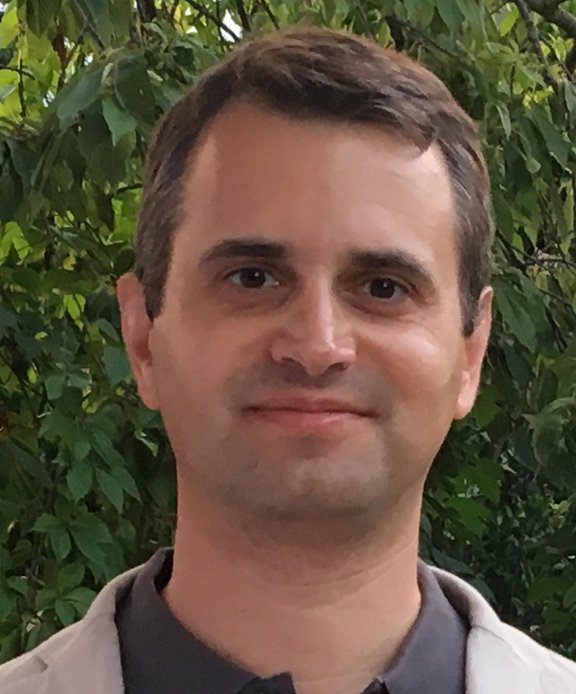
Christoph Wagner is a Lecturer in Lighting at the Royal Conservatoire of Scotland, where he has been employed since 2012. He holds a PhD (part-time) in scenography jointly from the Royal Conservatoire of Scotland and the University of St. Andrews, focusing on technological advancements in lighting design and archival methodologies since 1960. His research involves the Francis Reid Archive, Glyndebourne Opera archives, and practitioner interviews. Education: Graduated with distinction from Queen Margaret University College in Edinburgh, completed a Postgraduate Certificate in Teaching Higher Arts Education, and is pursuing his PhD. Research interests revolve around the intersection of technology and lighting design, particularly how innovations shape artistic expression and archival practices. He explores how historical lighting techniques are preserved and revived through modern digital tools, with a focus on operatic productions and archival documentation. Professional work includes lighting design for diverse theatre genres (devised theatre, cabaret, corporate events) across international stages, including the Tron Theatre, Soho Theatre, Tokyo Metropolitan Theatre, and The Arches. Notable projects include Hamlet , Victory , One Green Bottle , and collaborations with comedians like Eddie Izzard and Catherine Tate. His technical contributions are praised for enhancing dramatic storytelling through lighting, such as creating atmospheric tension in How To Act Around Cops and guiding audiences through narrative journeys in Victory .
Francis Y. Yan is an Assistant Professor of Computer Science at the University of Illinois Urbana-Champaign (UIUC), holding an affiliate appointment in Electrical & Computer Engineering within the Grainger College of Engineering. He leads the Illinois Networked Systems and AI (NSAI) research group, focusing on building intelligent networked systems that are safe, robust, and performance-optimized through practical machine learning integration. Prior to joining UIUC in January 2025, he served as a Senior Researcher at Microsoft Research Redmond under Victor Bahl. His educational background includes: Ph.D. in Computer Science from Stanford University (2020), advised by Keith Winstein and Philip Levis B.S. in Computer Science (Yao Class) and B.A. in Economics from Tsinghua University (2015) Additional undergraduate studies at MIT Yan's research adopts a holistic approach to practical machine learning for networked systems, emphasizing judicious application rather than indiscriminate use. He builds real-world systems and research platforms to lay ML foundations, devises deployable algorithms using domain insights, and validates performance through extensive empirical evidence. His work consistently addresses operator concerns regarding ML deployment—focusing on safety, robustness, generalization, and efficiency—while strategically combining ML with classical networking and systems techniques. Analysis of his 15 most recent publications (2023-2025) reveals dominant themes in resource allocation for microservices (DeDe, Autothrottle), real-time video optimization (Mowgli, GRACE), and LLM-driven network algorithm design. His work bridges theoretical advances with industrial deployment, evidenced by platforms like Puffer (400,000+ users) and OpenNetLab that have become community standards for validating congestion control algorithms. His research has been recognized with top honors: USENIX NSDI Outstanding Paper Award (2024) for Autothrottle APNet Best Paper Award (2022) IRTF Applied Networking Research Prize (2021) USENIX NSDI Community Award (2020) USENIX ATC Best Paper Award (2018) for Pantheon Yan actively recruits master's and undergraduate researchers for his NSAI group, prioritizing self-motivated students for projects in networked systems and AI. His research is supported by industry collaborations (notably Microsoft) and manifests in deployable platforms like Puffer—which has enabled award-winning research at NSDI and SIGCOMM—and OpenNetLab for real-time communications. His work directly impacts production systems including Microsoft Teams and Bing. He founded and directs the Illinois Networked Systems and AI (NSAI) research group, which operates critical infrastructure including Puffer (a live TV service and research platform) and OpenNetLab. These platforms facilitate community-wide validation of novel algorithms, with Puffer alone supporting multiple best-paper awards at top conferences. Current workstreams span cloud resource management (Teal, Autothrottle, DeDe), low-latency video (Puffer, Tambur, Mowgli), and LLM-augmented systems (Nada, Designing Network Algorithms via LLMs).
Conrad Alexandrowicz is a Professor in the Department of Theatre at the University of Victoria, Faculty of Fine Arts. Holding a B.F.A. in Dance from York University and an M.F.A. in Directing from the University of Alberta, he is a renowned theatre director, choreographer, and scholar with a focus on interdisciplinary performance. Education: B.F.A. in Dance, York University; M.F.A. in Directing, University of Alberta Awards: Jessie, Sterling, and Dora Awards for artistic excellence His research spans queer theatre , climate crisis pedagogy , and performance innovation . As founder of Wild Excursions Performance, he created over 45 works blending dance and theatrical elements. Recent publications include Performing the Nonhuman (2024) and co-edited Theatre Pedagogy in the Era of Climate Crisis (2021). Publication Trends: His work consistently bridges artistic practice with critical discourses on gender, environmental sustainability, and absurdist literature adaptation. Scientific Awards: Jessie Award Sterling Award Dora Award A veteran educator, he teaches movement for actors and devised physical theatre , directing department productions while contributing to global dialogues on transformative theatre practices.
Stacy Holman Jones is a Professor of Theatre and Performance in the School of Languages, Literatures, Cultures and Linguistics at Monash University. With over 23 years of academic experience, she has developed an international reputation for leadership in performance studies, particularly in feminist and queer theory, new materialist research, and critical arts-based methodologies. Her educational background includes a PhD in Communication/Performance Studies from the University of Texas at Austin (2001), an MA in Communication from California State University Sacramento (1996), and a BA in Humanities (1988). Professor Jones's research focuses on performance as socially, culturally, and politically resistive and transformative activity. She is a recognized leader in critical autoethnography and has published over 100 articles, book chapters, and editorials, as well as authored, co-authored, and edited 14 books including the influential Handbook of Autoethnography (2013, 2021) and Queering Autoethnography (2018). Her work spans cultural critique, social inclusion, education, resilience building, designing for social impact, and enhancing health and wellbeing among minoritarian communities. Analysis of her recent publications reveals a strong trajectory toward creative ecological approaches to mental health, collaborative autoethnographic methods, and innovative design for social impact. Her research increasingly integrates performance studies with mental health applications, particularly in educational settings, while maintaining strong connections to queer theory, new materialisms, and critical autoethnography. International Congress of Qualitative Inquiry's Special Career Award National Communication Association's Distinguished Service Award in Performance Studies Janice Hocker Rushing Early Career Research Award Organization for the Study of Communication, Language, and Gender Feminist Teacher/Mentor Award Over the Rainbow Recommended Book List for Queering Autoethnography (2019) International Congress of Qualitative Inquiry Qualitative Book Award, Honourable Mention (2020) Multiple Good Design Awards for 'The Tomorrow Party' (2024) Professor Jones has been part of 3 successful ARC applications totaling $1,353,604, including as Lead CI for DP200102876 Staging Australian Women's Lives (2020-2023). She is currently accepting PhD students with supervision interests in theatre and performance studies, social change and social justice, and health and wellbeing research. She serves as the founding editor of Departures in Critical Qualitative Research and has been actively involved in professional organizations including serving as President of the International Congress of Qualitative Inquiry (2015-2018). Her current research activities include multiple collaborative projects such as 'Playing Transitions - Settling and Belonging in School together' (2024-2027), 'Learning Creates: Tomorrow Party' (2024), and 'Canopy: Creative partnerships for policy advocacy in Climate and Health' (2024), demonstrating her commitment to interdisciplinary, impact-focused research that bridges theory and creative practice.
Dr. Talley Murphy is an Assistant Professor at Rutgers University, specializing in Critical Theory, Theater and Performance, Media Studies, and Modern Drama. Their research explores the politics of embodiment, carcerality, and surveillance through a lens of theatrical and performative analysis. They hold a PhD in Theatre and Performance Studies from Brown University, where they held a Deans’ Faculty Fellowship prior to joining Rutgers. Education: PhD in Theatre and Performance Studies (Brown University). Research focuses on the interplay between embodiment, power structures, and media, particularly in 20th-century and contemporary contexts. Current projects include a book on how gestures reproduce systems of control in the U.S. through theatrical analysis. They also engage in interdisciplinary stage direction and experimental video work, collaborating on new performance pieces. No published articles are listed here, but their work intersects with critical theory, performance studies, and cultural politics. Awards and grants are not explicitly mentioned in the provided text. Advising and grants: No formal advisees or grant details listed. Collaborations include interdisciplinary performance devising and institutional dramaturgy roles. They maintain an active creative practice alongside scholarly work. Labs/Teams: Engages in new work devising through collaborations highlighted at talleymurphy.com, blending scholarly and artistic directions.
Deborah Stein is a distinguished faculty member in the Department of Theatre and Dance at the University of California, San Diego (UCSD), where she teaches playwriting and theatrical collaboration. She is also Co-Artistic Director of Stein | Holum Projects (SHP), a collaborative laboratory for creating innovative performances. Her work bridges academic scholarship and professional theatre, with national commissions and festival premieres. BA, Swarthmore College MFA, Brown University (studied with Paula Vogel) Her research and creative practice focus on playwriting, experimental performance, and interdisciplinary collaboration . She explores narrative innovation through devised theatre, often working with ensembles and MFA students to create original works that challenge traditional forms. Her work emphasizes emotional depth, physicality, and social themes. The 15 most recent creative projects reflect a strong trend in collaborative, experimental, and socially engaged theatre . They span festival productions, commissioned works, and student collaborations, often developed in residency settings. Keywords include immersive storytelling, devised creation, and political resonance, with subfields ranging from physical theatre to identity exploration. Deborah has received numerous honors and grants supporting her artistic research: Drama Desk Award Nomination (CHIMERA) National Theatre Project Award (2015) NYSCA Grant Bush Artist Fellowship Two Jerome Fellowships McKnight Advancement Grant Alumna, New Dramatists She actively mentors MFA students, having co-created THE BITTER GAME with Keith Wallace and MOVERS + SHAKERS with graduate students. Her advising integrates creative development with academic rigor. She has secured external funding from NEFA, ArtsEmerson, and foundations to support collaborative projects. Her work has been developed in partnership with institutions such as Playwrights’ Horizons, HERE, and La Jolla Playhouse. Deborah leads creative research through Stein | Holum Projects, which functions as a performance laboratory. This collective has developed work at major venues including FringeArts, the Playwrights’ Center, and Perry-Mansfield, fostering a national network of experimental theatre makers.
Kerrie Reading is a Senior Lecturer in Drama at Bath Spa University's Bath School of Music and Performing Arts. She joined the institution in 2022, following a 15-year freelance career as a theatre practitioner and prior academic roles at Cardiff Metropolitan University. Education : PhD (2017), MPhil (2013), and MDrama (2007) from Aberystwyth University, University of Birmingham, and University of Kent respectively. Kerrie's research explores the body as a site of performance , with a focus on trauma and somatic practices . Her work bridges site-specific performance , community theatre , and archival studies . Key themes include: Oral histories and archives Applied theatre in urban spaces Devised theatre methodologies Embodied knowledge in performance Post-COVID community engagement Historical efficacy of performance spaces Her recent publications examine grassroots theatre adaptation, performative archives, and site-specific practices. Current projects emphasize trauma-informed somatic techniques and rural futures through performance. Awards : Fellow of Advance HE (FHEA). Professional Memberships : Advance HE.
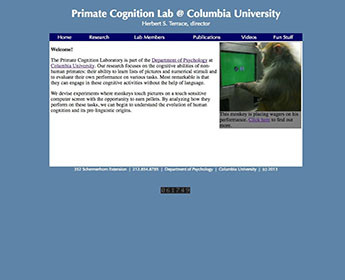
Herbert Terrace is a Professor of Psychology at Columbia University, where he directs the Primate Cognition Lab within the Department of Psychology in the Faculty of Arts and Sciences. His research focuses on animal cognition, particularly primate cognition and the evolution of language. Dr. Terrace received his Ph.D. from Harvard University in 1961. His academic journey has been dedicated to understanding cognitive processes that do not require language, with a particular focus on rhesus monkeys' ability to learn serial tasks, numerical sequences, and social learning paradigms. His research interests span across animal cognition, cognitive psychology, primate cognition, and the evolution of language. Dr. Terrace has made significant contributions to understanding how non-human primates process numerical information, learn through observation, and develop cognitive skills that may represent precursors to human language. His work on the evolution of intelligence examines cognitive processes that can be performed without language, providing insights into what language adds to those fundamental cognitive abilities. Notably, he has written extensively on the evolution of language, particularly in his 2019 book "Why Chimpanzees Can't Learn Language and Only Humans Can," where he argues that separating the evolution of language into the origin of words and the origins of grammar makes an intractable problem more manageable. Dr. Terrace has taught courses including Evolution of Intelligence and Consciousness, Evolution of Cognition, and Evolution of Language at Columbia University. His laboratory, the Primate Cognition Lab, devises experiments where monkeys interact with touch-sensitive computer screens to earn food rewards, allowing researchers to analyze their cognitive performance and understand the pre-linguistic origins of human cognition. Among his notable scientific contributions are the development of the simultaneous chaining methodology for studying serial learning in animals, groundbreaking work on numerical cognition in non-human primates, and research on cognitive imitation that has implications for understanding autism spectrum disorders. His research has been published in top journals including Science, Nature, and Psychological Science. Dr. Terrace has mentored numerous researchers in the field of comparative cognition and has directed the Primate Cognition Lab at Columbia University for many years. His work continues to influence our understanding of the cognitive capabilities of non-human primates and their relevance to human cognitive evolution.
Professor Scott Palmer is a distinguished academic at the University of Leeds, serving as Professor of Light and Performance within the School of Performance and Cultural Industries (Faculty of Arts, Humanities and Cultures). With over 30 years of teaching and management experience in Higher Education, he was a founder member of the School in 2001 and has held numerous senior management roles including Interim Head of School, Director of Student Education (2019-2022), Director of Enterprise and Knowledge Transfer, and Programme Manager for BA (Hons) Performance Design for over a decade. In 2017-18, he was appointed to an Excellence and Innovation Fellowship at the Leeds Institute for Teaching Excellence & Innovation. PhD (Leeds) - Light, Scenography and the Choreography of Space Cert. Education (Manchester) BA Hons. Drama (Wales) Professor Palmer is a leading international advocate for scenography as an intellectual discipline. His research focuses on light, darkness and atmosphere in performance, designing for audience experience, and since 2017, the field of XR (Extended Reality). His influential monograph Light: Readings in Theatre Practice (Palgrave Macmillan, 2013) significantly contributed to establishing scenography as a scholarly field, exploring how light has influenced staging practices throughout history. He has co-edited major works including Scenography Expanded (Bloomsbury 2017) and the groundbreaking Contemporary Performance Lighting (2023), the first critical anthology focused specifically on performance lighting. His recent publications reveal evolving research trends from historical analyses of light in theatre to contemporary explorations of XR, immersive environments, and audience experience. Keywords across his work consistently emphasize scenography, audience experience, light design, and the integration of digital technologies in performance. His sub-field specializations span historical lighting techniques, immersive theatre practices, site-specific performance, 360-degree environments, and the theoretical frameworks connecting technological innovation with theatrical expression. Excellence and Innovation Fellowship at the Leeds Institute for Teaching Excellence & Innovation (2017-18) Research impact highlighted by AHRC as an exemplar case study Contributions to BBC Radio 3's Illuminating the Stage (broadcast December 25, 2017) Professor Palmer has supervised numerous PhD candidates and led collaborative student projects resulting in public performances including Pandora's Box (2009), Dream/Play (2010), Just Before Dawn (2011), Into the Dark (2012), Blood Wedding (2013), The Dreaming (2015), The Waiting Room (2017), and Within This House (2018). His research has been supported by significant grants including the AHRC-funded Projecting Performance (2006-08), UKRI-funded Surround Stories (XR Stories), and AHRC-funded Bridging the Gaps exploring Mixed Reality Performance of Chinese Opera. He plays an active role in international scholarly communities as co-convenor of the IFTR Scenography Working Group (2013-16), inaugural member of the TaPRA Scenography Working Group, and contributor to OISTAT Education and History and Theory Commissions. Professor Palmer is a member of the PLACE, Practice as Research, and Participation Research Groups at Leeds, and was co-instigator of the Leeds-based Performing Light Network. His SignalSpace web resource, developed with colleague Maria Kapsali, explores digital creativity and mobile phone applications in performance contexts. He regularly presents research outcomes at international conferences including IFTR, TaPRA, ICIDS, and ZipScene, demonstrating his commitment to advancing both theoretical understanding and practical applications of performance design.
Jim Davis is an Associate Professor of Theatre & Performance Studies at Kennesaw State University. He coordinates the Theatre in Society general education course and teaches foundational courses in theatre history, American performance traditions, and theatre studies. Ph.D. in Theatre from Bowling Green State University M.A. in Theatre from University of Northern Iowa B.A. in Drama/Speech from Clarke College Davis operates as a theatre generalist, combining practical and scholarly work in acting, directing, devising, dramaturgy, and puppetry. His research emphasizes interdisciplinary connections between theatre and broader societal domains like literature, politics, economics, and popular culture. He has investigated intersections of performance with comic book history, Harlem Renaissance musical theatre, fandom communities, and professional sports culture. This work aligns with Vera Mowry Roberts' vision of theatre as a liberalizing force across academic disciplines.
Matteo Tamburini is a Group Leader at the Max Planck Institute for Nuclear Physics (MPIK) in Heidelberg, leading the Extreme Field Quantum Plasma Dynamics and Relativistic Laboratory Astrophysics group. He also serves as a Lecturer at the International Max Planck Research School in Quantum Dynamics (IMPRS-QD). His academic journey includes a PhD in Physics from the University of Pisa, Italy, and postdoctoral research at MPIK. Research Interests: Tamburini specializes in quantum plasma dynamics, strong-field quantum electrodynamics (QED), and high-intensity laser-plasma interactions. He focuses on topics such as radiation reaction effects, relativistic astrophysical simulations, and the generation of ultra-high energy particles and gamma-ray bursts. His work bridges theoretical modeling with experimental validation at facilities like FACET-II (SLAC), Gemini (UK), and DESY. Experimental Contributions: Key projects include devising experiments to probe quantum radiation reaction (E-332, E-320, E-305), developing the SFQEDtoolkit for QED simulations, and advancing polarized laser-wakefield acceleration. His research often involves close collaboration with international teams and leverages cutting-edge facilities like the Gemini laser and FACET-II. Awards & Service: Tamburini is recognized as an IOP trusted reviewer for peer review excellence. He organizes the Seminar Theoretical Quantum Dynamics and contributes to reviewing for journals like Physical Review Letters and Nature Physics. He has secured significant funding, including a 4-year scholarship for student Michael Quin. Lab/Teams: Leads the Extreme Field Group at MPIK, focusing on advancing understanding of quantum plasma phenomena and relativistic astrophysical processes through theoretical and computational approaches.
Peter Duffy is a Professor and Head of the Master of Arts in Teaching (MAT) program in Theatre Education at the University of South Carolina's College of Arts and Sciences, Department of Theatre and Dance, where he also serves as Director of Undergraduate Studies. With an MFA from the University of North Carolina at Greensboro (2007) and an Ed.D. from the University of South Carolina (2014), he prepares graduate students to become drama teachers while offering courses in drama-based pedagogies and arts integration. His educational background includes: MFA, University of North Carolina at Greensboro, 2007 Ed.D., University of South Carolina, 2014 Duffy's research centers on teaching and learning , devising new works in community settings , cognition and the arts , culturally responsive pedagogies , and performed research . As a director and former public-school teacher, education director, and New York City teaching artist, his work bridges theory and practice through participatory and embodied methods. His research emphasizes drama-based approaches to education and arts integration across curricula, with national and international recognition for innovative pedagogical frameworks. Analysis of his 2014-2024 publications reveals a dominant focus on research-based theatre , theatre of the oppressed , and embodied cognition within educational contexts. His work consistently addresses teacher education and culturally responsive practices through innovative methodologies like ethnodrama and duoethnography. A recurring theme explores drama as a tool for examining social issues and enhancing learning in K-12 and teacher training environments, often incorporating qualitative-quantitative integration and community-based applications. His scientific achievements include: AATE’s Win Wright Special Recognition award (2013) Outstanding Theatre Educator Award from the South Carolina Theatre Association (2017) Garnet Apple Award for teaching excellence at the University of South Carolina (2017) Duffy serves as Director of Research for the International Drama/Theatre Education Association (IDEA) and is an active AATE member. His advising focuses on preparing future drama educators through the MAT program, while his publications like the 2019 book "Drama Based Research: Provocations of Practice" and the widely adopted ethnodrama "ReformED" demonstrate significant scholarly impact. Though specific grants aren't detailed, his extensive international collaborations and research output suggest robust external funding. Through partnerships with IDEA and community organizations, Duffy develops drama-based educational programs that enable students and educators to explore complex social and educational issues through performance. His work extends to national initiatives like "ReformED", which uses teacher interviews to examine educational evolution and supports National Teacher's Day observances across U.S. institutions.
Jess Thorpe serves as a part-time Lecturer in the Arts in Justice at the Royal Conservatoire of Scotland's School of Dance, Drama, Production and Film, designing creative projects in prisons and with justice-impacted communities. She concurrently holds leadership roles as Co-Artistic Director of Glass Performance and founder/trustee of Justice and Arts Scotland (formerly SPAN), demonstrating deep institutional integration across academic and community spheres. Her educational trajectory includes ongoing doctoral research through a PhD by portfolio jointly supervised by the Royal Conservatoire of Scotland and University of St Andrews, reflecting her commitment to scholarly-practitioner development. This advanced study builds upon her extensive practical foundation in justice-oriented arts. Thorpe's research investigates transformative intersections between theatre practice and criminal justice systems, with particular emphasis on youth engagement in carceral environments, therapeutic applications of performance, and community reintegration frameworks. Her pioneering work established Polmont Youth Theatre—the first prison-based youth theatre in Scotland—and Junction 25, which received the CATS Whiskers award for outstanding contribution to Scottish theatre. Current investigations focus on ethical practitioner responsibilities, mental health interventions through performance, and international knowledge exchange. Analysis of her 2024-2025 outputs reveals concentrated exploration of mental health (MENTOLOGY), ethical boundaries in practitioner roles, and transnational justice arts models. Her work increasingly incorporates cross-cultural methodologies while maintaining core focus on prison-based creative interventions, demonstrating evolutionary depth in both theoretical frameworks and practical applications. Thorpe's recognition includes: CATS Whiskers award for outstanding contribution to Scottish theatre (2015) Drama and Education prize for 'A Beginners Guide to Devising Theatre' (2021) Universities UK 'Nation’s Lifesavers' distinction (2019) BBC Expert Woman designation (2019) List Magazine's top 100 creative talent (2011) Best Production for Children and Young People award (2025) Her advisory impact manifests through leadership of Glass Performance's youth initiatives and Justice and Arts Scotland's sector development. While specific grant details remain undisclosed, her Creative Scotland collaborations and international engagements (including Uruguay academic visits) indicate robust funding partnerships. The MadeAtUni campaign recognition underscores her work's life-changing societal impact through university-community synergies. Thorpe directs dynamic teams including Junction 25 performance company and Polmont Youth Theatre, with future work expanding through 2025 projects exploring mental health frameworks (MENTOLOGY), international justice arts models, and ethical practitioner standards. Her upcoming SHARE #3 symposium participation indicates continued knowledge mobilization within global performance-criminal justice networks.
Brittney S. Harris is an Assistant Professor of Applied Theatre and Co-Director of Research at Virginia Tech’s Center for Communicating Science. She holds an M.F.A. in Acting from the University of Georgia and a B.F.A. from Old Dominion University. Her work bridges performance and activism, focusing on racial justice, mental health, and community healing through devised theatre. She co-led a 2023 NEH fellowship on ensemble-based theatre in Rwanda and pioneered workshops like ‘River Stories’ and ‘The Umbrella Method.’ Her research examines social resilience via narrative storytelling, addressing systemic inequities through performances like Pedigree and Being B.A.D. . She has presented at ATHE, NeMLA, and the Global Conference on Women and Gender, and her play The Request (or Prison Fan Fiction) is under development. Awards include an Emmy for Exodus: Homecoming and a C4AA Faculty Fellowship for voter advocacy initiatives. Harris advises collaborative projects like the 4-VA grant-funded Voices Unbound , fostering youth well-being through devised theatre. Her creative scholarship emphasizes sacred spaces for individuality and ensemble-based methods, impacting both academic and community stages globally.
Gisela Cardenas is a Professor at Barnard College with extensive international experience training theater professionals and directing productions across Europe and the Americas. Her pedagogical approach integrates physical theater techniques with textual analysis, focusing on classical works, devised theater, and multimedia collaborations. Education: B.A. Social Sciences M.A. Performance Studies, New York University M.F.A. Directing, Columbia University Teaching emphasizes: Fundamental acting techniques integrating Lecoq, Mnouchkine, and Stanislavsky methods Physical approaches to Shakespearean text Contemporary reinterpretation of Chekhov using Viewpoints technique Cross-cultural adaptations of Greek tragedy She founded InTandem Lab in 2015 to develop innovative performance projects bridging traditional and experimental theater forms.