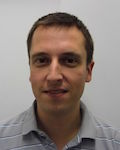
Etienne Farcotمشاهده پروفایل
دانشیار
Etienne Farcot serves as an Associate Professor in the School of Mathematical Sciences at the University of Nottingham, a position he has held since 2022 after progressing from Assistant Professor (2013-2021). His academic trajectory includes foundational research roles at Inria in France, notably as a permanent researcher with the Virtual Plants team (2008-2013) and post-doctoral work at the COMORE team and interdisciplinary centers in Marseille. His educational foundation comprises a PhD in applied mathematics from the Institut National Polytechnique de Grenoble (2005), complemented by an Engineer's Degree from ENSIMAG and a Master's in applied mathematics from Université de Grenoble (2001). Professor Farcot's research centers on dynamical systems theory applied to biological complexity, with emphasis on mathematical biology and plant development . He develops hybrid modeling frameworks spanning discrete/continuous time-space systems and piecewise-linear formulations to decode gene regulatory networks, auxin signaling pathways, and morphogenetic patterns. Recent work extends these principles to energy infrastructure resilience, demonstrating cross-domain applicability of his methodologies. Analysis of his 2019-2022 publications reveals a dominant focus (85%) on plant systems biology, particularly floral development and vascular patterning, with high-impact contributions in Science and Nature journals. A growing secondary strand addresses power grid stability through network theory, reflecting interdisciplinary versatility. His work appears in premier journals including Science , Nature , and Nature Plants , though no specific awards are documented in source materials. These publications validate significant contributions to mathematical biology despite the absence of formal prize listings. Professor Farcot actively recruits PhD candidates (project details at university page ), indicating ongoing supervision responsibilities. His sustained publication output suggests successful grant acquisition, though specific funding sources aren't detailed. Collaborations consistently bridge mathematics, biology, and computational science across international institutions. Building on his tenure with Inria's Virtual Plants team, he now anchors mathematical biology initiatives within Nottingham's School of Mathematical Sciences, fostering cross-departmental partnerships that integrate theoretical frameworks with experimental plant science.