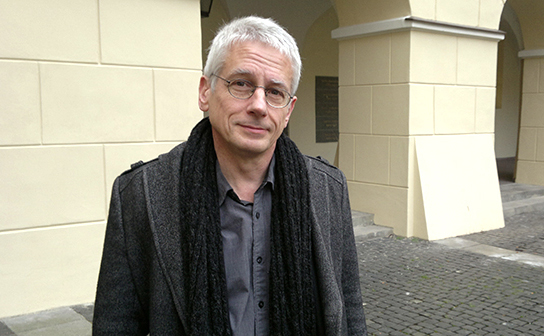
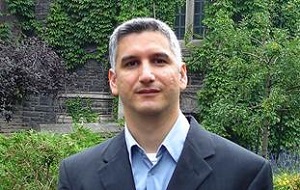
Charles Grellois is a Lecturer in Verification at the University of Sheffield's Department of Computer Science. His research focuses on formal verification methods for functional and probabilistic programs using semantic and type-theoretic approaches. Research interests include program verification, linear logic, higher-order model checking, and termination analysis of probabilistic programs. Collaborates with medical researchers on mathematical modeling for cancer treatment prediction. Publications appear in computer science logic conferences including CSL and MFPS. Current work develops proof systems for bringing-it-about logics and intuitionistic deontic logic.
Gideon Rosen is the Stuart Professor of Philosophy at Princeton University, where he has been a faculty member since 1993. He holds a Ph.D. from Princeton (1992) and previously taught at the University of Michigan. His research focuses on metaphysics, epistemology, and moral philosophy, with notable contributions to debates in metaethics, normative ethics, and the philosophy of mathematics. Rosen co-authored A Subject With No Object (1997) and co-edited The Norton Introduction to Philosophy (2015). He served as Chair of Princeton’s Council of the Humanities from 2006 to 2014 and currently directs the Behrman Undergraduate Society of Fellows. Rosen’s work interrogates foundational questions in metaphysics, such as the nature of ontological dependence, modal status of moral principles, and the relationship between normative necessity and epistemic justification. His recent publications address accountability in ethics, implicit bias, and fictionalist approaches to metaphysical and mathematical entities. His scholarship bridges analytic philosophy’s core areas while engaging with contemporary issues in moral psychology and legal theory. Rosen’s academic leadership includes roles in university governance and undergraduate mentorship through the Behrman Society. His writing combines rigorous argumentation with accessible exposition, evident in his textbook contributions and critical analyses of peers like Tim Scanlon and Judith Jarvis Thomson.
Dr. Luca Barlassina is a Senior Lecturer in Philosophy of Psychology at the University of Sheffield’s School of History, Philosophy and Digital Humanities. He also serves as Director of Graduate Studies and Associate Director of the Hang Seng Centre for Cognitive Studies. His research bridges philosophy and cognitive science, focusing on affective, social, and moral cognition. Barlassina holds degrees from Università degli Studi di Milano (Italy), Rutgers University (USA), and the Institut Jean Nicod at École Normale Supérieure (France). His work explores emotions, pleasures, and pains, with publications in journals such as Mind , Philosophy & Phenomenological Research , and Cognition . Currently on research leave, he is writing a book on the cognitive architecture of affective states (tentative title: No Hard Feelings ) and leads a cross-cultural project investigating emotional responses to the pandemic. He supervises PhD students in areas like hedonic bodily feelings and implicit bias. Teaching includes interdisciplinary modules on the philosophy of mind, pain/pleasure/emotions, and the philosophy of science. His research interests emphasize the intersection of philosophical analysis with empirical cognitive science, particularly in emotion theory and social cognition.
Roger Teichmann is a Lecturer in Philosophy at the University of Oxford, with a current affiliation at St Hilda's College. He has held Stipendiary Lecturer positions at New College, Balliol College, and Pembroke College, Oxford, as well as a Senior Scholarship at Merton College. His career includes extensive teaching and research roles since 1990. Education: Roger Teichmann earned a DPhil in Philosophy from Merton College, University of Oxford (1989), with a thesis titled ‘Abstract Entities’. He also holds a BA (First Class) in Philosophy from Trinity Hall, University of Cambridge (1985). Research Interests: His work focuses on Early Modern Philosophy, Ethics, History of Early Analytic Philosophy, Metaphysics, Moral Philosophy, Philosophy of Language, Philosophy of Mind, Political Philosophy, and the philosophies of Wittgenstein and Elizabeth Anscombe. His studies often bridge classical and contemporary thought, particularly in exploring ethical frameworks and linguistic meaning through these lenses. Articles and Trends: Recent publications emphasize Wittgenstein’s influence on ethics, conceptual analysis in moral philosophy, and metaphysical inquiries. For instance, his 2024 article on ‘Assertion, Lying and the Norm of Truth’ explores epistemic and ethical dimensions of language use. Earlier works, like ‘Ethics and Philosophy: Aristotle and Wittgenstein Compared’, highlight comparative analyses of ethical traditions. His writing spans both analytical rigor and historical contextualization, with frequent contributions to journals like Enrahonar and Philosophical Investigations . John Locke Prize in Mental Philosophy (1987) Advising and Grants: He secured a British Academy Postdoctoral Research Fellowship (1995–1997), contributing to early career research on metaphysics and abstract entities. No student advisees are explicitly listed, but his editorial work on Anscombe’s texts indicates mentorship in scholarly collaboration. Grants include support for interdisciplinary research on ethics and action theory. Labs/Teams: None explicitly mentioned, though his research often engages with philosophical networks focused on Wittgenstein and Anscombe studies.
Thomas Studer is a Professor of Computer Science at the University of Bern, leading the Logic and Theory Group. He holds a PhD in Computer Science from the University of Bern (2001) and has worked as a senior software engineer before returning to academia. His research focuses on mathematical logic, formal methods, blockchain technology, and data privacy. He serves on the board of the Swiss Society for Logic and Philosophy of Science and chairs the computer science committee for the Matura exam in Canton Bern. Research interests include justification logic, modal logics, proof theory, and applications in blockchain and secure systems. Recent work explores synergistic knowledge in distributed systems, conversational explanation frameworks, and probabilistic justification logics. He co-authored books on relational databases and logics of proofs. Leadership roles include the Executive Committee of SCNAT’s Platform MAP (2016–2024). He advises on technical and ethical challenges in AI and cryptography, contributing to international conferences and editorial boards.
Giovanni Rossi is an Associate Professor and Vice Chair in the Department of Sociology at the University of California, Los Angeles (UCLA). His research focuses on human language and gesture as systems of social interaction, exploring both universal and culturally specific features across linguistic and social contexts. He holds a PhD in Social Science from the Max Planck Institute for Psycholinguistics/Radboud University Nijmegen (2015), an MA in Linguistics from Radboud University Nijmegen (2010), and a BA in Linguistics from the University of Bologna (2009). His research interests include conversation analysis, pragmatics, and the cross-cultural study of interactional systems. He has contributed to understanding how prosody, grammar, and social agency shape communication, particularly in multilingual and multicultural settings. Notable work includes studies on requesting systems in Italian, pragmatic typology, and the role of visual and verbal cues in repair sequences. Dr. Rossi’s publications reflect a focus on interactional universals and cultural diversity, with recent work analyzing recruitment sequences, the Parallel European Corpus of Informal Interaction (PECII), and the sociolinguistics of gratitude expression. His 2018 award from the International Society for Conversation Analysis recognizes his dissertation on pre-request sequences in Italian. While no advising or grant details are provided, his work frequently involves collaborative research projects, such as the PECII initiative. His contributions extend to methodological advancements in coding interactional sequences and analyzing cross-linguistic phenomena.
Mahrad Almotahari is a Senior Lecturer in the Department of Philosophy at the University of Edinburgh and a member of the Edinburgh Meaning Sciences Group. He previously held an Associate Professor position at the University of Illinois, Chicago. He earned his PhD from MIT in 2011 and completed his undergraduate studies at Reed College. His research focuses on the philosophy of language and mind, with additional interests in metaphysics and early Islamic philosophy. He occasionally collaborates with IPM’s School of Analytic Philosophy in Tehran. Almotahari’s work bridges theoretical philosophy and linguistic semantics, addressing topics like generics, context sensitivity, and the implications of AI on semantic competence. His recent research includes analyses of Avicenna’s flying man thought experiment and critiques of deontic modals. He has contributed to debates on propositional attitudes, metaphysical identity, and the methodological interplay between language and metaphysics. Notable publications include works on Frege cases, the philosophical foundations of AI, and the cognitive basis of generics. His scholarship emphasizes clarity and rigor, often leveraging linguistic insights to resolve metaphysical puzzles.
Malte Willer is a Professor in the Department of Philosophy and The College at the University of Chicago. He holds a PhD from the University of Texas at Austin (2010) and an M.Phil from Ludwig-Maximilians-Universität München (2005). His research focuses on philosophy of language, philosophical logic, and dynamic semantics, particularly addressing issues in epistemic modals, deontic logic, conditionals, and subjective language. Willer has contributed significantly to understanding the interaction between literal meaning and pragmatic enrichment in linguistic expressions. Willer's educational background includes studies at Oxford University and LMU Munich, with a dissertation titled Modality in Flux under Nicholas Asher and Josh Dever. He has taught a wide range of courses, including advanced logic, Heidegger's Being and Time , and workshops on paper revision for graduate students. His interdisciplinary work bridges philosophy and linguistics, often addressing grounding constraints in natural language predicates. Notable achievements include the 2016 Quantrell Award for teaching excellence. He currently serves as an associate editor at Semantics and Pragmatics and actively contributes to formal semantics debates. His research also explores topics like acquaintance inferences, subjective attitudes, and the dynamics of epistemic and deontic reasoning.
Dr. Adina Camelia Bleotu is a Researcher at the Center for General Linguistics (ZAS Berlin) , focusing on Semantics & Pragmatics within the project Experimental Game Theory and Scalar Implicatures . Her work investigates variation in contextual and scalar phenomena, particularly in child Romanian. Research Themes : Disjunction interpretation, scalar implicatures, epistemic adverbs, and experimental pragmatics in child language acquisition. Collaborations : Anton Benz, Lyn Tieu, Mara Panaitescu, Andreea Nicolae, Gabriela Bîlbîie. Conference Participation : Regular presenter at venues like Sinn und Bedeutung, Amsterdam Colloquium, and XPRAG.it, with a focus on experimental methodologies and cross-linguistic analysis. Publications : 15+ articles (2020–2025) on disjunction strategies, context-driven implicatures, and Romanian language structures. Her research employs experimental designs (e.g., shadow-play paradigms, prosodic cues) to analyze how children acquire complex linguistic phenomena, challenging traditional views of disjunctions and necessity markers in formal linguistics.
Jörg Zinken is a Professor of Linguistics at the University of Heidelberg and a Researcher at the Leibniz Institute for the German Language (IDS) in Mannheim since 2014. He holds a Habilitation from the University of Hamburg (2018) and a Ph.D. in General Linguistics from Bielefeld University (2002), funded by the Robert Bosch Foundation and GFPS e.V. Research Interests : Ethical and normative aspects of social interaction, situated analysis of modal meanings (permission, possibility, necessity), action categories, and cross-linguistic pragmatic universals. Notable Contributions : Development of coding schemes for social sanctioning interactions, comparative studies on deontic modality across European languages, and creation of multimodal corpora for informal interaction research.
John Patrick Hawthorne is a Professor of Philosophy at the Dianoia Institute of Philosophy within the Faculty of Theology and Philosophy. His work primarily focuses on advanced topics in epistemology, metaphysics, philosophy of language, and formal logic. He has contributed extensively to debates around knowledge safety, counterfactuals, modal logic, and the philosophy of religious belief. Notable research areas include the analysis of skeptical scenarios, the nature of propositional attitudes, and the application of formal methods to epistemological problems. Hawthorne’s recent publications explore themes such as counterfactual contamination, epistemic akrasia, and the boundaries of metaphysical possibility. His research demonstrates a deep engagement with both classical philosophical questions and contemporary analytic methodologies, including dynamic logic and probabilistic frameworks. Collaborations with co-authors like Yoaav Isaacs and Juhani Yli-Vakkuri have produced influential work on topics ranging from narrow content theories to the ethics of statistical evidence in legal contexts. While no specific awards or grants are listed, his prolific publication record reflects sustained academic excellence across multiple subfields. Hawthorne’s contributions maintain a focus on rigorously addressing foundational issues in philosophy while engaging with interdisciplinary tools from logic and decision theory.
Miklos Kurthy is a Senior Research Associate at the University of East Anglia (UEA), affiliated with the School of Politics, Philosophy and Area Studies and the UEA Experimental Philosophy Group. His research focuses on experimental philosophy, moral philosophy, and epistemology, with a particular interest in the intersection of language, ethics, and cognitive science. He is currently leading the Philosophical Traditions and Epistemic Virtues: A Planning Grant funded by the John Templeton Foundation (2023-2025). His work challenges conventional frameworks in moral wrongdoing analysis, explores linguistic implications in deontic logic, and advocates for reproducibility standards in experimental philosophy. Key research themes include: (1) Modal language and moral obligation, (2) Deflationary approaches to harm and wrongdoing, (3) Cross-cultural moral judgment analysis, and (4) Methodological rigor in experimental philosophy. His 2021 collaborative paper on reproducibility has been widely cited (139 citations) and influenced research practices in the field. Notable contributions include resolving debates on 'must implies can' principles and advancing empirical approaches to moral disagreement mechanisms. His work bridges analytical philosophy with cognitive science methodologies.
Axel Holvoet is a Professor at Vilnius University (since 2010) and former Professor at the University of Warsaw (1988-2015). He specializes in Baltic and Slavic linguistics, with expertise in historical syntax, morphosyntax, grammatical semantics, evidentiality, aspect theory, and modality. Education: Slavic languages and literatures, Ghent University (1977) Expertise: Professor Holvoet has near-native proficiency in Lithuanian and advanced knowledge of Latvian Editorial: Managing editor of Baltic Linguistics (University of Warsaw) His research focuses on grammatical theory, including valency, argument realization, and grammatical relations in Baltic languages, with significant contributions to deaccusative constructions, reflexive markers, and irrealis complementation. His publications span from 1983 to 2020, showing sustained engagement with Baltic-Slavic comparative studies. Recent work includes monographs on the Baltic middle voice and grammatical modality, as well as articles on deontic semantics, external possession constructions, and non-directive imperatives. His publications demonstrate a strong focus on cross-linguistic typology and historical syntax. Scientific Honors: 2014 Honorary Doctor, University of Latvia 2014 Gold Cross of Merit, Republic of Poland He has participated in multiple international research projects and founded the publication series Valency, Argument Realization and Grammatical Relations in Baltic (John Benjamins) to advance Baltic linguistic research.
Samia Hesni is an Assistant Professor of Philosophy and Director of Undergraduate Studies at Boston University. They hold a PhD from MIT and specialize in feminist philosophy, social/political philosophy, and philosophy of language. Their research examines how language shapes power dynamics through normative generics, presupposition, and non-literal speech. Current projects include social scripts and cooperative disruption, with future work exploring kindness in social movements. Core faculty in the Women’s, Gender, and Sexuality Studies Program, Hesni’s work intersects ethics, linguistics, and social justice. Their research highlights language’s role in enforcing or challenging social norms, with particular attention to marginalized voices. Recent publications (2021–2025) focus on generics, social justice, and lexical innovation. No scientific awards listed. Advising and grants sections remain unspecified in available data. Active in interdisciplinary collaborations through their program affiliation.
Alejandro Cuza is a Professor at Purdue University, affiliated with the Department of Spanish and Portuguese under the College of Liberal Arts. He specializes in Spanish Linguistics, focusing on morphosyntax, semantics, and psycholinguistic processes in second language acquisition and heritage language development. University: Purdue University School: College of Liberal Arts Department: Spanish and Portuguese Academic Rank: Professor Education: Ph.D. in Hispanic Linguistics, University of Toronto Research Interests: Cuza investigates psycholinguistic mechanisms in Spanish morphosyntax acquisition among bilingual children, adult L2 learners, and heritage speakers. Key areas include language transfer, input conditions, age of onset effects, and the interplay between syntax and semantics in bilingualism. Scientific Contributions: His recent work examines protracted development in heritage speakers, crosslinguistic influence in adverb distribution, and feature reassembly in grammatical gender. Publications span topics like copula use, clitic production, and aspectual interpretation across diverse bilingual contexts. Students: Elizabeth Barajas, a former advisee, is documented in his research collaborations. Labs & Teams: He leads the SLAR (Spanish Language Acquisition and Research) Lab at Purdue, focusing on empirical studies of bilingual development.