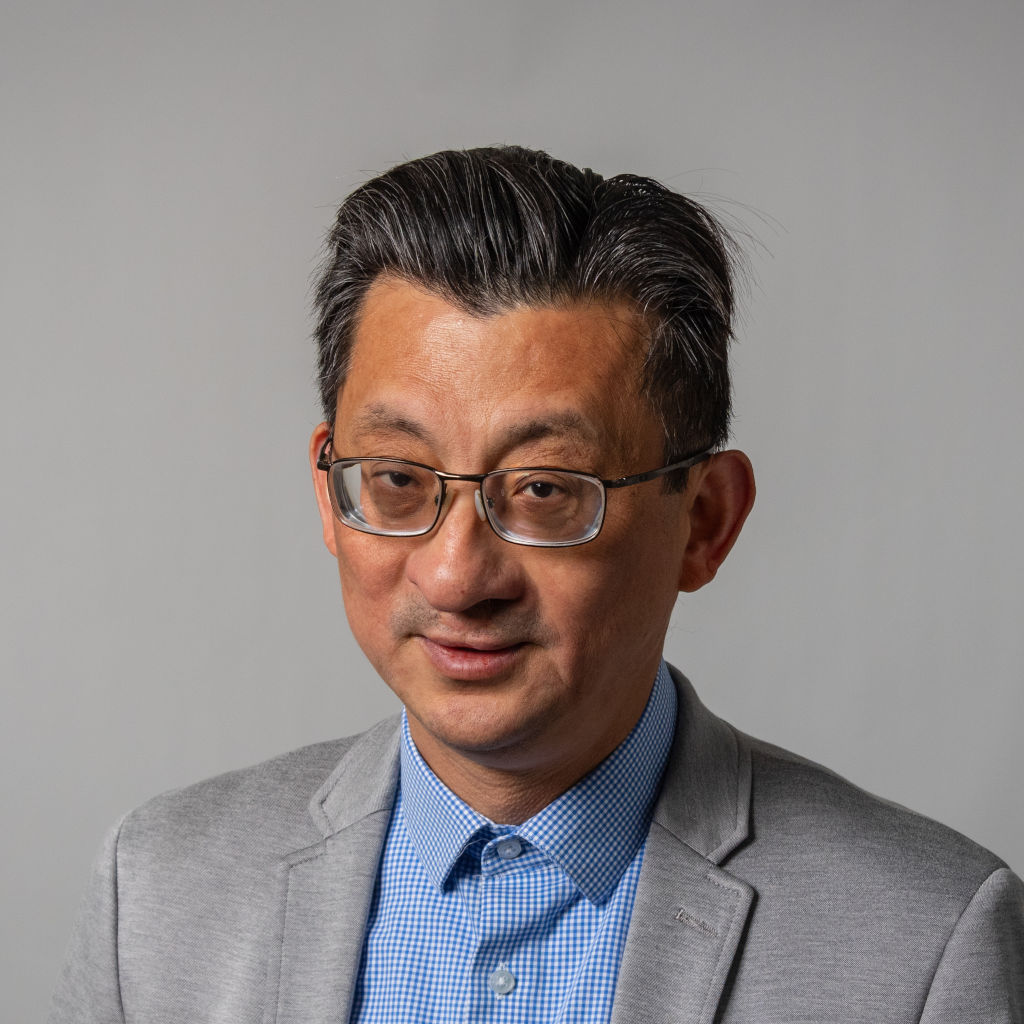
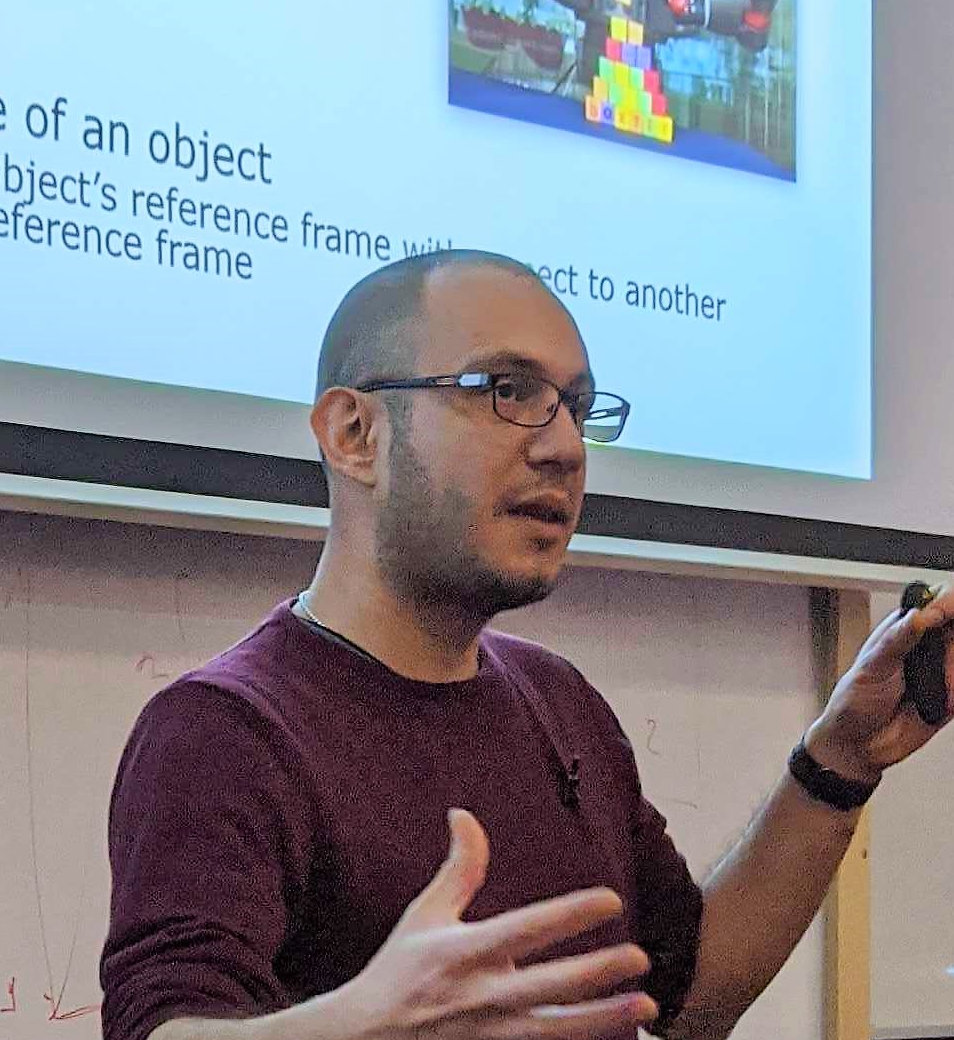
Silvia Tolu is an Associate Professor at the Technical University of Denmark's Department of Electrical and Photonics Engineering, specializing in Neurorobotics. She leads the NeuroRobotics Technology Lab (NRT-LAB), focusing on bio-mimetic control architectures for compliant robotic systems. Her research integrates neuroscience, computer science, and biology to develop solutions for assistive robotics and neurodegenerative disease diagnosis. Her research interests span: Neuro-robotics and neuromorphic engineering Bio-inspired control systems and adaptive motor control Machine learning for robotic applications Human-robot compliant interaction Cerebellar control models Publications primarily focus on neurorobotics, bio-inspired control, and human-robot interaction, with recent advances in learning-based control systems for soft robots and aerial manipulation. Awards include the AEG Elektrofonden Research Grant and funding for human-robot interaction safety research. Current projects include LOCOPD (Lundbeck Foundation), AEROTRAIN (EU Marie Curie ITN), and compliant human-robot interaction systems. She supervises multiple PhD students in neurorobotics and maintains international collaborations across Europe and Asia. Laboratory resources include advanced robotic platforms for musculoskeletal and soft robot control.
Jiong Tang is a Pratt & Whitney Chair Professor in Design and Manufacturing at the University of Connecticut , where he also serves as Co-Director of the Management and Engineering for Manufacturing Program . He received his B.S. and M.S. in Applied Mechanics from Fudan University, China (1989 and 1992), and his Ph.D. in Mechanical Engineering from Pennsylvania State University (2001). Prior to joining UConn, he worked at the GE Research Center as a research engineer. Research Interests : System dynamics, control theory, smart materials, vibration suppression, uncertainty propagation, computational intelligence, and multi-physics system modeling. Current Projects : Digital twin development for aerospace materials, physics-informed machine learning in manufacturing, adaptive metasurface design, and optimization of cooperative robotics. Methodological Focus : Combines Bayesian deep learning , Gaussian process metamodeling , transformer-based architectures , and multi-fidelity data fusion for industrial applications. His work emphasizes smart sensing , electromechanical integration , and uncertainty-robust inverse analysis . Collaboration : Research funded by federal agencies and industrial partners , with particular emphasis on aerospace and manufacturing technologies. His recent publications highlight generative adversarial networks for defect detection , piezoelectric metamaterials , and physics-guided neural network architectures across mechanical, structural, and composite systems.
Alberto Sanfeliu Cortés is a Full Professor of Computational Sciences and Artificial Intelligence at the Universitat Politècnica de Catalunya (UPC), where he has been a faculty member since 1981. He is affiliated with the Institut de Robòtica i Informàtica Industrial (IRI), a joint center of UPC and CSIC, and serves as the Scientific Director of the Unit of Excellence Maria Maeztu at IRI. He leads the Mobile Robotics research line and coordinates the Artificial Vision and Intelligent Systems Group (VIS). He previously served as director of IRI and the UPC Department of Automatic Control. Research interests: His work spans Artificial Intelligence, Robotics, Computer Vision, Pattern Recognition, SLAM, Human-Robot Interaction, Autonomous Systems, and Networked Robotics . He focuses on both theoretical and applied aspects, including urban robotics, autonomous navigation, and the integration of large language models in robotic systems. His research is deeply interdisciplinary, bridging engineering, AI, and societal applications. The recent publications highlight a strong trend toward human-centered robotics , particularly in urban environments, last-mile delivery, and cybernetic avatars. There is growing emphasis on large language models for explainability and personalization, collaborative robotics , and context-aware navigation using vision transformers. His work increasingly addresses societal integration of robots in smart cities and sustainable systems. Scientific Awards: Technology Prize from Generalitat de Catalunya Fellow of the International Association for Pattern Recognition (IAPR) Advising and Grants: He has supervised multiple PhD students, with current advisees working on topics like human intention learning and LLM-enhanced interaction. He has led 45 R&D projects, including 16 EU-funded ones, and was coordinator of the URUS project. Current projects include TORNADO (foundation models for robots handling deformable objects) and SOCIAL PIA (cybernetic avatars). He has also collaborated with Volkswagen Research on autonomous driving initiatives. Labs and Teams: He leads the Artificial Vision and Intelligent Systems (VIS) group and the Mobile Robotics research line at IRI, a premier robotics institute in Spain. His team is actively involved in EU and national projects, focusing on real-world deployment of intelligent robotic systems.
Dan Casas is a Senior Applied Scientist at Amazon in Seattle and an Associate Professor (Profesor Titular) on leave from King Juan Carlos University in Spain. His research spans the intersection of Computer Graphics, Computer Vision, and Machine Learning with a focus on 3D reconstruction, modeling, and animation of virtual humans and clothing. He has authored over 40 high-impact publications in top venues including SIGGRAPH, CVPR, and NeurIPS, and holds 3 international patents. Dr. Casas received his M.Sc. degree (2009) from Universitat Autònoma de Barcelona (Spain), including a research visit at Carnegie Mellon University. He earned his Ph.D. in Computer Graphics (2014) from the University of Surrey (UK), supervised by Prof. Adrian Hilton. He completed postdoctoral research at the University of Southern California's Institute for Creative Technology (2014-2015) and the Max Planck Institute in Saarbrücken (2015-2016). His research interests center on creating realistic virtual humans and digital clothing through advanced techniques in computer vision and machine learning. Casas has pioneered methods for 3D reconstruction of humans and garments from video input, physics-based simulation of soft-tissue deformations, and data-driven approaches to character animation. His work bridges the gap between theoretical computer graphics and practical applications in virtual reality, digital fashion, and immersive communication. Analysis of his recent publications reveals a consistent focus on human digitization, with increasing emphasis on machine learning approaches. His work has evolved from traditional computer graphics techniques toward neural representations and diffusion models, particularly in the areas of 3D garment simulation and human avatar creation. The trend shows growing integration of physics-based modeling with data-driven approaches to achieve both realism and computational efficiency. Marie Skłodowska-Curie Individual Fellowship (2015) FBBVA Leonardo Fellowship (2021) Medal from the Royal Academy of Engineering of Spain for Young Researcher Award (2023) i3 certification (outstanding researcher) from Spanish Ministry of Universities (2022) Winner of 2021 IEEE Retail Digital Transformation Grand Challenge Multiple Outstanding Reviewer Awards at top conferences (CVPR, BMVC, 3DV) Dan Casas has successfully advised multiple PhD students including Suzanne Sorli, Cristian Romero, Raquel Vidaurre, and Igor Santesteban (now at Meta Reality Labs), with several ongoing students including Melania Prieto-Martin, Gonzalo Gómez-Nogales, and Andrés Casado-Elvira. He has secured significant research funding as Principal Investigator, totaling over €1.2 million from Spanish Ministry of Science projects, EU H2020 programs, and industry fellowships including the FBBVA Leonardo Fellowship. His leadership extends to conference organization as Area Chair for ICCV 2023 and General Chair for ACM i3D 2020. Dr. Casas leads research in digital human modeling with applications in virtual reality, fashion technology, and immersive communication. His team develops advanced techniques for creating personalized 3D avatars from minimal input (like smartphone videos), addressing challenges in geometry, appearance, and physical simulation of virtual humans and their clothing.
Anaís Garrell Zulueta is an Associate Professor at the Polytechnic University of Catalonia (UPC) and a Robotics Researcher at the Institut de Robòtica i Informàtica Industrial (CSIC-UPC) . She serves as Vice-Director of the Mobile Robotics and Intelligent Systems subline and supervises the RAIG - Mobile Robotics and Artificial Intelligence Group . PhD (2013): European Doctorate with highest honors from UPC B.S. in Mathematics (2006) from University of Barcelona Diploma d'Estudis Avançats (DEA) in Control, Vision, and Robotics from UPC Her research focuses on Human-Robot Interaction (HRI) and robot cooperation , particularly in urban environments . Key themes include: Explainable AI for robot transparency Human motion behavior prediction Socially aware navigation systems Collaborative transport robotics Autonomous last-mile delivery systems Cybernetic avatars and societal implications Recent projects (2023-2025) include: TORNADO: Foundation models for robots handling deformable objects HandIA: AI-based rehabilitation tools LENA: Lifelong navigation learning TRIFFID: First responder assistance robotics SOCIAL PIA: Cybernetic avatar modeling Scientific recognition includes: Second Prize for Best Spanish Robotics Thesis Best Paper Award Nomination (IEEE/RSJ IROS, 2009) As an advisor, she supervises: PhD students: Ferran Gebelli Guinjoan, Lavinia Hriscu, Edison Bejarano Final year projects: 8 students on topics like LLM-enhanced interaction and LiDAR SLAM systems She operates within the Institut de Robòtica i Informàtica Industrial (IRI) and collaborates with Carnegie Mellon University.
Gerardo Aragon Camarasa is a Senior Lecturer at the School of Computing Science, University of Glasgow, where he leads research in the Computer Vision and Autonomous Systems group. His work focuses on solving real-world challenges in robotic perception, manipulation, and grasping using advanced AI techniques. Research Interests: Robotics and AI for advanced manufacturing systems Perception and manipulation of deformable objects Autonomous robotic systems for chemical and domestic applications Robot behavior modeling and self-awareness His publications demonstrate strong emphasis on robotic vision (garment perception, hand-eye calibration), AI integration (multimodal LLMs, reinforcement learning), and industrial applications (chemical robotics, Industry 5.0 ethics). Recent work shows growing focus on foundation models for robotics and simulation frameworks. Research Leadership: He leads multiple grants including an EPSRC programme grant for chemical robotics and a Royal Society project on robotic teleoperation. Actively supervises 7+ PhD students and has graduated 8+ doctoral researchers in robotics and computer vision. Infrastructure: Leads research using dual-arm robots and maintains active GitHub repositories and YouTube channels demonstrating robotic manipulation systems. Regular contributor to top robotics conferences (ICRA, IROS) and journals.
François Chaumette is a Senior Research Scientist (Directeur de recherche) at Inria, affiliated with IRISA and the Centre Inria de l'Université de Rennes. He has been a key researcher in robotics and computer vision since 1990 and led the Lagadic research team from 2004 to 2017. His research interests are centered on robot vision, particularly visual servoing and active perception . He has made foundational contributions to image-based and position-based visual servoing, and his work integrates control theory, computer vision, and robotics. His research spans applications in mobile robotics, aerial systems, medical robotics, space robotics, and soft object manipulation. The recent publications highlight a consistent focus on visual servoing under complex constraints—such as motion blur, occlusions, and deformations—applied to drones, cable-driven robots, and space systems. There is a strong emphasis on robustness , stability analysis , and hybrid sensing (e.g., vision + proximity, vision + force). His work with the RemoveDebris mission demonstrates real-world impact in space robotics. AFCET/CNRS Prize for best Ph.D. in Automatic Control Best paper awards at RFIA 1996 & 2004 Best paper in IEEE T-RA (2002) Best paper in IEEE RA-L (2019) Best paper in IEEE RAM (2020) IEEE Fellow (2013) He has advised over 30 Ph.D. students, many of whom have become active researchers in robotics. He has served in editorial roles for top journals including IEEE Transactions on Robotics , IEEE Robotics and Automation Letters , and the International Journal of Robotics Research . He was elected to the IEEE RAS Administrative Committee (2016–2018) and served on ERC grant panels for robotics. Chaumette is the main developer of ViSP (Visual Servoing Platform), a widely used C++ library for visual tracking and servoing. His leadership in both theoretical advances and software tools has significantly shaped the visual servoing community.
Guillem Alenyà Ribas is a Researcher and Director of the Perception and Manipulation group at the Institut de Robòtica i Informàtica Industrial (IRI), a joint center of the Spanish National Research Council (CSIC) and the Polytechnic University of Catalonia (UPC), Barcelona. His research focuses on integrating robots into human environments, particularly in assistive robotics and the manipulation of deformable objects such as garments. His research interests span Human-Robot Interaction (HRI) , assistive robotics , explainable AI , robot personalization , deformable object manipulation , and benchmarking . He aims to make robots more transparent, adaptive, and safe in real-world applications. His work combines AI planning, vision, learning from demonstration, and user-centered design to develop systems that can assist in healthcare, domestic, and industrial settings. Recent publications reveal a strong trend in explainability and personalization in HRI, with a focus on frailty assessment in elderly care , real-time explanations , and counterfactual reasoning . His team also advances benchmarking in cloth manipulation , 3D reconstruction of clothed humans , and ontology-based reasoning for robot plans . This reflects a multidisciplinary approach combining robotics, AI, and social sciences. Coordinator of ROB-IN, CLOE-GRAPH, and BURG projects Principal Investigator in SeCuRoPS and DEMETER 5.0 Former coordinator of SIMBIOTS, HuMoUR, and SOCRATES He has supervised numerous PhD students, many of whom have received prestigious awards such as the Georges Giralt PhD Award and the AIHUB.CSIC Prize. His leadership in technology transfer and European projects highlights his role in bridging academic research with real-world applications. He leads the Perception and Manipulation group at IRI, fostering collaboration across disciplines and mentoring a large team of researchers, PhD students, and technical staff. The group actively contributes to open science through standardized datasets and reproducible methodologies.
Dongyi Wang is an Assistant Professor in the Department of Biological and Agricultural Engineering at the University of Arkansas, where he directs the Smart Agriculture and Food Engineering (SAFE) Lab. His work bridges advanced technologies like artificial intelligence, robotics, and machine vision with agrifood manufacturing to enhance product quality, safety, and worker welfare. Ph.D. in Bioengineering from the University of Maryland, College Park B.S. in Electrical and Computer Engineering from Fudan University Visiting experience at The Chinese University of Hong Kong Research interests span smart agrifood manufacturing , robotics , machine vision , and artificial intelligence , with applications in crop monitoring, food safety, and healthcare. His lab develops solutions like automated defect detection, pathogen sensing, and sustainable processing systems. Article analysis reveals a focus on AI-driven agricultural automation , hyperspectral imaging , robotic manipulation of bio-products , and food safety innovations . Recent works include YOLO-based tomato defect segmentation, E. coli biosensing, and UAV-based blackberry monitoring. Awards & Memberships College of Engineering Dean’s Award of Excellence Rising Star Research Award (UARK) Outstanding Mentor Award (UARK) Professional memberships in ASABE and IEEE As an educator, he teaches instrumentation and artificial intelligence in agrifood manufacturing . The SAFE Lab, funded by USDA NIFA, NSF, and federal/local agencies (> $7M), prioritizes workforce development in AI/robotics for agrifood industries.
Upinder Kaur is an Assistant Professor in the Department of Agricultural & Biological Engineering at Purdue University , part of the College of Engineering. Her research focuses on robotics, precision agriculture, and cyber-physical systems, with a strong emphasis on integrating data science and digital technologies into agricultural practices. Her work spans areas such as agricultural robotics , cybersecurity for robotic systems , and animal health monitoring . Notable projects include developing multimodal datasets for animal-robot interaction and creating self-powered in-vivo sensing systems for precision dairy farming. She also explores cybersecurity solutions to protect robotic networks against emerging threats. Her articles highlight a trend toward cross-disciplinary innovation , blending robotics with agriculture, healthcare, and cybersecurity. Recent work demonstrates advancements in soft robotics design, zero-day malware detection frameworks, and traceability systems for commodity supply chains. No scientific awards are listed, though her contributions to precision agriculture and robotic cybersecurity are significant. Advising and grants details are currently unavailable, but her research aligns with Purdue's focus on sustainable and technology-driven solutions for modern agricultural challenges.
Lucia Seminara serves as an Associate Professor in the Department of Naval, Electrical, Electronic, and Telecommunications Engineering (DITEN) at the University of Genoa's Polytechnic School. She teaches Electronic Devices, Sensors, and Sensing Systems for Master's programs in Electronic Engineering and Engineering for Natural Risk Management, while also contributing to Philosophy of Medicine for Philosophical Methodologies. As a member of the Joint Teacher-Student Commission, she bridges academic governance with pedagogical innovation in engineering education. Her research pioneers tactile sensing systems using piezoelectric polymers (PVDF) and electronic skin for robotics and prosthetics. She investigates indentation mechanics on soft electronic skin, grasping speed sensitivity, and hierarchical sensorimotor control frameworks for human-in-the-loop robotic hands. Key innovations include machine learning-based contact force estimation and electrotactile feedback systems that restore natural touch perception in prosthetic devices, addressing critical gaps in sensory substitution technology. Analysis of her 2021-2025 publications reveals escalating integration of machine learning with tactile sensing, particularly in symmetry detection for efficient haptic exploration and transdisciplinary human-in-the-loop applications. Recent work emphasizes real-world implementations like post-stroke rehabilitation systems and high-bandwidth human-machine interfaces, demonstrating a strategic shift from foundational sensor development toward clinically viable solutions with measurable user impact. Dr. Seminara's research lineage includes significant contributions to the Roboskin project (2013), which established large-area tactile sensor arrays for robotics. Her current work extends this foundation through investigations into viscoelastic properties, stress transmission modeling, and AI-driven tactile perception, positioning her at the forefront of intelligent electronic skin development with active collaborations across engineering, neuroscience, and clinical rehabilitation domains.
Dmitry Berenson is an Associate Professor in the Robotics Department and Electrical Engineering and Computer Science Department at the University of Michigan. He holds a B.S. from Cornell University (2005) and a Ph.D. from Carnegie Mellon University (2011). His research focuses on algorithms for robotic manipulation, motion planning, and control, emphasizing integration with real-world systems and open-source distribution. He has received the IEEE RAS Early Career Award and NSF CAREER Award. His academic journey includes postdoctoral work at UC Berkeley (2012) and faculty positions at Worcester Polytechnic Institute (2012-2016). He leads the ARM Lab, exploring topics such as deformable object manipulation, tactile control, and learning-based planning. Teaching responsibilities include courses like ROB 502 (Programming for Robotics), EECS 465 (Algorithmic Robotics), and ROB 520 (Motion Planning). Education: B.S., Electrical and Computer Engineering, Cornell University (2005) Ph.D., Robotics Institute, Carnegie Mellon University (2011) Postdoctoral Research, UC Berkeley (2012) Research Interests: Learning and motion planning for manipulation Control theory and optimization Deformable object interaction Robot perception and tactile systems Key Contributions: Development of algorithms for manipulation under uncertainty Advances in motion planning with contact feedback Integration of learning with classical robotics methods Recent publications emphasize probabilistic modeling, tactile-driven control, and generalization in learned dynamics. His work addresses challenges in cluttered environments, deformable objects, and safe human-robot collaboration.
Leonidas Guibas is the Paul Pigott Professor of Computer Science at Stanford University, leading the Geometric Computation group. He is a Hans Fischer Senior Fellow at the Technical University of Munich (TUM), associated with the Visual Computing Focus Group under Prof. Matthias Nießner. His research bridges computer vision, graphics, and machine learning, focusing on 3D data processing, geometric modeling, and sensor networks. Guibas holds prestigious awards including the Vannevar Bush Fellowship and ACM Allen Newell Award, and is a member of the US National Academy of Engineering and American Academy of Arts and Sciences. Education: Ph.D. from Stanford University under Donald Knuth, with prior appointments at Xerox PARC, MIT, and international institutions. His work emphasizes algorithms for sensing, reasoning, and acting in physical environments, with contributions to robotics, computational geometry, and discrete algorithms. Research interests span 3D vision (e.g., generative models for shape synthesis), deep learning architectures for spatiotemporal data, and multimodal sensor integration. Recent projects include object pose estimation, functional relationship learning in scenes, and deformation-aware 3D model retrieval. Publications highlight advancements in 3D reconstruction, point cloud analysis, and geometric deep learning. His TUM fellowship supported work on digital twins and visual computing, emphasizing high-fidelity environmental modeling. Awards also include IEEE and ACM Fellowships, underscoring his impact on theoretical and applied computer science.
Katherine J. Kuchenbecker is the Director of the Haptic Intelligence Department at the Max Planck Institute for Intelligent Systems in Stuttgart, Germany, and an Honorary Professor at the University of Stuttgart. She previously held a tenured position as an Associate Professor at the University of Pennsylvania. Her research focuses on haptic interfaces and sensing systems, enabling users to interact with virtual and distant objects through touch. She earned her Ph.D. in Mechanical Engineering from Stanford University and completed postdoctoral research at Johns Hopkins University. Her academic journey includes leadership roles such as co-chair of the IEEE Technical Committee on Haptics and associate editorships for major conferences. She has received numerous awards, including the NSF CAREER Award (2009), IEEE Academic Early Career Award (2012), and elevation to IEEE Fellow (2021). Her work spans applications in medical robotics, teleoperation, and human-robot interaction. Kuchenbecker’s research emphasizes translating haptic technology into real-world applications, such as surgical training, tactile feedback in virtual environments, and assistive devices. Her team’s contributions include innovations in wearable haptic devices and tactile sensing for robots. She frequently delivers keynote addresses and chairs international conferences, furthering the field’s global impact. Her publications highlight advancements in haptic feedback systems, surgical robotics, and biomimetic sensors. She also advocates for diversity and leadership in academia, serving as Spokesperson for the International Max Planck Research School for Intelligent Systems since 2017.
Camille Schreck is a researcher in Computer Graphics currently holding an Inria Starting Faculty Position (ISFP) at Inria Nancy within the MFX Team. She has been actively contributing to the field of computer graphics with a focus on physics-based simulation and geometric modeling since completing her PhD in 2016. Her educational background includes an engineering degree from ENSIMAG (Grenoble INP) in 2013, followed by a PhD at the University of Grenoble-Alpes supervised by Stefanie Hahmann and Damien Rohmer. Between 2016 and 2020, she conducted postdoctoral research at IST Austria in Chris Wojtan's group. Dr. Schreck's research spans physics-based simulation of natural phenomena, geometric modeling, and computational fabrication techniques. Her work demonstrates particular expertise in simulating deformable materials like paper, water dynamics, and developing novel methods for 3D printing and shape manipulation. She has successfully bridged theoretical computer graphics with practical applications in digital fabrication. Her publication record shows consistent high-impact contributions to top computer graphics venues including SIGGRAPH, Eurographics, and Computer Graphics Forum, with recent work focusing on star-shaped particle simulation, self-shaping 3D printed structures, and efficient mesh processing techniques. The progression of her research demonstrates a clear trajectory from fundamental paper simulation to increasingly complex physical phenomena and fabrication methods. Young Research Fellow of Eurographics France (YFR EGFR) - 2024 Dr. Schreck serves on numerous program committees including SIGGRAPH, Eurographics, and Shape Modeling International. She teaches courses in computer graphics and parallelism at ENSG-GeoRessources and Telecom Nancy, both part of Université de Lorraine. Her teaching spans from 2020 to the current 2024-2025 academic year. As a member of the MFX research team at LORIA (Inria Nancy), she collaborates on advancing the state of the art in physics-based animation and geometric modeling, with her StarDEM project representing a significant contribution to particle simulation methods.