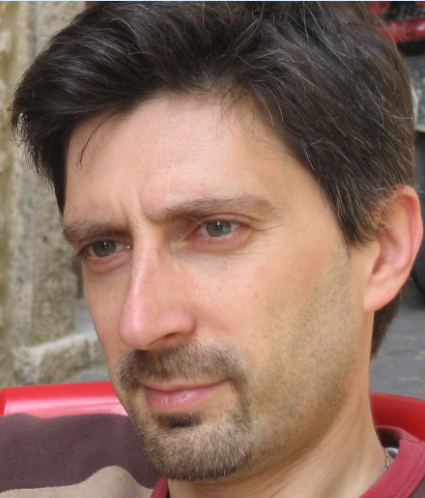
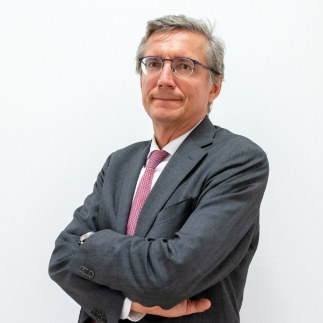
Walter Didimo is a Full Professor of Computer Engineering at the University of Perugia, with a career spanning over two decades. His expertise lies in Graph Drawing, Network Visualization, and Algorithm Engineering, contributing to advancements in Computational Geometry and Big Data. Researcher in Graph Algorithms (1996-2000) Assistant Professor (2001-2004), Associate Professor (2005-2024), Full Professor (2024-) Director of Research Unit CINI (2019-2022) His research focuses on hybrid graph visualization models (e.g., ChordLink), distributed graph processing (e.g., GiViP), and practical applications in cultural heritage (e.g., CHIP) and web analytics (e.g., COWA). Recent work includes scalable algorithms for heterogeneous networked data and visual analytics for genomics (GGB Consortium). Scientific Awards: Best Paper Award - Track 2, Graph Drawing 2021 He has been instrumental in technology transfer, co-founding Vis4 Srl (2009) and contributing to the GGB Consortium. His editorial roles include Associate Editor of IEEE Access and guest editorships for CGTA and JGAA.
Santa Di Cataldo is an Associate Professor at the Department of Control and Computer Engineering (DAUIN) of Politecnico di Torino. His research focuses on computer vision, pattern recognition, digital image processing, and medical image processing, with applications in industrial systems and AI for manufacturing. Scientific Branch: IINF-05/A - Information Processing Systems ERC Sectors: PE6_8 - Computer graphics, computer vision, multi media, computer games ERC Sectors: PE6_11 - Machine learning, statistical data processing His work includes developing AI-driven anomaly detection frameworks, physics-informed neural networks for additive manufacturing optimization, and neuro-symbolic approaches for Industry 4.0 applications. He supervises PhD students in Artificial Intelligence and Computer Engineering programs, collaborating on projects like BIG (Blue Is Green) and PNRR-Complementary Plan. Premio Donna Innovazione (2010) He leads courses such as Machine Learning in Applications and Applied AI and Machine Learning , while contributing to bioinformatics and robotics-related teaching. His research is supported by IAM@PoliTo and EDA groups, utilizing LADISPE laboratory facilities.
Bartolomeo Montrucchio is a Full Professor of Information Processing Systems (ING-INF/05) at the Department of Control and Computer Engineering (DAUIN) of the Polytechnic University of Turin. He is a member of the Interdepartmental Center Photonext - PoliTo Interdepartmental Center on Applied Photonics and serves as deputy director at the Interuniversity Center of Regional Interest for the Training of Secondary School Teachers (CIFIS) since July 2012. Additionally, he has held an adjunct professor position at the University of Illinois at Chicago during July 2008. Professor Montrucchio's research spans several cutting-edge areas with a primary focus on quantum computing, computer vision, and sensor networks. His work encompasses image processing, scientific visualization, parallel and distributed systems, and wireless sensor networks. He actively contributes to European research initiatives including the EQUO (European QUantum ecOsystems) project as Scientific Responsible. His research bridges theoretical computer science with practical applications across multiple industries. His publication record shows a strong trajectory toward quantum technologies, with numerous recent publications focusing on quantum machine learning, quantum algorithms for financial applications, and quantum applications in cybersecurity. His work demonstrates increasing emphasis on practical implementations of quantum computing in real-world scenarios, particularly in industrial settings and telecommunications. Best student paper award at BIOSIGNAL2002, conferred by EURASIP, Italy (2002) Associate Editor of IEEE TRANSACTIONS ON VEHICULAR TECHNOLOGY (2019-present) Professor Montrucchio actively supervises numerous PhD students working on quantum computing applications across various domains including finance, cybersecurity, traffic optimization, and industrial use cases. His teaching portfolio includes courses on Quantum Computing, Parallel and Distributed Computing, and Image Processing and Computer Vision across multiple degree programs including Computer Engineering, Biomedical Engineering, and Quantum Engineering. He leads multiple research projects funded by both competitive calls and commercial contracts, with a significant focus on quantum technologies since 2019. His patent portfolio includes several inventions related to tire manufacturing processes and visual rehabilitation for telemedicine.
Renato Ferrero is an Associate Professor at the Department of Control and Computer Science (DAUIN), Politecnico di Torino (Polito) , with key roles as contact person for training activities and member of the PIC4SeR Interdepartmental Center for Service Robotics . His research spans Wireless Sensor Networks (WSN) , Internet of Things (IoT) , and Environmental Monitoring , supported by competitive grants like AGRITech Spoke 6 (2022-2025) and MIUR funding (2017). He has published extensively on topics including air pollution monitoring , quantum-inspired security , and agricultural technology , with recent work focusing on deep learning for mask/respirator detection and biofertilizer analysis . As an IEEE Access Associate Editor and program committee member for conferences like COMPSAC and RFID-TA, he contributes to academic governance. His teaching includes Computer Architecture (2019-2025) and Ubiquitous Computing (2019-2021) at Polito. He advises PhD students Chiara Panico and Nicola Dilillo , with projects in Data Science , Computer Vision , and AI Life Sciences .
Paul Major is a Full Professor in the Department of Mechanical and Aerospace Engineering at the Polytechnic University of Turin, where he has established himself as a leading researcher in aerospace systems. He serves as a member of the PhotoNext Interdepartmental Center for Applied Photonics and the University Internship Commission, demonstrating his commitment to interdisciplinary research and student development across multiple domains of engineering. Professor Major's research focuses on digital twin technology, prognostics and diagnostics of aerospace systems, and embedded sensor systems. His work bridges theoretical modeling with practical applications, particularly in the areas of augmented reality for aircraft monitoring, optical fiber sensors for structural health monitoring, and machine learning applications for predictive maintenance of electromechanical systems. His research has significant implications for improving aircraft safety, efficiency, and sustainability, with applications extending to lunar exploration technologies and space habitat design. His recent publications reveal a strong trend toward integrating advanced computational methods with physical systems, particularly in the domains of lunar exploration technology, additive manufacturing for aerospace applications, and sustainable aviation solutions. The interdisciplinary nature of his work spans aerospace engineering, computer science, materials science, and control systems, reflecting the increasingly interconnected nature of modern engineering research. His team has made significant contributions to optical sensor integration, AR visualization for maintenance, and prognostic frameworks for electromechanical systems. Professor Major actively mentors doctoral students, with current advisees including Matteo Bertone, Pierluigi Vergari, Armando Vittorio Atzori, and several others working on cutting-edge aerospace projects including lunar drones, aircraft anti-icing systems, and electromechanical actuator diagnostics. He has secured numerous research grants from both competitive funding bodies and commercial contracts, including projects like ASTRA (Advanced Space Tethers for Remote-sensing Applications), SmartCore, and FreME (Freno Multidisco Ad Attuazione Elettromeccanica Smart). He leads the ASTRA research group focused on Additive manufacturing for Systems and sTRuctures in Aerospace and is actively involved with the student team ICARUS. His work has practical applications in both terrestrial and space environments, with recent projects addressing lunar exploration technologies, sustainable aviation solutions, and advanced monitoring systems for aerospace applications.
Michele Taragna is a Tenured Associate Professor in the Department of Electronics and Telecommunications (DET) at the Polytechnic University of Turin, actively teaching across degree programs: Experimental Modeling for PhD students in Electrical, Electronic and Communications Engineering (2019-2025), Estimation and System Identification for Mechatronic Engineering Master's program (2019-2026), and Automatic Control for Computer Engineering Bachelor's program (2019-2026) as course holder or collaborator. His research centers on Systems and Control Engineering , with primary interests in data-driven control for autonomous vehicles and fleets, direct virtual sensors, and machine learning-enhanced system identification. Key areas include Set Membership methods for robustness under bounded noise, computational complexity reduction in Nonlinear Model Predictive Control (NMPC), sensor fusion for robotics, and applications in automotive suspensions. This work aligns with ERC sectors PE7_1 (Control engineering), PE1_20 (Control theory), and PE6_12 (Scientific computing). Trends in his publications (2024-2004) reveal sustained innovation in applying Set Membership identification to NMPC for autonomous vehicles, achieving real-time feasibility through search domain reduction. Sensor fusion techniques using Kalman filters for mobile manipulators and data-driven filter design for uncertain LTI systems with bounded noise are recurring themes, emphasizing practical implementation and computational efficiency. Scientific awards: None documented in provided materials. Advising and research funding: Supervised PhD student Mattia Boggio (2020-2024) in Electrical, Electronic and Communications Engineering; thesis on Real-time Nonlinear Model Predictive Control with domain reduction. Led the nationally funded PRIN project Controllo ad alte prestazioni a partire dai dati sperimentali (2007-2009) as Scientific Responsible. He is a core member of the Automatica research group within DET, focusing on system identification, control design, and validation for dynamic systems with applications in automotive and robotics domains.
Leonardo Badia is an Associate Professor at the University of Padova . He holds a PhD in Information Engineering from the University of Ferrara and has held academic positions at IMT Lucca Institute and the University of Padova since 2016. Research Interests : His work focuses on mathematical optimization for communication networks, including Markov models for protocol analysis, cross-layer optimization of routing/scheduling/resource allocation, Age-of-Information (AoI) , energy harvesting , and game theory applications. He has published over 200 papers in top-tier journals and conferences. Recent Articles highlight his contributions to AoI optimization, adversarial modeling in CPS, strategic cooperation in IoT/metaverse, and energy-efficient network protocols. His work spans telecommunications , game theory , and networking , with subfields like hybrid ARQ , multi-radio resource management , and QoS-aware scheduling . Awards : Best Paper Awards at IEEE MobiWac 2005, IEEE CAMAD 2006, and IEEE Globecom 2007.
Leonardo Aragão is a Researcher at the CMCC Foundation (Euro-Mediterranean Center on Climate Change Foundation) in Bologna, Italy, affiliated with the Institute for Earth System Predictions and Earth System Modelling and Data Assimilation Division. His work bridges meteorological research and climate prediction, focusing on high-impact environmental phenomena. Research Focus Dr. Aragão specializes in analyzing cyclonic activity impacts on climate variability and associated environmental disasters including floods, landslides, windstorms, and storm surges. His methodology integrates atmospheric modelling with advanced computational techniques for processing meteorological data across scales. Current research emphasizes machine learning-driven climate downscaling for seasonal forecasting, leveraging expertise in data quality control, visualization, and extreme event detection systems. Professional Profile With extensive involvement in European research projects, he maintains dual expertise in theoretical meteorology and practical data science. His computational proficiency spans multiple programming languages for handling diverse climate datasets, from localized observations to global models. Teaching experience across meteorological disciplines informs his approach to model development and interdisciplinary collaboration within climate science. Scientific Recognition No specific awards or fellowships are documented in the provided materials. Academic Contributions While student mentorship details are unreported, his role includes developing analytical frameworks adopted in climate hazard assessment. Grant funding specifics remain undisclosed in available sources. Research Infrastructure As core personnel in the Earth System Modelling and Data Assimilation Division, he contributes to CMCC's High Performance Computing Center initiatives, focusing on enhancing predictive capabilities for climate extremes through integrated modelling systems.
Francesco Benedetti is an Associate Professor of Psychiatry at the Faculty of Medicine and Surgery, Vita-Salute San Raffaele University in Milan, a position he has held since 2018. He directs the Psychiatry and Clinical Psychobiology research unit at the Neuroscience Division of the IRCCS San Raffaele Hospital in Milan, a role he has occupied since 2009. Additionally, he serves as Head of the Simple Structure with departmental value in the Department of Clinical Neurosciences at the same hospital since 2002. Dr. Benedetti completed his medical degree from the University of Modena in 1991 with full marks and honors, followed by specializations in Clinical Psychology from the University of Milan (1995) and Psychiatry from Vita-Salute San Raffaele University (2005), both with full marks and honors. He obtained National Scientific Qualifications for associate professor (2014) and full professor (2017) in Psychiatry. His research focuses on the intersection of neuroscience and behavioral disorders, with particular emphasis on brain imaging of psychopathology, psychiatric genetics (especially imaging genetics), chronobiology and chronotherapy, neurobiology of mood disorders, schizophrenia, and anxiety disorders. He also investigates clinical psychobiology across the lifespan and neuroinflammation in psychiatric conditions. His work spans from basic neuroscience to clinical applications, with a strong translational focus. Dr. Benedetti's recent publications demonstrate a strong focus on advanced computational approaches to understanding mood disorders, neuroimaging biomarkers, and the relationship between inflammation and psychiatric conditions. His research increasingly incorporates machine learning techniques and multi-modal approaches to differentiate psychiatric conditions and predict treatment outcomes. International Society for Bipolar Disorders Best Poster Award (2008) European College of Neuropsychopharmacology Best Poster Award (2001) Premio "Antonio D'Errico" (2000) Dr. Benedetti has supervised numerous doctoral students through his participation in doctoral committees at Vita-Salute San Raffaele University from 2018-2024. He leads several significant research initiatives including the EU-funded MOODSTRATIFICATION project (2018-present) investigating immune signatures for therapy stratification in mood disorders, and participates in the international ENIGMA network (2017-present) focused on neuroimaging genetics in psychiatry. He directs the Psychiatry and Clinical Psychobiology research unit at IRCCS San Raffaele Hospital, which collaborates with multiple European research centers through networks like ENPACT (European Network on Psychosis, Affective disorders and Cognitive Trajectory) and previously MOODINFLAME (2008-2012), which investigated neuroinflammation in mood disorders.
Prof. Fabio Gasparetti is a tenured Full Professor at the Department of Civil, Computer and Aeronautical Engineering of the University of Rome 3 , Italy. His academic profile spans Machine Learning , Recommender Systems , and Educational Technology , with a strong focus on Cultural Heritage digitization and Social Media analytics. He is affiliated with the university's AI Lab (a website currently under construction). Email: fabio.gasparetti@uniroma3.it Phone: 0657333212 Location: Via Vito Volterra 62, Rome Research Interests revolve around: Contextual Recommender Systems for cultural and educational domains Social Network Mining for community detection and user modeling Machine Learning Applications in aerospace engineering and e-learning Temporal Analysis of MOOC dynamics and behavioral patterns Prerequisite Modeling for educational content sequencing Cultural Ecosystems in digital pandemic contexts Recent Publications (2021-2025) demonstrate interdisciplinary synergy between Computer Science and Humanities domains, particularly in: Machine Learning for aerospace physics Multimodal LLMs in art interpretation Social data-driven cultural personalization Graph-based educational community monitoring Cross-platform museum positioning Migration discourse analysis
Carla Limongelli is an Associate Professor at Roma Tre University's Department of Civil, Computer and Aeronautical Engineering within the School of Engineering. Her academic work bridges computer science with educational applications, focusing on intelligent systems for learning environments. Her research interests center on artificial intelligence applications in education, with particular expertise in concept mapping systems, learning management platforms, and technology-enhanced museum experiences. Dr. Limongelli has developed innovative approaches to adaptive learning, social robotics in educational contexts, and multimodal learning analytics that track both physiological responses and behavioral patterns. Her recent publication trends reveal a strong focus on leveraging large language models for educational purposes, with increasing attention to multimodal applications combining visual, textual, and physiological data streams. This work spans from automated question generation to social robot interactions in museum settings. Dr. Limongelli has contributed significantly to the development of systems that support teachers in course building, concept map creation, and personalized learning path configuration, with applications extending from traditional educational settings to cultural heritage environments.
Giovanni Buccolieri serves as a University Researcher at the Department of Mathematics and Physics "Ennio De Giorgi" at the University of Salento. He maintains a dual teaching appointment, delivering courses for both the Department of Mathematics and Physics and the Department of Cultural Heritage, demonstrating his interdisciplinary expertise bridging physics and cultural preservation. His primary research interests focus on Physics Applied to Cultural Heritage , with specialized expertise in Optics , Colorimetry , X-ray Analysis , and Infrared Reflectography . His work centers on developing and applying physical methodologies for the diagnostics, analysis, and conservation of cultural artifacts. His research integrates theoretical physics with practical conservation needs, creating bridges between scientific analysis and heritage preservation. Analysis of his recent publications reveals a consistent focus on developing non-invasive diagnostic techniques for cultural heritage objects. His work spans from fundamental optical principles to practical applications in museum settings, with particular emphasis on color analysis, radiation-based techniques, and geometric optics applications. His research demonstrates a strong commitment to creating scientifically rigorous yet practically applicable methods for conservators and heritage professionals. Buccolieri actively contributes to academic training through his teaching roles in both the Cultural Heritage and Optics and Optometry degree programs. His courses include Fundamentals of Physics Applied to Cultural Heritage , Geometric Optics with Laboratory , and Visual Optics , reflecting his dual expertise in both cultural heritage applications and optical science.
Gioacchino Cafiero is an Associate Professor at the Department of Mechanical and Aerospace Engineering (DIMEAS), Polytechnic University of Turin. His research focuses on data-driven experimental fluid mechanics, particularly applying machine learning techniques like deep reinforcement learning and genetic algorithms to control turbulent flows and optimize fluidic actuators. As a member of the Fluid Dynamics research group, he leads projects such as GREENER (drag reduction via sinusoidal riblets) and WINDED (drone wind investigation), while also directing commercial research on friction stress measurement methodologies. Specializes in turbulent flow control and machine learning applications Teaches PhD courses on Machine Learning for Flow Control Supervises students in aerospace engineering programs Recent publications analyze jet turbulence with explainable AI, heat transfer fluctuations in channel flows, and riblet-induced drag reduction. His work bridges aerospace engineering and fluid dynamics, contributing to SDG goals 9 (Industry Innovation) and 13 (Climate Action). Scientific awards include the Learning to Teach (L2T) Open Badge from Politecnico di Torino.
Carlo Casali is an Associate Professor in the Department of Medical-Surgical Sciences and Biotechnologies at Sapienza University of Rome's Faculty of Medicine and Pharmacy. His career spans over three decades in neurology with specialized expertise in neurogenetics, mitochondrial disorders, and hereditary ataxias. He directs the Neurogenetics Outpatient Clinic and coordinates the Neurological Diseases Course at the Latina campus. His research focuses on molecular mechanisms of neurodegenerative disorders, particularly mitochondrial cardiomyopathies, Friedreich's ataxia, and hereditary spastic paraplegias. Casali pioneered the characterization of mitochondrial DNA mutations (A4300G, G8363A) and developed the hematopoietic stem cell transplant protocol for MNGIE. His current work integrates AI-driven gait analysis with exoskeleton rehabilitation for cerebellar ataxia. Casali's publication portfolio includes 118 papers (h-index 20, 1140 citations), with recent work emphasizing biomarker discovery and digital phenotyping. His research is supported by Telethon Foundation grants and national projects including the SPG4 epidemiology study. He actively collaborates with Columbia University's Neurology Department, maintaining a 30-year research partnership. As an educator, he coordinates multiple degree programs including Physiotherapy at Latina and teaches Neurology across medical and healthcare curricula. His clinical work bridges molecular diagnostics with patient-centered rehabilitation, focusing on improving functional outcomes in rare neurological disorders.
Mariano Serrao is an Associate Professor at the Department of Medical-Surgical Sciences and Biotechnologies, Sapienza University of Rome, specializing in neurology and rehabilitation medicine. With over two decades of academic and clinical experience, he maintains active scientific collaborations with institutions including IRCCS C. Mondino in Pavia, Aalborg University in Denmark, and IRCCS Neuromed of Pozzilli. His work bridges clinical neurology with advanced biomechanical analysis and neurorehabilitation technologies. MD with honors (110 e lode) from Sapienza University of Rome (1994) Neurology specialization with honors (70/70 e lode) (1999) PhD in Neuroscience and Motor Rehabilitation and Behavioral Sciences (2003) Dr. Serrao's research focuses on the intersection of neurology, biomechanics, and rehabilitation. His primary areas include electromyography, spinal reflex analysis, evoked potentials, movement disorders, and the physiology and pathophysiology of both movement and pain. He has pioneered work in clinical biomechanics, particularly in gait analysis for neurological conditions including cerebellar ataxia, Parkinson's disease, and stroke rehabilitation. His recent work integrates artificial intelligence with biomechanical data to improve diagnosis and treatment of rare neurological disorders. His 86+ publications demonstrate a clear trajectory from foundational neurophysiological research toward innovative rehabilitation approaches. Recent work increasingly incorporates AI, mixed reality, and wearable technology for neurorehabilitation, while maintaining strong roots in headache disorders and migraine pathophysiology. His research bridges basic neurophysiology with clinical applications, particularly in movement disorders and pain mechanisms. Professional Affiliations Italian Neurological Society (SIN) Italian Society of Clinical Neurophysiology (SINC) Italian Society for the Study of Headaches (SISC) Italian Society of Neurological Rehabilitation (SIRN) President and Founding Member of the Italian Society of Movement Medicine (since 2007) Editorial Activities Dr. Serrao serves as reviewer for numerous prestigious journals including Clinical Neurophysiology, Archives of Physical Medicine and Rehabilitation, and European Journal of Neurology. Research Infrastructure He leads the Repetitive Magnetic Stimulation Laboratory and directs the research project "Decoding the spinal motor output in individuals with Hereditary Spastic Paraplegia." His teaching includes courses in Neurology, Rehabilitation Methodology, and Pediatric and Geriatric Rehabilitation for Physiotherapy and Orthopedics programs.