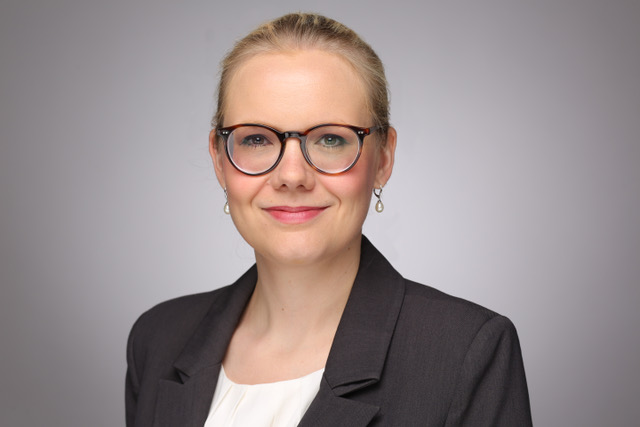
Prof. Anna K. Bernzen is a junior professor (tenure-track to W3) for Civil and Commercial Law at the University of Regensburg. She holds a PhD from the University of Osnabrück, where her dissertation "Courtroom Reporting" won the Injipn Bakker Grunwald Prize. Her academic journey includes studies at the University of Mannheim (law with economics minor) and a research stay at the University of Oxford. She has practical experience in journalism (Handelsblatt, ARD legal department), legal clerkships (Frankfurt Regional Court, Hessian Office for Private Broadcasting), and roles at Google Germany GmbH and international law firms. Her research focuses on intersections of law and technology, including intellectual property, data protection, and media law. She has lectured on courtroom reporting ethics and legal journalism. Her work bridges legal theory with modern challenges in digital communication and regulatory frameworks. Education: PhD (University of Osnabrück), Diplom-Jurist (University of Mannheim) Awards: Injipn Bakker Grunwald Prize (2021) Affiliations: Research Center for Legal Issues of New Technologies and Data Law (ForTech e.V.)
Michael Backes is the founding director and CEO of the CISPA Helmholtz Center for Information Security, a leading institution in cybersecurity and privacy. He is also a professor at Saarland University and director of the CISPA-Stanford Center. His research spans trustworthy machine learning, secure software systems, and privacy-preserving technologies, with over 300 publications in top venues. Backes holds a professorship at Saarland University since 2005 and was a Max Planck Fellow at the Max Planck Institute for Software Systems (2007–2017). He earned his doctorate and has been recognized with numerous honors, including an honorary doctorate from Université de Lorraine. His research focuses on trustworthy information processing, particularly in machine learning and AI security. He investigates privacy-preserving methods, secure model training, adversarial robustness, and ethical AI. His work combines theoretical foundations with practical applications in medical data privacy, mobile security, and large language models. The recent publications highlight a strong trend in securing AI systems—especially large language models—against data leakage, prompt theft, misuse, and bias. His group develops benchmarks (e.g., HateBench, MGTBench), analyzes model memorization, and designs privacy-preserving techniques, reflecting a deep engagement with emerging AI security challenges. ACM Fellow (2023) IEEE Fellow (2018) ERC Synergy Grant (2014) ERC Starting Grant (2009) Karl-Heinz Beckurts Prize (2019) MIT TR35 Award (2009) NSA Cybersecurity Research Award (2017) IBM and Microsoft Research Awards Backes has mentored over 30 PhD students and postdocs, many of whom now hold faculty or leadership positions globally. He leads a large research group at CISPA and runs a competitive postdoc fellowship program. His team receives substantial funding from EU and German agencies. He actively promotes technology transfer and public engagement in cybersecurity. He leads the AI Security and Privacy research group at CISPA, which includes current members such as Xinyue Shen, Yang Zhang, and Wenhao Wang. The group collaborates internationally, notably with Stanford University, and operates at the intersection of systems, AI, and security research.
Savvas Zannettou is an Assistant Professor at the Faculty of Technology, Policy, and Management (TPM) at Delft University of Technology (TU Delft). He is also an Associated Researcher at the Max Planck Institute for Informatics (MPI-INF) and a core member of the iDrama Lab. His research is centered on applying machine learning and data-driven analysis to understand online phenomena such as misinformation, hate speech, and algorithmic recommendations on social media platforms. His research interests lie at the intersection of computer science, social media, and policy. Key areas include online disinformation, hate speech detection, algorithmic transparency, toxic content in AI-generated media, and platform moderation. He employs large-scale data analysis to study user behavior on platforms like TikTok, Twitter, Reddit, and WhatsApp, with a strong focus on ethical and societal implications. His recent publications reveal a strong trend in auditing social media algorithms, analyzing AI-generated harmful content (e.g., hateful memes), and leveraging data donation frameworks to study user exposure. His work frequently appears in top-tier venues like WWW, IEEE S&P, USENIX Security, and ICWSM. He has led research on topics including QAnon, incel communities, state-sponsored trolls, and the impact of moderation policies. He has received several scientific honors, including: Distinguished Paper Award, ACM IMC 2018 Best Paper Honorable Mention, ICWSM 2020, 2024 Best Paper Honorable Mention, CSCW 2021 Best Paper Honorable Mention, ACM CCS 2022 Best Senior Program Committee Member, AAAI ICWSM 2022, 2023 Savvas Zannettou actively mentors students, with several PhD and Master’s advisees leading publications in top conferences. He has been involved in significant grant-funded research, including a €1.3M NWO project on trusted flaggers under the Digital Services Act (DSA), and has secured funding from Google’s Academic Research Award Program. He serves on the program committees of major conferences such as ICML, NeurIPS, USENIX Security, and The Web Conference. He is a core member of the iDrama Lab, which focuses on data-driven research for advanced modeling and analysis, particularly in the context of online safety and platform governance.
Anjo Vahldiek-Oberwagner is a Research Scientist at Intel Labs and an Adjunct Lecturer at TU Munich, where he contributes to both industrial R&D and academic education in systems and security. His work bridges hardware and software security, focusing on confidential computing, in-process isolation, and secure cloud deployments. PhD in Computer Science, Max Planck Institute for Software Systems & Saarland University, 2019 B.Sc. in Applied Computer Science, Cooperative University State University Baden-Wuertemberg, 2009 His research centers on system security, particularly techniques for protecting data confidentiality and integrity at rest, in-flight, and in-memory. He explores operating systems, distributed systems, and hardware-assisted security mechanisms such as Intel MPK and SGX. His work on ERIM, HFI, Endokernel, and Graphene has advanced secure in-process isolation and trusted execution environments. He has published extensively in top venues like USENIX Security, ASPLOS, and IEEE S&P. His recent publications reflect a strong trend toward practical, deployable security solutions for modern computing environments, including secure AI/ML deployments, efficient in-process isolation, and hardware-accelerated sandboxing. Themes include memory safety, performance optimization, and real-world applicability of security primitives. Scientific awards include: Distinguished Paper Award and Internet Defense Prize, USENIX Security 2019 (ERIM) Distinguished Paper Award, ASPLOS 2023 (HFI) IEEE Micro Top Picks 2024 (HFI) Intel Hardware Security Academic Award (Honorable Mention) DARPA Riser 2022 Intel Labs Gordy Award Honorable Mention He actively mentors and serves on program committees (EuroSys, USENIX Security, ASPLOS), chairs artifact evaluation (USENIX Security, EuroSys, SC), and is an Associate Editor for ACM TOPS. He has advised no formal students listed, but collaborates widely across Intel and academia. His work is supported by Intel and DARPA, and he holds multiple patents in secure computing and TEEs. He leads research on memory-safe architectures and secure cloud deployments at Intel Labs. He is involved in several research projects, including: Secure In-Process Memory Isolation, Shielding Applications in Untrusted Clouds via SGX, Memory-Safe Hardware and Software Architecture, and Research Artifacts and Evaluation. He is also a key contributor to the Graphene Library OS and works on validation and endorsement services for confidential computing.
Prof. Mark Brönstrup is the Head of the Chemical Biology Research Group at the Helmholtz Centre for Infection Research (HZI) and holds a W3 Professorship at Leibniz Universität Hannover. He studied Chemistry at Philipps-Universität Marburg and Imperial College London, earning his doctorate in Organic Chemistry from TU Berlin in 1999. His career includes roles at Aventis and Sanofi-Aventis, where he led teams in natural product sciences and biomarker research. His research focuses on chemical biology, antibiotic discovery, and translational medicine, with a strong emphasis on developing novel antimicrobial agents like cystobactamids. Key projects include targeting bacterial pathogens such as Salmonella, Pseudomonas aeruginosa, and Staphylococcus aureus. Brönstrup’s work integrates metabolomics, drug design, and molecular mechanisms to combat antibiotic resistance and infectious diseases. His research interests span chemical biology, natural product sciences, and translational medicine, with a focus on antibiotic discovery and mechanisms of bacterial pathogenicity. Collaborations involve institutions like HZI, Leibniz Universität Hannover, and international partners, leveraging expertise in drug development and microbiology. He leads a high-impact research team contributing to cutting-edge studies in antimicrobial therapies, metabolomics, and protein-inhibitor interactions.
Prof. Dr. Friederike A. Eyssel is a Professor in the Department of Psychology at the Faculty of Psychology and Sport Science, Bielefeld University. She leads the research group "Applied Social Psychology and Gender Studies" at the Center for Cognitive Interaction Technology (CITEC), a central interdisciplinary research institute. Her work bridges psychology, robotics, and gender studies, focusing on human-technology interaction. Her research interests include social robotics, anthropomorphism, dehumanization, and gender dynamics. She explores how humans perceive and interact with robots and AI systems, combining experimental social psychology with cutting-edge technology. Her interdisciplinary approach is central to Bielefeld's strategic research area on the Socio-Technical World. Her recent work involves major interdisciplinary projects such as CRC TRR 318 "Constructing Explainability," PREDICT, and Bots Building Bridges (3B), reflecting her engagement with the societal implications of AI and intelligent systems. She has also contributed to initiatives like AI Academy OWL and the New Center for Co-constructive Artificial Intelligence. Bielefeld University Equality Prize (2021) Karl-Peter Grotemeyer Prize for Excellence in University Teaching (2021) IEEE-RAS Distinguished Lecturer Award (2022) Prof. Eyssel is actively involved in academic governance, serving as Chairwoman of the Ethics Commission and the Equal Opportunities Commission at Bielefeld University. She has held visiting professorships at institutions including New York University Abu Dhabi, TU Dortmund, and the University of Cologne. Her leadership in interdisciplinary research and commitment to equality and teaching excellence underscore her significant contributions to academia. She is affiliated with key research centers including CITEC, CoR-Lab, and the Interdisciplinary Center for Gender Studies (IZG), and collaborates with strategic partners such as Miele, Bertelsmann, and Honda. Her research is supported by major funding bodies including the DFG, ERC, BMBF, and VolkswagenStiftung.
Dr. Vanessa Dizinger serves as a Scientific Associate in the Research Methods working group (AG 12) within the Faculty of Education at Bielefeld University. She provides specialized consulting for empirical projects and qualification theses, focusing on research methodology and data protection compliance. Her research examines teacher stress mechanisms, health impacts on educators, and interprofessional collaboration dynamics within school environments. Dr. Dizinger's work bridges theoretical educational psychology with practical applications in all-day school systems, investigating how organizational structures affect teacher well-being and performance. Doctoral Award of the University Society of Bielefeld (January 2016) As a methodological expert, Dr. Dizinger advises students on empirical research design and serves as module responsible for multiple research methods courses including 'Research Methods Module,' 'Methodologies and methods of empirical research,' and 'Research project.' She maintains regular consultation hours for empirical research support. Dr. Dizinger contributes to several university research initiatives including the Center for Childhood and Youth Research (ZKJF) and Bielefeld Center for Data Science (BiCDaS). She serves as Data Protection Coordinator for research projects and participates in faculty governance through the Structure, Budget, Personnel Committee (StruKo).
Dr. Tamás Haraszti is a researcher at RWTH Aachen University specializing in soft matter physics and biomaterials engineering. His work focuses on developing advanced hydrogel-based systems for biomedical applications, including bioprinted tissue models, synthetic cell mimics, and mechanoresponsive materials. He holds the position of Project Leader and serves as Data Protection Commissioner, reflecting his dual role in research innovation and institutional governance. His research interests span biomaterials design, tissue engineering, and mechanobiology. Notable contributions include scalable kidney fibrosis models via bioprinting, anisotropic collagen scaffolds for cell culture, and microgel platforms for cytokine scavenging. He collaborates extensively with groups in immunology, polymer chemistry, and synthetic biology. Recent work emphasizes hydrogel functionalization for antibacterial surfaces, mechanotransduction studies in muscle cells, and synthetic cells harboring bacterial division machinery. His publications demonstrate cross-disciplinary approaches in materials science and biomedical engineering, addressing challenges in regenerative medicine and therapeutic delivery systems.
Dr. Jan Henrik Ziegeldorf is a researcher at RWTH Aachen University, affiliated with the Institute for Energy Efficient Buildings and Indoor Climate at the EON Energy Research Center (EONERC) and the Communication Systems Group (COMSYS) within the Department of Computer Science. He holds a PhD in Computer Science from RWTH Aachen, earned in 2018, and has been contributing to research in data security and privacy since 2017, initially part-time and then full-time. His research focuses on data security, privacy-preserving technologies, and cryptographic protocols , with applications in blockchain, IoT, cloud computing, and genomics. He has made significant contributions to secure multi-party computation, differential privacy, anonymization, and homomorphic encryption. His work bridges theoretical cryptography with practical system implementations, particularly in constrained environments and decentralized architectures. The recent publications reflect a strong trend in privacy-preserving machine learning, secure blockchain systems, and genomic data protection . These works demonstrate expertise in designing frameworks (e.g., SHIELD, BLOOM) that enable secure computation while maintaining performance, especially in outsourced and distributed settings. His research often targets real-world privacy threats in cloud storage, mobile apps, and decentralized networks. Univention Graduate Award (3rd place) for the best thesis in 2016 FOLKS Award for the best Master's thesis in 2015 Dr. Ziegeldorf has actively advised numerous Master’s and Bachelor’s students on topics ranging from secure localization to blockchain privacy and differential privacy. His service includes program committee roles for IEEE Blockchain conferences and peer review for top-tier journals such as IEEE, ACM, and Elsevier publications. He is involved in collaborative research within the COMSYS group and contributes to interdisciplinary projects linking energy systems, networking, and privacy. He is part of the COMSYS research team at RWTH Aachen, which focuses on communication systems, security, and privacy in networked environments. The group works on both foundational and applied aspects of secure and efficient digital systems, with strong industry and academic collaborations.
Friedemann Vogel is a full Professor of Socio- and Discourse Linguistics at the University of Siegen, Faculty I (Arts and Humanities), within the German Department. His work bridges linguistics, media studies, and cultural science, focusing on the interplay between language, knowledge, and power. He leads multiple research projects and platforms, including the Diskursmonitor and the DFG-funded subproject on mayoral communication within the Collaborative Research Center 'Transformations of the Popular'. University: University of Siegen School: Faculty I Department: German Department Email: friedemann.vogel@uni-siegen.de Office: HD 4203, Hölderlinstr. 3, 57076 Siegen Education: Dr. Phil. (summa cum laude), University of Heidelberg (2011) Studies in German Linguistics, Psychology, and Philosophy, University of Heidelberg (completed with distinction) Technical High School, Carl-Engler-Schule, Karlsruhe Friedemann Vogel's research centers on discourse analysis, strategic communication, and digital media. He investigates how language shapes collective knowledge, legal systems, and democratic participation. His methodological approach combines empirical analysis with computational tools such as NLP and corpus hermeneutics. Key areas include legal linguistics, computer-assisted analysis of large language datasets, and the role of digital platforms in shaping public discourse. He has pioneered research on authentication practices, online access control, and right-wing discourse in social media. His recent publications reveal a strong trajectory in analyzing political discourse, particularly during crises, and in developing theoretical frameworks for discourse intervention and public discourse cultivation. Themes of linguistic democracy, freedom of expression, and digital citizenship recur across his work, reflecting a commitment to socially engaged scholarship. The integration of digital tools and open-access platforms underscores his innovative approach to linguistic research. Scientific Awards and Honors: President of the International Language and Law Association (ILLA) Appointed to the Board of Trustees of Grimme Research College, University of Cologne (2022) Advisory Board member, virTUos project (TU Dresden) Vertrauensdozent, Rosa-Luxemburg-Stiftung Founder and coordinator of CAL² (Computer Assisted Legal Linguistics) Friedemann Vogel has secured significant research funding from institutions including the German Research Foundation (DFG), the Federal Ministry of Justice, the Hans Böckler Foundation, and the State of North Rhine-Westphalia. He advises students and leads interdisciplinary research teams, fostering collaboration between linguistics, law, and digital humanities. His projects often involve international cooperation, such as with Beijing Foreign Studies University. He is actively involved in academic service, serving on editorial boards and steering committees. He leads the Diskursmonitor research group and the CAL² international research network, both of which function as collaborative platforms for interdisciplinary discourse analysis. His work emphasizes open science, digital education, and public engagement, exemplified by initiatives like the 'Reclaim your data' MOOC and virtual privacy awareness projects.
Ibraheem Al-Dhamari is a postdoctoral researcher in the Software Engineering Institute at the University of Koblenz, Germany. He holds a PhD in Computer Science supported by DAAD scholarships, alongside MSc and research grants from DAAD. His primary research focuses on Trustworthy AI, Deep Learning, Medical Image Analysis, and Cellular Automata, with applications in healthcare imaging and data protection. He has contributed to projects like medical image registration algorithms and cochlear implant analysis. Al-Dhamari's academic journey includes postdoctoral work at the Institute of Software Engineering (Department 4), and he previously belonged to the Arbeitsgruppe Paulus (Active Vision Group). His work bridges computer science and medicine, emphasizing practical tools for clinical imaging challenges. He actively mentors students seeking thesis opportunities in AI and medical imaging through DAAD-funded programs. His achievements include developing ultra-fast algorithms for medical image analysis and pioneering multi-modal imaging fusion techniques. He maintains an active GitHub profile showcasing repositories like medical-image-registration-course and tutorials on deep learning and recursion. Al-Dhamari is affiliated with organizations such as the International Data Spaces Association and contributes to open-source software for medical research. Key awards include DAAD scholarships for MSc (2007), short research (2008), and PhD (2012). His research has led to innovations in cochlear duct measurement, cervical spine analysis, and cellular automata-based data mining. He remains a sought-after collaborator in interdisciplinary projects at the intersection of AI and healthcare.
Krishna Pacifici is an Associate Professor in the Department of Forestry and Environmental Resources at North Carolina State University, affiliated with the College of Natural Resources and the Center for Geospatial Analytics. His research focuses on quantitative ecology, wildlife ecology, and structured decision making under uncertainty. He holds a Ph.D. in Forest Resources from the University of Georgia and advanced degrees in Statistics, Wildlife Ecology, and Fisheries and Wildlife Sciences from NC State. Education includes: Ph.D., Forest Resources, University of Georgia (2011) M.S., Statistics, University of Georgia (2012) M.S., Wildlife Ecology, North Carolina State University (2007) B.S., Fisheries and Wildlife Sciences, North Carolina State University (2003) Research emphasizes understanding ecological responses to environmental stressors and developing quantitative methods for conservation decision making. Key areas include spatio-temporal modeling, disease ecology, and adaptive management. Over 20 grants totaling millions of dollars fund projects on topics like red snapper abundance estimation, alligator ecology, and climate vulnerability assessments for wild turkeys. Grants include major NSF-funded work on North American mammal distribution models and a USGS study on Neuse River waterdogs. Collaborations span federal agencies, NGOs, and international partners. Teaching includes FW 453/553 Principles of Wildlife Science. Labs/Teams: Leads projects through the Southeast Climate Science Center and collaborates with USGS, NOAA, and state wildlife agencies. Active in developing geospatial tools for conservation decision support systems.
Prof. Monika Oswald is a Professor of Chemistry, Physical Chemistry, and Environmental Chemistry at the University of Applied Sciences Rheinland-Pfalz. She is affiliated with Department 1 and holds office in Building 2, Room 221. Her research focuses on interdisciplinary applications of chemistry, particularly in environmental sustainability and physical chemistry methodologies. She contributes to programs such as the Hermann Hoepke Institute and collaborates on projects addressing climate protection and renewable energy systems. Her academic work integrates with institutional initiatives like the Biogenic Workshop and Research Data Management (FDM@HAW.rlp). No specific awards or publications are explicitly listed in the provided text, though her involvement in cross-departmental research suggests active contributions to academic and applied science.
Prof. Dr. Elmar Schulte genannt Geldermann is a Professor of Organic Crop Production at the Hochschule Worms (University of Applied Sciences RheinMain), affiliated with Department 1. His primary role involves academic leadership and research in organic farming and sustainable agricultural practices. He is based in Building 2, Room 116, and reachable via phone at +49 6721 409 492. His research interests focus on advancing organic crop production techniques, agroecological systems, and the integration of environmental sustainability into agricultural practices. He contributes to academic programs such as Agricultural Economics, Environmental Protection, and Green Engineering, reflecting his commitment to interdisciplinary approaches in sustainable development. No specific scientific awards or publications are explicitly mentioned in the provided text. His involvement with the Hermann Hoepke Institute and research data management initiatives at the university suggests engagement in applied research and institutional academic infrastructure.
Christoph Buchert is a Professor of Criminal Law, Criminal Procedure Law, and Intervention Law at the University of Police and Public Administration, Cologne . His work bridges academia and law enforcement, with a focus on legal frameworks governing police operations, data protection, and corporate compliance. Research Interests : Criminal law, procedural law, data protection, compliance systems, and police ethics. Awards : Recipient of the Teaching Award (2021/22) and the Förderpreis der Peregrinus-Stiftung für die Universität Mainz for his dissertation. Publications highlight trends in smart policing, GDPR compliance, whistleblower protections, and judicial reforms. His work spans book chapters, journal articles, and legal commentaries. Notable Contributions : Analysis of data privacy in police operations, legal implications of undercover policing, and corporate compliance mechanisms. Scientific Awards Förderpreis der Peregrinus-Stiftung (2016) Teaching Award (2021/22)