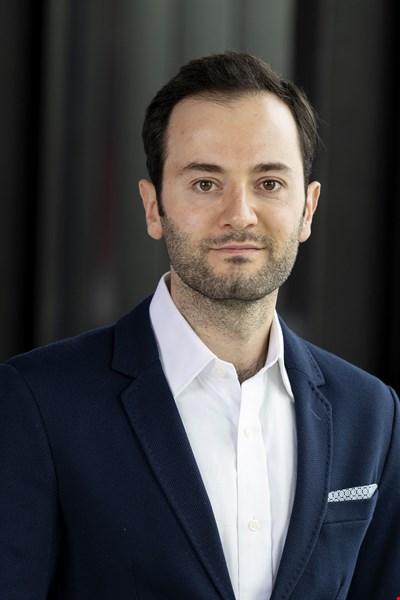
Masaki Takahashi is a postdoctoral researcher at AAU Energy, Aalborg University, Denmark, within the Faculty of Engineering and Science and the Department of Power Electronics System Integration and Materials. His work focuses on wide-bandgap power devices, power electronics packaging, and reliability engineering, particularly in thermo-mechanical simulations and failure analysis of power modules. Education: B.Sc. (2014) and M.Sc. (2016) from Kwansei Gakuin University, Japan; Ph.D. (2024) in Energy Technology from Aalborg University. Research Interests: Thermal stress analysis of SiC and GaN devices Thermo-mechanical reliability of power modules Failure mechanism prediction 3D simulation techniques for reliability design Key Projects: CoDE Center of Digitalized Electronics (2021–2026) PhD Project: Reliability Design of 10kV SiC MOSFET Modules (2021–2024) Awards: Recipient of the APEC 2023 Outstanding Poster Award for work on thermal stress analysis. Collaborations: Active in international projects, with visiting research at Kyushu Institute of Technology (Oct-Dec 2023).
Jialu Zhang is a Tenure-Track Assistant Professor in the Department of Electrical and Computer Engineering at the University of Waterloo. Her research focuses on AI-driven solutions for programming challenges, including LLM-powered software development, automated debugging, and program repair. She holds a PhD in Computer Science from Yale University (2023) and a BS in Electrical and Computer Engineering from Shanghai Jiao Tong University (2017, IEEE Honor Class). Her work emphasizes practical applications like Gmerge (merge conflict resolution), PyDex (automated code repair), and Clef (AI-assisted competitive programming). She collaborates with Microsoft Research’s RiSE and PROSE teams, exploring industry partnerships in AI-assisted software engineering. Recent projects include productizing Gmerge for Microsoft Edge and developing educational tools like PyDex for AI-driven tutoring systems. Zhang actively seeks students (Masters/PhD/interns) and industry collaborations to advance AI’s role in programming and software engineering. Her research bridges foundational AI capabilities with real-world software development challenges, emphasizing both technical innovation and educational impact.
Prof. Dr. Sven Feurer is a Research Professor of Marketing at Bern University of Applied Sciences' Business School, leading the Institut Marketing & Global Management. His roles include Co-Institutsleiter and Head of the Marketing Group since 2022. He holds a PhD from the University of Mannheim and has held academic positions at Karlsruhe Institute of Technology and Vanderbilt University. His research focuses on consumer behavior, pricing strategies, innovation management, and marketing ethics, with prominent publications in Journal of Marketing , Journal of Consumer Research , and Journal of Product Innovation Management . His research explores topics such as radical innovation adoption, technology acceptance, and pricing fairness. Notable projects include studying AI's influence on price perception and consumer reactions to personalized pricing. He collaborates internationally, including with Vanderbilt University's Owen Graduate School of Management. Feurer’s 20+ peer-reviewed articles address dynamic energy tariffs, B2B social media use, and consumer responses to really new products. He co-authored the 2024 book Price fairness . His work bridges academic rigor and practical marketing challenges, emphasizing ethical considerations in pricing and innovation.
Hossein Heidarian Ghaleh is a Lecturer in the Department of Business Entrepreneurship & Finance at the University of East London (UEL), part of the Royal Docks School of Business and Law. He holds a PhD in Human Resource Management and Organisational Behaviour, an MSc in Strategic Human Resource Management, and a BSc in Business Administration. His research focuses on the implementation of HR practices and their psychological impacts on employees and workplace behaviors, often published in top-tier journals like the British Journal of Management and Human Resource Management . Prior to academia, he spent a decade in banking, gaining HR and operational experience. Education: PhD in Human Resource Management and Organisational Behaviour MSc Strategic Human Resource Management BSc Business Administration Research Interests: Hossein’s work explores high-performance work systems, HR devolution, in-role and extra-role behaviors, leadership dynamics, and individual ambidexterity. His studies frequently address the balance between exploration and exploitation in organizational innovation, as well as the paradoxical effects of HR practices on employee behaviors and firm performance. Publications Trends: His recent articles emphasize the interplay between HR practices and organizational outcomes, including how enabling HR practices create consistency-flexibility paradoxes, and how career traps influence managerial involvement in HRM. He also investigates the ‘dark side’ of HPWS and self-sacrificial leadership, shedding light on unintended consequences of common HR strategies. Teaching & Advising: Teaches modules like Knowledge Management, Reward Management, and International HRM. No doctoral students listed, though his teaching involves guiding students in practical HR concepts. No grants mentioned.
Daniel Strüber is an Associate Professor in Software Engineering at Chalmers University of Technology and the University of Gothenburg, Sweden, and an affiliate of the Department of Software Science at Radboud University Nijmegen, Netherlands. His research focuses on model-driven engineering, AI engineering, and empirical software engineering, addressing challenges in software quality, variability management, and security. He holds a PhD (summa cum laude) from Philipps University Marburg and has held academic positions including Assistant Professor at Chalmers and postdoctoral roles at King's College London and Philipps University Marburg. Education: PhD in Computer Science, Philipps University Marburg (2011–2016) Diplom (M.Sc. equivalent) in Computer Science, Philipps University Marburg (2005–2011) Research Interests: Strüber's work spans model-driven engineering, AI integration in software systems, and empirical studies. Key areas include: Model-based languages and tools for software quality assurance Machine learning-enabled systems and their engineering principles Robotics software engineering and variability management Formal methods for consistency and security Search-based optimization in model-driven development Recent Contributions: Recent work includes studies on LLM-assisted reverse engineering, empirical analysis of manual abstraction in software systems, and model-driven approaches for edge deployment of ML models. His research bridges theory with practical implementations in domains like robotics and web-based systems. Awards: Best Reviewer Award (SoSyM 2025) Distinguished Reviewer Awards (GPCE 2024, SPLC 2023) Transformation Tool Contest Awards (2020, 2016) EASST Best Paper Awards (ICGT 2020, ICGT 2017) Grants & Leadership: Co-editor of a JSS special issue on Product Line Engineering (2024) and program co-chair of SPLC 2024. Active in conferences like ICSE, ICGT, and MODELS. Leads grants such as the VR SEMLA project (2022–2024) and the DFG EUphORia fellowship (2019). Teaching: Courses include 'Software Engineering for AI Systems' at Chalmers and 'Software Product Lines' at Radboud University. Involves students in real-world projects via GiPHouse, a student-run company.
Prof. Bruno Defude is a Professor at Telecom SudParis, part of the University of Paris-Saclay. He has been affiliated with the institution since 1992, holding roles such as lecturer-researcher, department director, and currently serves as Deputy Director of Research and Doctoral Training. He leads the ACMES studies initiative and focuses on interdisciplinary research in distributed systems, cloud computing, and educational technologies. Education: Doctorate in Computer Science (1986), Grenoble INP Habilitation à Diriger des Recherches (HDR) (2005), UPMC Research Interests: Prof. Defude's work spans cloud computing architectures, data integration challenges, process mining, sensor networks, and adaptive learning systems. His contributions emphasize scalable solutions for distributed environments and privacy-aware service composition. Recent Trends: Recent publications highlight advancements in natural language querying of process data, multi-objective task scheduling in fog computing, and spatio-temporal data aggregation in vehicular networks. His work bridges theoretical foundations with practical implementations in distributed systems. Labs/Teams: Director of ACMES studies, involved in interdisciplinary research collaborations across computer science and telecommunications domains.
Stuart Green, M.D., is a Clinical Professor in the Department of Orthopaedic Surgery at the University of California, Irvine (UCI) School of Medicine. He is a globally recognized orthopaedic surgeon specializing in post-trauma limb reconstruction, the Ilizarov Method, and medical ethics. Dr. Green has made transformative contributions to orthopaedic surgery through innovations like the Rancho Technique and the GS/GSH Intramedullary Nail, and as co-inventor of the FDA-approved Precice Nail. He continues to serve as Medical Director for the Precice division of NuVasive and is actively involved in research, education, and ethical discourse in surgery. His research interests include: Biomechanics of external and internal fixation Limb lengthening and its effects on muscle tissue Medical ethics in surgical practice and device development Innovation in reconstructive techniques History of orthopaedic surgery Dr. Green’s extensive publication record—around 150 articles, four books, and 23 book chapters—reflects his deep engagement across clinical, ethical, and historical domains. His recent scholarly work emphasizes ethical challenges in surgeon-industry collaboration, biomechanical optimization of fixation devices, and the long-term outcomes of limb lengthening technologies. These publications demonstrate a consistent focus on improving patient outcomes through innovation, ethical rigor, and biomechanical precision. He has received significant recognition through invitations as Presidential Guest Speaker at major orthopaedic societies and keynote speaker at the ASME Biomechanics Section. His contributions were highlighted in the AAOS’s 75th-anniversary publication Moving Stories . He has served on the Ethics Committees of both the AAOS and UCI Medical Center and was a panelist on surgeon-industry ethics with federal officials. Dr. Green has advised on major research initiatives, including the development of the Precice Nail, and has led animal studies and clinical translation efforts. He has held editorial leadership roles as Deputy Editor of Clinical Orthopaedics and Related Research and Associate Editor for several orthopaedic journals. His work bridges clinical practice, research, innovation, and ethics. He is actively engaged in academic and clinical labs, including the Orthopaedic Biomechanics Laboratory at Long Beach Veterans Hospital, where he collaborates on fixation biomechanics and muscle adaptation during limb lengthening with Dr. Thay Q. Lee and Dr. Vincent Caiozzo.
Prof. Igor Dejanović is a Regular Professor at the Department of Informatics, Faculty of Technical Sciences, University of Novi Sad. He holds a BSc (2000) and MSc (2008) in Computer Science from the same institution, followed by a PhD in 2012 with a thesis on 'Contributions to Methods of Rapid Software Development Based on Extensible Domain-Specific Specifications'. Positions Held: 2000–2004: Technical Associate at Faculty Computing Center 2004: Selected as Assistant Professor 2008: Promoted to Assistant Professor 2012: Promoted to Associate Professor 2017: Promoted to Full Professor Research focuses on domain-specific languages, software patterns, model-driven development, and software configuration management. He has contributed extensively to software engineering methodologies and education in technical informatics.
Prof. Dr. Veronika Hellwig serves as Professor of Analytical Chemistry and Instrumental Analysis at Lübeck University of Applied Sciences, where she heads the Chemical and Environmental Engineering (B.Sc.) and Technical Biochemistry (M.Sc.) programs and acts as Deputy Head of the CIB Competence Center for Industrial Biotechnology. Her work bridges academic research and industrial applications in environmental and pharmaceutical chemistry. Her academic foundation includes: Chemistry studies at Universities of Freiburg and Bonn (1989-1994) PhD in Organic Chemistry at LMU Munich under Prof. Steglich (1995-1998) Research focuses on environmental pollutant analysis , natural product discovery , and pharmaceutical applications . She pioneered methods for detecting pollutant-induced protein expression in marine ecosystems and isolates bioactive compounds from fungi with antiviral, antiparasitic, and analgesic properties. Her work integrates analytical instrumentation with ecological and medical challenges, notably reducing surgical smoke in operating theaters through device innovation. Publication trends reveal an evolution from fungal metabolite characterization (1998-2005) to environmental impact studies (2011) and medical device safety (2015), demonstrating consistent application of chemical analysis to real-world health and ecological problems across 25+ years. As academic leader, she oversees curriculum development for two degree programs and drives industry collaboration through the CIB Competence Center, focusing on biotechnology transfer. Her prior roles include establishing a research group at Helmholtz-Zentrum Geesthacht (2006-2012) and laboratory management at Bayer HealthCare.
Dr. Mia McLanders serves as an Adjunct Lecturer in the School of Psychology at the University of Queensland, where she bridges psychological science with clinical healthcare improvement through human factors engineering and simulation-based methodologies. Her work directly impacts neonatal resuscitation protocols, trauma care systems, and medical device design for high-acuity environments. She completed her PhD at the University of Queensland in 2018 with the thesis "Developing the NeoReady TM : a systems approach to supporting teams during neonatal resuscitation", establishing her focus on systems-level interventions in emergency care. Dr. McLanders' research centers on human factors in healthcare , emphasizing medical simulation , neonatal resuscitation , and trauma care systems . Her methodology integrates cognitive task analysis, teamwork observation, and technology evaluation to address critical gaps in clinical workflows. Key contributions include designing cognitive aids for resuscitation teams and developing vibrotactile monitoring systems that reduce cognitive load during emergencies. Analysis of her publication trajectory reveals consistent interdisciplinary collaboration across medicine and psychology, with recent work (2024) prioritizing scalable solutions for rural healthcare barriers and standardized neonatal training. Her studies uniquely combine laboratory validation with real-world clinical implementation, particularly through the Queensland Trauma Education (QTE) program. No scientific awards or fellowships are documented in available materials. While no graduate student supervision is indicated, her collaborative network spans anesthesiology, emergency medicine, and human factors research groups. Current projects appear focused on expanding telehealth-supported trauma care and refining the NeoReady TM system for broader clinical adoption. Her research is operationally linked to the Queensland Trauma Education initiative and neonatal resuscitation improvement programs, involving multidisciplinary teams of psychologists, clinicians, and biomedical engineers working within University of Queensland-affiliated healthcare simulation frameworks.
Professor Barrie Mecrow is a distinguished academic at Newcastle University's School of Engineering, Department of Electrical and Electronic Engineering. With over two decades of research experience, he has established himself as a leading expert in electrical machines, motor drives, and fault-tolerant systems. His work spans multiple application domains including aerospace, electric vehicles, and renewable energy systems. Professor Mecrow's research primarily focuses on the design, analysis, and control of advanced electrical machines. His expertise encompasses permanent magnet machines, switched reluctance motors, thermal management of electrical machines, and fault-tolerant drive systems. He has made significant contributions to understanding electromagnetic losses, improving torque density, and enhancing the reliability of electric drives in safety-critical applications. His recent work has particularly emphasized thermal management solutions for high-power density machines and advanced control strategies for multi-phase motor drives. Analysis of Professor Mecrow's publication record reveals a consistent focus on practical engineering solutions with strong industrial relevance. His research has evolved from fundamental machine design and analysis to integrated drive systems with particular emphasis on reliability, thermal management, and fault tolerance. The trend in his recent publications shows increasing attention to thermal challenges in high-power density machines, advanced control strategies for multi-phase drives, and innovative winding configurations for specialized applications. Professor Mecrow has supervised numerous PhD students who have gone on to become established researchers in their own right. His research has strong industry connections, particularly with aerospace and automotive sectors, as evidenced by the applied nature of his publications focusing on fault-tolerant systems for aircraft applications and electric vehicle traction motors.
Gregory Doerk is a Materials Scientist specializing in AI Accelerated Nanoscience at Brookhaven National Laboratory's Center for Functional Nanomaterials (CFN). As a key member of the Electronic Nanomaterials Group, he conducts cutting-edge research on self-assembly processes for nanofabrication applications. His work bridges fundamental polymer science with practical applications in energy, optics, and electronics manufacturing. Doerk earned his B.S. in Chemical Engineering from Case Western Reserve University (2005) and his Ph.D. in Chemical Engineering from the University of California, Berkeley (2010). His academic journey was complemented by philosophical studies that shaped his approach to scientific inquiry, recognizing both the power and limitations of scientific knowledge. Dr. Doerk's research focuses on directing the self-assembly of polymers to create tailored nano-architectures for optical, chemical, and energy applications. He specializes in block copolymer systems, developing combinatorial, high-throughput, and adaptive experimental methods to integrate self-assembly into scalable manufacturing processes. His work addresses the challenge of scaling block copolymer assembly to larger feature sizes (approaching 200nm) that can influence light for structural color applications, overcoming the natural limitations of traditional block copolymer systems. His 15 most recent publications reveal a strong trajectory toward AI-accelerated materials discovery, with increasing focus on autonomous experimentation, combinatorial approaches, and hierarchical structures. The research spans fundamental polymer science to applied nanotechnology, with applications in photonic materials, energy conversion, and advanced manufacturing. His work demonstrates a progression from basic self-assembly mechanisms to increasingly sophisticated systems incorporating machine learning and high-throughput methodologies. 2021 DOE Early Career Research Program award recipient As a senior scientist at CFN, Doerk mentors numerous users from academic and industrial institutions worldwide, helping them develop self-assembly processes for diverse applications ranging from microfluidics to biosensing. He has secured significant research funding, including the prestigious DOE Early Career award, and actively contributes to the scientific community through organizing workshops at major conferences including the American Physical Society March Meeting and the NSLS-II & CFN User Meetings. His collaborative approach has resulted in numerous interdisciplinary projects spanning multiple DOE facilities. Dr. Doerk leads research in the Electronic Nanomaterials group at CFN, where he operates specialized equipment for block copolymer self-assembly, solvent vapor annealing, and pattern transfer. His lab focuses on developing adaptive experimental methods that combine self-assembly with AI-driven discovery, creating a unique environment where traditional materials science intersects with cutting-edge computational approaches. The team regularly collaborates with researchers using Brookhaven's National Synchrotron Light Source II for in-situ characterization of self-assembly processes.
Dr. Robert Vogt-Ardatjew is a researcher specializing in Radio Systems , with a focus on Electromagnetic Compatibility (EMC) , Risk Management , and Software Defined Radio (SDR) . His work spans Shielding Effectiveness , Propagation Channel Modeling , and Frequency-Selective Emission Detection , contributing to both academic research and practical EMC engineering solutions.
Dr. Ali Badiei serves as Senior Lecturer in Building Services and Renewable Energy at Brunel University's College of Engineering, Design and Physical Sciences, within the Mechanical and Aerospace Engineering department. His expertise bridges academic research and practical engineering solutions for sustainable building systems. His educational background includes: PhD in Building Energy Research, Loughborough University (2018) MSc with Distinction in Low Carbon Building Design and Modelling, Loughborough University (2013) BSc (Hons) in Mechanical Engineering, Middle East Technical University (2012) Badiei's research centers on decarbonizing the built environment through innovative energy systems. Key focus areas include solar-assisted heat pumps, building-integrated renewable technologies, and low-carbon cooling solutions. His work combines dynamic energy modeling with experimental validation to address real-world challenges in energy efficiency and climate resilience, particularly emphasizing practical implementation in residential and commercial buildings. Current investigations explore AI-enhanced forecasting for dew point coolers and thermal storage optimization using nanomaterials. His publication portfolio demonstrates consistent advancement in building energy systems, with recent articles emphasizing data-driven approaches to thermal management, hybrid renewable systems, and climate-responsive design. Notable trends include increasing integration of machine learning for performance prediction and a strategic shift toward circular economy principles in energy system design. Professional recognitions include: Fellow of Chartered Institution of Building Services Engineers (FCIBSE) Fellow of Higher Education Academy (FHEA) Chartered Engineer (CEng) status As Course Director for MSc Renewable Energy Engineering, Badiei supervises PhD research in domestic decarbonization, Passivhaus analysis, and smart energy technologies. His funded projects span multiple continents with support from BEIS, InnovateUK, EU, and EPSRC, including patented solar-thermal innovations and large-scale field trials of heat pump systems. Current initiatives focus on retrofit solutions for social housing and modular data center cooling. His leadership extends to the Centre for Sustainable Energy Technologies, where he directs experimental validation of novel HVAC systems and collaborates with industry partners on technology commercialization through B2B channels.
Professor Alvaro Gil Gonzalez is affiliated with the Higher Technical School of Engineering at the University of Santiago de Compostela . As a researcher at the Materials Institute (iMATUS) and member of the Strategic Grouping in Materials (AEMAT) , he specializes in Soil Science and Agricultural Chemistry while leading research in ceramics, industrial materials, and advanced manufacturing techniques through his leadership of the CMInd research group. PhD in Chemistry (University of Santiago de Compostela, 2000) Focus on 3D printing, catalytic materials, and sustainable construction Active in European research projects (2007–2023) His research interests span: 3D Printing of functional ceramics and catalytic systems Catalysis for chemical reactions and environmental applications Sustainable Materials using agricultural waste (argan shells, wheat straw) Ceramic Science including alumina composites and photonic crystals Environmental Engineering through industrial waste recycling Recent publications (2017–2025) demonstrate expertise in: 3D-printed catalytic systems Waste-to-resource material design Graphene-oxide composites Metal-free photocatalysis Nanostructured healthcare materials Photonic crystal fabrication As a faculty member at USC, he combines academic leadership with experimental innovation in advanced material synthesis and characterization techniques.