Dr. Friederike Windel is an Assistant Professor in the Psychology, Health and Gender department at the American University of Paris (AUP), where she joined in 2023. Her work focuses on intersectional analyses of race, nationalism, and digital discourse. She holds a PhD in Critical Social Personality and Environmental Psychology from The Graduate Center, CUNY. Her research employs mixed-methods approaches, including computational social science and discourse analysis. Key research interests include Whiteness studies, the affective dimensions of nationalism, and the role of social media in shaping public discourse around race and migration. Her doctoral research examined White nationalist discourses in Germany through Twitter data and focus groups. She has published in journals such as Journal of Community & Applied Social Psychology and Critical Discourse Studies . Teaching includes courses on social psychology, cultural psychology, and critical topics like racism and nationalism. She co-leads the Democracy Lab: Prison Education Workshop, exploring pedagogical engagement with incarcerated populations. Her interdisciplinary collaborations include work with the New Media Lab and Center for the Humanities at CUNY, focusing on mental health and public space programming.
Amanda Lilly is an Assistant Professor in the Department of Communication Studies at Utah State University. Her research focuses on interpersonal communication in online contexts, particularly sexual communication in digital dating scenarios and the psychological dynamics of health-related messaging. Her work examines how sexual content in online initiation messages influences relational development, using quantitative methods with qualitative explorations. She explores vaccine hesitancy, trust in public health messaging, and barriers to organ donation within racialized communities. Recent studies include framing strategies for vaccine acceptance and the role of social media platforms like Facebook in emotional support dynamics. Her research bridges communication theory with applied issues in health and digital relationships. No scientific awards are listed. Advising and grant information are unavailable in the provided texts.
Sarah K. Dreier serves as Assistant Professor of Political Science at the University of New Mexico, where she integrates computational methods with traditional political science research. Her work bridges comparative politics, human rights studies, and data science through innovative applications of natural language processing. Education: Ph.D. in Political Science, University of Washington - Seattle (2019) B.A., Northwestern University Research Focus: Dreier specializes in analyzing government rationalizations for human rights abuses, state oppression dynamics, and the intersection of religion with gender/sexuality politics. Her methodological approach uniquely combines qualitative analysis with computational text mining, particularly examining how governments justify rights violations through discourse. Fieldwork spans East Africa, Western Europe, and the United States, with recent projects investigating religious diversity's impact on sexual minority attitudes in Africa and legislative rhetoric patterns. Publication Trends: Her scholarly output demonstrates increasing methodological sophistication, evolving from traditional case studies to advanced NLP applications. Recent work focuses on computational analysis of government rhetoric, media framing of violence, and algorithmic bias in text analysis. Geographic scope centers on Africa while incorporating US legislative behavior and European conflict cases, reflecting her comparative framework. Scientific Recognition: NSF Postdoctoral Fellowship in Political Science and Computer Science and Engineering Data Science Postdoctoral Fellowship at University of Washington's eScience Institute Professional Development: Prior to academia, Dreier gained policy experience at the Center for American Progress and World Bank consultancy. Her research has secured competitive interdisciplinary funding, particularly supporting her innovative work at the political science-computer science interface. Current projects emphasize undergraduate research integration through experiential learning models that advance both teaching and faculty scholarship.
Dr. Franziska Komossa is an Assistant Professor of Integrative Planning for Landscape Multifunctionality at the Landscape Architecture and Spatial Planning group at Wageningen University & Research (WUR), Netherlands. She serves on the editorial board of Landscape Online . Her research focuses on human-space interactions, particularly landscape multifunctionality—balancing biodiversity, agriculture, urbanization, and recreation through stakeholder engagement. She employs interdisciplinary methods like participatory GIS, spatial analysis, and qualitative research (e.g., surveys, workshops) to address trade-offs in peri-urban landscapes. Her work bridges social and environmental sciences, emphasizing stakeholder perceptions in land-use decisions. Notable projects include analyzing media narratives on wildlife (e.g., wolves in Switzerland) and quantifying user preferences for outdoor recreation in Europe. She teaches courses such as Studio Strategic Planning and Planning and Research Methods , fostering future planners and researchers. Recent publications highlight innovative methods for assessing multifunctionality, including computational text analysis and user-generated content profiling. While no awards or grants are explicitly mentioned, her contributions to participatory planning frameworks and policy-relevant research reflect her impact in landscape studies.
Jay (Ju-Sung) Lee is an Assistant Professor in the Department of Media and Communication at Erasmus School of History, Culture and Communication, Erasmus University Rotterdam. His academic work bridges social, communication, and semantic networks with advanced digital methodologies. He is actively engaged in research involving computational social science, network analysis, and text analysis. Education: Ph.D. in Quantitative Sociology, Carnegie Mellon University, 2008 M.S. in Organization and Decision Sciences, Carnegie Mellon University B.S.E. in Computer Science, Princeton University His research focuses on analyzing textual discourse from organizations, media, and the public, particularly in contexts of societal tension such as the financial and refugee crises. He investigates how discourse structures relate to social and organizational behavior through computational and network-based methods. His methodological expertise includes statistics, network analysis, computer-aided text analysis, and agent-based modeling. The recent articles highlight a strong trend in digital and computational approaches to communication and society, spanning science communication, urban data ethics, media representation, and cultural networks. His work integrates both qualitative and quantitative techniques, with a consistent focus on societal impact and methodological innovation. There are no scientific awards explicitly mentioned in the provided text. Jay Lee has supervised or collaborated with researchers across disciplines, though no formal list of advisees is provided. He has been involved in externally funded projects such as the NWO project “Digging into Data” and has contributed to academic service through peer review and event organization. His research has been supported by international collaborations with institutions in the U.S., Canada, and the U.K. He was previously a postdoctoral researcher at the University of Twente’s Department of Governance and Technology for Sustainability and at the Center for Computational Analysis of Social and Organizational Systems (CASOS), Carnegie Mellon University. He contributes to the ERMeCHS research cluster in Digital Humanities and aligns with UN Sustainable Development Goals through his digital and societal research.
Elizabeth Van Couvering is an Assistant Professor of Media and Communication Studies at Karlstad University, Sweden. She holds a PhD from the London School of Economics and Political Science, an MBA from the Open University, and a BA in Cultural Anthropology from Bryn Mawr College. Her research focuses on the political economy of digital platforms, search engines, algorithmic gatekeeping, and gig economy labor dynamics. She also explores data visualization and climate communication. Teaching responsibilities include media theory, strategic communications, science and technology studies, and data visualization courses. Current research projects include 'Algorithms and media organisations' and 'SWEGIG' (job intermediary platforms in Sweden). Her work draws from over three decades of industry experience in digital media, including roles at early internet companies like Cyberia, Easynet, and Webmedia. Education: PhD, London School of Economics and Political Science (2002) MBA, Open University BA, Bryn Mawr College Her research highlights platform power structures, algorithmic accountability, and the socio-economic impacts of digital transformation. Recent work examines AI chatbots' political information retrieval and gig workers' resistance to algorithmic management. She has co-authored influential studies on search engine bias, media literacy, and VR immersion theory. Professional activities include advising projects for Nielsen Online and IAB Europe, while personal interests bridge technology and textile crafts—she has hacked knitting machines using Arduino chips. She collaborates with Karlstad colleagues on interdisciplinary projects and teaches in Swedish ("och svenska!").
Dr. Jennifer Weible is a Professor in the Department of Teacher and Special Education at The Pennsylvania State University's College of Education, where she serves as Director of Graduate Ed Tech programs. She teaches in Master's, Doctoral, and undergraduate elementary/STEM education programs. Education: Ph.D. in Learning, Design, and Technology (Penn State, 2014) Certifications: Pennsylvania Instructor 2 License (Chemistry & Physics), ISTE Certified Educator, Google Level 1 & 2 Educator Her research focuses on science curiosity and technology-supported learning , with emphasis on makerspaces, computational thinking, and emerging technologies. Publications highlight applications of AI in education, game-based learning tools, and smart city technologies. Scientific awards: AT&T Fellowship, Ralph T. Heimer Award Dr. Weible has taught courses ranging from Qualitative Research in Educational Technology to Mobile Learning , and has over two decades of prior experience as a high school chemistry and physics teacher.
Rui João Peixoto José is an Assistant Professor with Habilitation at the Information Systems Department, School of Engineering, University of Minho. He holds a PhD in Computer Science from Lancaster University (2001) and teaches Ubiquitous Systems, Distributed Systems, Digital Innovation, Service Engineering, and Urban Informatics. As a Senior Researcher at Centro Algoritmi, he leads the Urban Computing R&D Group, focusing on Smart Cities, urban platforms, and locative services that blend digital information with physical/social settings. PhD in Computer Science (2001), Lancaster University Assistant Professor at University of Minho since [year] Senior Researcher at Centro Algoritmi Co-founder of 3 companies (2 University of Minho spin-offs) His research spans 150+ publications, including top journals (IEEE Computer, Sensors, Personal and Ubiquitous Computing) and conferences (Ubicomp, PerDis). Key areas: Smart Cities, urban platform design, pervasive computing, mobile payment systems, and public digital displays. Collaborations with Bosch Car Multimedia on soft smart mobility. Scientific Contributions : 98+ publications (h-index 12 in ResearcherID) 585+ Scopus citations (h-index 11) 1300+ Google Scholar citations (h-index 16) Leadership & Service : PI/co-PI in 9 projects (FP7, FET-OPEN, Portugal/CMU funded) 80+ Program Committee roles (Ubicomp, CHI, IEEE Transactions) Editorial Board member: RISTI and ADCAI journals General/TPC Chair of 2 international conferences Entrepreneurial Impact : Co-founded 3 companies, including 2 University of Minho spin-offs. Focus on pervasive computing and urban technology solutions.
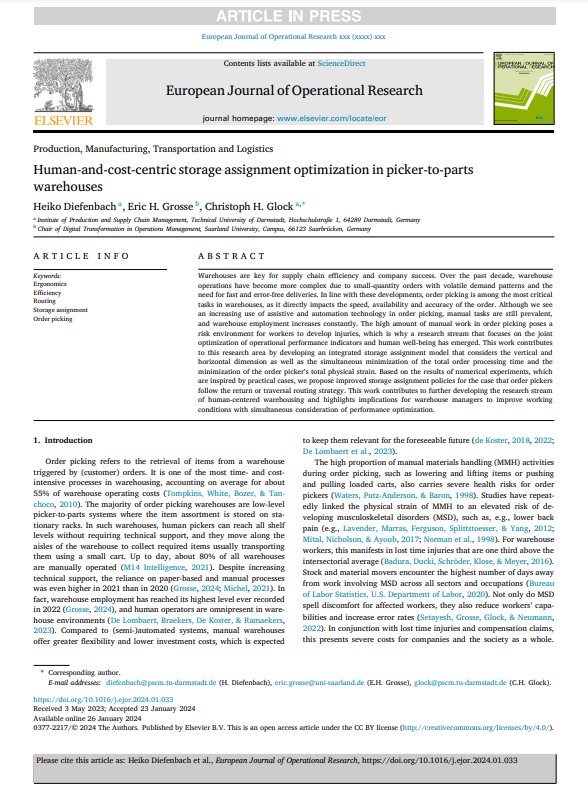
Eric Grosse is a Junior Professor for Business Administration, especially Digital Transformation in Operations Management, at Saarland University, Faculty of Humanities and Social Sciences. His research focuses on integrating human factors—such as ergonomics, fatigue, learning, and behavior—into decision models for logistics and production systems. He leads several interdisciplinary research projects including Human-Centric Production and Logistics, Models for an Active Aging Workforce, and Behavioral Order Picking. University: Saarland University School: Faculty of Humanities and Social Sciences Department: Junior Professorship for Business Administration, especially Digital Transformation in Operations Management Academic Rank: Assistant Professor Email: eric.grosse@uni-saarland.de His research interests include Operations Management, Digital Transformation, Human Factors in Logistics, Ergonomics in Warehousing, Behavioral Operations, and Sustainable Logistics. His work emphasizes human-centered design in warehousing and production, aiming to balance economic efficiency with worker well-being. He develops optimization models that simultaneously minimize costs and physical strain, and explores how learning, incentives, and fatigue affect order picking performance. The analysis of his recent publications reveals a consistent focus on integrating ergonomic and economic objectives in manual materials handling and order picking. Key themes include storage assignment optimization, workforce scheduling with ergonomic constraints, human-robot collaboration, and the impact of worker behavior and fatigue on system performance. His methodologies often combine mathematical modeling, simulation, and empirical validation through case studies and experiments. Eric Grosse actively collaborates with researchers from institutions such as TU Darmstadt and has published in top-tier journals like the International Journal of Production Research, Computers & Industrial Engineering, and International Journal of Operations & Production Management. His work supports warehouse managers in improving working conditions while maintaining operational efficiency. Human-Centric Production and Logistics System Design Models and Methods for an Active Aging Workforce Behavioral Order Picking Green Warehousing Supply Chain Resilience Warehousing 4.0/5.0 Digital Transformation Coaching He advises and co-supervises research with a team of collaborators and has contributed to the development of assessment tools like the Warehouse Error Prevention (WEP) tool. His research is funded by the German Federal Ministry for Economic Affairs and Energy, indicating active grant involvement. Though no formal students are listed, his co-authored papers suggest mentorship of junior researchers. He has no listed scientific awards in the provided text.
Kamil Rafał Filipek is an Assistant Professor at the Department of Economic Sociology and Social Research Methods , Faculty of Philosophy and Sociology , Maria Curie-Skłodowska University (UMCS), Lublin. He serves as Director of the Center for Artificial Intelligence and Computer Modeling and co-founded SZOP.ai, a data science initiative. His work bridges artificial intelligence , social media , and social capital theories with quantitative empirical analysis. PhD in Sociology, John Paul II Catholic University of Lublin MA in International Relations, UMCS MA in Sociology, John Paul II Catholic University of Lublin His research focuses on algorithmic bias , networked publics , and digital labor precarity . Current projects include DARIAH.PL (Digital Humanities infrastructure) and European Union studies on migrant worker rights. He co-developed methodologies for detecting AI model bias and social capital analysis in digital contexts. As a frequent speaker, he has presented at the Arctic Circle conference (2024) and co-organized panels on fake news detection using eye-tracking technology at the 2022 Internet Governance Forum . His work appears in journals like Polish Sociological Review and PLoS ONE , with over 1700 ministerial score points and h-index values across citation databases.
Corey Clark, Ph.D., serves as Deputy Director of Research and Assistant Professor in the Department of Computer Science and Engineering at Southern Methodist University's Lyle School of Engineering. He leads the Human and Machine Intelligence (HuMIn) Game Lab, pioneering research at the intersection of gaming, artificial intelligence, and human computation to solve large-scale problems in healthcare, education, and national security. Dr. Clark holds a Ph.D., M.S., and B.S. in Electrical Engineering from The University of Texas at Arlington, where he graduated Magna Cum Laude for his undergraduate degree. His doctoral research focused on nanoscale modeling and simulation techniques for Molecular Beam Epitaxy and Chemical Vapor Deposition of exotic materials. His research spans Artificial Intelligence, Game Development, Human Computation, Distributed Computing, Machine Learning, Computational Biology, and Educational Technology. Clark is renowned for transforming commercial video games into distributed computing platforms through human computation, enabling breakthroughs in medical diagnostics and educational technology. His technical innovations in HTML5/JavaScript multithreading have been featured at major international game conferences. Analysis of Clark's 15 most recent publications (2022-2024) reveals a dominant focus on generative AI applications integrated with gaming mechanics, particularly for knowledge graph enhancement, medical diagnostics, and computational thinking education. Key trends include explainable AI systems, human-AI collaboration through gameplay, blockchain applications, and privacy-preserving machine learning, demonstrating consistent innovation in applying game-based approaches to real-world problems. Dr. Clark has secured over $1.7 million in competitive research funding, including: Human Computation for Ocular Tomography Analysis ($62,924) with Retina Foundation Cryptocurrency Transactional Analysis via Gaming ($60,000) with Raytheon Game-Based Adult Literacy (XPrize) ($480,000) Flexible Electronics for Airborne Laser ($820,000) with Missile Defense Agency Networked C4ISR Chip ($850,000) with US Army As CTO for Dallas-based game technology companies, Clark has helped raise over $12 million in startup funding. His HuMIn Game Lab currently develops immersive gameplay systems for cancer treatment research using crowdsourced computation and machine learning, with recent projects including therapeutic discovery platforms and blockchain-based task completion systems.
Mathias Schulze is a Professor of German Language and Literature in the Department of European Studies at San Diego State University (SDSU), and Director of the Language Acquisition Resource Center. He holds a PhD in Language Engineering (Applied Linguistics) from UMIST (now part of the University of Manchester). His career includes roles at universities in Sunderland, Manchester (UK), and Waterloo (Canada), where he directed the Waterloo Centre for German Studies. He has served as co-editor of the CALICO Journal (on Computer-Assisted Language Learning) for eight years. Key research focuses include CALL (Computer-Assisted Language Learning), language education, and social bilingualism. He maintains blogs Texterium and Pantarhei Press . His work spans language acquisition methodologies, technology integration in education, and bilingualism studies. Notable contributions include pioneering parser-based CALL systems, studies on digital gaming's role in language development, and research on sustainable interaction-based language learning approaches. He has authored over 30 articles between 2002–2017, emphasizing computational analysis, learner interactions, and CALL software applications. Professional highlights include leadership in CALL research networks, cross-continental academic collaborations, and contributions to German diaspora studies in North America. His work bridges theoretical linguistics, applied pedagogy, and technological innovation in language education.
Jinkyung Katie Park is an Assistant Professor in the School of Computing at Clemson University, an affiliated faculty member of the Media Forensics Hub, and co-director of the Human And Technology Lab (HATLab). Her work sits at the intersection of Human-Computer Interaction, online safety, and human-centered AI, with a passionate focus on protecting vulnerable populations—especially adolescents—in digital spaces. Education: Ph.D. in Information Science, Rutgers University, 2022 M.A. in Records & Archives Management, 2017 B.B.A. in Business Administration, 2011 Research Interests: Dr. Park’s scholarship centers on Human-Computer Interaction for Online Safety . She investigates the psychological and social mechanisms behind online risk (e.g., incivility, privacy violations) and designs socio-technical interventions that empower youth rather than merely restrict them. Her recent projects span: Resilience-based frameworks for adolescent digital well-being Human-AI collaborative systems for real-time risk detection on social media Participatory co-design of privacy and safety tools with teens Ethical, explainable AI that encodes human values for mental-health and conversational agents Methodologically, she integrates qualitative, quantitative, and computational techniques—interviews, participatory design, surveys, NLP, and machine learning—to produce actionable insights for designers, policymakers, and educators. Publications Trend: Across her 15 most recent papers (2024-2025) she consistently tackles youth online safety through interdisciplinary lenses—HCI, AI, social computing, and health informatics. Collectively this corpus signals a shift from adult-centric, fear-based models toward resilience, empowerment, and community-oriented solutions, often co-created with adolescents themselves. Scientific Awards & Recognition: Rutgers iSchool Dissertation Award (runner-up) Outstanding Graduating Student Award, Rutgers University Multiple NSF-funded project grants (PI/co-PI) Funding & Advising: Dr. Park has served as PI or co-PI on several NSF awards focusing on youth online safety, AI-mediated risk detection, and community-based interventions. While specific grant codes and dollar amounts are not listed, the narrative emphasizes sustained federal support for her interdisciplinary work. No individual student names are disclosed in the provided source. Labs & Teams: At Clemson she co-directs the Human And Technology Lab (HATLab) and holds an affiliated appointment with the Media Forensics Hub , positioning her to collaborate with computing, social science, and forensics researchers on large-scale, convergent projects.
Brenda Reyes Ayala is an Assistant Professor in the School of Library and Information Studies at the University of Alberta’s Faculty of Education. Her research focuses on web archiving, digital preservation, and information quality, with a particular emphasis on technical and human dimensions of preserving digital heritage. Her work addresses challenges such as archivability metrics, content drift detection, and visual correspondence analysis in web archives. She also explores socio-technical aspects like internet access barriers (e.g., in Cuba) and user misconceptions about web archives. Key themes in her publications include automated quality assurance processes, metadata management, and the application of machine learning to evaluate archival and translation quality. Her research bridges technical innovations with human-centered perspectives to ensure web archives remain accessible and meaningful for scholars and communities. Her contributions include advancing methodologies for detecting quality issues in archived websites through visual and textual analysis, as well as assessing the loss of regional digital heritage in Western Canada.
Gi Woong Choi is an Assistant Professor of Instructional Design and Technology in the School of Education at the University of Cincinnati. He previously held a faculty position at SUNY Oswego in Human-Computer Interaction. His academic training includes a Ph.D. in Learning, Design, and Technology from Penn State University, an M.S. in Cognitive Science and Engineering (HCI) from Yonsei University, and a B.S. in Bio and Brain Engineering from KAIST. Ph.D.: Learning, Design, and Technology, Penn State University, 2018 M.S.: Cognitive Science and Engineering (HCI), Yonsei University, 2009 B.S.: Bio and Brain Engineering, KAIST, 2007 Dr. Choi's research is centered on the integration of technology in learning environments, particularly focusing on AI in education, mobile and game-based learning, informal STEM learning, and makerspaces. His work explores how emerging technologies can support problem-solving, deepen engagement, and democratize access to learning, especially in underserved rural communities. He is particularly interested in the educational affordances of technologies and how they shape learning experiences in both formal and informal settings. His recent publications reflect a strong trend in designing and evaluating technology-enhanced learning in libraries and informal spaces, with a growing emphasis on equity, accessibility, and the role of generative AI in education. Themes such as inclusive design, computational thinking, and online learning environments are recurrent across his work, often involving co-design with communities and practitioners. Dr. Choi is the Principal Investigator of a federally funded grant from the Institute of Museum and Library Services titled Family Makers: Online STEM Program Model to Support Rural Libraries , which supports the co-design of online engineering programs for rural children and families. His research has been published in leading journals including TechTrends , Computers in Human Behavior , and Information and Learning Science . He advises graduate students, including doctoral candidate J. H. Kang, and has professional experience in game user experience design and GUI research, which enriches his academic perspective. Starting in Fall 2025, he will join Florida State University as an Assistant Professor in Instructional Systems and Learning Technologies. His lab, the Family Makers Project, is a research-practice partnership with rural libraries and community engineers aimed at strengthening rural libraries as hubs for engineering learning and creativity. The project emphasizes culturally relevant curriculum design, community collaboration, and sustainable dissemination through workshops and toolkits.