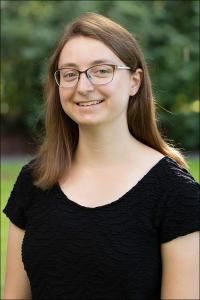
Kyla Pohl is a Visiting Assistant Professor of Mathematics at Colby College and an ABD PhD candidate at the University of Oregon, where she is advised by Ben Young. Her academic background includes a Bachelor of Arts degree in Mathematics with a concentration in Japan Studies from St. Olaf College and a Master's degree in Mathematics from the University of Oregon. Her research focuses on algebraic and enumerative combinatorics, with primary emphasis on Jack symmetric functions, hook length formulas, and probabilistic methods. She employs experimental approaches using SageMath and maintains an active GitHub repository showcasing implementations of combinatorial algorithms. Pohl's publications demonstrate expertise in both combinatorics and algebra, with recent work exploring probabilistic aspects of symmetric functions. Her research trajectory shows increasing focus on combinatorial algorithms and computational approaches to partition theory. She contributes to academic service through seminar organization and maintains educational resources including Jupyter notebooks demonstrating Markov Chain Monte Carlo methods. Her teaching experience includes courses in mathematics and mentorship through the Directed Reading Program.
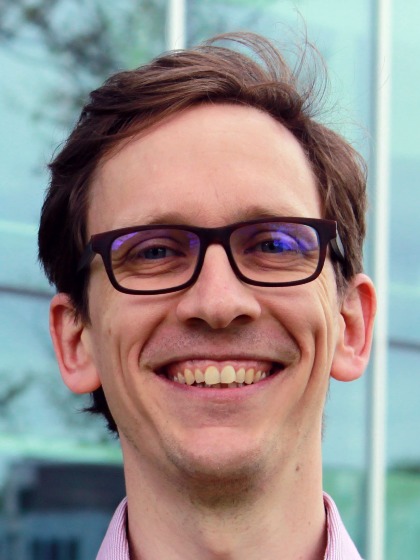
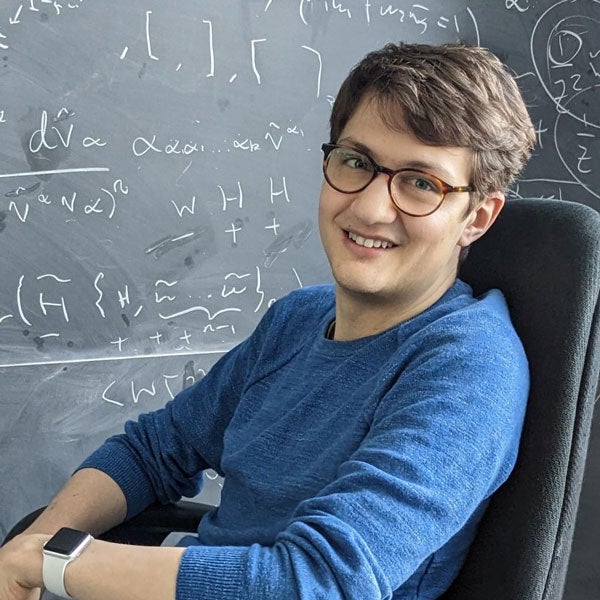
Benjamin Good is an Assistant Professor of Applied Physics and (by courtesy) of Biology at Stanford University. He holds the Alden H. and Winifred Hubbard Brown Faculty Fellowship and is based in the Department of Applied Physics within the School of Humanities and Sciences. His research bridges theoretical biophysics, evolutionary dynamics, and microbial ecology. Dr. Good received his Ph.D. in Physics from Harvard University in 2016 and his B.A. in Physics/Mathematics from Swarthmore College in 2010. His academic journey has focused on understanding evolutionary processes through the lens of statistical physics. His research interests span Theoretical Biophysics , Evolutionary Dynamics , Population Genetics , and Microbial Evolution . Good's work specifically examines short-term evolutionary dynamics in rapidly evolving microbial populations like the gut microbiome. He uses tools from statistical physics, population genetics, and computational biology to understand how microscopic growth processes and genome dynamics at the single cell level give rise to collective behaviors observable at the population level. His research spans from basic theoretical investigations of non-equilibrium processes to the development of computational tools for measuring these processes in natural and experimental microbial communities. Dr. Good teaches two key courses at Stanford: APPHYS237/BIO251: Quantitative evolutionary dynamics and genomics, and APPHYS205/BIO126/226: Introduction to Biophysics. His teaching emphasizes the application of physics principles to biological systems and quantitative approaches to evolutionary processes. Alden H. and Winifred Hubbard Brown Faculty Fellow Dr. Good actively mentors a diverse research group including postdoctoral fellows across multiple labs, graduate students in Applied Physics, Biology, Physics, and Biophysics programs, and undergraduate researchers. His lab collaborates extensively with experimentalists and leverages public sequencing repositories to develop theoretical frameworks for understanding microbial community dynamics from the ocean to the soil to the human gut.
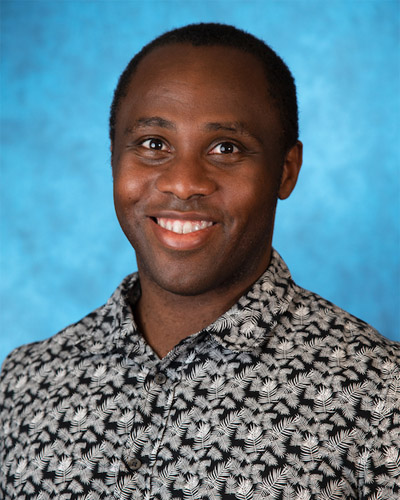
Gilles Bonnet is an Assistant Professor at the Bernoulli Institute for Mathematics, Computer Science and Artificial Intelligence within the University of Groningen , Netherlands. He is also affiliated with the Groningen Cognitive Systems and Materials Center (CogniGron) . His academic journey includes a PhD from University of Osnabrück (2016) under Prof. Matthias Reitzner, followed by a postdoc at Ruhr University Bochum (2016-2021) . Research Interests: His work bridges Probability Theory and Convex Geometry , focusing on high-dimensional stochastic structures. Key areas include random polytopes , Poisson hyperplane tessellations , and geometric inequalities . He has explored phase transitions in random polytopes and combinatorial diameter bounds. Scientific Contributions: Co-organized the Workshop On Randomness and Discrete Structures (2025) and the Spring School and Workshop on Polytopes (2019). His 2016 paper on Poisson tessellation earned a best poster award at the 18th Stochastic Geometry workshop. Awards: Best poster award (2016) Teaching: Delivers courses on Probability and Measure , Random Geometry , and Stochastic Processes at the University of Groningen and Ruhr University Bochum.
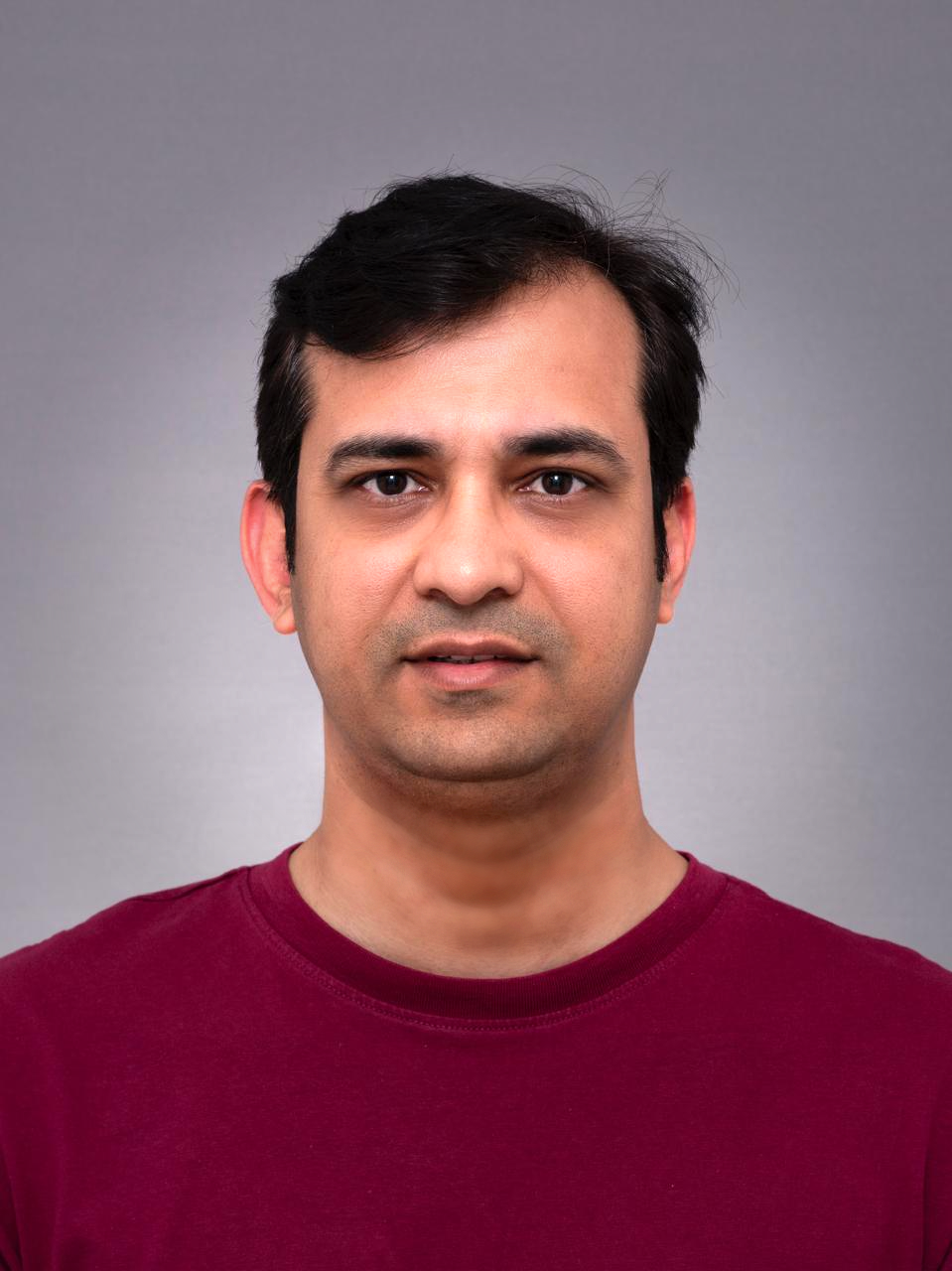
Sandro Rubino is a Fixed-term tenure-track Assistant Professor at the Department of Energy (DENERG) at Politecnico di Torino, where he is also a Member of the Interdepartmental Center PEIC - Power Electronics Innovation Center. His academic appointment falls under the scientific disciplinary sector IIND-08/A - Power Electronic Converters, Electrical Machines and Drives (Area 0009 - Industrial and Information Engineering). Dr. Rubino's research focuses on electric drives and electrical machines, with particular expertise in induction motor drives, synchronous motor drives, and advanced torque control techniques. His work spans from fundamental motor control theory to practical applications in electric vehicles and e-mobility systems. He has developed high-performance torque controllers for various types of electric motors including electrically excited synchronous motors, induction motors, and multi-three-phase motor configurations. His research addresses critical challenges in motor drive systems including fault tolerance, efficiency optimization, and performance derating under abnormal conditions. His publications reveal a strong focus on practical applications of motor control theory, particularly in the context of electric vehicles and sustainable transportation. The trend in his recent work shows increasing sophistication in control algorithms for multi-phase motor systems, with emphasis on fault tolerance and performance optimization under challenging operating conditions. His research bridges theoretical electrical machine modeling with practical implementation challenges in modern power electronic drive systems. Dr. Rubino has received multiple prestigious awards including the IAS-IDC ECCE Prize Paper Award in 2020, 2022, and 2024 from IEEE Transactions on Industry Applications, the IEEE Italy Section Power and Energy Society (PES) Chapter Best PhD Thesis Award in 2020, the IEEE Italy Section Industrial Electronics (IES) Chapter Best PhD Thesis Award in 2021, and the IAS-IDC Transactions Paper Award in 2024. He actively supervises PhD students including Nicola Macri', Alessandro Ionta, and Luisa Tolosano, focusing on advanced topics in multi-phase motor drives and torque control. Dr. Rubino leads or participates in several significant research projects including TEAMING - e-powerTrain prEdictive mAintenance using physics inforMed learnING (2023-2027), SUPERDRIVE - Superconductive Synchronous Machine Drives for High-Power Applications (2023-2025), and SEMDY - Sustainable and Efficient Motor Drive System for E-mobility Applications (2022-2025), where he serves as Scientific Responsible. Within the Power Electronics Innovation Center (PEIC), Dr. Rubino contributes to advancing the state-of-the-art in electric drive systems, with particular emphasis on applications supporting Sustainable Development Goals 7 (Affordable and Clean Energy), 9 (Industry, Innovation, and Infrastructure), and 11 (Sustainable Cities and Communities).
Richard Anantua is an Assistant Professor in the Department of Physics and Astronomy within the College of Sciences at the University of Texas at San Antonio (UTSA), and also serves as an Adjunct Professor at Rice University since 2024. His research group is pioneering Event Horizon Telescope (EHT) science in Texas, focusing on computational and theoretical astrophysics related to black holes and relativistic phenomena. Assistant Professor, UTSA – 2022–Present Adjunct Professor, Rice University – 2024–Present Postdoctoral Fellow, Harvard-Smithsonian Center for Astrophysics – 2019–2021 Postdoctoral Fellow, UC Berkeley – 2016–2019 Education: Ph.D. in Physics – Stanford University M.S. in Physics – Stanford University B.S. in Physics and Philosophy – Yale University B.S. in Economics and Mathematics – Yale University Ed.M. in Education Policy and Management – Harvard University Richard Anantua’s research focuses on computational astrophysics , particularly the modeling of emission near supermassive black holes using general relativistic magnetohydrodynamic (GRMHD) simulations. His work bridges theoretical models with observational data from cutting-edge instruments like the Event Horizon Telescope (EHT) and its next-generation counterpart (ngEHT). Key areas include black hole accretion flows, relativistic jets, plasma physics, and neutrino emission. He has developed methodologies to connect simulation variables—such as electron temperature, magnetic field strength, and current density—to observable signatures across the electromagnetic spectrum. The recent publications from his group reflect a strong trend in high-resolution modeling of black hole environments , with emphasis on M87, Sgr A*, and theoretical constructs like primordial black holes and dark matter alternatives. These works integrate numerical simulations with observational predictions, particularly for EHT and ngEHT capabilities, covering emission morphology, jet stability, plasma composition, and neutrino physics. The interdisciplinary nature of his research spans astrophysics, plasma physics, and computational science. Scientific Engagement and Mentorship: Active mentor of postdoctoral researchers, PhD students, master’s students, and undergraduates at UTSA. Group members regularly present at national conferences such as the American Astronomical Society (AAS) and SCEECS. Supervised master’s thesis on GRMHD emission modeling. Anantua has been involved in major collaborations, including the Event Horizon Telescope Collaboration during his postdoc at Harvard, and continues to lead a vibrant research group at UTSA. His lab focuses on advancing computational tools for black hole imaging and theoretical modeling of extreme astrophysical environments.
Dr. Muhammad Muzammal Naseer serves as an Assistant Professor in the Computer Science department at Khalifa University's College of Computing and Mathematical Sciences. Previously, he held research positions at Data61 (CSIRO), Inception Institute of Artificial Intelligence, and Mohamed Bin Zayed University of Artificial Intelligence (MBZUAI) from 2018 to 2024. His academic background includes: Ph.D. in Engineering & Computer Science, Australian National University (ANU), 2022 M.Sc. in Electrical Engineering, King Fahd University of Petroleum & Minerals (KFUPM) B.Sc. in Electrical Engineering, University of the Punjab (PU) His research specializes in robust intelligent systems through adversarial machine learning for AI behavior explanation, self-learning methodologies (self-supervision, self-distillation), and multimodal large language models. Key application domains include healthcare security and image/video understanding, with publications in top venues like CVPR, NeurIPS, and TPAMI. Dr. Naseer teaches Artificial Intelligence (COSC604), Introduction to Machine Learning (COSC434), and Machine Vision and Image Understanding (COSC606). He is affiliated with the Center for Cyber-Physical Systems Research and actively recruits Ph.D. students for his research group focusing on AI robustness and security.
Adam M. Rosen is a Professor of Economics at Duke University's Department of Economics, where he has served since 2019. Previously, he held academic roles at University College London (UCL), including Associate Professor (2013–2016) and Assistant Professor (2006–2013). He is an affiliated researcher with the Centre for Microdata Methods and Practice (CeMMAP) and the Institute for Fiscal Studies (IFS). His research focuses on econometric theory and applications, particularly in instrumental variable methods, partial identification, and structural models. Rosen earned his Ph.D. in Economics from Northwestern University (2006) and a B.A. in Economics and Mathematics with Computer Science from Cornell University (1999). His work has been published in top journals such as the Review of Economic Studies, Econometrica, and the Journal of Econometrics. He has received numerous awards, including Fellow of the Journal of Econometrics (2024) and the Best Associate Editor Award (2024). Rosen's research interests span econometric theory, partial identification, instrumental variables, and applied microeconometrics. His recent work includes advancements in IV methods for Tobit models, discrete choice models, and counterfactual analysis. He has advised over a dozen PhD students and contributes actively to professional service, including editorial roles at the Journal of Econometrics and Econometrics Journal. He has held grants from the European Research Council and ESRC, among others, and his teaching spans advanced econometrics courses at both UCL and Duke. His affiliations with CeMMAP and IFS reflect his commitment to advancing microdata methods and policy analysis.
Minshuo Chen is an Assistant Professor in the Department of Industrial Engineering and Management Sciences at Northwestern University. He previously served as an Associated Research Scholar in the ECE department at Princeton University, collaborating with Prof. Mengdi Wang. His research focuses on developing methodologies and theoretical foundations in generative AI, reinforcement learning, and optimization. He holds a Ph.D. from Georgia Tech (supervised by Prof. Tuo Zhao and Wenjing Liao), a Master's from UCLA, and a Bachelor's from Zhejiang University. Key research areas include diffusion models for distribution estimation, foundations of learning (approximation and optimization), and reinforcement learning applications in complex systems. He has presented at major conferences like INFORMS 2024 and NeurIPS 2023, and serves as an area chair for NeurIPS 2023. His recent work emphasizes theoretical guarantees for diffusion models, including statistical rates and optimization perspectives. He has received awards such as the ARC-TRIAD Student Fellowship and William S. Green Fellowship. Collaborations include studies on POMDPs, policy evaluation, and manifold learning.
Daniel J Eck is an Assistant Professor in the Department of Statistics at the University of Illinois Urbana-Champaign within the College of Liberal Arts & Sciences. His research focuses on statistical methodology development driven by collaborations in diverse fields such as sports analytics, evolutionary biology, economics, and biostatistics. He holds a PhD in Statistics from the University of Minnesota (2017) and a BS in Mathematics from Southern Illinois University Carbondale (2009). Education: PhD in Statistics, University of Minnesota, 2017 BS in Mathematics, Southern Illinois University Carbondale, 2009 His research interests emphasize methodological innovation in areas like envelope models, variance reduction techniques, and applications in sports and ecology. Recent work explores fire effects on plant fitness, soybean genomics, and infectious disease intervention design. He actively collaborates with researchers across disciplines and mentors graduate students in statistical methods. Eck teaches courses such as Baseball Analytics and Advanced Regression Analysis. Research Trends: His articles span statistical theory (e.g., envelope estimation), applied ecology (fire-pollination interactions), and sports analytics (player performance comparisons). He balances foundational methodology with practical applications in diverse domains. Advising & Grants: Eck advises graduate students on projects in evolutionary biology and economics. While specific grant details are not provided, his research reflects active engagement with funded collaborative projects. He maintains affiliations with the Department of Statistics and has ties to computational biology and public health initiatives. Labs/Teams: While no specific lab is mentioned, his work aligns with interdisciplinary teams at UIUC and Yale School of Public Health (prior postdoctoral affiliation).
Xudong Chen is an Associate Professor in the Department of Electrical & Systems Engineering at Washington University in St. Louis, part of the McKelvey School of Engineering. Previously, he held an Assistant Professor position at the University of Colorado, Boulder. He earned a BS in Electronics Engineering from Tsinghua University (2009) and a PhD in Electrical Engineering from Harvard University (2014). His research focuses on control theory, decision theory, dynamical systems, stochastic processes, and network science, with a particular emphasis on large-scale multi-agent systems. Applications span quantum systems, smart materials, neuroscience, social science, robotics, drones, and spacecraft. His work develops advanced mathematical tools and engineering methods to address challenges in these complex systems. Notable Awards: 2023 A.V. Balakrishnan Early Career Award 2021 Donald P. Eckman Award NSF CAREER Award (2021) AFOSR Young Investigator Award (2020) Chen has secured grants including NSF support for graphon-based structural system theory and AFOSR funding. He leads a research group and maintains a lab website for collaborative projects. His work bridges theoretical foundations with practical applications across diverse engineering domains.
Thomas G. Anderson is an Assistant Professor in the Department of Computational Applied Mathematics and Operations Research at Rice University. His research focuses on numerical analysis, spectral methods, and scientific computing, with applications in wave propagation and fluid dynamics. He joined Rice in 2023, following postdoctoral work at the University of Michigan and a PhD in applied and computational mathematics from Caltech. Education: PhD in Applied and Computational Mathematics, Caltech (Department of Computing+Mathematical Sciences) MS in Applied Mathematics, New Jersey Institute of Technology Bachelor’s in Applied Mathematics, New Jersey Institute of Technology Research Interests: Development of high-order numerical methods for partial differential equations Fast algorithms for singular integral operators in potential theory Parallelizable algorithms for long-time wave propagation simulations Volumetric discretization techniques for complex geometries Articles Trends: His recent work emphasizes efficient computational methods for wave and fluid dynamics, including hybrid frequency-time analysis, fast evaluation of volume potentials, and stabilization of viscous liquid layers. He explores both theoretical foundations and practical algorithm design. Grants and Advising: No specific grants or advisees listed in the provided text. Labs/Teams: Active collaboration with computational mathematics groups at Rice and prior institutions, including work at Lawrence Livermore National Laboratory.
Fangwei Si is the Cooper-Siegel Assistant Professor of Physics at Carnegie Mellon University's Department of Physics, with courtesy appointments in Biomedical Engineering. His research focuses on uncovering biological laws through quantitative biophysics , integrating microfluidics , imaging , and physical modeling . He previously held postdoctoral positions at The Scripps Research Institute and University of California, San Diego, and earned his Ph.D. in Mechanical Engineering from Johns Hopkins University. Ph.D.: Johns Hopkins University (2015) B.S.: Peking University (2009) His research bridges cell surface biophysics , cellular adaptation , and bacteria-phage interactions , emphasizing how cells optimize fitness through precise membrane organization and component redundancy . Current projects explore mechanical compression effects , quantitative adaptation principles , and phage-host coevolution . The lab's articles reveal trends in cell size control (2017-2019), mechanosensation (2018), and stochastic modeling (2020-2021), extending to machine learning approaches (2025) and high-throughput imaging (2024). Key methods include microfluidics , genetic modulation , and physical modeling . At CMU, Si leads the Experimental Cell Biophysics Lab, mentoring Ph.D. students like Mo Zhou and Christopher Aldrich , alongside postdocs and undergraduates. His lab received NIH and NSF grants in 2023 to advance research on microbial systems.
Eamonn Bell is an Assistant Professor in the Department of Computer Science at Durham University, with affiliations to the Institute of Advanced Study. His research focuses on digital humanities, applying computational methods to musicology and examining the history of digital technology in music production. He leads projects like CCP-AHC and DISKAH to enhance digital infrastructure for arts researchers. Previously, he was a postdoctoral Research Fellow at Trinity College Dublin, studying the cultural impact of the Compact Disc. He holds a PhD in Music Theory from Columbia University (2019) and a joint degree in Music and Mathematics from Trinity College Dublin (2013). His educational background includes advanced studies in music theory, digital humanities, and mathematics. He teaches courses on algorithms, software engineering, and music processing within Durham’s Computer Science curriculum. Supervision includes postgraduate students focusing on music technology and computational analysis. Research interests span digital musicology, the history of technology, and accessibility of computational tools for non-specialists. Awards include the Government of Ireland Postdoctoral Fellowship (2019–2021). His work addresses ethical issues in genetic studies of musicality and explores emerging digital tools for music analysis, such as time-coded YouTube comments and CD data extraction techniques. Key initiatives include designing DRI projects for UK-based researchers and advancing digital skills through collaborative frameworks. He actively participates in academic conferences and has published widely on topics ranging from media archaeology to interdisciplinary computational research.
Bailey Kacsmar is an Assistant Professor in the Department of Computing Science at the University of Alberta and an Alberta Machine Intelligence Institute (Amii) Fellow. Her research focuses on developing human-centered privacy solutions, combining technical privacy mechanisms (e.g., private machine learning, secure computation) with user perception studies and usability evaluations. She holds a PhD and MMath in Computer Science from the University of Waterloo. Education: PhD in Computer Science, University of Waterloo Masters of Mathematics (MMath), University of Waterloo Research Interests: Privacy-preserving machine learning and AI User-centric privacy design Cryptography for private computation Usability of privacy-enhancing technologies Recent Work Trends: Her publications emphasize practical privacy solutions, including private set intersection protocols, differential privacy in machine learning, and user comprehension of privacy mechanisms. Awards: 2025 U of A Award for Outstanding Mentorship in Undergraduate Research Honorable Mention for CRA Outstanding Undergraduate Researcher Award (Jialiang Yan) Teaching & Advising: Courses include Cryptography for Digital Privacy and Privacy, Cryptography, Network Security. Advises graduate students and undergraduate researchers on privacy-preserving technologies. Emphasizes ethical and human-centered approaches in advising. Labs & Teams: Leads the PUPS (Practical Usable Privacy and Security) Lab, focusing on interdisciplinary privacy research spanning technical design, usability, and societal impact.
Mitchell L. Neilsen is a Professor in the Department of Computer Science at Kansas State University's College of Engineering, where he also serves as the graduate program director. He holds the Warren and Gisela Kennedy - Carl and Mary Ice Keystone Research Scholar position and maintains an active research program with multiple ongoing projects. His educational background includes a Ph.D. in Computer Science (1992), M.S. in Computer Science (1989), and M.S. in Mathematics (1987), all from Kansas State University, plus a B.S. in Mathematics Education from the University of Nebraska-Kearney (1982). After beginning his career as an assistant professor at Oklahoma State University, he returned to K-State in 1996. Research Interests: Cyber-Physical Systems: Design, Analysis, Verification of systems integrating computing, networking, and physical processes Distributed Systems: Algorithms, design, and analysis of distributed computing systems Scientific Computing: Computational Fluid Dynamics, Finite Element Analysis, High Performance Computing, and Simulation Application Areas: Agriculture technology, Dam safety analysis, Mobile applications, Natural resources management, and Real-time Embedded Systems His research program shows clear evolution toward agricultural technology applications, particularly high-throughput phenotyping, while maintaining strong foundations in cyber-physical systems and scientific computing. Recent publications indicate increasing integration of machine learning and computer vision techniques into traditional research areas. Research Funding: National Science Foundation U.S. Department of Agriculture Sandia National Laboratories Department of Homeland Security Private industry partners Dr. Neilsen has mentored numerous graduate students through their M.S. and Ph.D. programs, with recent advisees focusing on applications in agricultural technology, dam safety, and embedded systems. His advising approach emphasizes practical applications of theoretical computer science concepts. Current Teaching (Fall 2024): CIS 450 - Computer Architecture and Operations CIS 625 - Concurrent Software Systems CIS 720 - Advanced Operating Systems