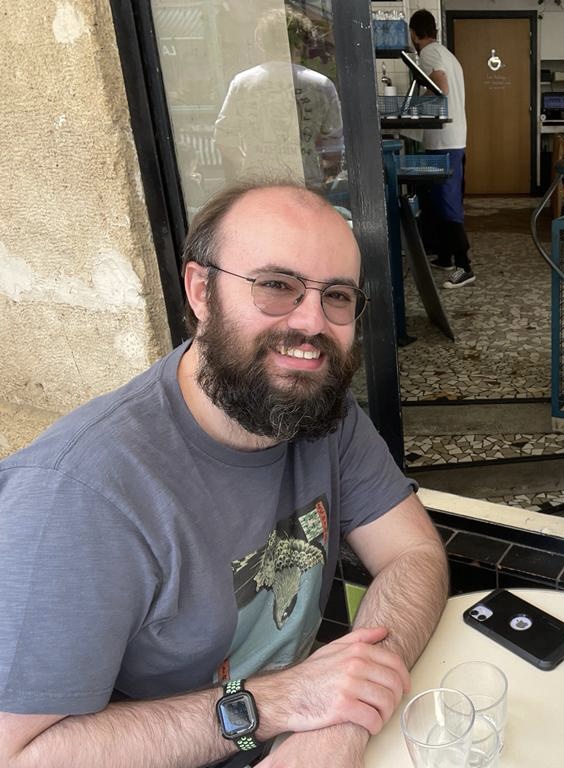
Karl Audun Kagnes Borgersen is a PhD Research Fellow at the Department of Information and Communication Technology, University of Agder. He combines his research work with a part-time role as AI Coordinator for Grimstad campus. Research Interests focus on: Machine learning applications in recommender systems Deep learning model evaluation and comparison AI-driven automation for fashion e-commerce Publications demonstrate expertise in: Image similarity metrics using pre-trained models Comparative analysis of novel machine learning architectures Human-in-the-loop AI systems for fashion tagging
Christian Walter Peter Omlin is a Professor at the Department of Information and Communication Technology, University of Agder. He holds an honorary position at the University of South Africa and has held academic roles across institutions in South Africa, Cyprus, and Fiji. His expertise spans artificial intelligence, machine learning, and ethical AI. Omlin’s research emphasizes explainable AI, reinforcement learning, and applications in Industry 4.0, healthcare, and particle physics monitoring. He leads projects like the Telkom/Cisco Center for IP Computing and has contributed to virtue ethics in AI agent design. Education: PhD from Rensselaer Polytechnic Institute (1995), M.Eng from ETH Zurich (1987). Research Highlights: Developed affinity-based reinforcement learning (ab-RL) for interpretable AI agents. Advanced data quality monitoring (DQM) for CERN’s CMS detector using time-aware deep learning. Explored virtue ethics in AI through role-playing agents and ethical dilemma modeling. Teaching: Courses include Principles of AI, Algorithms, Urban Computing, and Digital Health. Grants/Advising: Led the Telkom/Cisco Center and the South African Innovation Fund’s “HearSEE” consortium. Supervised theses at multiple universities. Labs/Teams: Involved in CERN’s HCAL detector anomaly detection and dental radiology AI applications.
Alireza David Anisi is an Associate Professor at the Department of Engineering Sciences , University of Agder. With a PhD in Optimization and Systems Theory and an M.Sc. in Engineering Physics, he specializes in autonomous systems and robotics , particularly in agri-tech and harsh environments . His industrial experience spans 15+ years in defense and oil & gas sectors. Academic Background: PhD: Optimization and Systems Theory M.Sc.: Engineering Physics Research Interests include formal verification and learning for autonomous systems, combinatorial optimization for multi-robot task/path planning, computational optimal control for trajectory optimization, and nonlinear observer design. His work bridges academic research with industrial R&D. Selected Publications highlight trends in robotics safety assurance, formal verification methods, and industry-specific applications (defense, oil & gas, agriculture). Recent works focus on runtime verification in ROS 2 and RoboStar technology integration. Patents: Power system optimization (EP18162642.5, 2018) Mechanical grip system (SE1300179, 2013) Sensor arrangement for machine vision (WO2014026711, 2012) Tool changer for explosive environments (WO2012007188, 2011) Industrial robot control method (EP2466404, 2010) Harsh environment mobile robot (WO2011107137, 2010) Anisi contributes to the Robotics and Automation research group, focusing on real-world applications in agriculture, energy, and industrial sectors. He teaches MAS221 Industrial IT and Robotics and emphasizes collaboration between academia and industry.
Filippo Sanfilippo is a Professor at the Department of Engineering Sciences, University of Agder (UiA), Grimstad, Norway. He holds a PhD in Engineering Cybernetics from NTNU, specializing in robotic control systems. His research focuses on robotics, wearables, human-robot collaboration, AI, and control theory, with emphasis on applications in healthcare, Industry 5.0, and emergency response. He leads projects like SAKO (Service Robots in Municipal Health Services) and the EMERALD initiative (3D printing biomimetic mechatronic systems). He chairs IEEE Norway Section and the IEEE Robotics & Automation Joint Chapter, and serves as Treasurer of NAIS (Norwegian AI Association). His research groups include Artificial Intelligence, Biomechatronics, and Collaborative Robotics. He coordinates activities in teaching robotics at bachelor/master levels and supervises PhD students. Over 70+ publications span journals like IEEE Transactions and conferences like HICSS and ICRA. Key contributions include VR/AR integration in surgical training, federated learning for edge devices, and adaptive control for flexible robotic joints. He actively promotes interdisciplinary research through digital twins, human-robot teaming frameworks, and ethical AI applications.
Geir Hovland is a Professor at the Department of Engineering Sciences, University of Agder. He holds an MSc in Engineering Cybernetics from NTNU (1993) and a PhD in Robotics from the Australian National University (1997). His research focuses on robotics, control systems, industrial IT, and modeling/identification of dynamic systems. He serves as Chief Editor of the MIC Journal . Research Interests: Robotics and automation, including flexible manipulators and sensor networks Control systems for offshore and industrial applications Parallel kinematic machines and mechatronic systems Blockchain stability analysis (nonlinear control) Publications: Over 100 peer-reviewed articles in journals like Robotics , IEEE Transactions , and MIC Journal , with a focus on advanced control strategies, sensor optimization, and robotics in harsh environments. Labs/Teams: Leads the Norwegian Motion-Laboratory and collaborates with industry partners on projects like autonomous mooring systems and offshore crane modeling.
Lucas Georges Gabriel Charpentier is a Doctoral Research Fellow at the University of Oslo's Faculty of Mathematics and Natural Sciences, affiliated with the Research Group for Language Technology and the Digital Security (SEC) group. His research focuses on Natural Language Processing, deep learning, privacy, and machine learning, with an emphasis on language models, computational linguistics, and ethical AI applications. He has contributed to studies on multilingual models, model fusion (BERT vs GPT), compositional generalization, and privacy-preserving techniques. Charpentier is actively involved in international conferences, including the BabyLM Challenge and NoDaLiDa/Baltic-HLT, and collaborates with researchers across institutions. His work bridges theoretical advancements and practical applications in NLP, addressing challenges in low-resource languages and model efficiency. Education: Pursuing a PhD in Informatics at the University of Oslo Research interests include language model architecture optimization, multimodal learning, and ethical considerations in AI. His publications span topics from continual training for Norwegian languages to re-identification risks in documents. Charpentier's contributions highlight innovations in neural network design and interdisciplinary approaches to computational linguistics.
Charles Jensen is an Associate Professor at the University of Oslo's Department of Informatics, specializing in digital signal processing and image analysis. His research focuses on developing advanced computational methods for pattern recognition, machine learning, and acoustic signal processing applications. Research interests span medical imaging, geophysical data analysis, and remote sensing, with emphasis on adaptive algorithms for noise reduction and automated interpretation. Recent publications demonstrate innovations in ultrasound image enhancement and seismic data processing using neural networks. His work in the Digital Signal Processing and Image Analysis group involves developing practical solutions for real-world challenges in healthcare diagnostics and geological exploration.
Martine Tan is a Doctoral Research Fellow at the University of Oslo, affiliated with the Research Group for Digital Signal Processing and Image Analysis. She holds a position within the Faculty of Mathematics and Natural Sciences and the Department of Digital Signal Processing and Image Analysis (DSB). Her work focuses on probabilistic modeling of visual data and computational challenges in statistical estimation. Research interests include digital signal processing, image analysis, machine learning, computer vision, data science, and pattern recognition. These areas are reflected in her publications, such as her 2023 study on hierarchical topic discovery in images and a 2021 paper exploring computational barriers in LASSO solutions. Her research bridges theoretical frameworks with practical applications in visual and statistical domains. Martine’s academic contributions emphasize probabilistic methodologies and high-dimensional data challenges. She has no explicitly stated scientific awards or part-time affiliations. No advising roles or grant information is provided in the text. She is part of the Digital Signal Processing and Image Analysis research group at UiO.
Trygve Christian Eftestøl is a Professor of Information Technology at the Department of Electrical Engineering and Computer Science, University of Stavanger. His academic background includes a PhD in signal processing from NTNU and an M.Sc. in Electrical and Computer Engineering from HiS, Stavanger. He is a senior member of IEEE and serves on the board of the Cognitive Lab at UiS since 2025. Educations: PhD in Signal Processing (NTNU/HiS, 2000) M.Sc. in Electrical and Computer Engineering (HiS, Stavanger) Research Interests: His work focuses on biomedical data analysis, including resuscitation, cardiac science, waveform analysis (ECG, thorax impedance), and MRI for myocardial injury. He is involved in multidisciplinary projects such as digital pathology, newborn resuscitation, sports medicine, neurogenerative diseases, and prostate cancer imaging. He co-founded the Biomedical Data Analysis Laboratory (BMDLab) and serves as its deputy leader since 2020. Articles Trends: Recent publications emphasize machine learning applications in healthcare (e.g., EEG-based neurodegenerative disorder classification, MRI segmentation for myocardial injury), predictive models for cardiac arrest outcomes, and AI-driven solutions in oncology and pathology. His work bridges signal/image processing with clinical needs, addressing challenges in resuscitation, cardiology, and diagnostic accuracy. Awards/Grants: No specific awards listed, but his leadership roles and research contributions highlight sustained academic and clinical impact. Advising & Labs: Supervises/co-supervises PhD projects in areas like human activity recognition and prostate cancer detection. Active in BMDLab, collaborating nationally and internationally on biomedical data analysis.
Antonio Candea Leite is an Associate Professor at the Department of Mechanical Engineering and Technology Management, Norwegian University of Life Sciences (NMBU). His research focuses on adaptive and robust control systems, visual servoing, robot manipulators, and agricultural robotics applications. His work emphasizes: Development of autonomous navigation systems for agricultural robots Integration of computer vision for precision agriculture tasks Control strategies for uncertain robotic systems Automation in food quality measurement and pest management Advanced sensor integration for manufacturing processes Recent research trends show strong emphasis on: CNN-based crop row detection for autonomous navigation (2024) Human-robot collaboration frameworks for fruit picking (2024) Robotics solutions for fatty acid measurement in food production (2023-2022) Precision pest control systems using smart automation (2023) No scientific awards or grants are explicitly listed in the provided information. He is actively involved in advising and developing robotic platforms for agricultural and industrial applications without specific student names mentioned here.
Michael Kampffmeyer is a 33-year-old Professor at the Machine Learning Group at UiT The Arctic University of Norway in Tromsø, where he researches the development of deep learning algorithms that learn with limited data and their explainability. Born in 1991 in Hamburg, Germany, he developed an early relationship with Norway through family holiday trips, spending six months as an exchange student in Alvdal at age 15 before completing high school in the UK. Remarkably, just 14 years after beginning his integrated master's degree in Energy, Climate and Environment at UiT at age 18, he achieved the position of professor. Kampffmeyer's research focuses on addressing two critical challenges in contemporary AI: the interpretability aspect and the inefficient training processes that require massive amounts of data, computing power, and energy. His work aims to develop more efficient and explainable AI models that can function effectively with limited data, with particular applications in medical image analysis where he collaborates with Universitetssykehuset Nord-Norge (UNN). His team has grown significantly from 5 to around 35 members since he began his PhD in 2015. The analysis of Kampffmeyer's recent publications reveals a strong focus on medical imaging applications, particularly in cardiac analysis and mammography, alongside work on making AI models more efficient and explainable. His research spans few-shot learning techniques for medical image segmentation, uncertainty modeling in graph networks, and super-resolution techniques for satellite imagery. A consistent theme across his work is the development of methods that require less data while maintaining or improving performance, addressing his core research mission of creating more efficient AI systems. Kampffmeyer is actively involved in securing significant research funding, with his team working on a proposal to join a new national AI center that would distribute approximately 200 million NOK, with a substantial portion allocated to UiT. He emphasizes the importance of international visibility, recognizing that continued representation at major international conferences is essential for maintaining their position at the forefront of AI research. His vision for the future of AI includes multimodal approaches that incorporate various types of data beyond just text and images, inspired by how humans use multiple senses to understand the world.
Shahzad Ahmad is a Doctoral Research Fellow at the Faculty of Computer Science, Engineering and Economics, Østfold University College. His research focuses on Machine Learning, particularly in areas like Zero-Shot Learning and Action Recognition. He has published work on Temporal Token Learning in Transactions on Machine Learning Research (TMLR). Contact: shahzad.ahmad@hiof.no .
Aniket Anand Gurav is a Research Fellow at the Faculty of Information Technology, Engineering and Economics at Østfold University College, Norway. He is based in Halden and can be reached at aniket.a.gurav@hiof.no. His academic work is closely tied to the Machine Learning research group. Research Interests Gurav's research focuses on Machine Learning , particularly in Pattern Recognition and Image Analysis , with applications in computer vision and artificial intelligence. His work addresses challenges in Handwritten Word Image Recognition , leveraging neural networks for Norwegian language processing. Recent Publication In 2023, Gurav co-authored a paper introducing ResPho(SC)Net , a zero-shot learning framework designed for recognizing Norwegian handwritten text. This contribution aligns with advancements in Optical Character Recognition and Document Image Analysis . Labs and Teams He is affiliated with the Machine Learning research group, which drives interdisciplinary projects at the intersection of computer science and engineering.
Roland Olsson is an Associate Professor at the Department of Computer Science and Communication, Oslo and Akershus University College of Applied Sciences (HIOF). He holds a doctorate from the University of Oslo (UiO) and previously served as an Associate Professor at Chalmers University of Technology in Gothenburg, Sweden. His research focuses on machine learning, automatic programming, and algorithm design through large-scale combinatorial search, particularly via his ADATE system. Olsson’s work emphasizes meta-machine learning, including the automatic design of neural network architectures. His research group explores applications in image processing, symbolic regression, and optimization. Key areas include improving algorithms for edge detection, oil well event prediction, and real-time CNC machine control through imitation learning. Publications span domains like evolutionary computation, industrial informatics, and smart grids. His work frequently appears in journals like IEEE Open Journal of the Industrial Electronics Society and conferences such as IEEE International Conference on Big Data and Smart Computing. Though no specific awards are listed, his contributions to automatic programming and machine learning algorithms are widely recognized in the academic community. Olsson’s advising and grant involvement is implied through collaborative projects with industry partners (e.g., CNC machine operators, oil well monitoring). He leads the Machine Learning group at HIOF and teaches courses in machine learning. His research extends to interdisciplinary applications, including IoT architectures for smart grids and healthcare activity recognition.
Aliaksandr Hubin is an Associate Professor of Statistics at Østfold University College (OUC), affiliated with the Section for Research Administration. He provides statistical support to researchers at OUC while conducting methodological research in Bayesian statistics, machine learning, and operations research. His academic background includes a PhD from the University of Oslo (2014–2018), a Master's from Molde University College (2012–2014), and a Specialist degree from Belarusian State University (2008–2013). His research focuses on Bayesian model selection, nonlinear regressions, neural networks, and weak supervision in machine learning. Hubin has held positions at the Norwegian Computing Center (2018–2020) and the University of Oslo as a postdoc (2021–2022). His work spans methodological advancements in MCMC algorithms, variational inference, and applications in epigenetics, econometrics, and healthcare. Key achievements include developing the GMJMCMC algorithm for Bayesian logic regression and the 'skweak' framework for weak supervision in NLP. His awards include the NIMA 2014 award for best MSc graduate, Belarusian Ministry of Education First Award (2013), and recognition at the Graybill 2017 conference. His research has been published in journals like Bayesian Analysis , Neural Computing & Applications , and Scientific Reports , with a focus on model uncertainty quantification and scalable Bayesian methods.