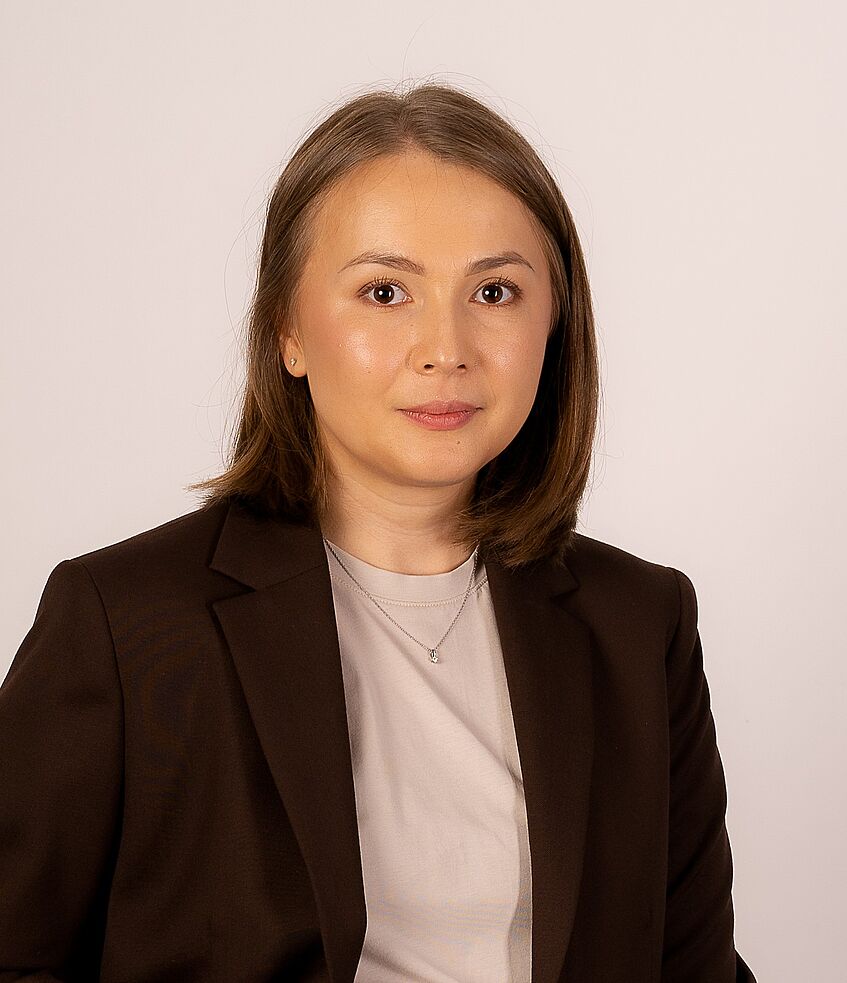
Lesley Howell is a Professor of Pharma and Medicinal Chemistry and Director of Education at Queen Mary University of London's School of Physical and Chemical Sciences. She holds a Queen Mary Academy Fellowship (2021-2024) focused on advancing pedagogical strategies like Peer Led Team Learning (PLTL), which enhances student engagement and reduces attainment gaps. Her research spans two core areas: medicinal chemistry targeting protein-protein interactions (PPIs) in GPCRs and chemical education initiatives emphasizing outreach, diversity, and decolonizing STEM curricula. She collaborates with the McCormick Group on GPCR heteromer projects and Dr. Tippu Sheriff on BAME scientist contributions to chemistry. Her work also explores mixed-reality laboratory environments to improve educational outcomes. In teaching, she leads modules such as Foundations of Practical Chemistry and Advanced Pharmaceutical Chemistry. Her supervisory roles include mentoring PhD students Zara Farooq and Christos Matsingos. Research highlights include developing stapled peptides to disrupt GPCR oligomers and identifying cannabinoid receptor modulators. She advocates for inclusive education through projects like 'Does chemistry outreach influence university choices?' and 'Effective outreach evaluation.'
Dr. James Stovold is an Assistant Professor at the Data Science Institute, Lancaster University. His research focuses on emergent behavior, cognitive robotics, and unconventional computing methods, particularly leveraging neural cellular automata and swarm robotics for innovative applications in AI and computational systems. His recent work explores topics such as human-AI symbiosis, reaction-diffusion chemistry for neural networks, and mixed-initiative design tools. Publications span disciplines including artificial intelligence, computational biology, and human-AI interaction. His research has been featured in numerous conference contributions and journal articles, emphasizing interdisciplinary approaches to solving complex computational and robotic challenges. He can be reached via email at j.stovold@lancaster.ac.uk.
Nadiia Gumerova , PhD, is a researcher at the Institute of Biophysical Chemistry under the Faculty of Chemistry at the University of Vienna , Austria. Her work focuses on polyoxometalate chemistry, including targeted synthesis, structural analysis, and biomedical applications. She has published extensively on aqueous speciation, metal-substituted polyoxometalates, and their interactions with proteins and biological systems. PhD in Inorganic Chemistry (2014), Donetsk National University Post-doctoral fellow (2019–present), University of Vienna Lise Meitner fellow (2017–2019), University of Vienna Her research interests encompass polyoxometalate design, structural transformations in biological environments, and development of bioactive materials. Recent work includes studies on vanadate-protein interactions, antibiotic activity of Preyssler-type clusters, and enzyme inhibition by polyoxotungstates. Publications (15 most recent) highlight trends in polyoxometalate speciation under varying ionic strengths, biomedical applications of Anderson-Evans and Keggin-type derivatives, and structural insights into metal-substituted tungsten clusters. Keywords span Inorganic Chemistry , Biochemistry , and Materials Science . Grants include the FWF Meitner Program M2203 (2017–2019) and FWF Stand-Alone Project P33927 (2021–2023). She collaborates with the RompelLab and contributes to interdisciplinary projects applying inorganic chemistry in biological contexts.
Professor Graeme Ruxton at the School of Biology, University of St Andrews, is a leading researcher in evolutionary ecology focusing on interspecies sensory interactions. His work spans predator-prey dynamics, plant-pollinator communication, and statistical methodology. Current positions: Professor, School of Biology Key institutions: University of St Andrews, European Commission (H2020 MSCA Fellowship SCAVENGER), BBSRC Research interests center on: Evolutionary ecology of sensory interactions Camouflage, crypsis and mimicry Signaling system stability Nonparametric statistical methodology Biophysical scaling effects Plant-animal coevolution Recent publications show: 2025 work on snake digestion strategies and zebra stripe functionality 2024 developments in statistical analysis of ecological data 2023 contributions to signaling game theory Methodological innovations from 2018-2022 Scientific recognition includes: Fellow of the Royal Society of Edinburgh (2012) Research supervision includes: 2023-2022 thesis supervision on mixed-species antipredator strategies 2022 thesis on aphid-ladybird interactions 2017 shark coloration research
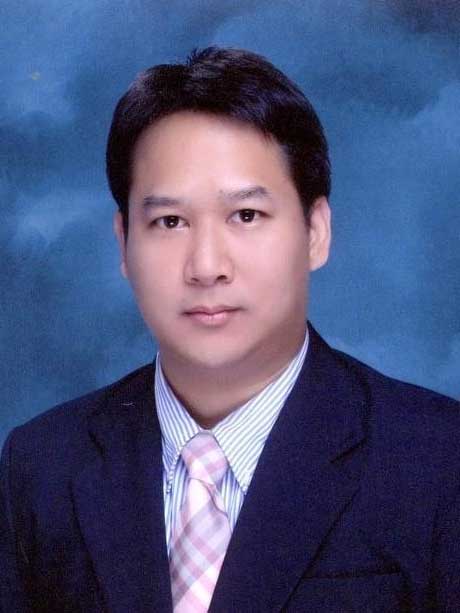
Dr. Sivarit Sultornsanee is an Associate Teaching Professor in the Department of Mechanical and Industrial Engineering at Northeastern University, Boston, MA, and serves as an Assistant Program Advisor for the Data Analytics Engineering program. His research focuses on IoT, intelligent factory transformation, machine learning-driven price optimization, image search engines, biomedical signal processing, and AI applications in business. Education: Ph.D. in Interdisciplinary Engineering (Data Analytics Engineering) from Northeastern University (2012); M.S. in Computer Engineering from the University of Massachusetts (2007). Research Interests Internet of Things (IoT) : Developing smart factory solutions and IoT-driven industrial systems. Machine Learning Applications : Price recommendation systems and ML models for business optimization. Biomedical Signal Processing : EEG/EMG analysis for healthcare diagnostics (e.g., epilepsy, neuropathy). Image Search Engines : Semantic segmentation and AI-driven image analysis techniques. AI in Business : Strategic use of AI for business decision-making and market analysis. Publications Trends : Recent work spans geotechnical engineering (soil mechanics, CBR prediction), medical imaging (diabetic retinopathy detection), and finance (portfolio optimization via neural networks). Earlier research emphasized signal processing in manufacturing and biomedical diagnostics. Affiliations : Member of ECIT-Thailand, International Federation of Classification Societies (IFCS), and Electrical Engineering Academic Association of Thailand.
Dr. Waseem Kaialy is a Senior Lecturer in Pharmaceutics at the School of Pharmacy, Faculty of Science and Engineering, University of Wolverhampton. He earned his BPharm (2007) with five Academic Excellence Awards, followed by a PhD in Pharmaceutics from the University of Kent (2013) in collaboration with Pfizer Ltd. His academic journey includes roles as a pharmacy manager (2007-2008), teaching assistant (2008-2009), postdoctoral research associate (2013-2014) at Kent, and visiting researcher at Luleå University of Technology (Sweden). Education: BPharm (2007), PhD (2013), PGC Academic Practice in Higher Education (2014-2015) Certification: AoFAQ Level 3 Award in First Aid at Work (2016) Dr. Kaialy’s research focuses on enhancing drug delivery systems through particle engineering, with emphasis on: Optimizing aerosolization performance of dry powder inhalers Improving solubility and dissolution rates of poorly soluble drugs Enhancing flowability and tabletability of poorly compactible drugs His work spans pharmaceutical solid-state properties, triboelectrification effects, and lyophilization techniques, with over 90 publications, 1331 citations, and leadership roles in editorial boards for 25 journals. Notable scientific awards include the ERAS Fellowship and Fellowship of the Higher Education Academy . Dr. Kaialy has supervised multiple research-based degrees at Wolverhampton, focusing on composite particle engineering and novel formulation strategies.
Shawn Loewen serves as Professor and Associate Chair for Graduate Studies in Michigan State University's Department of Linguistics, Languages, and Cultures within the College of Arts & Letters. He directs the Second Language Studies (SLS) program and teaches second language acquisition and quantitative research methods courses. His educational background includes an MA from Temple University and PhD from the University of Auckland. Loewen's research centers on instructed second language acquisition (ISLA) , second language interaction , and quantitative methodology , with particular focus on bridging SLA research and classroom practice. He investigates how teachers engage with research and how mobile-assisted language learning impacts pedagogy. His recent publications reveal strong trends in mobile language learning effectiveness (Duolingo/Babbel studies), research-practice interface challenges, and methodological rigor in SLA. He examines nonverbal feedback mechanisms, synchronous communication platforms, and pronunciation acquisition through both empirical and theoretical lenses. His scientific recognition includes: Fulbright award for Polish University collaboration (2021) As SLS program director, Loewen fostered the graduate community that earned MSU's 2018 Outstanding Graduate Program Community Award. Since 2018, he has served as associate editor of The Modern Language Journal while securing research grants including the Fulbright. Though specific advisees aren't listed, his leadership roles indicate active graduate mentorship across second language studies. Loewen maintains active involvement in the SLS program and collaborates on language learning technology projects, frequently addressing media inquiries about language app efficacy as seen in Kiplinger's 2024 coverage.
Kamal Premaratne serves as a Professor in the Department of Electrical & Computer Engineering at the College of Engineering, University of Miami. His scholarly work uniquely bridges technical expertise in machine learning and signal processing with social science research on conspiracy theories and political extremism. With numerous publications in both technical and social science journals, he demonstrates an exceptional interdisciplinary approach to understanding complex contemporary phenomena. Professor Premaratne's research spans two primary domains: advanced computational methods and social/political analysis. In computational methods, he focuses on quantum tensor networks for time series analysis, graph neural networks for gesture recognition, and uncertainty quantification in machine learning systems. His social science research examines conspiracy theories including the "White Replacement" theory, QAnon, and "white genocide" narratives, investigating their sociodemographic correlates and relationship to political extremism. His work often employs mixed-methods approaches combining qualitative analysis with quantitative content analysis and network analysis. Analysis of Premaratne's recent publications reveals a strong focus on understanding how conspiracy theories spread on social media platforms and their relationship to political behavior. His technical work shows innovative applications of quantum physics concepts to machine learning problems, creating more interpretable models while maintaining performance. This dual focus demonstrates how computational methods can be applied to social science questions and vice versa. Professor Premaratne actively collaborates with researchers across disciplines including psychology, political science, and communication studies. His research has been published in high-impact journals such as Scientific Reports, Journal of Politics, and Political Science Quarterly. Though specific grant information isn't detailed in the available materials, his extensive publication record suggests substantial research activity. His work has significant implications for understanding political polarization, misinformation spread, and developing more interpretable AI systems.
Professor Huiru (Jane) Zheng is a Professor of Computer Science at the School of Computing, Ulster University. She serves as Theme Leader of Data Analytics and Systems in the AI Research Centre and is a full member of the Computer Science Research Institute. As a Fellow of the UK Higher Education Academy and Senior Member of IEEE, she has established herself as a leading researcher with significant contributions to bioinformatics and healthcare informatics. Her educational background includes: PhD in Bioinformatics (2003) from Ulster University Postgraduate Certificate in Teaching in Higher Education (2005) from Ulster University Professor Zheng's research spans multiple domains of data science with applications in healthcare, agriculture, and environmental monitoring. Her primary interests include integrative data analytics in systems biology, machine learning for healthcare decision support, and assistive technology development. She has particular expertise in applying advanced data mining techniques to complex biological datasets, with a focus on improving healthcare outcomes and supporting independent living through technology. Her extensive publication record demonstrates a clear trend toward interdisciplinary research that bridges computer science with practical applications. Recent work shows increasing focus on real-world implementations of AI in digital health, precision agriculture, and environmental monitoring systems. The breadth of her research interests is evident in publications ranging from gait analysis using smart insoles to methane prediction in dairy farming and wildfire monitoring using UAVs. Professor Zheng has received notable recognition for her contributions: Fellow of the UK Higher Education Academy Senior Member of IEEE As a principal investigator, Professor Zheng has successfully secured substantial research funding from diverse sources including EPSRC, TSB, DEL, NHS, Invest NI, Innovation UK, and the European Commission. Her leadership extends to editorial roles for international journals and organizing major conferences such as the UK Workshop on Computational Intelligence. She has supervised numerous research students through her various projects. Professor Zheng leads several active research initiatives including the AI Research Centre's Data Analytics and Systems theme. Her current projects involve developing digital twin technology for personalized healthcare, AI-assisted systems for post-stroke rehabilitation, methane prediction models for sustainable dairy farming, and age-friendly built environment assessment systems. These projects often involve multidisciplinary collaboration across computer science, healthcare, agriculture, and environmental science domains.
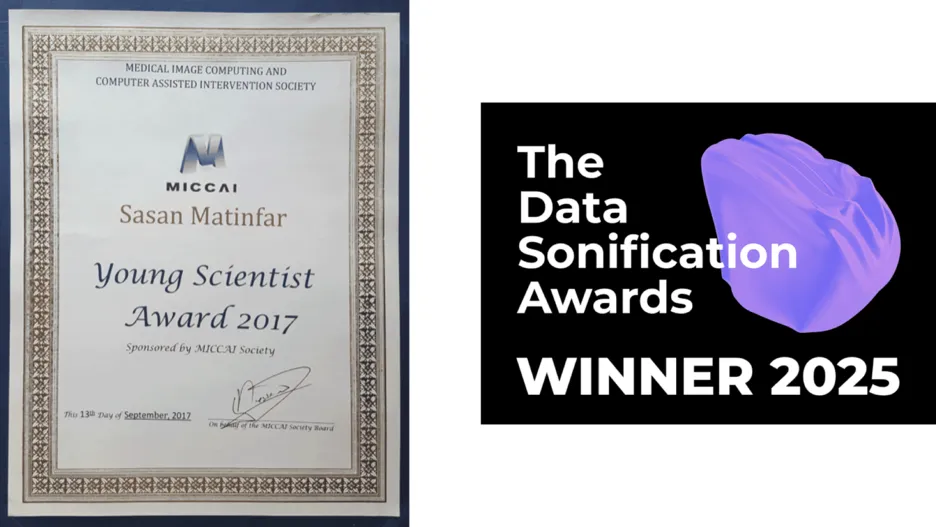
Sasan Matinfar is a research scientist at the Technical University of Munich (TUM), affiliated with the Chair of Computer Aided Medical Procedures (Prof. Navab) and the Munich Center for Machine Learning (MCML). He serves as scientific staff at Rechts der Isar Hospital, developing XR and sonification systems for surgical environments since 2020. His educational background includes: Master’s and Bachelor’s in Computer Science, Ludwig Maximilian University of Munich (LMU) Musicology, Franz Liszt University of Music, Weimar Piano Interpretation, Art University of Tehran Matinfar pioneers medical sonification and multisensory XR, creating auditory interfaces that convert tissue properties into sound for surgical guidance. His work in user-centered design produces clinically viable tools like the Ocular Stethoscope for retinal procedures and physics-based BioSonix frameworks, merging computer vision with perceptual audio engineering to enhance intraoperative precision without visual overload. Analysis of his 12 recent publications (2017-2025) reveals an evolving research arc from foundational surgical soundtracks to sophisticated context-aware sonification. Current work integrates generative AI with real-time tissue deformation modeling, focusing on multimodal frameworks where auditory feedback complements visual navigation in complex surgeries like cardiac interventions and retinal peeling. Key recognitions include: The Data Sonification Award (2025) MICCAI 2023 Best Paper Nominee (top 3% of submissions) MICCAI Young Scientist Award (2017, top 2% of papers) As an educator, Matinfar mentors students through TUM courses including Medical Augmented Reality (WS 2025/26) and Surgical Robotics, while co-organizing the Medical Augmented Reality Summer School and IEEE ISMAR 2025’s MIX Workshop. His patented technologies emerge from collaborations with Politecnico di Milano, TU Dresden’s CeTI, and Balgrist Hospital Zurich, securing interdisciplinary grants in surgical data science. Matinfar operates within TUM’s NARVIS Lab for medical image analysis and RobUSt for robotics-ultrasound integration, leveraging the German Heart Center Munich (DHM) infrastructure to validate XR systems in live surgical workflows and advance vision-language models for intraoperative decision support.
Jane E. Parker is a Professor and Research Group Leader at the Max Planck Institute for Plant Breeding Research in Cologne, Germany, where she leads the "Resistance pathway dynamics in plant immunity" research group within the Department of Plant-Microbe Interactions. She has been a Principal Investigator in the Cluster of Excellence on Plant Sciences (CEPLAS) since 2012 and maintains extensive national and international collaborations in plant immunity research. Professor Parker's research focuses on plant immunity mechanisms, particularly how plants detect invading pathogens and activate defense pathways. Her laboratory investigates TIR-domain enzymatic activities, NLR immunity, and plant-microbe interactions using approaches ranging from genetics, CRISPR-Cas9 technology, RNA-seq, ChIP-seq, to protein biochemistry and structure-function analyses. Current projects include NLR immunity decision-making, biotic stress network architectures across plant lineages, tracking immune-stimulating nucleotides, and defense metabolites impacting plant interactions with beneficial and pathogenic fungi. Her recent publications demonstrate a strong focus on the biochemical mechanisms of plant immune receptors, particularly TIR-domain proteins and NLR receptors, with applications across plant species from Arabidopsis to crops like rice and barley. This work has revealed conserved working principles while also identifying clade-specific variations in defense signaling modules. Elected as International Member of The US Academy of Sciences (NAS), 2023 Elected as Fellow of The Royal Society (FRS), 2023 Elected to Academy of Europe, 2017 Elected to EMBO, 2016 Elected to Leopoldina German National Academy of Sciences, 2013 Max-Planck Society 'C3' Independent Research Fellowship, 2004-2009 Alexander von Humboldt 'Sofja Kovaleskaja' award, 2001 Professor Parker leads an active research group with multiple postdocs, students, and technicians. She has served on numerous editorial boards including Science, Trends in Plant Science, and Current Opinion in Plant Biology. As a Principal Investigator in CEPLAS, she has coordinated plant-microbe sections and served on various grant review panels for organizations including DFG, ERC, and NSF. The Parker lab maintains state-of-the-art facilities for plant molecular genetics, biochemistry, and imaging. They collaborate extensively with structural biologists, organic chemists, and computational biologists to advance understanding of plant immune mechanisms. The lab is part of the CEPLAS research infrastructure, which includes specialized platforms for plant microbiota studies, synthetic biology, and data science.
Orlando Hernandez is an Associate Professor in the Department of Electrical and Computer Engineering at The College of New Jersey. He holds a Ph.D. in Electrical Engineering from Southern Methodist University (2002), an M.S.E.E. (1993) and B.S.E.E. (1991) from the University of South Florida. Prior to his academic career, he held industry positions at Texas Instruments and Maxim Integrated Products from 1993-2003, serving in design management roles for imaging systems, ASIC development, and microcontroller technologies. His research focuses on high-performance VLSI architectures for computer vision applications, including color image segmentation, digital signal processing, embedded systems, and mixed-signal design. Key research areas include hardware acceleration for image compression algorithms, real-time traffic monitoring systems, autonomous robotics, and advanced encryption implementations. His work consistently bridges theoretical algorithms with practical hardware implementations. Professional affiliations include Senior Membership in the Institute of Electrical and Electronics Engineers (IEEE). He has secured multiple research grants including a $93,320 National Science Foundation award for image processing instrumentation and several industry-sponsored equipment grants from Texas Instruments and Xilinx.
Sidney S. Fels is a Professor at the University of British Columbia, affiliated with the Human Communication Technologies Lab in Vancouver. His research spans Human-Computer Interaction (HCI), Virtual Reality, Biomechanical Engineering, Speech Synthesis, and Medical Imaging. He focuses on innovative interfaces, surgical simulation, and AI-driven educational tools. Recent work includes advancements in touch interaction systems (e.g., HaloTouch), chatbot-assisted learning, and biomechanical modeling for medical applications. His research interests emphasize bridging computational models with real-world applications, particularly in healthcare and education. Notable contributions include contributions to CHI conferences, SIGGRAPH, and INTERSPEECH, showcasing work on AI ethics in learning environments, vocal tract modeling, and pervasive computing systems. Fels collaborates extensively with researchers in engineering, medicine, and computer science, reflecting his interdisciplinary approach to solving complex human-centric challenges. Labs/Teams: Human Communication Technologies Lab at UBC.
Frederic Pincet, PhD is an Associate Research Scientist in the Department of Cell Biology at Yale School of Medicine. He leads research in membrane dynamics, synaptic vesicle fusion, and protein-lipid interactions within the Rothman Lab . His work combines biophysical techniques with cell biology to study fundamental mechanisms of membrane remodeling and fusion processes. Education : Received his PhD from École Normale Supérieure de Paris (1994). Research Interests : SNARE protein complexes and their role in exocytosis Membrane curvature and tubulation mechanisms Collagen secretion pathways via intercompartmental continuities α-synuclein-induced membrane dysfunction in neurodegenerative diseases Development of photosensitive nanoprobes for vesicle isolation Recent Trends in Publications : His 2024 work focuses on synaptotagmin oligomerization dynamics and novel extracellular vesicle isolation techniques. Recent studies highlight dual-ring SNAREpin machinery regulation and membrane protein interactions in reduced dimensions. Ongoing research explores collagen secretion mechanisms and mitochondrial membrane control via apolipoproteins. Labs/Teams : Active contributor to the Rothman Lab , collaborating closely with James E. Rothman (Nobel Laureate in Physiology/Medicine).
Shuchi Deb is an Associate Professor of Industrial, Manufacturing, and Systems Engineering at the University of Texas at Arlington, where she has served since 2019 and was promoted to Associate Professor in September 2024. She directs an active, grant-funded research program that blends human-factors engineering, virtual & augmented reality, and transportation safety to improve human-system interaction across manufacturing, education, and public-safety domains. Education: Ph.D. in Industrial & Systems Engineering, Mississippi State University, 2017 M.S. in Industrial and Management Engineering, Montana State University, 2014 B.Sc. in Industrial and Production Engineering, Shahjalal University of Science & Technology (Bangladesh), 2006 Research & Innovation: Deb’s scholarship focuses on human-centred design of complex socio-technical systems. She exploits immersive technologies—virtual, augmented and mixed reality—to study and enhance safety, training transfer, and user experience in contexts ranging from automated-vehicle interactions and cyclist–infrastructure compatibility to additive-manufacturing education and police reality-based training. Her work repeatedly integrates psychophysiological sensing (EEG, eye-tracking, facial-expression analysis) with usability engineering to create adaptive, trustworthy human-machine interfaces. Recent federally supported projects include an NSF grant to build a bilingual VR platform for additive-manufacturing education ($837 k), a USDOT project developing a driver-readiness monitor for prolonged automated driving, and a Department of Justice award with the Fort Worth Police Department to create VR-based reality training scenarios ($269 k). These grants exemplify her translational approach: coupling rigorous human-factors experimentation with deployable technological solutions. Scientific Recognition: Outstanding Contribution & Mentorship Award, UT Arlington (2024) Best Graduate Student Paper, Mississippi State University (2017) IIE/FlexSim Simulation Competition Winner (2016) SEMS Best Student Paper, IISE (2016) Annual Ergonomics Design Competition, Auburn University (2015) Advising & Grant Leadership: Deb has chaired or served on more than a dozen Ph.D. and M.S. thesis committees and mentored over twenty undergraduate researchers. Since 2019 she has attracted > US $2.3 million in external funding as PI or Co-PI, supporting a broad cohort of graduate researchers who disseminate their work annually at ASEE, IISE, HFES, TRB, and AHFE conferences. Labs & Teams: She founded and advises the Human Factors Lab at UT Arlington, a shared facility equipped with VR headsets, motion-capture systems, driving and cycling simulators, and psychophysiological recording suites. The lab collaborates with industry (Fort Worth Police, local manufacturers) and across campus (Computer Science, Mechanical & Aerospace Engineering) to provide interdisciplinary training to students.