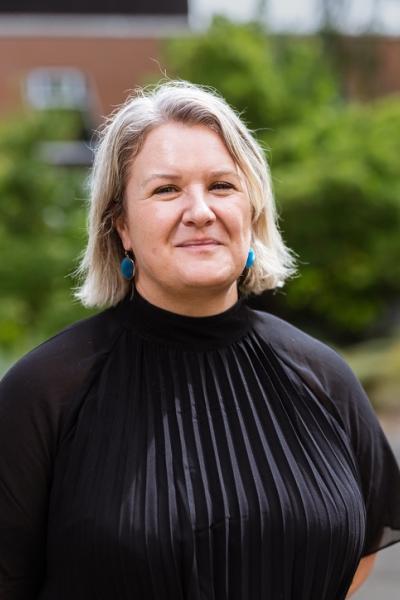
Janine O'Flynn is the Director of the Crawford School of Public Policy at the Australian National University (ANU) since 2023. Previously, she held the position of Professor of Public Management at the University of Melbourne and served as a visiting professor at institutions like City University Hong Kong and Fudan University. Her research focuses on public management reform, governance relationships, and ethical policy-making. Notable contributions include work on public value creation, performance management systems, and positive public administration. She has authored over 75 publications, including Pathways to Positive Public Administration (2024) and co-edited the Research Handbook on Public Management and COVID-19 (2024). O'Flynn has received prestigious awards such as the National Academy of Public Administration Fellowship (2022) and the Best Book Award at the Academy of Management (2013). She actively advises governments globally and chairs research committees for organizations like the Centre for Public Impact. Education: PhD (Melbourne), Bachelor of Commerce (Hons., Melbourne). Key Roles: Editorial Board Member: Public Administration , Public Management Review , and others Board of Directors, Public Management Research Association Advisory Board, Victorian Public Sector Commission Research Focus: Public sector reform, governance ethics, policy complexity, and agile government frameworks.
Associate Professor Madeline Taylor is an Australian Research Council (ARC) Early Career Industry Fellow at Macquarie Law School and Co-Lead of the Energy, Communities, and Market Regulation Stream at the Transforming Energy Markets Research Centre. She specializes in socio-legal aspects of energy transition, focusing on regulatory frameworks, energy justice, and land-use conflicts between energy developers and communities. Her work bridges property law, commercial law, and comparative law to address challenges in renewable energy integration and resource governance. Affiliations: Honorary Associate at Sydney Environment Institute, Member of Sydney Institute of Agriculture Industry Partners: NSW Department of Primary Industries and Spark Renewables (FAARM Project) Research Interests: Energy law and policy, agricultural-legal synergies, renewable energy siting, and just transition principles. She co-edits the Oil, Gas and Energy Law Journal and contributes to the LexisNexis Energy and Resources Law in Australia . Recent Articles Highlight Key Themes: Offshore wind governance, agrivoltaics regulatory systems, hydrogen licensing, and energy justice frameworks. These works emphasize interdisciplinary approaches to balancing economic, environmental, and social dimensions of energy transitions. Awards: 2023 Lawyers Weekly Women in Law Academic/Researcher of the Year, 2024 AFR Higher Education Awards Finalist, Clean Energy Council Transformational Leadership Scholarship Teaching and Engagement: Embeds climate justice in commercial law education; advises governments and NGOs on energy policy. Active in RE-Alliance Management Committee and IUCN Climate Change Law initiatives.
Professor Jacqueline Manuel is a Professor of English Education and Curriculum Coordinator for Secondary English at the University of Sydney's Faculty of Arts and Social Sciences. She holds a PhD (UNE), DipEd (UNE), and BA (Hons I) from the University of New England. Her research focuses on secondary English education, curriculum history, teacher development, and teenage reading practices. She coordinates the English curriculum methodology for the Master of Teaching (Secondary) program and advises multiple PhD students. Current projects include co-editing volumes on English teacher development and leading international collaborations like the Professional Lives of English Language Arts Teachers Project. She has held significant roles in curriculum committees and boards, including chairing NSW Board of Studies committees and serving on AITSL panels. Key research interests span educational history, teacher professional identity, creativity in arts education, and early career teacher support. Notable publications include Reimagining Shakespeare Education (2023) and Teenagers and Reading (2012). Awards include the 2018 Alan Laughlin Award for Educational Leadership and 2016 Outstanding Service Award. Professor Manuel collaborates with institutions like the International Federation for the Teaching of English (IFTE) and chairs multiple editorial boards. Her work integrates international perspectives, emphasizing English as an emancipatory subject promoting social justice.
Saule Burkitbayeva is a Research Fellow at the ANU College of Law , focusing on intersections of climate change , agriculture , and policy . Her work emphasizes embedded emissions accounting and carbon footprinting in agri-food systems. PhD in Economics (KU Leuven) MSc in Agricultural Economics (University of Saskatchewan) Bachelor in Agricultural Economics (University of Saskatchewan) Her career spans research institutes and international organizations in Canada, Belgium, Germany, Ukraine, Kazakhstan, and Australia, with fieldwork in Central and South Asia. Current research themes include: Climate Change & Climate Finance Environmental Law International Economic Law Law & Economics She has collaborated with the World Bank , Asian Development Bank , and UNDP , and her publications appear in high-impact journals and edited volumes.
Professor Terry Flew (BEc (Hons), MEc (Sydney), MBA (QUT), PhD (Griffith)) is a leading academic at the University of Sydney , holding the Professor of Digital Communication & Culture position within the Faculty of Arts and Social Sciences . As an Australian Research Council Laureate Fellow (2024-2029), he leads the Centre for AI, Trust & Governance , a flagship initiative involving multiple faculties. His international appointments include Research Fellow at the UK Creative Industries Policy & Evidence Centre and Honorary Professor at the University of Nottingham Ningbo China. Co-Director, Centre for AI Trust and Governance Member, SSSHARC research center International collaborations with Carleton University (Canada), Communications University of China, University of Glasgow (UK) Research Focus : Specializing in platform governance , digital policy , and mediated trust , Professor Flew bridges media economics , AI ethics , and creative industries . His work examines digital platform regulation , news media sustainability , and global internet governance , with recent projects analyzing trust mechanisms in AI systems and digital content regulation . The 2024-2028 Laureate Fellowship on "Mediated Trust" integrates these themes. Publications & Grants : With 16 authored/edited books and 129 journal articles , he has secured $11 million in research funding (including $9.9 million from ARC). Key grants include ARC Discovery projects on digital platform governance and Linkage projects on citizen journalism. Professional Leadership : Served as ICA President (2019-2020), ANZCA President (2009-10), and Lead Commissioner for the Australian Law Reform Commission. Currently sits on editorial boards of Journal of Communication , Global Media and Communication , and Media International Australia .
Associate Professor Samantha Schulz is a sociologist of education at The University of Adelaide's School of Education, within the Faculty of Arts, Business, Law and Economics. She specializes in educational justice, focusing on First Nations education, race critical theory, affect studies, and gender equity. Her work spans international contexts including Kenya, India, China, and Australia's APY Lands. She is co-convenor of the Pedagogies for Justice Research Group, affiliated with CRESI and the Fay Gale Centre for Research on Gender. As Program Director for the Master of Teaching program, she emphasizes socially engaged pedagogies. Recent research includes the ARC-funded 'Culturally Responsive Schooling' project (2022-24) and studies on gender-based violence in educational settings. Her publications explore decolonial methodologies, critical race theory, and the intersection of affect and pedagogy. Her grants include leadership roles in projects addressing Indigenous sovereignty in education, culturally responsive curriculum design, and restorative practices. Notable collaborations involve UniSA and Open University of Cyprus. She co-edits the Routledge 'Local Global Issues in Education' series and actively publishes on topics ranging from toxic masculinity in academia to anti-racist policy frameworks. Her advising focuses on fostering critical scholarship in Masters and PhD candidates, with research supervision emphasizing justice-oriented educational practices. She leads initiatives like 'Teaching in an era of digital influence' and has contributed to policy discussions on preventing violent extremism in schools. Her work bridges theoretical rigor with practical advocacy for marginalized communities in education systems globally.
Julian Millie is a Professor in Indonesian Studies at Monash University, Faculty of Arts, where he coordinates and teaches in the Indonesian Studies program. His academic work bridges anthropology, religious studies, and Southeast Asian studies, with a focus on the social and political dimensions of Islamic practice in Indonesia. His research centers on embodied Islamic routines, including preaching, ritual, and commemoration of regional Islamic figures. He has led major ARC-funded projects such as Preaching Islam: politics, performers and publics and Glocalisation and sub-national Islams , and currently leads the international project Islamic Bureaucracies and Pious Publics in Turkey and Indonesia . Anthropology of Indonesia Islamic Culture and Society Ritual and Religion Public Islam and Preaching Social Change in Muslim Societies Political Anthropology His recent publications (2023–2024) reveal a continued focus on Islamic consumerism, reformist critiques of consumption, ritual embodiment, and the politics of Islamic education. These works span journals like Asian Studies Review and edited volumes on preaching and Malay-Indonesian Islamic studies, showing strong interdisciplinary reach into sociology, cultural studies, and education policy. Julian Millie has contributed to scholarly discourse through editorial roles, including guest editorships for Asian Studies Review (2023) and International Journal of Cultural Studies (2013). His media engagements highlight his commitment to public anthropology, commenting on the state of Indonesian studies in Australia and Islamic education policy. He is actively involved in research grants, including current funding from 2020 to 2025, and has collaborated with scholars across Australia, Indonesia, and Turkey. While no formal advisees are listed, his leadership in research projects suggests mentorship and team coordination. He is a central figure in the study of contemporary Indonesian Islam, contributing to both academic and public understanding.
Hongfu Sun is a Senior Lecturer at the School of Engineering, University of Newcastle. His research focuses on innovating MRI mechanisms for clinical and research applications, particularly in Quantitative Susceptibility Mapping (QSM). He is internationally recognized as a pioneer in QSM and integrates MR physics, signal processing, and AI for medical imaging advancements. Sun holds a Ph.D. in Biomedical Engineering from the University of Alberta, Canada. Professional Experience: Senior Lecturer at University of Newcastle (current) ARC DECRA Research Fellow at University of Queensland (2021–2023) Postdoctoral Researcher at University of Calgary (2015–2019) Research Interests: Focuses on MRI innovation, including QSM, deep learning for medical imaging, and AI-driven reconstruction techniques. His work addresses challenges like sub-millimeter resolution and artifact reduction in MRI. Recent projects involve generative AI models for MRI analysis and accelerated quantitative imaging methods. Grants and Funding: AU$1.69M in grants, including a 2021 ARC DECRA for microscopic MRI techniques 2024 NHMRC grant for Parkinson’s disease MRI diagnostics Teaching: Course coordinator for Medical Imaging and Signal Processing at University of Newcastle Focus on biomedical imaging, computational methods, and signal analysis Labs/Teams: Leads research in MRI innovation, collaborating on QSM, deep learning applications, and translational imaging techniques. Active in interdisciplinary projects combining physics, AI, and clinical medicine.
Glen Searle is an Associate Professor at the Faculty of Architecture, Design and Planning at The University of Sydney, specializing in urban planning and metropolitan governance. His academic career demonstrates a strong focus on strategic planning, infrastructure governance, and urban policy development, particularly within the Australian context. Professor Searle's research interests span urban planning, strategic planning, metropolitan governance, infrastructure governance, land use planning, urban sustainability, and city development. His work critically examines planning systems, governance structures, and policy implementation challenges in metropolitan areas, with particular attention to Sydney's urban development strategies and infrastructure projects. He has made significant contributions to understanding the complexities of metropolitan governance, the public interest in mega infrastructure planning, and the challenges of population growth management. Analysis of Professor Searle's recent publications reveals a consistent focus on governance frameworks for urban infrastructure, metropolitan strategic planning, and the intersection of planning policy with population dynamics. His work demonstrates a methodological diversity, employing systematic literature reviews, case studies, and network analysis to examine urban phenomena. A notable trend is his increasing focus on infrastructure governance, particularly how governance structures respond to crises and changing urban conditions. His research bridges theoretical planning concepts with practical policy applications, often drawing on Australian case studies while connecting to international planning discourse. Professor Searle has secured significant research funding, including the 2020 Infrastructure Governance Incubator grant from The Henry Halloran Trust and the 2019 Population Growth and Regional Connectivity research grant from the Australian Housing and Urban Research Institute. His collaborative approach is evident in his extensive co-authorship patterns across multiple institutions and disciplines. His scholarly contributions include numerous journal articles in leading planning and urban studies publications, book chapters, and edited volumes such as Global Planning Innovations for Urban Sustainability (2019). Professor Searle's work has appeared in high-impact journals including Urban Studies , Journal of Planning Literature , Urban Policy and Research , and Planning Theory and Practice .
Dr Andrew Richardson is a Senior Lecturer in Social Work at the Faculty of Health , specialising in relationship-based social work practice with adults. He holds a Professional Doctorate in Social Work and serves as Branch President of the Australian Association of Social Workers (AASW) since June 2023. His research focuses on psychodynamic practice, social policy, strengths-based approaches, and participatory methods, with a particular emphasis on adult social care personalisation in the UK and Europe. Richardson contributes to UN Sustainable Development Goals through his work. Key achievements include editing a Special Issue of the Journal of Social Work Practice on adult social care personalisation and authoring a doctoral thesis on lived experiences in social care. He is a Fellow of the Royal Society of Arts (FRSA) and Royal Society of Public Health (FRSPH). Richardson is registered to supervise postgraduate research and actively collaborates on international research networks, particularly in social work practice contexts. Education: Professional Doctorate in Social Work External Roles: Branch President, AASW (2023–present) Key Research Areas: Psychodynamic practice, policy analysis, participatory methodologies, and personalisation frameworks His recent work explores professional identity reconstruction using Indigenous wisdom, university student wellbeing interventions, and social work practice in Australia's Northern Territory.
Professor Gary Edmond is a law professor at the University of New South Wales School of Law, directing the Program in Expertise, Evidence and Law. Holding a BA(Hons) from the University of Wollongong, LLB(Hons) from the University of Sydney, and PhD from the University of Cambridge, he bridges legal scholarship with forensic science expertise through extensive research grants and international collaborations. Education: BA(Hons), LLB(Hons), PhD Institutions: University of New South Wales, Australian Academy of Forensic Sciences His research focuses on the intersection of law and forensic science, examining expert evidence reliability, forensic reporting practices, and the adversarial legal system's limitations. With over $1.4 million in research funding since 2007, he leads interdisciplinary projects involving policing agencies and forensic institutions across Australia and international partners. Recent publications analyze judicial handling of expert evidence, cognitive biases in courtroom identification, and forensic science reform. His work has shaped evidence law understanding through the 6th edition of 'Australian Evidence: A principled approach to the common law and the uniform acts' and advisory roles in high-profile inquiries like the Goudge Inquiry. Awards: Fellow of the Royal Society of New South Wales As Chair of the Evidence-based forensics initiative and member of Standards Australia’s forensic science committee, he continues to influence policy while teaching core legal subjects including Courts, Procedure, Evidence and Proof, and Introducing Law and Justice.
Associate Professor Sunghoon Kim holds a position at the University of Sydney Business School's Discipline of Work and Organisational Studies. He previously taught at UNSW Business School, Cornell University, and Peking University. His PhD is from Cornell University, with MBA and BBA degrees from Seoul National University. His research focuses on strategic HRM, employment relations, and the impact of technological changes like AI on workplaces. He has edited major works including the Routledge Handbook of Human Resource Management in Asia and contributes to the APRU project on 21st-century work transformations. Kim serves as Associate Editor for journals like Human Resource Management and Asia Pacific Journal of Human Resources . His recent work addresses algorithmic management, employee well-being in AI contexts, and cross-border labor dynamics. He has advised students researching migrant worker choices and voice processes in organizations. Media engagements include commentary on workplace perks and work-life balance in South Korea. Teaching responsibilities include courses on performance management, strategic HRM, and international HR practices. His research highlights the intersection of technology, culture, and organizational sustainability.
Dr. Edoardo Bertone is a Senior Lecturer at Griffith University's School of Engineering and Built Environment - Architecture and Design. He holds a PhD in Water Resources Engineering from Griffith University and Bachelor/Master degrees in Civil Engineering from the Polytechnic University of Turin. His research focuses on data-driven modeling, Bayesian Networks, and System Dynamics applied to water resources management, climate change adaptation, and the water-energy nexus. He is affiliated with Griffith's Cities Research Institute and Australian Rivers Institute, collaborating on projects with water utilities, governments, and private entities. Dr. Bertone has received awards such as the 2024 PVC Science Excellence in Teaching and the JSPS Fellowship (2022). He supervises doctoral and master's students in areas like water quality management and climate change impacts. Education: PhD in Engineering (Griffith University, 2015); MEng and BEng in Civil Engineering (Polytechnic University of Turin, 2009-2011). Research Interests: Water quality modeling, drinking water optimization, data-driven prediction, climate change adaptation, and sustainable development goals. He leads over 25 funded research projects, including initiatives on reservoir water quality management in Thailand, real-time nutrient monitoring, and cyanobacteria bloom modeling. Dr. Bertone’s work integrates advanced sensors, machine learning, and Bayesian networks to address environmental challenges. Awards: Listing includes PVC Excellence Awards (2024, 2017), JSPS Fellowship, and recognition as a Rising Star in Queensland Science (2015). Grants & Supervision: Principal supervisor for 10+ doctoral candidates and collaborator on projects funded by Seqwater, CSIRO, and the Ian Potter Foundation. Key grants include $745k for biofertilizer combatting eutrophication and $269k for coagulation optimization models. Dr. Bertone’s contributions extend to urban sustainability, co-editing the book *SeaCities: Urban Tactics for Sea-Level Rise* and developing frameworks for integrating SDGs into architectural education.
Rachel Nordlinger is a Professor of Linguistics and Director of the Research Unit for Indigenous Language at the University of Melbourne's School of Languages and Linguistics. Her research focuses on documenting and describing Australian Indigenous languages, with a particular emphasis on syntactic and morphological theory. She has conducted extensive fieldwork with communities speaking Bilinarra, Wambaya, Gudanji, Murrinhpatha, and Marri Ngarr, contributing to language preservation efforts. She holds a PhD from Stanford University and has authored influential works including A Grammar of Wambaya and co-edited volumes like The Languages and Linguistics of Australia . Nordlinger is a Fellow of the Australian Academy of Humanities (2017) and leads major grants like the ARC Centre of Excellence for Dynamics of Language (2014-2026). Her work integrates linguistic theory with community-driven language revitalization projects, emphasizing the interconnectedness of language and cultural knowledge. Key research grants include projects on polysynthetic language processing (2021-2025), Indigenous language documentation, and cross-linguistic syntactic analysis. Nordlinger collaborates with institutions such as PARADISEC and the Kanamkek-Yile Ngala Museum to preserve endangered language materials. Her interdisciplinary approach bridges formal linguistic analysis with applied community linguistics.
Stacy Holman Jones is a Professor of Theatre and Performance in the School of Languages, Literatures, Cultures and Linguistics at Monash University. With over 23 years of academic experience, she has developed an international reputation for leadership in performance studies, particularly in feminist and queer theory, new materialist research, and critical arts-based methodologies. Her educational background includes a PhD in Communication/Performance Studies from the University of Texas at Austin (2001), an MA in Communication from California State University Sacramento (1996), and a BA in Humanities (1988). Professor Jones's research focuses on performance as socially, culturally, and politically resistive and transformative activity. She is a recognized leader in critical autoethnography and has published over 100 articles, book chapters, and editorials, as well as authored, co-authored, and edited 14 books including the influential Handbook of Autoethnography (2013, 2021) and Queering Autoethnography (2018). Her work spans cultural critique, social inclusion, education, resilience building, designing for social impact, and enhancing health and wellbeing among minoritarian communities. Analysis of her recent publications reveals a strong trajectory toward creative ecological approaches to mental health, collaborative autoethnographic methods, and innovative design for social impact. Her research increasingly integrates performance studies with mental health applications, particularly in educational settings, while maintaining strong connections to queer theory, new materialisms, and critical autoethnography. International Congress of Qualitative Inquiry's Special Career Award National Communication Association's Distinguished Service Award in Performance Studies Janice Hocker Rushing Early Career Research Award Organization for the Study of Communication, Language, and Gender Feminist Teacher/Mentor Award Over the Rainbow Recommended Book List for Queering Autoethnography (2019) International Congress of Qualitative Inquiry Qualitative Book Award, Honourable Mention (2020) Multiple Good Design Awards for 'The Tomorrow Party' (2024) Professor Jones has been part of 3 successful ARC applications totaling $1,353,604, including as Lead CI for DP200102876 Staging Australian Women's Lives (2020-2023). She is currently accepting PhD students with supervision interests in theatre and performance studies, social change and social justice, and health and wellbeing research. She serves as the founding editor of Departures in Critical Qualitative Research and has been actively involved in professional organizations including serving as President of the International Congress of Qualitative Inquiry (2015-2018). Her current research activities include multiple collaborative projects such as 'Playing Transitions - Settling and Belonging in School together' (2024-2027), 'Learning Creates: Tomorrow Party' (2024), and 'Canopy: Creative partnerships for policy advocacy in Climate and Health' (2024), demonstrating her commitment to interdisciplinary, impact-focused research that bridges theory and creative practice.